Dieser ältere Herr hat mich geprankt 😂 und um 50€ ärmer gemacht! #battle #funkychicken #shorts
Wollt ihr mich herausfordern? Schreibt mir auf Insta: www.instagram.com/chris_boehm
Wollt ihr mich herausfordern? Schreibt mir auf Insta: www.instagram.com/chris_boehm
SAN DIEGO – Roman ‘Chocolatito’ Gonzalez and Julio Cesar Martinez will square off Saturday night at Pechanga Arena (DAZN, 8:30 p.m. ET/ 5:30 p.m. PT). At Friday’s ceremonial weigh-in, Gonzalez weighed 114.8 pounds. Martinez weighed 116.4 pounds.
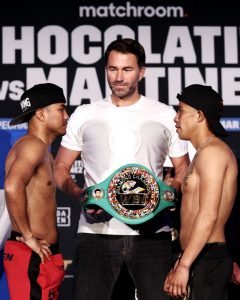
Chocolatito and Martinez are ready to get it on in San Diego. Photo / @DAZNBoxing
There were tense moments leading up to and immediately following the official weigh-in, which took place hours earlier. Gonzalez (50-3, 41 knockouts) easily made weight, but Martinez, the WBC flyweight titleholder, weighed 117 pounds, two pounds above the junior bantamweight limit.
Click here for the story of Martinez missing weight.
Martinez (18-1, 14 KOs), who resides in Mexico City, was given two hours by the California State Athletic Commission to lose the excess weight. The two camps eventually agreed after Martinez was only able to drop down to 116.4 pounds.
Gonzalez, who resides in Managua, Nicaragua, last fought on March 13 of last year, losing a close split-decision to Juan Francisco Estrada. The 34-year-old is ranked No. 2 by The Ring at 115 pounds.
THIS FIGHT
#ChocolatitoMartinez@CsarReyMartnez1: 116.4lbs@chocolatitobox: 114.8lbs pic.twitter.com/2oNKQhoMIF
— Matchroom Boxing (@MatchroomBoxing) March 4, 2022
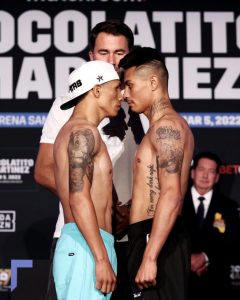
Mauricio Lara and Emilio Sanchez had the most intense staredown of the media weigh-in. Photo / @DAZNBoxing
In the co-feature, featherweight contender Mauricio Lara (23-2-1, 16 KOs) of Mexico City, who is ranked No. 3 by the Ring at 126 pounds, will face Emilio Sanchez (19-1, 12 KOs) of North Hollywood, California.
Both fighters weighed in at the contracted weight of 126 pounds.
Fringe lightweight contender Angel Fierro (19-1, 15 KOs) weighed in at 134.6 pounds. He will square off against three-time world title challenger Juan Carlos Burgos (34-6-2, 21 KOs) in a crossroads clash of fighters who reside in Tijuana, Mexico. Burgos weighed 132 pounds.
In the opening bout of the main portion of the Matchroom Boxing USA card, junior middleweight Souleymane Cissokho will face Mexico’s Roberto Valenzuela (19-2, 19 KOs) in a 10-round bout.
Cissokho (14-0, 9 KOs), who is originally from Senegal and now resides in Bagnolet, France, weighed in at 153.8 pounds. Valenzuela weighed 154 pounds.
Other undercard weights:
Diego Pacheco 170, Genc Pllana 171
Fernando Molina 139.6, Miguel Angel Aispuro 139.8
Anthony Herrera 118.6, Jose Toribio 118.2
Skye Nicholson 129, Jessica Juarez 129
Marc Castro 134.8, Julio Madera 134.4
Francisco A. Salazar has written for The Ring since October 2013 and has covered boxing in Southern California and abroad since 2000. Francisco also covers boxing for the Ventura County (California) Star newspaper. He can be reached by email at [email protected] or on Twitter at FSalazarBoxing
The post Roman Gonzalez-Julio Cesar Martinez undercard weigh-in results appeared first on The Ring.
Todays video has lots of great moments playing with BazingaThatB, a fellow Twitch broadcaster. We start off hunting Sanitar on Shoreline for the final quest items that we both need before moving over to Customs and getting into some wild PvP fights.
https://www.twitch.tv/BAZINGATHATB
Watch LIVE Monday – Saturday at 8:30AM EST
Twitch.tv/DeadlySlob
SHIRTS AND MERCH:
https://www.bunkerbranding.com/collections/the-marksmen-deadlyslob
Got questions? Reach out to me on Twitter:
Posts by Deadlyslob
Biz Inquires:
[email protected]

A dozen DeWalt large diameter circular saw blades hit the market during Q1 2022. These include both 10- and 12-inch blades, and they range from 24T framing saw configurations to 100T ultra-fine finish blades. These DWA series blades replace their predecessors and appear to no longer be made in the USA. They are, however, priced considerably lower across the board.
These DeWalt large diameter saw blades each deliver up to 3X the life of the former models. Normally, we’d dismiss such claims, but DeWalt did a good job specifying their basic testing parameters. The 3x claims compared, for example, the DeWalt DWA11280 80T fine finish blade to the DeWalt DW3232PT blade. The test had them both ripping double-stacked 3/4″ x 48″ particleboard. They also compared new comparable blades against the legacy 10-inch 60T DW3215PT and 40T DW7140PT as well as the 12-inch 32T DW3123. When comparing the more aggressive 12-inch DWA11240 40T blade, they got 2X the life.

All DeWalt large diameter circular saw blades feature carbide-tipped teeth in an ATB (alternating top bevel) configuration. They also have identical body slots to reduce vibration and noise while cutting. Lastly, DeWalt continues to use its ToughCoat anti-stick coating to reduce friction and gumming. As we’ve learned through extensive use, cleaning your circular saw blades results in better performance and less wear on your saws.
Designed for improved finish quality when cutting material like maple and other hardwoods, the blades are specifically designed by tooth count to increase performance and life.
Most of the new large diameter circular saw blades can be found now from DeWalt retailers. The 10-inch 24T DWA11024 hits shelves in April of 2022. They come in the following sizes and tooth configurations:








For more information on DeWalt products and accessories, visit the DeWalt website.
The post DeWalt Large Diameter Saw Blades appeared first on Pro Tool Reviews.
This content was originally published here.
Roman ‘Chocolatito’ Gonzalez takes on Julio Cesar Martinez for the WBC diamond super flyweight championship in a can’t miss bout between two of the most exciting fighters in the division on March 5 at the Pechanga Arena in San Diego, California, Live Stream on DAZN.
Chocolatito was widely regarded as a top 5 pound for pound fighter at one point before he suffered back to back losses to Thai knockout artist Srisaket Sor Rungvisai in 2017.
After those defeats he went on a four fight win streak before losing to Mexican rival Juan Francisco Estrada by split decision in his most recent outing.
Julio Cesar Martinez is a tough Mexican fighter who held the WBC flyweight title since 2019 before losing it on the sales on Friday for failure to make the weight limit twice.
Martinez paid a hefty fee and Chocolatito will make him pay in the ring on Saturday night.
Before the Main Event card on DAZN, fight fans will be treated to a FREE live stream on Matchroom Boxing’s official YouTube channel (Video Below).
The Before The Bell undercard bouts will feature undefeated young talent, most notably Marc Castro who is quickly becoming a must see fighter in the lightweight division.
Also the pro debut of Australian Olympian Skye Nicolson taking on undefeated Local fighter out of San Diego Jessica Juarez in a women’s super featherweight clash.
Rounding out the card are Anthony Herrera versus Jose Toribio in a bantamweight bout, and super middleweights Diego Pacheco and Genc Pllana in the opening fight of the broadcast.
The Live Stream starts at 2:45 PM PT on March 5, 2022.
Before The Bell Fight Card
Lightweight – Marc Castro vs Julio Madera
Bantamweight – Anthony Herrera vs Jose Toribio
Women’s Super Featherweight – Skye Nicolson vs Jessica Juarez
Super Middleweight – Diego Pacheco vs Genc Pllana
YouTube video upload by Matchroom Boxing
💀 NO, THANK YOU.
🌌 Patreon | https://www.patreon.com/birb_tm
😌 The guys look great and I look horrified.
=========== Check out my other social media! ===========
🔌 Main Channel | https://www.youtube.com/c/BirbReacts
🔌 More Videos | https://www.youtube.com/c/BenAndBeats
🔌 TwitchTV | https://www.twitch.tv/birb_tm
🔌 Twitter | https://twitter.com/birb_tm
🔌 Instagram | https://www.instagram.com/birb_tm/
🔌 Discord | https://discord.gg/TDDGvGHuCM
🔌 Store | https://teespring.com/stores/appreciation-station
🔌 Spotify | https://open.spotify.com/user/go_deacs1996
=================================================
🧾 Translate for me: http://www.youtube.com/timedtext_cs_panel?c=UCYnkPGPqLy7PgVixfY7hqrg&tab=2
🌴 Don’t forget to click that little notification bell to make sure you *actually* see all my new videos!
💙 Thanks for watching! Feedback in general is always very much appreciated.
#StrayKids #스트레이키즈 #VENOM
www.davamuzik.com #davarap #zamanakarşı #gündüzgece
Instagram 👇
https://www.instagram.com/dava_muzik
Prodüktör: Muharrem Sungur
Söz Müzik: Muharrem Sungur
Senaryo: Muharrem Sungur
Video: @supercut.films
Klip Almanya’nın Nord-Rhein-Westfalen eyaleti olan Duisburg Hamborn, Landschaftspark Nord’ da çekilmiştir.
“Gündüz Gece” albümünün ilk klibi “Zamana karşı” ile karşınızdayım.
Bu güzide albüm Türkçe Rap tarihinin en iyi albümleri arasında yerini alacaktır.
Benim için ayrıca heyecan verici olan, klip’ de kızım Zeynep Meyra ile rol almak oldu.
Baba-kız Türkçe Rap’e efsanevi bir hatıra bıraktık.
Şarkı sözleri:
Part 1:
Hayat zamana karşı bir yarış
hoş vedası kaldı akılda son bir bakış
eşliğinde ölümüne susuş
Kolaysa boğuş
bir koğuş
iki mahkum
birisi kanlı bıçaklı
diğeri zeytin dallı
Birinin dili zehirli
diğerinin ki ballı
Biri hatırlayamamaktan
diğeri unutamamaktan bunadı
çok aradı
kapılar araladı
bomboş evlere vardı ve anladı
Aradaki uçurum mesafe değildi zaman farkı
yanlış zaman dogru insan
doğru zaman yanlış insan
hep öyle değil mi?
bu böyle değil mi?!
Söyle!
öyle oldu böyle mi?!
Bu köhne tertibi
elinin tersiyle ittiğinde,bitti mi?
merak ettim, filmin sonu iyi bitti mi?
Tam oldu olacak derken
yine canım acıyor
yine benim anam ağlıyor
gerisi yalan ağlıyor…
Nakarat:
Yol duracak, sen gidecek
Zor gelecek, kolay bitecek
Kaybolacak, bulunmayacak
Kalp yanacak, göz dolacak
Iz kalacak, silinmeyecek
Risk alacak, bilinmeyecek
Çok bakacak, görülmeyecek.
Hiç başlamadan hep bitecek
Özlersin, ah ile vah ile
Beklersin,ki yitip giden geri gelsin
Gözlersin, gözlerinde damla yaşla
Bilmelisin, cekip giden geri gelmez..
Part 2:
Birbiri ardına vedası var umutların
ve dahası var unutların
yüklenmiş yükü omuzlarım
Soluk soluğa sokaklarında koşmaktayım ben.
Düşüp sürünmekten bi taat
vesvesesi beynimde iltihap
yankılanır kulaklarımda imdat
Ben gerçeğim, onlar sanal, gör bak!
Üstüme üstüme gelen duvarlarla
zaten oynamak istemediğim bi oyunun içindeyim,
ben sen diye bir derdin kederindeyim.
JUNEAU — Last Tuesday, a small rocket lifted off from Alaska’s state-owned spaceport, soaring into the morning sky above Kodiak with a constellation of small satellites onboard.
The rocket was designed and built by a California-based company, Astra, but its flight was powered in part by millions of dollars from the Alaska Permanent Fund.
By the end of March 2023, the corporation that manages Alaska’s $80 billion trust fund expects to have $200 million invested in projects and companies with ties to Alaska. It’s the fund’s biggest investment within its home state since the 1980s, and key details — including the size of the individual investments and even the names of the ultimate recipients — are being kept secret.
That secrecy is alarming current and former elected officials who say it isn’t a good practice because it prevents oversight and may invite corruption. When the Permanent Fund Corp. was created, legislators said they wanted it to be “insulated from political influences … but accountable to the people through their elected officials.”
The corporation’s earnings, deposited in the Permanent Fund, supplied two-thirds of the state’s general-purpose revenue in the budget passed by lawmakers last year and is expected to supply close to half of that revenue this year. That’s led to greater interest in what decisions the fund is making, and why.
Permanent Fund employees and members of the corporation’s governing board say they’ve been surprised by the pushback and that the new in-state investment program has the potential to earn billions for the state of Alaska, and it’s been designed to prevent corruption and political influence.
Craig Richards, chairman of the corporation’s board of trustees, said in December that even though the program is young, “it certainly appears as positive or better than expectations.”
The in-state investments are a small portion of the fund, but they’re part of a broader shift: This year, about 20% of the fund will be invested in private equity investments impossible for the public to inspect.
Sen. Bert Stedman, a Sitka Republican and chairman of the Senate Finance Committee, said the risks are higher when those kinds of investments are made within the state.
“The state is so small and the investment pool is so shallow that $200 million is a lot of money for the state of Alaska. So we are very concerned with the interrelationships … we’re always concerned that an arm’s length transaction might not be as distant as we assume,” he said.
In the past few months, the Alaska Legislature has begun examining the fund’s holdings in Russia, Gov. Mike Dunleavy has called for the fund to divest from some banks, and state lawmakers are investigating the firing of the fund’s former executive director.
Skepticism over the in-state investment program has received less legislative attention, but the issue could have a greater impact on the state of Alaska than any of the other topics.
By law and policy, the Permanent Fund must prioritize financial returns. What happens when a business funded by the Permanent Fund has to lay off workers or closes entirely? Would political pressure force the fund to change its finances-first approach in order to save jobs? Will state officials change policies to benefit corporations whose profits determine the success of state investments?
Other states have invested their pension funds in local businesses and projects. Those decisions have created jobs and encouraged outside investment, but the financial returns have been mixed, and political pressure has forced some odd choices.
North Dakota’s brand-new equivalent to the Permanent Fund is being tapped for a bison-themed amusement park among other questionable investments.
In California, a billion-dollar targeted investment in racial minority-owned businesses failed to perform as well as non-targeted investments, but Florida beat benchmarks with an investment in high-tech businesses within that state, and New York has also found success.
In January, former Gov. Frank Murkowski asked whether the Permanent Fund has been endangered by the combination of secrecy, a change in strategy, and the firing of the fund’s director.
“Unless these changes can be explained and justified and limits placed on them, the Legislature should require APFC to return to its successful conservative investment strategy. We must demand transparency. We must demand answers and we must demand that the best interest of the Permanent Fund comes before personal interests and political gains,” he wrote.
Alaskans tend to think about the Permanent Fund as an extension of the stock market. When the Dow Jones or S&P 500 spike or plunge, there are stories about the value of the Permanent Fund. There’s an automated Twitter account that regularly posts details of the stocks the fund owns.
Stocks are what’s considered “public equity.” An ordinary person can see their value and buy a share from open markets. But public equity investments account for less than 40% of the Permanent Fund.
A growing share of the fund, including the new in-state program, is what’s called “private equity.”
Greg Allen is the chief executive officer of Callan, a firm that provides independent advice to the Permanent Fund.
“Think of a brand-new company that is just starting up,” he said, “and they want to make some kind of widget that’s going to change the world. But they don’t have any capital, and they need a lot of capital to get this thing off the ground and make it through the first three to five years where they’re not going to be making any money.”
Private equity investors will go out and give that company money in exchange for a share of the company. Sometimes, instead of a new company, it’s an established company that’s looking to expand or change operations.
“(The investor is) betting that over time, these guys are going to execute, the company’s going to grow, and pretty soon, they’re going to be able to sell it into the public markets and make a colossal amount of money,” he said.
“You have one home run and 10 zeroes because they’re investing in very risky companies, but they’re diversifying across a lot of companies,” he said.
It takes time for those home runs to develop — years, sometimes a decade or more — and there’s rarely a quick exit. Losses tend to come in the first few years, causing what Allen and other financial experts call a “J curve.” The value of the total investment drops at first, then rises as successes outweigh the losses.
The Alaska Permanent Fund didn’t make its first private equity investment until 2004, but that kind of investment grew rapidly, making up 4% of the fund by the late 2000s, 11% by 2017, and it’s about 20% now.
That growth has come because the fund — and similar funds nationwide — have been phenomenally successful with it. Over the past five years, the fund’s private equity investments have generated an average return of 29%. During the same period, its public equity investments had a 15% return, and its real-estate investments had a 3% return.
In the recent past, the returns have been even better.
“We had this explosive return year in private equity and venture capital last year, a 65% return,” said Marcus Frampton, the fund’s chief investment officer, earlier this year.
To manage the new in-state private equity program, the Permanent Fund has hired Anchorage-based McKinley Capital Management and Barings, a global firm.
Those companies heard the pitches of companies asking for money, did their research, and over the past three years, they’ve been making investments using $100 million apiece from the corporation.
McKinley had spent about $90 million of its share as of Sept. 30, and Barings had invested $43 million as of Feb. 3.
By design, there’s no decision-making by the Permanent Fund Corp. officials.
“We have no involvement in the selection of the investments. Oftentimes, we don’t find out about them until they show up on the monthly or quarterly reporting,” said Valerie Mertz, the corporation’s interim executive director.
To understand what Barings and McKinley are buying, look at the southeastern corner of Kodiak Island, where free-ranging cattle and buffalo share land with Alaska’s state-owned spaceport.
In the early 2000s and 2010s, neighbors dubbed it “Space Pork Kodiak” for its reliance on government-funded contracts and subsidies. Now, about half of the business at the spaceport comes from small startup companies, and it hasn’t received a direct state subsidy in years.
McKinley has used some Permanent Fund money to invest in three companies with links to the spaceport and the space industry.
McKinley Capital CEO Rob Gillam told Permanent Fund trustees in December that he sees an opportunity in the space business.
In 2019, a satellite company called Starlink received permission to launch up to 12,000 satellites intended to offer Internet access virtually everywhere in the world. Most of those satellites haven’t been launched yet, but the company is already seeking permission for 30,000 more.
Gillam said SpaceX, Starlink’s parent company, is going to need help from other companies to send those satellites to orbit, and those companies are poised to grow.
“In the next generation or two, I think that’s something that’s really going to dominate,” he said.
California-based Astra sent a rocket to orbit from Kodiak in November on a test flight, then launched again on Tuesday.
McKinley’s other space-related investments include a company that hopes to use a giant centrifuge to fling satellites into orbit, and Airbus Ventures, which helped fund a company called LeoLabs. That company operates a space-looking radar site near Fairbanks.
There’s no guarantee that Astra or the other two space-related investments will pan out. Starlink could abandon its plans. SpaceX might not need the help getting to orbit. Or the companies could simply fail.
After Astra’s November launch in Kodiak, a rocket launch from Florida failed to reach orbit, and some investors are betting against the company’s success.
McKinley is also sending money toward terrestrial investments. It backed the acquisition of Peter Pan Seafoods by American buyers and is investing in a new airline that will start flying between Anchorage and Dutch Harbor this spring.
A list of investments provided by the company shows McKinley also put money into a series of venture capital firms that focus on high technology and environmentally friendly projects.
Lowercarbon Capital, one of the recipients of an investment, says the projects it funds are “buying us time to unf**k the planet.”
In all of these cases, the size of the investment wasn’t disclosed, and in cases where the Permanent Fund’s money is going into another venture capital fund, it isn’t possible to see what companies or projects are receiving money.
Barings and McKinley have different strategies as they handle the Permanent Fund’s money, and it shows up in the investments they’ve made so far. Where McKinley has leaned high-tech, Barings has favored Alaska’s traditional industries.
According to Barings, it purchased part of Alaska Communications, has invested in a gold mining project in Interior Alaska, bought a stake in a new cargo terminal at Anchorage International Airport, purchased part of Southwest Alaska’s Grant Aviation, and has invested in a company that funds mining projects worldwide.
Mina Pacheco Nazemi runs the Alaska Future Fund, which is the collective name for Barings’ share of the in-state Alaska program.
This is her ninth in-state investment program, and she said Alaska’s effort is structured similar to the rest and is designed to avoid political pressure or corruption.
Private equity isn’t regulated by either the federal Securities and Exchange Commission nor Alaska’s state division of banking and securities, but advisers like Pacheco Nazemi and Gillam are licensed by the SEC. That makes them subject to regular federal inspection and the federal law banning “pay for play”.
SEC officials said that means the advisers can’t provide something of value to an official, and that official — whether it’s the governor, a Permanent Fund trustee, or someone else related to the fund — can’t give something of value to the adviser in order to steer an investment.
Gillam said that beyond the legal reasons, there are logical reasons against steering an investment. His performance is judged on financial returns, and steering an investment would endanger that performance.
“Why would I do that? I’m just going to get fired,” he said. It would also endanger the entire company, which is much larger than the Permanent Fund’s investment.
“We maintain full discretion, which means that the Permanent Fund staff, no one on the board … they cannot say, ‘I need you to invest in XYZ.’ We are the fiduciary, we serve as the investment manager, and we do all the work to underwrite all deals,” Pacheco Nazemi said.
When it comes to picking investments, she said ideas can come from people simply emailing tips or from Barings’ own staff.
These investments aren’t like a restaurant in Spenard; the Alaska Future Fund is targeting each investment to be at least $5 million, in a company worth at least $10 million. It won’t typically invest in technology startups, and the company needs to have a presence in Alaska.
Every idea, big or small, goes through a three-step process of review, research and decision-making, she said, and it can take months. Only about 5% of all the pitches they receive result in investments, she told Permanent Fund Corp. trustees in December.
At the same December meeting, she said there were 10-20 investments being actively examined and two in “deep stages” of analysis in addition to the five confirmed ones, but Pacheco Nazemi declined to say what those two are.
Job creation isn’t a factor in picking what gets funded and what isn’t.
“This program is managed for return, first and foremost,” Pacheco Nazemi said. “So we’re managing and always looking at the financial return.”
How can Alaskans judge success? Look at the financial returns five years from now, she said.
The Alaska Permanent Fund Corp. started its in-state program to make money and because state law requires it.
The Permanent Fund was created in 1976, but in its first four years, it was managed by the state’s revenue department. In 1980, the Alaska Legislature passed a law creating the Permanent Fund Corporation.
In that law, legislators included a provision saying that the corporation shall invest within the state of Alaska as long as those investments are available and “have a risk level and expected return comparable to alternate investment opportunities.”
In the corporation’s first years, state politicians pressured its board of trustees to invest in Alaska.
“It is crystal clear that the first call on the Permanent Fund should be to provide mortgage money,” said longtime Republican politician Tom Fink in 1979.
In 1981, trustees responded to that pressure by voting to invest 5% of the fund in in-state mortgages and 5% in certificates of deposit with in-state banks. By 1987, the fund had spent $224 million on in-state investments and had set aside $80 million for home mortgages in Alaska.
The 1980s oil bust and the subsequent crash of Alaska’s real estate market turned this strategy into a mistake, and because the fund was so much smaller than it is today, it wasn’t a small mistake.
“We did fund home mortgages in Alaska on a very small scale and we have seen some losses in that area,” executive director Dave Rose told the Associated Press in 1989.
Two years later, the corporation sold its remaining 165 home mortgages to KeyBank for $25 million.
The experience of the 1980s appeared to sour the corporation on most in-state investments, and state lawmakers relaxed restrictions on out-of-state investments, eliminating them altogether in 2005.
That meant investments within Alaska had to compete with investments anywhere in the world, and the corporation’s annual reports indicate Alaska didn’t compete well.
In the late 1990s, the fund’s only Alaska holdings were a mall in Ketchikan, the Pioneer Building in Anchorage, and the corporation’s office building in Juneau.
The corporation also bought $300 million in certificates of deposit from Alaska banks and renewed them regularly, but that program ended in 2013.
By 2018, the fund’s only asset in Alaska was its office building.
The corporation does hire some in-state companies to invest part of the fund on its behalf. In 2018, those amounted to less than 2% of the fund, and none of the investments were in Alaska.
That year, as the corporation’s trustees prepared to vote on a new investment policy, trustees worried that the fund’s in-state investments were so small that they might violate the requirement passed by the Legislature in 1980.
“The statute came up and we had a discussion,” Richards said, “both because it’s our investment mandate … but also, just because we thought it could be beneficial if that could be done well.”
Andy Mack, Gov. Bill Walker’s commissioner for the Department of Natural Resources, also sat on the corporation’s board at the time and said trustees were worried about the state of the Alaska economy.
Oil prices had plummeted, causing widespread layoffs and steep state budget cuts that caused more Alaskans to lose their jobs.
“It was pretty hard,” he said in a December interview, “to walk from the Capitol building, where we’re in a heated debate over $1 million or $4 million, and we’ll walk over to a quarterly meeting of the Board of Trustees and realize that we were exporting $150 million, almost, in fees to other places in the United States for management.”
Mack said the thought was, “could we deploy a small portion of the available dry powder, if you will, into Alaska-based companies? Could we do it in a way that might help fund local companies?”
Mack brought up the issue during a 2018 board meeting, but it was Richards, Walker’s former attorney general and a Walker appointee to the board, who encouraged trustees to create a new program.
When the board met that fall to discuss its options, Richards and Rodell listed a $200 million Alaska investment program among the possibilities, and that was what the board of trustees ultimately agreed upon.
“We supported the concept of in-state investment for a small slice of the Permanent Fund to enable Alaska-based companies to help our economy and generate jobs here,” Walker said in February. “However, I believe where the money is invested should be transparent.”
When the trustees approved the program, they were following a familiar idea.
Public pension funds have invested in private equity for decades, but in 1999, at the direction of the New York legislature, that state’s public pension fund created a special account devoted to investments in New York State.
In 2013, the pension fund noted that “overall returns have been satisfactory.”
Other states followed New York’s example.
Florida started a program in 2008, focusing on high-tech companies within the state. By summer 2020, it had invested more than $820 million within its state, creating over 19,000 jobs in the process. The state’s independent accountability office concluded that net financial returns exceeded expected benchmarks.
California’s experience was mixed. Starting in 2001, its biggest pension fund, known as CalPERS, spent $1 billion on private equity investments in a program that focused on minority-owned businesses and those in economically disadvantaged areas.
The program was successful at creating jobs, but in 2018, the pension fund’s chief investment officer said nine of the 10 fund managers in the first phase of the program lost money. In the second phase, the program earned positive returns “but still underperformed our overall benchmark.” CalPERS hasn’t repeated the program.
In 2007, CalPERS started a $465 million fund devoted to clean energy investments in the state. Six years later, it had an annualized return of negative 9.7%.
“Our experience is this has been a noble way to lose money. And we’re not here to lose money,” CalPERS chief investment officer Joseph Dear told the Wall Street Journal in 2013.
When these programs started, many were subject to public-records laws that required public disclosure.
In 1999, the Houston Chronicle discovered that a third of the private equity investments made by the University of Texas’ trust fund were with firms personally or politically connected to a university leader or then-Gov. George W. Bush.
Three years later, the California-based San Jose Mercury-News won a lawsuit requiring CalPERS to disclose more information about its private-equity investments. Other lawsuits, requesting more disclosure, followed.
In response, companies receiving those investments began backing away from deals with public funds. Rather than lose access to investment opportunities, states weakened their public records laws.
Alaska didn’t need to.
When the Alaska Legislature created the Alaska Permanent Fund Corporation, it inserted a special clause into state law that allows the corporation to ignore Alaska’s public records act under specific circumstances.
For most of the corporation’s history, that clause didn’t draw much attention. The corporation’s investments were public investments, and its first officers encouraged transparency.
“Any efforts by interest groups to win concessions from the fund will be more readily seen if the fund is more visible,” board chairman Elmer Rasmussen wrote in the 1982 annual report.
When it comes to the in-state investment program, the Permanent Fund has denied public records requests for copies of its contracts with McKinley and Barings, and voluntary disclosures by those companies have resulted in the only publicly available information.
Legislators have said they’re frustrated by the lack of disclosure and have called it a reason to limit the program, if not end it entirely.
“I don’t think we should add any more (money to the program). Like, what’s done is done. Let’s not add any more, even though they have the flexibility,” Von Imhof said.
She is among a group of legislators supporting a change in the makeup of the corporation’s governing board. That legislation, from Rep. Andy Josephson, D-Anchorage, is still in early development.
The growth of private equity means the fund has changed, von Imhof said, and oversight should change too, she said.
#холостяк11 #нателлакирс #холостяк2021
Прем’єра шоу “Холостяк 11” ВЖЕ цього тижня 5 березня 2021 року на каналі СТБ.
Головним героєм шоу “Холостяк-11” став 31-річний бізнесмен з Харкова, засновник логістичної компанії Михайло Заливако.
У шоу “Холостяк-11” візьме участь Анна Богдан – колишня дружина екс-глави Офісу президента Андрія Богдана.
Також колишня учасниця угорського шоу “МастерШеф”, дівчина із Мукачева Антонія-Джесіка Чегі бере участь у шоу “Холостяк 2021”.
Та інші претендентки на серце холостяка, яких тримають у таємниці.
ІНСТАГРАМИ УЧАСНИЦЬ:
https://instagram.com/p.u.s.t.o.v.a.r
https://instagram.com/adelasantyxx
https://www.instagram.com/valentinavvalencia/
https://www.instagram.com/manchkina5/?hl=ru
https://instagram.com/victory_zav
https://www.instagram.com/elkrutikova/
https://instagram.com/olha_ditkovskaya
https://instagram.com/egiptyanochka?igshid=1shmtzhatptu7
https://www.instagram.com/julia_dankova/
https://instagram.com/cherez_kray?igshid=1hwuvgh3v0qgj
https://instagram.com/myyyrmyr?igshid=1qkueiisgy7lv
https://www.instagram.com/hana_offic/
https://instagram.com/nadin5_?igshid=15nyabsy2g3qe
https://instagram.com/dana_selfy?igshid=cxgp00pneui9
https://instagram.com/ulyana_korkh_?igshid=sopn3ofrc9f6
https://instagram.com/_ya_ne_tu_?igshid=1v1wg347ndb5c
https://instagram.com/saltykova_anna_?igshid=1clmwgj0mz6rg
https://instagram.com/hannastorozhuk?igshid=xc1f33x6yxjw
https://instagram.com/julia_lukovskaya_?igshid=cdnhg209s88d
https://instagram.com/by_guzeeva?igshid=1km19k5enb5ds
https://instagram.com/rosali_kovbasa?igshid=1xhgtly1b8j3p
ЯКЩО ВАМ ПОДОБАЄТЬСЯ МІЙ КОНТЕНТ, ПІДПИШІТЬСЯ НА КАНАЛ
https://www.youtube.com/channel/UC5osgOqDHFfOdXlaAhNG7bA?view_as=subscriber
Заходь на мій інстаграм, та спостерігай за всім нажимо:
https://www.instagram.com/natella_kirs/?igshid=2e10j89yzunn
ЗА МНОЮ МОЖНА СТЕЖИТИ:
На сторінці у Фейсбук
FB: https://www.facebook.com/natella.kirs
МІЙ ТЕЛЕГРАМ: https://t.me/kirs_tv
💰ГРОШОВИЙ ГАМАНЕЦЬ для розвитку каналу⚡️
Буду вдячна за будь-яку фінансову підтримку каналу : 4441114423715950
СПІВПРАЦЯ – [email protected]
_______________________________________________________________
CRANSTON – Republican Sen. Jessica de la Cruz formally launched her campaign for the 2nd Congressional District seat on Wednesday, at a press conference that was followed by visits to several small businesses across Rhode Island.
de la Cruz, a state senator who currently represents District 23 in Burrillville, Glocester and North Smithfield, hopes to succeed U.S. Rep. Jim Langevin, who has held the seat since 2001, and announced in January that he will not seek reelection.
The 40-year-old two-term senator, a North Smithfield resident, was critical of Pres. Joe Biden, stating the country has seen, “economic chaos and increasing division,” since the 2020 election, rather than the moderation and unity that was promised.
“As a state senator, every single day my inbox is filled with messages from Rhode Islanders who are struggling to feed their families, to put gas in their vehicles, to pay their bills and make ends meet,” de la Cruz said during the announcement at 39 West Restaurant and Lounge. “Rhode Islanders need relief now, Rhode Islanders need change now.”
de la Cruz, a mother of three and native of East Providence, entered the political arena in 2018, serving on the judiciary and labor committees in her first term. She was named Senate Minority Whip in her second term.
The campaign announcement was followed by visits to several small businesses, including Boomerang’s Roadhouse, Bayco Auto, and Heritage Gun and Coin in West Warwick.
“Big corporations can absorb the pain of inflation while small businesses are on the brink of closing,” de la Cruz noted on social media. “Just another reason to suspend the gas tax and work towards energy independence.”
The other Republicans who have announced runs for the 2nd Congressional District are former Cranston Mayor Allan Fung and former state Rep. Robert Lancia. Democrats who have officially joined the race include state Treasurer Seth Magaziner; former political strategist Michael Neary; former Langevin rep Joy Fox; former state representative Ed Pacheco; Biden administration official Sarah Morgenthau; and Omar Bah, executive director of The Refugee Dream Center in Providence.

