DeWalt has several models of laser distance measures. With a variety of features that support a range of leveling and layout applications, DeWalt Laser Distance Measures deliver a variety of accuracies and convenience to the jobsite. Ranging from 30-foot to over 330-foot working ranges, these LDMs all retail for less than $100 and some feature DeWalt Tool Connect.
DeWalt DW040HD 40 ft. Pocket Laser Distance Measurer
This DeWalt DW040HD Pocket Laser Distance Measure measures up to 40 ft. away. The backlit, high contrast LCD display (white on black background) makes it easy to read—even in harsh sunlight. For basic distance measurements and area calculations, this tool deserves a place in your bag or glove box.
It is accurate within 1/4″ at 40 ft., and it uses a Li-ion rechargeable battery. Connect the included USB micro cord to recharge it. The DeWalt DW040HD 40 ft. Laser Distance Measure retails for $29.97 and includes a wrist strap.
This pocket-sized DeWalt Laser Distance Measure also features a backlit, high contrast LCD display for visibility in various lighting conditions. This compact and lightweight model can also quickly measure distance for a variety of applications, including painting and flooring estimates.
It is accurate within 1/8″ at 30 ft., and it includes two AAA batteries. The MSRP on the 55 ft. DeWalt DW055E Laser Distance Measure is about $41.
DeWalt DW099S Bluetooth 100 ft. Laser Distance Measurer
The DeWalt DW099S Bluetooth 100 ft. Laser Distance Measurer comes with Bluetooth-enabled. It works with the DeWalt Tool Connect App to allow for measurement and photo storage. You can also mark up those photos and retrieve them later within the app. The DeWalt Tool Connect App is available on both Android and Apple platforms.
This model of the DeWalt Laser Distance Measure features a 1.5″ black, backlit LCD screen. The high contrast screen provides visibility in various lighting conditions. It displays continuous measurement tracking that quickly finds the distance from a target. Distances are displayed in feet, inches, and meters. It can calculate area and volume, and it can perform simple addition and subtraction functions.
Designed for drop resistance, this model features an over-molded grip. It also comes packaged with a wrist strap for added carrying convenience. Accurate up to 3/32″ at 100′, this DeWalt Laser Distance Measure retails for around $100.
DeWalt DW0330S Tool Connect 330 ft. Laser Distance Measurer
The DeWalt DW0330S Tool Connect 330 ft. Laser Distance Measurer lets you take and store measurements. You can also mark up photos using the Tool Connect app as well as create and export projects.
Powered by a single AAA battery, the DeWalt DW0330S Laser Distance Measure features a large backlit color LCD screen. While maintaining a high contrast design, the LCD features helpful color icons to let you know the current mode and measurement settings.
Distances can be displayed in feet, inches, and meters. It also lets you calculate area, volume, and more. Combined with the app, you get a lot of functionality for estimating, remodeling, and trade work.
DeWalt also built this laser measurer with a nice over-molded grip to prevent damage if you drop it. Accurate up to 1/16″ at 30 ft, this DeWalt Laser Distance Measure retails for around $268.
Laser Distance Measurers are great tools for any professional who is estimating distances or working out how much material they might need. They’re quick and relatively easy to use, the range of distance exceeds the capability of the tape measure, and you don’t need a second person to help grab a measurement. When you can get the accuracy to within the +/- 1/16″ range, the LDM is a great tool for most measurements.
The problem with laser distance measurers—even ones from DeWalt—is that they can be thrown off by the color or material of the surface. They also need an actual surface to bounce a laser off of. It also can’t grab hold of the end of a board, so “pull” measurements won’t work. Professionals use these tools for their primary strength: estimating. If you need to measure actual material, you likely still need a standard tape measure when accuracy is critical.
All that said, the DeWalt Laser Distance Measure seems helpful for many applications, especially the 100-foot model. Bluetooth connectivity and online measurement storage seem like a great way to stay organized, and the Tool Connect App has some other neat features, such as battery readings and tool location.
These LDMs are priced pretty well for what they do. In the case of the 100-foot model, you might get better range for the $100 price point, but you don’t see a whole lot of other LDMs with Bluetooth connectivity at that price. For the 40-foot model, the short range and +/- 1/4″ accuracy probably limit it to DIY applications, though for under $30, the professional might find it useful in some capacity.
Time to start grabbing some new tool kits and add-ons for dad! Right now, Amazon has this DEWALT Drill Bit Set for only $9.98! (Reg. $16.98) Additional details include:
135 Degree Split point tip design to help reduce walking
High Speed Steel to be u…
BALTIMORE—Highlighting the product’s strength and versatility, a new television commercial from industrial tool manufacturer DeWalt demonstrates how efficiently one of the company’s popular power saws can rip through a human rib cage. “The XR Power Detect cordless circular saw from DeWalt can cut through just about…
Amazon has the DEWALT 20V Max Cordless Drill / Driver Kit, Compact, 1/2-Inch (DCD771C2) marked down to only $99 + Free shipping (was $159)! Dewalt drill has compact and lightweight design that fits into tight areas High performance motor of the power drill delivers 300 unit watts out (UWO) of power ability completing a wide […]
UPDATE: Dead! Don’t miss another deal – Follow us on Whatsapp – Click here to subscribe ______________ Amazon has the BLACK+DECKER BCRK32W Compact Refrigerator Energy Star Single Door Mini Fridge with Freezer, 3.2 Cubic Ft., White marked down to only $132 + Free shipping (was $220)! COMPACT & STYLISH – This space saving small refrigerator (17.5″” […]
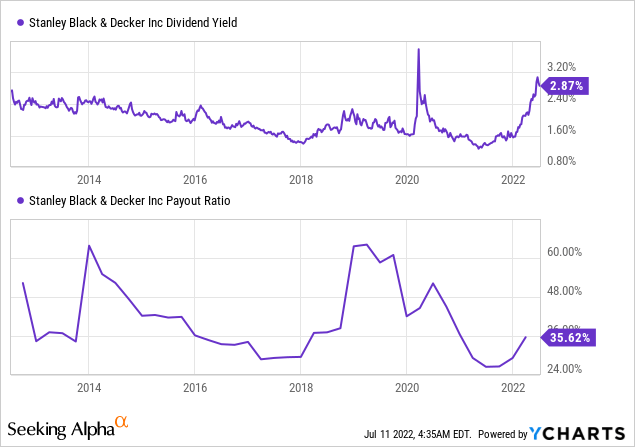
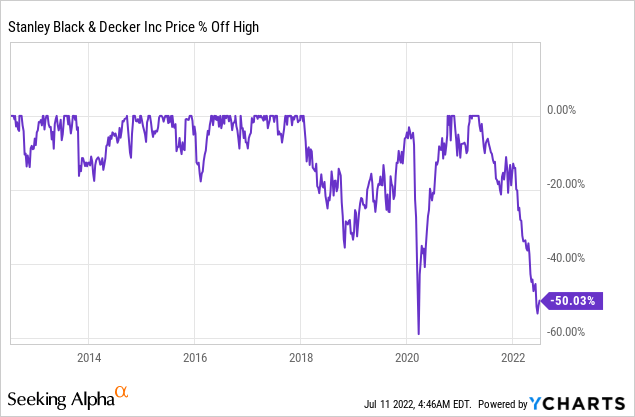
Stanley Black & Decker, Inc. (NYSE:SWK) belongs to a small group of companies labelled dividend kings. A group of companies who stand out for their rock-solid stability through hard times. Rarely do they go on sale, as the market treasures their reliability in tough times, but in the instance of SWK, the company is now down 50% from its recent high. With a payout ratio around 30%, investors can still expect SWK to churn out that quarterly compensation, while waiting for the stock to reverse its current collapse.
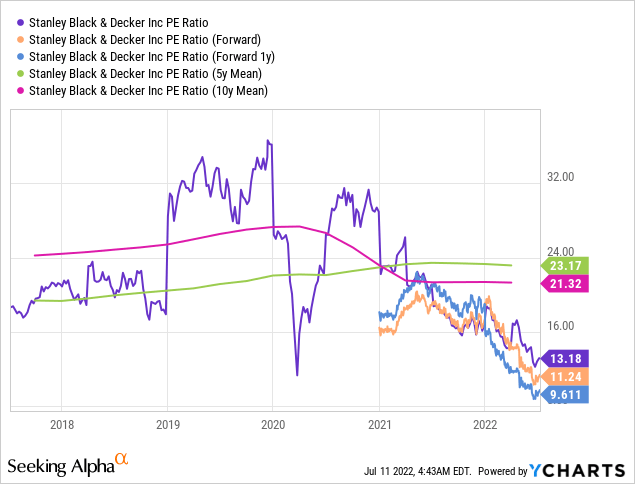
The dividend yield is currently at a decade high outside the Covid-19 market crash, underlining the market having gone too far in punishing the company. Q1-2022 performance showed strong revenue growth, but still came short of expectations, with management having to downwards revise the EPS outlook for FY2022 substantially, causing the obvious question as to what will happen with the current consensus EPS estimates for FY2023 and beyond. There is a likelihood those will have to come down during the upcoming earnings as inflation continues to run strong, but even so, the forward P/E ratio stands at 11.2 and forward 1y at 9.6.
As such, there is a margin of safety in this instance, even if forward expectations will suffer before the business environments turn to the better. For those going long today, it requires patience, as I believe the market will want certainty before allowing the stock to regain its steps.
Who Is Stanley Black & Decker
Stanley Black & Decker can trace its roots back all the way to 1843, having gone through numerous mergers and acquisitions since then, most noticeable the 2010 merger between Stanley and Black & Decker in order to become the company it is today. While mostly on the buying side of market activity, the company has completed one large divesture in recent times, the plan for Swedish based Securitas AB to purchase SWKs electronic security business, as communicated in December 2021, for $3.2 billion. The associated discontinued operations secured a revenue of $1.6 billion with a net income of $89 million for SWK during FY 2021.
Even more recent, in April 2022, SWK sold its automatic door business to Allegion (ALLE) for $900 million, acting as the last part of the security divesture transactions. Revenue from divestures, frees up capital for acquisitions, such as when the remaining 80% of MTD was agreed to, also during December 2021, for $1.5 billion. Back in November of 2021, SWK also closed a much smaller acquisition at the price of $373.6 million to acquire the company Excel Industries, a manufacturer of premium turf care equipment. Going hand in hand with the later deal for MTD, who manufacturers outdoor equipment, such as lawn mowers.
Stanley Black & Decker is most famous for its do-it-yourself power tools segment, but if we dive into the most recent 10-K (FY2021), there is a more diverse offering, although fairly concentrated. Revenue is secured via sales connected to power tools both professional and DIY, fastening tools, hydraulic tools as well as outdoor equipment such as mowers. Revenue is distributed via a lot of brands such as DeWalt, Black+Decker, Irwin Industrial Tools, Craftsman, Mac Tools, MTD as well as a number of international brands such as Facom, Sidchrome, USAG and Guiqiang.
FY2021, the company secured $15.6 billion in revenue for a net income of $1.7 billion, well ahead of FY2020’s revenue of $13 billion and net income of $1.2 billion. The company has a total of around 71.000 employees.
SWK splits its revenue into Tools & Storage, $12.8 billion in revenue, Industrial, $2.4 billion in revenue and Corporate overhead, $336 million in revenue. The geographical breakdown shows 60% of sales is in the US, 21.3% in Europe, 8.5% in Asia and the remaining 10.3% in Canada and rest of the Americas.
Revenue for FY2022 is expected to come in at $18.95 billion with FY2023 expected to be $19.76 billion. This corresponds to a growth of 21.3% and 4.3% respectively.
In the last three months, SWK has experienced fourteen downwards revisions for full year revenue as well as seventeen downwards EPS revisions – only receiving one upwards revision for its revenue. So, let’s have a look at how the company has performed in recent times.
Q1-2022 Performance And FY2022 Outlook – The Soft Spot
The company reported its Q1-2022 performance on April 28th. Revenue came in at $4.4 billion, 20% growth YoY but $220 million below expectations. Management explained revenue was being pressured by temporary electronic component issues, as we’ve seen across multiple industries in the most recent couple of years, where supply chain issues have run rampant.
Additionally, management downwards revised GAAP EPS guidance from $10.10-10.70 to $7.20-8.30, as a result of inflation worries, causing the stock to drop 8% intraday. As a consequence of the Q1 performance, management guided FY revenue growth to be in the mid 20’s, while current forward consensus estimates are the previously mentioned 21.3%, suggesting the market doesn’t believe in the company being able to live up to its own guidance.
Q1-2022 Financial Performance
All in all, the Q1-2022 results and adjusted outlook left Wall Street disappointed, striking a more critical tone, with the downwards adjusted forward expectations soon following.
During the earnings call, the word “inflation” came up more than thirty times, and in combination with the need to integrate new businesses in form of the recent acquisitions, it’s fair to say that market participants are a bit weary. Management stated the need to offset inflation via pricing strategy, as also evident by the operating margin being down YoY, although up 260 basis points QoQ.
Q1-2022 Financial Performance
Now, turning to cash flow. As a result of our lower full earnings guidance and higher inventory values at year-end due to the additional wave of inflation we experienced in the last 60 days, we expect free cash flow to now be in the range of $1 billion to $1.5 billion. This range does still reflect a modest working capital reduction year-over-year. We still plan to complete our $4 billion share repurchase program. However, since we see a lower cash flow performance in 2022 for the reasons just articulated, we will defer the remaining portion of — or $1.7 billion until 2023. We continue to pursue a disciplined capital allocation approach that aims to balance share repurchase activity with a commitment to dividends and strong investment-grade credit ratings. We are committed to the completion of this repurchase program in 2023.
As a consequence of the adjusted free cash flow outlook, management also stated they expect to push some of the planned share buyback activity in to 2023. Jim Loree, CEO, concluded the earnings call by saying that there is no question the company is currently facing one of the more challenging business environments in recent times.
Q1-2022 Financial Performance
On a positive note, we did see what appears to be a positive set of trades, getting a good deal on both divestures and acquisition related activities.
Taking The Long Perspective
That leaves investors with a bit of good and a bit of bad. Management has divested a business unit, acquiring and expanding another, which should drive long-term value for the company. On the other hand, the short-term outlook is very uncertain due to the usual suspect, inflation and lack of knowledge as to where the economy is heading. Usage of long- and short-term impact here is of course my own choice of wording, but in a situation as the one here, I believe it’s about taking the high-level perspective on the business. The company dates back to 1843, having survived an immense number of recessions, so let’s just say there is an overwhelming likelihood the company will also be here after the one we might potentially face this time.
A natural question is then whether the company is in good shape – lets zoom out.
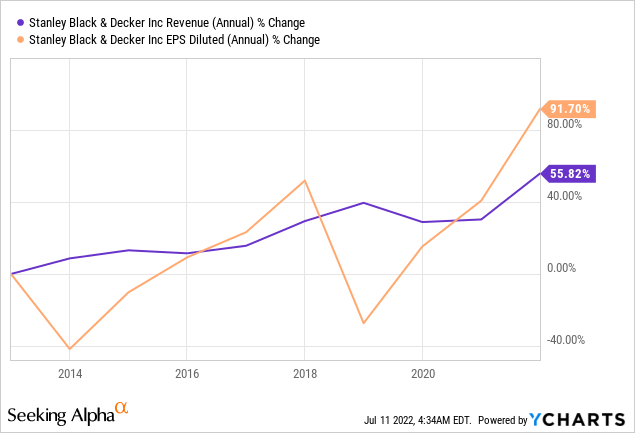
Data by YCharts
Age hasn’t stopped Stanley Black & Decker from growing its revenue substantially over the past decade, with EPS growth outpacing revenue growth. Speaking of age, Stanley Black & Decker is also amongst the small group of companies able to label themselves as dividend kings. This title is reserved for companies who have managed to pay a growing dividend for at least fifty straight years, and currently, that streak has reached fifty-four years in the case of SWK. Accounting wise, income can change with depreciation policies and the like, but dividends is cash that has to be paid out, and having grown that dividend for more than five decades speaks to the resilience of the business.
While there is concern about the outlook for this fiscal year, earnings are estimated to be back on track for FY2023 with a 16.9% growth on top of an expected 6.4% decline in EPS for this year. That FY2023 outlook may have to be revised, but carrying such an extended history of operations, it appears to be a question of time before the company is back on track.
Data by YCharts
It’s quite impressive the payout ratio remains so low on average, despite being such a mature company, however not exactly unusual for the dividend kings. That payout ratio should be expected to trend higher given the outlook for this year, but as quite evident from the payout fluctuations, SWK is a cyclical business.
Two negatives to point out, would first of all be the long-term debt development, having grown considerably in recent years as interest rates were low. FY2021 EBITDA/Debt ratio stands at 2.7 with TTM EBITDA/Debt ratio coming in at 4.5, a level I would like to avoid seeing turn higher. Currently, the company carries an A- credit rating from fitch, and I prefer my investments to keep their debt levels in control. As such, while the buyback program appears timely due to the depressed share price, it’s also aggressive considering the relative size of its current debt load, and associated exposure to interest rate hikes.
Some of the pressure could be alleviated by management continued its divesture strategy, as exemplified by the recent announcement to sell its oil & gas business. However, that only works if management then utilizes the proceeds to retire debt. Should earnings contract considerably, the credit rating outlook may change, but being an A- rated company, I don’t see any risks for its status as investment grade.
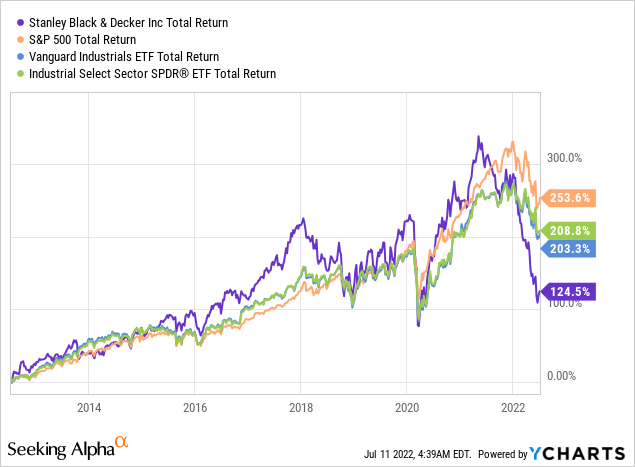
Secondly, we can observe return levels, as the company has been within reach of the S&P 500 index for most of the past decade, with the current market pullback, having been very tough on the overall performance.
Data by YCharts
Had we measured the performance up until 2021, Stanley Black & Decker would have outpaced the S&P 500, as well as its peers. For now, we are staring at a gap which hasn’t been larger in the past decade, causing me to assume that gap will have to be narrowed at one point, pointing in favor of SWK, as little suggests this company won’t be around for the long haul.
2022 Investor Presentation
The very source of SWK’s long-term viability, stems from its long list of respected brands amongst both the DIY and professional segment. Still driving innovation within for instances batteries, cordless offerings, etc., all from an umbrella of ESG awareness. On top of that, comes strategic acquisitions to broaden the portfolio in search of relevance amongst customers.
2022 Investor Presentation
Stanley Black & Decker is a disciplined company, belonging to the top tier of its peer group in terms of capital efficiency and ability to drive returns. Underlining this, is the fact that acquisitions are only conducted if they are in line with the existing long-term financial targets, to ensure the portfolio isn’t undermined by accumulating weaker assets. Unfortunately, the company does have a history of exhibiting impairment charges in relation to completed acquisitions, meaning management executes this strategy with mixed results seen over a longer period. I do, however, see value in shoring up and focusing the portfolio of assets.
Given Stanley Black & Decker’s maturity as a company, the price to earnings metric is a very reasonable gauge into its valuation, while allowing for a relative comparison extending several years back.
Data by YCharts
At a first glimpse, SWK is anything but expensive, as its current P/E ratio comes in at just above 13, with a forward P/E of 11.2 and forward 1y P/E of 9.6. In fact, SWK can then quickly appear very appetizing. I would however urge a bit of constraint as I previously mentioned the forward earnings expectations, coming in rather hot with significant growth expected for especially FY2023.
I wouldn’t be surprised if the forward expectations in terms of earnings will have to come down substantially. Management said it themselves, the business finds itself in one of the more difficult environments in recent times, and input inflation is causing difficulties. However, even if forward earnings are reduced considerably, it wouldn’t elevate the P/E ratio to anywhere near the five or ten year means.
Speaking of the long-term means, I don’t agree that a mature business such as SWK, growing its revenue on average 5% annually in the recent decade, should trade at a P/E multiple above 20. Those levels are reserved for fast growing companies, and SWK isn’t it. As such, I expect a P/E ratio more in line with the general market, perhaps to the higher side, deserving that small notch for being a dividend king. The S&P 500 has traded at an average P/E of roughly 19-20 in the recent decades, but that average also having been increased by the index trading at a higher average P/E in recent years leading up to the current market pullback.
Seeing SWK trade at a P/E ratio of 17-18 isn’t a stretch as I see it, but I don’t believe the company should be expected to return to trading above P/E ratios of 20 anytime soon. Additionally, given the uncertainty tied to the forward earnings, I wouldn’t expect the stock to make a rapid return to previous levels in the current situation – for that to happen, we need to see how the company handles the current environment in the upcoming quarters.
Data by YCharts
All those observations aside, SWK remains a very stable business, that has weathered a tremendous number of global recessions, and today appears timely for investors to go long the stock, although it most likely requires patience, despite the ongoing collapse in the stock price perhaps suggesting a quick return to previous highs.
Stanley Black & Decker is trading 50% off its recent high, something it hasn’t done in the previous decade outside of the Covid-19 market crash. The P/E ratio comes in at 13.2 compared to the five-year mean of 23.2 and ten-year mean of 21.3. On a forward basis the P/S ratio is 11.2 and forward 1y the ratio is 9.6. All signals’ points towards the business being undervalued, and I also find this being a situation of a broken stock and not a broken company. However, as evident from the latest earnings call, the business is finding itself in a tough environment with inflation causing issues in terms of securing satisfactory margins, while revenue also disappointed slightly despite being up 20% YoY.
There is a likelihood that forward earnings expectations will have to come down, deflating what could appear to be an immediate recovery in the share price. The company currently carries strong ratings from the credit companies, but that could also change over the coming quarters as the company has increased its debt load substantially, increasing vulnerability towards growing interest rate payments during a time where working capital is difficult to manage due to the fluctuating business environment. This would only be an issue in a scenario where earnings suffer significantly, and being an A- rated company, I don’t observe any risks to the longevity of the company.
I find that Stanley Black & Decker remains a solid company for those taking a long-term perspective, but I don’t expect much short-term positive action in terms of the share price as the market will most likely be awaiting the coming quarters.
Stanley Black & Decker Inc. (NYSE:SWK), the well-known hand and power tools company, was one of the post-pandemic high-flyers as its stock price nearly tripled from the March 2020 low of $75. However, fears of a recession, a weakening housing market and ongoing supply chain disruptions led to a 50% decline since May 2021. As a result, SWK is now trading at a non-GAAP P/E ratio of below 11, well below its historical median of 18. The company is a dividend king with 54 years of dividend increases, meaning Stanley has been able to increase its dividend during eight recessions, starting with the 1969 to 1970 recession and including the brief recession in 2020.
This article follows on from my previous article in which I explained why I personally do not consider the recent earnings restatement to be too problematic, although I realize that the event could continue to weigh on the share price and has likely impaired trust in management. However, as a dividend-oriented investor, I don’t mind an extended period of stagnant share prices, as I can then buy shares without haste. Such periods often lead to above-average returns if growing dividends are consistently reinvested, as Prof. Siegel explains in his highly recommended book, “The Future for Investors: Why the Tried and the True Triumphs Over the Bold and the New.” Stanley definitely fits the bill of “Tried and True”, as it is an industrial company which roots date back to 1843.
In this article I want to share with you why I finally got around to investing in this company. I bought my first tranche when the stock dropped to $100 a few weeks ago, and I plan to add to my position in the coming months. However, Stanley will not become a core position in my portfolio – in part because of the earnings restatement and related deficiencies in internal controls, but also for other reasons discussed in this article.
Company Overview
Stanley Black & Decker is a diversified global manufacturer of hand tools, power tools, outdoor products and related accessories, engineered fastening systems and products, services and equipment for oil & gas and infrastructure applications, and automatic doors. The company operates through two segments, Tools & Storage ((T&S)) and Industrial. Stanley’s T&S segment consists of the Power Tools Group, Hand Tools, Accessories & Storage, and Outdoor Power Equipment businesses accounted for nearly 84% of SWK’s sales in 2021. Understandably, the Industrial segment is pretty cyclical and its operating margin is also weaker (10% in 2021, compared to 15% for the T&S segment). The Industrial segment had an operating margin of almost 14% before the outbreak of the pandemic, but its performance has already started to recover.
SWK is relatively focused on the U.S., where it generated 60% of its 2021 sales, while Europe, emerging markets, Canada and other regions accounted for 17%, 14%, 5% and 4%, respectively. Sales in emerging markets grew in line with global sales, as the segment already accounted for 14% of sales in 2018. Stanley’s tools face significant competition from well-known competitors such as Bosch, Makita, more specialized brands, as well as private label brands from home improvement retailers such as Lowe’s (LOW) and The Home Depot (HD). The two retailers are also important customers of SWK, with a sales contribution of 15% (down 2% YoY) and 15% (up 1% YoY), respectively, in 2021.
Growth & Profitability
Figure 1 shows Stanley Black & Decker’s sales performance since 2006 and includes the most recent analyst consensus estimate for 2022. SWK has grown its top-line at a compound annual growth rate (CAGR) of more than 6% over the past decade. Since 2006, the company has grown sales at a CAGR of more than 10%. I think this is a great performance for a company that sells mostly products that are typically not replaced very often. During the Great Recession, sales declined 1% in 2008 and 16% in 2009. Operating profit declined by 29% and 9%, respectively, during those years, confirming that SWK is indeed a fairly cyclical company with considerable operating leverage.
It should be borne in mind that the company’s strong sales growth is partly due to SWK’s growth strategy of acquiring other companies from time to time. For example, The Stanley Works (SWK’s former name) acquired Black & Decker in 2009/10, adding not only the well-known power tool brand to the portfolio, but also Black & Decker’s professional range sold under the DeWalt brand. Recent acquisitions include the remaining 80% stakes in MTD Holdings Inc. and Excel Industries, which establish SWK as the world’s leading supplier of outdoor products and complement its position as the fastest growing supplier of cordless power tools for outdoor use. Given the increasing importance of non-petrol-powered gardening tools, I consider these acquisitions to be very smart and timely.
Figure 1: Stanley Black & Decker’s net sales since 2006 (own work, based on the company’s 2007 to 2021 10-Ks and the 2022 consensus sales estimate as published on Seeking Alpha)
SWK also sells underperforming or out-of-fit assets from time to time, most recently its security business to Sweden’s Securitas AB (OTCPK:SCTBF, OTC:SCTBY) for $3.2 billion in cash. Personally, I view this divestiture positively, as it leaves SWK as an industrial company focused on hand and power tools, apart from its automatic doors business which was not part of the deal.
Stanley’s growth model entails the risk of impairment charges, as acquisitions sometimes prove less profitable than originally planned. Besides impairments, restructuring-related charges are also regularly recorded (Figure 2). Restructuring and impairment charges are certainly significant, amounting to nearly $1.4 billion since 2006, compared to $8.1 billion the company spent on acquisitions during those years (i.e., 17%).
Figure 2: Stanley Black & Decker’s restructuring and impairment charges since 2006 (own work, based on the company’s 2007 to 2021 10-Ks)
While impairment and restructuring costs are certainly not insignificant, the company has nevertheless managed to grow operating profit even faster than sales (10- and 15-year CAGRs of 7.4% and 11.5%, respectively). This performance can be attributed to the gradual reduction in selling, general and administrative ((SG&A)) expenses (Figure 3). It could be hypothesized that SWK is underinvesting in advertising, but this seems unlikely given its strong sales growth (which is, of course, partly due to SWK’s pronounced M&A activity). However, as shown in Figure 4, SWK continues to invest responsibly in advertising.
Figure 3: Stanley Black & Decker’s selling, general & administrative expenses since 2010 in % of net sales (own work, based on the company’s 2011 to 2021 10-Ks)
Figure 4: Stanley Black & Decker’s advertising costs since 2010, in % of net sales (own work, based on the company’s 2011 to 2021 10-Ks)
While SWK’s sales and earnings growth is certainly very healthy, the company is not overly profitable, as underscored by its ROIC (based on net operating income after tax) and CROIC (based on normalized free cash flow), which at times are equal to or below the company’s weighted average cost of capital (WACC, based on a 7% risk premium). It should be noted that the comparison with WACC is not entirely correct in an academic sense, as profitability ratios based on free cash flow should be compared with the cost of equity. In this way, SWK’s relatively weak CROIC looks even worse.
Figure 5: Stanley Black & Decker’s (cash) return on invested capital and its weighted average cost of capital based on a 7% equity risk premium (own work, based on the company’s 2011 to 2021 10-Ks)
In addition to improving acquisitions and integrating acquired businesses (i.e., reducing restructuring costs and avoiding impairments), Stanley could likely increase its CROIC through better working capital management. Days sales outstanding declined from more than 50 days in the early 2010s to 32 days in 2021, and inventory days increased from about 70 days to 142 days. The company was partially able to mitigate these effects by extending payment terms with its suppliers, as evidenced by a more than two-fold increase in days payables outstanding. It should also be noted that 2021 was an exceptional year in which many companies had to significantly increase their working capital (especially inventories), and SWK is no exception, with cash flow related to increasing inventories of nearly $2 billion. Note, however, that the weak CROIC in 2021 is only marginally due to this effect, as I have normalized free cash flow with respect to working capital movements.
All of this sounds quite negative, but it seems worth noting that SWK remains a company with relatively strong normalized free cash flow ((nFCF)), which it has been able to grow at a 10-year CAGR of more than 11%. An illustration of SWK’s nFCF relative to its share price and enterprise value can be found at the end of this article in Figures 8 and 9. Note that restructuring and impairment charges and stock-based compensation expenses have been deducted from the calculations. Speaking of which, I personally consider SBCs relatively material at SWK, at typically around 10% of pre-compensation nFCF. Anyone interested in the topic and a comparison with several other companies should read my recent article.
Financial Stability And Dividend Safety
Particularly for cyclical industrial companies, I believe a solid balance sheet is a prerequisite for sound long-term investing. Stanley has maintained a relatively low interest coverage ratio over the past decade, at typically three to six times pre-interest nFCF. During a recession, the coverage is understandably even weaker, but I consider the fact that Stanley is an A-rated company and has been able to increase its dividend during several recessions to be an important indicator of long-term financial stability. In 2008 and 2009, the company increased its dividend by 3% per year, in line with previous years. I can imagine that SWK will continue to increase its dividend even in the event of an upcoming recession (with an associated significant decline in free cash flow), as the company’s payout ratio in relation to nFCF is typically around 50%. However, given the current share repurchase program and the likely onset of a recession, I expect near-term dividend growth to be below the 2006-2021 average growth rate of 6%.
Stanley’s upcoming debt maturities according to the 2021 10-K are very reassuring as just over $2 billion of the company’s long-term debt mature over the next ten years (Figure 6). Therefore, the company appears to be reasonably protected against rising interest rates. At the end of 2021, SWK’s weighted average interest rate on its long-term debt was approximately 3.75%.
Figure 6: Stanley Black & Decker’s upcoming maturities of its long-term debt at the end of 2021 (own work, based on the company’s 2021 10-K)
The company plans to buy back $4 billion worth of shares by 2023. While I think these buybacks are very well timed from a valuation perspective, the debt on SWK’s balance sheet has become very significant. As SWK’s short-term debt has increased from $2.2 billion at the end of 2021 to $5.1 billion at the end of Q1 2022, the company will likely refinance most of this debt over the longer term, also from the perspective of maturity matching. Therefore, SWK is certainly less protected against rising interest rates than the maturity profile of its long-term debt would suggest.
SWK’s current ratio has declined from its long-term average of 1.3 to below 0.9 in Q1 2022. The company had to increase its working capital by nearly $1.3 billion during the quarter, due to the seasonality of the business and the nature of SWK’s inventory management. Therefore, the decline should not be overinterpreted. Generally speaking, and leaving business seasonality aside, a current ratio of around 1 (or even less) is not necessarily a warning signal and is often a sign of efficient capital utilization.
I appreciate management’s good timing with respect to share repurchases (something rarely seen these days), but I nonetheless find the increase in debt somewhat concerning and hope the company can quickly refinance its short-term debt at still relatively low interest rates. After all, the current net debt is more than nine times the expected nFCF for 2022.
While this all sounds pretty negative, it seems worth noting that over the long term, SWK has not been one of those companies that has sacrificed the quality of its balance sheet through debt-fueled share buybacks. Since 2010, the company has generated nearly $8 billion in normalized free cash flow, but has only spent about $7 billion on share buybacks and dividends.
Post-retirement benefits are very manageable and amounted to $474 million, or 1.7% of total liabilities and shareholders’ equity at the end of 2021. In 2010, these liabilities were also barely worth mentioning at 4.2% of total liabilities and shareholders’ equity, but were nevertheless more significant.
From a historical perspective, Stanley Black & Decker’s shares are certainly anything but expensive, with a P/E ratio of below 11 and an EV/EBITDA multiple of 11. Stanley’s current normalized free cash flow yield is 6%, well above the historical average of 3.4%.
The extent of undervaluation is probably best illustrated by the FAST Graphs charts in Figure 7. However, I would be cautious about over-interpreting the expected earnings growth for 2023 and 2024, as analysts’ forecast accuracy has been far from optimal in the past – after all, SWK is still a moderately cyclical company.
Figure 7: FAST Graphs chart for SWK, based on adjusted operating earnings (obtained with permission from FAST Graphs)
The undervaluation of the share is also reflected in Figure 8, which sets the share price in relation to normalized free cash flow per share. Figure 9 is a more conservative, but in my view also more meaningful, approach to putting SWK’s share price into perspective, as it takes the company’s entire capital structure into account. Accordingly, the extent of undervaluation appears less pronounced given SWK’s high level of debt.
SWK is not a deep-value stock, and it could still see considerable downside if we experience a prolonged recession and the company misses analysts’ quite rosy earnings estimates, but I believe the risk/reward ratio at $100 is already quite favorable.
Figure 8: Overlay of Stanley Black & Decker’s share price and normalized free cash flow (nFCF) per share; note that Stanley’s 2010 nFCF was negative (own work, based on the company’s 2010 to 2021 10-Ks and the weekly closing share price of SWK)
Figure 9: Overlay of Stanley Black & Decker’s enterprise value and normalized free cash flow (nFCF); note that Stanley’s 2010 nFCF was negative (own work, based on the company’s 2010 to 2021 10-Ks and the weekly closing share price of SWK)
Stanley Black & Decker is a moderately cyclical industrial company with a portfolio of hand and power tools that will make any man’s mouth water. It is a dividend king, and given its relatively modest payout ratio and market-leading position, I don’t expect the company to break with its tradition. However, given that we are most likely approaching a recession, near-term dividend growth is likely to be in the low single digits, also in light of the recent and certainly substantial share repurchases. Stanley has pricing power, as evidenced by its relatively stable gross margin in the low 30% range. Free cash flow, as conventionally reported, is down significantly in 2021, but will recover over time as the company works down its substantially increased working capital.
The company’s dividend growth streak, which has defied eight recessions, is certainly an important indicator of Stanley’s long-term financial stability. Recently, debt has increased substantially due to unfavorable working capital movements and share repurchases. I am somewhat ambivalent about management’s opportunistic but debt-fueled share buybacks and personally would have preferred a more modest approach. I would generally like to see management improve the integration of acquired businesses – returns on capital are relatively weak and impairment and restructuring charges are the rule rather than the exception. Trust in management has been impaired by the meanwhile disclosed deficiencies in SWK’s internal control mechanisms. This are the main reasons why I do not see much near-term upside.
Stanley is a great company with a strong history, but it certainly has its weaknesses, which is why it will remain an ancillary position in my portfolio. I am in no hurry to build my position for the aforementioned reasons and because I consider it likely that the company will miss analysts’ relatively rosy estimates this year or next. As an income-oriented investor, I take a long-term view and welcome extended periods of undervaluation that allow me to build my positions without haste.
Thank you very much for taking the time to read my article. In case of any questions or comments, I’m very happy to read from you in the comments section below.
DEWALT, a Stanley Black & Decker brand and provider of total job-site solutions, has announced that one of its latest cordless innovations supporting the job site of the future: the ATOMIC COMPACT SERIES 20V MAX* Brushless Cordless 23-gauge Pin Nailer (DCN623).
According to DEWALT, its new ATOMIC COMPACT SERIES 20V MAX* Pin Nailer delivers an ideal balance of size and power for fine woodworking without hoses, compressors, or gas cartridges
With its high-output brushless motor, the DCN623 pin nailer is capable of driving 23-guarge pin nails from 5/8″ up to 1-1/2″ in length into a variety of woods, including solid oak.
“Our users need the convenience and freedom offered by a cordless pin nailer that eliminates the use of compressors and hoses that traditional pneumatic products require,” said Ryan Masters, senior product manager, Stanley Black & Decker. “The ATOMIC COMPACT SERIES 20V MAX* Brushless Cordless 23-Ga Pin Nailer delivers on those needs and is just one of the most recent innovations from DEWALT that is fueling the transition to a cordless job site.”
The tool boasts an impressive runtime with the ability to drive, on average, 2,000 nails per charge to help maximize uninterrupted work time.
For job-site efficiency, the low nail lockout system with LED indicator informs users when it is time to reload and in addition, this pin nailer features a tool-free jam release that helps to reduce downtime by quickly clearing jams, as well as tool-free depth adjust for precise nail placement.
The ATOMIC COMPACT SERIES 20V MAX* Brushless Cordless 23-Ga Pin Nailer will be available this month as a bare unit (DCN623B) or kitted with a battery and charger (DCN623D1) where DEWALT ATOMIC COMPACT SERIES products are sold.
Black + Decker Cordless Dustbuster – Under $40 (Reg $60). Passionate Penny Pincher is the #1 source printable & online coupons! Get your promo codes or coupons & save.