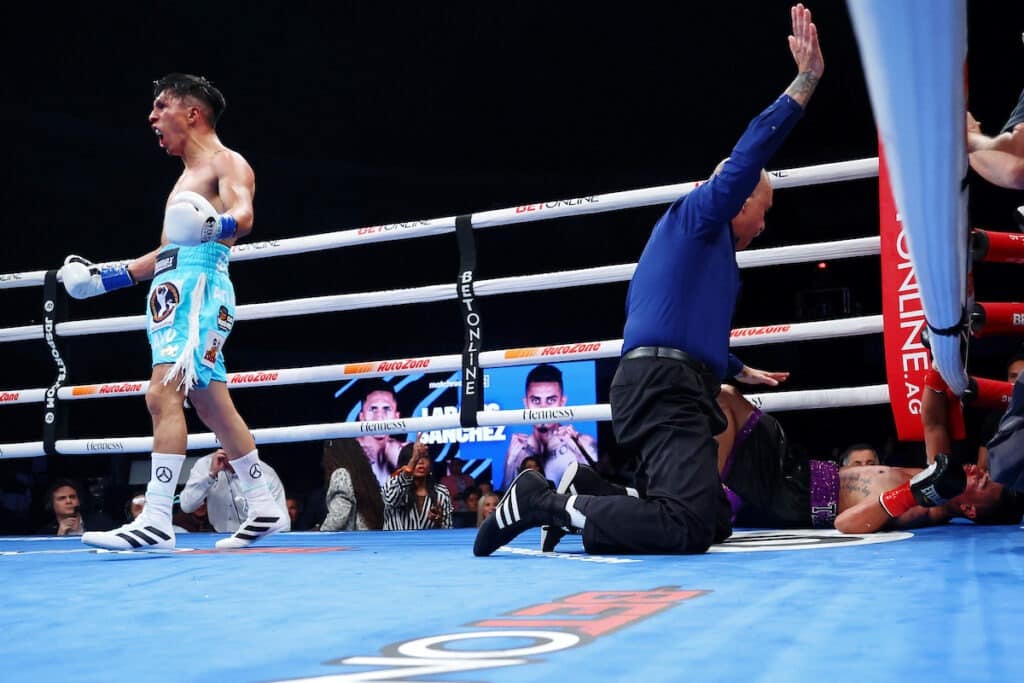
The Pechanga Arena in San Diego, California, was where the Matchroom Boxing card was headlined by the main event action between Roman ‘Chocolatito’ Gonzalez and Julio Cesar Martinez. But before that contest took place, there was an undercard with some exciting action leading up to that main event.
Here’s what went down before that took place:
To kick off the card, Anthony Herrera(2-0) got into some one-way traffic before stopping Jose Toribio (7-5) in the fourth round in a bout which is a reminder that there are levels to boxing, and Toribio was outgunned. Herrera moves
It was the pro debut of Skye Nicholson and took on late replacement local southpaw Jessica Juarez (3-1) which she won wide by decision using her distance to stay out of harm’s way. The six rounds of preliminary action were a tactical matchup, but this is what you usually see in pro debuts. We’ll see how she grows from here. White, the in-ring effort was tame. Her ring walk music choice of “New Sensation” by INXS was superb.
Skye Nicolson and Jessica Juarez during their March 5, 2022 fight at the Pechanga Arena. Photo Credit: Ed Mulholland/Matchroom.
Marc Castro recovered from an early knockout to remain undefeated (6-0, 5 KOs) by edging Julio Madera (3-2). Madera was game and sent Castro to the canvas in that second round, but Castro regained his legs and recovered sufficiently to close out the six-round contest.
The Youtube portion closed out with Diego Pacheco (14-0) giving Gene Pllana (9-4-1) the kitchen sink over two rounds. Pllana’s reputation of being a tough out was not the case here as Pacheco could land anything and did just that in two rounds before the fight was waved off.
The live-action portion kicked off with a fight that escalated quickly between Roberto Valenzuela Jr. (23-3) and Souleymane Cissokho (15-0) exchanging knockdowns in the 4th round of their contest. From there, Cissokho kept an eye out for that right of Valenzuela and proceeded to outbox him over the rest of ten rounds.
The following support bout didn’t provide as much entertainment but was a hard-fought majority draw between Angel Fierro (19-1-2) and Juan Carlos Burgos (34-6-3). If you missed this one, the biggest takeaway was that Fierro started strong, but Burgos could adjust, and the fight was a pretty competitive back and forth over thirty minutes.
Mauricio Lara celebrates after defeating Emilio Sanchez in their March 5, 2022 fight at the Pechanga Arena. Photo Credit: Ed Mulholland/Matchroom.
The co-main event of this card was where the fireworks were re-lit as Mauricio Lara (24-2-1) bought his hammer hands and violence with him as he looked to make a statement against Emilio Sanchez (19-2). Sanchez wasn’t going down swinging, and what transpired was a shootout that ended as the third round ended as Lara sent Sanchez down for the second.
Gibt es einen Ort, der besser geeignet ist für ein persönliches Gespräch als das eigene Bett?
In der zweiten Folge unseres neuen Talk-Formats „Better geht’s nicht“ unterhält sich Kulturfritze Marc Lippuner bei Kaffee und Croissants mit der Schauspielerin und Autorin Bärbel Stolz. Ein Gespräch über Berlinliebe und „Verliebt in Berlin“, über Schwaben in Prenzlauer Berg und „Die Prenzlschwäbin“, über die Schönheit von Dialekten, über Theaterleben und Kameralust, alte Bücher, aktuelle Bühnenprogramme und neue Ideen.
Tausend Dank an unseren Partner: Röwa – Die Bettenmacher
Welcome to Funny Animals Club!
We’ve selected the best of the funniest and cutest Cats😹 & Dogs🐶 videos that will make you laugh all day long.
Enjoy watching this Funny Video!
Try not to laugh!
A state task force investigating suspicious jobless claims has now referred 17 cases for criminal prosecution, the Colorado Attorney General’s Office said Friday.
The AG’s office, which is part of the Colorado Unemployment Fraud Task Force, said the total loss in unemployment fraud “exceeds $300,000.”
“These are complex cases that take time to develop, and now several cases have been referred to various DAs for prosecution,” Attorney General Phil Weiser said in a news release. “There’s more to come and we’ll continue to work diligently to hold those accountable who seek to cheat the state and engage in identity theft.”
Colorado Attorney General Phil Weiser. (Jesse Paul, The Colorado Sun)
The AG’s office highlighted a handful of cases but declined to share details on others since there are still active investigations going on. The public cases include:
Daniel Stonebarger pleaded guilty to wire fraud and is expected to be ordered to pay $28,142 in restitution to CDLE for unemployment benefits he wasn’t entitled to. His sentencing is set for April 22 in U.S. District Court, according to the AG’s office.
James William Emerick faces a two-count complaint of theft and cybercrime in a case filed in Jefferson County District Court by DA Alexis King of the First Judicial District.
The task force was created last March after the incessant attacks on the state’s unemployment system by local and international fraudsters. Of the 17 cases, 14 were sent to district attorneys statewide, one to the Attorney General’s Office and two to the U.S. Attorney for the District of Colorado.
The 17 cases are likely just a fraction of what’s under investigation but additional case details are not yet available, said Lawrence Pacheco, a spokesman for the AG’s office.
“We expect more case referrals in the near future,” Pacheco added.
The state’s labor department has been fighting fraud since the pandemic began. While some states like California reported paying $20 billion in unemployment benefits in fraudulent claims, Colorado officials say it’s been much less here because they implemented anti-fraud triggers that put payments on hold until they are investigated.
On Friday, officials at the state’s labor department said its latest data shows that 68,602 unique claims have been confirmed fraudulent. Of those, $33.7 million was paid to accounts deemed fraudulent.
Another $671 million in possible payments were stopped thanks to the labor department’s anti-fraud tools. And another $44.3 million in payments were recovered from banking institutions, said Phil Spesshardt, director of the Division of Unemployment Insurance.
That’s up from the $30 million CDLE confirmed as fraud in December, along with $600 million put on hold due to suspected fraud and $40 million recovered from banks.
After pandemic benefits ended in September, suspicious claims dropped to about 20% of incoming claims, though that changed after the Marshall fire in Boulder County. Fire victims were eligible for disaster unemployment assistance and that brought on a new wave of fraudulent filings.
“We are currently finding that 90% of all DUA claims filed are fraudulent,” Spesshardt said in an email. “These include claims with fictitious tax documentation uploaded to the system in an attempt to receive those benefits.”
We believe vital information needs to be seen by the people impacted, whether it’s a public health crisis, investigative reporting or keeping lawmakers accountable. This reporting depends on support from readers like you.
✅ Download my FREE mobile app 👇🏾
App Store = https://apple.co/3nhvjap
Google Play = https://bit.ly/3DRzS1I
💥 Don’t forget to SUBSCRIBE to my channel by clicking here ➞ ➞ http://bit.ly/DharMannYouTube **Make sure you CLICK THE BELL ICON so you can get notifications when my next video goes up so you don’t miss anything!
REMEMBER – We’re not just telling stories, we’re changing lives! So please help my videos change more lives by SHARING!
★ RECOMMENDED VIDEO FOR YOU ★
– Gamer Gets Cyberbullied At School: https://youtu.be/kmG9maCcut4
★ RECOMMENDED PLAYLIST FOR YOU ★
– My Best Videos: https://bit.ly/3z7QEIC
⚑ LEAVE A REVIEW ON IMDB ⚑
Share Your Review ➜ https://imdb.to/3zDwUgv
CHAPTERS:
00:00 Intern Is FIRED By MEAN BOSS
22:06 Recommended Video To Watch Next
💥 NEW VIDEOS MONDAY – FRIDAY at 5pm (PST) 💥
Idea: Dhar Mann and Elisandro Gonzalez
Writer: Dhar Mann and Elisandro Gonzalez
Director / Cinematographer: Ryan Koch
Senior Manager: Ruben Ortiz, Tony Corsini
Assistant Director:
Script Supervisor:
Editor: Grant Swanson
Assistant Editor: Javier Martinez
Composer: Nick Audy
Colorist: Remsen Allard
Trailer Editor: Brian Burkhardt
Casting Associate: Alisha Watson, Daniel Carrera, Lauren Parsons, Kevin Svec
Pre Production Manager: Hope Mueller, Luz Ortiz
Post Production Manager: Brian Nelson, Allan Dave Castro
Bookings Manager: Nix Villarubin
Bookings Associate: Jacq Balmeo, Sherri Salazar
Project Manager Associates: Katey Clausen, Miranda Romero
Lead Production Assistant:
Production Assistant: Gibson Reedy, Eddy Gonzalez
Gaffer: Wilson Chang
Best Boy Grip/PA: Theo Boccara
Best Boy/PA:
Makeup/Hair:
Sound Mixer / Boom Operator: Shane Valentin
Set Decorator:
Props Associate: Manuel Alcaraz
Studio Teacher:
Security: Gabriel Hererra, Ray Godinez, Daeshon Maxey
BTS Director:
BTS Editor:
BTS Assistant Editor:
BTS Colorist:
2nd Assistant Camera:
Actors:
Joe – Nick Robert Freedson
David – Chad Sano
Engineer 1 – Faye Jusay
Engineer 2 -Connor Bond
Engineer 3 – Mishelle Fuentes
Engineer 4 – Taylor West
Engineer 5 – Ina Dahilig
Engineer 6 – Amber Elston
Engineer 7 – Jacob Sola
Engineer 8 – Megan Rees
Investor – Randy Oppenheimer
Calvin – Michael Vaccaro
Edward – John W. Klenk
Assistant – Ashley Park
Intern – Mo Ankir
When Nathan Yemane’s father passed away two years ago, his father’s hospice experience wasn’t good enough. “Clinically it was competent, but culturally it was not,” he said.
“They looked at his last name and didn’t think the family spoke good English,” said Yemane over a Zoom call. “I just want to point out there’s definitely cultural incompetence that occurred.”
Yemane would know. He has been a licensed independent medical social worker since 2013. During that time, he’s seen many of the ways racism manifests in the medical system. He remembers, for example, when white staff at a hospital made fun of a Black family that requested a Black nurse, going so far as saying the family was being racist for preferring a nurse from their own community.
“When you think of end-of-life care and the life of a BIPOC participating in that medical system — what they deal with, what they’ve experienced within the medical systems, how they’ve been treated — there is a significant lack of trust,” Yemane said.
It’s one of the reasons why Yemane wants to open King County’s first Black-owned hospice care service provider.
He’s also inspired by his father, Yemane Berhan Gebremichael, who, before passing in 2020, had advocated for immigrants and youth for the past two decades. Gebremichael helped found Seattle’s Office of Immigrant and Refugee Affairs and advocated for raising the minimum wage in SeaTac, among many things.
Yemane named his business Y.B.G. Healthcare, in honor of his father and his legacy. But if and when he establishes the hospice service, he plans to do business under a different name, Heart ’n Soul. The Heart ’n Soul service provider is one of the only Black-owned hospice service providers in the country and has opened agencies in Tennessee and Michigan. Its office would be located in Renton, but staff would travel to clients wherever they are needed.
Yemane says he feels strongly that equity needs to come from the top, therefore leadership needs to reflect the community it serves. Yemane has filled the position for hospice medical director with Dr. Carla Ainsworth, who is Black, is a physician, and has practiced medicine since 2004. She is also board-certified in family medicine, geriatric care, and hospice and palliative care.
“It matters that patients feel like their health care team knows their community and their lived experiences,” Ainsworth said. “I think that this would allow us to connect some patients to hospice who had otherwise felt nervous or hesitant to do so.”
After getting in touch with Heart ’n Soul owner David Turner via LinkedIn, Yemane says Turner became a mentor to him.
“I saw the need here, and he had experience with running a Black-owned hospice,” Yemane said.
Before Yemane can officially establish the state’s first Black-owned hospice agency, he must obtain a Certificate of Need approved by the state’s Department of Health (DOH), which regulates the number of facilities in the state based on need. The application process is not only expensive, costing $21,968, it’s also rigorous.
According to King County data cited in Y.B.G.’s Certificate of Need application, Black patients are less likely to use hospice care. Yemane also found that Black people represent the demographic of the highest rates of hospice disenrollment.
Y.B.G. submitted its application Dec. 30 of last year, but it’s competing with three other potential hospice agencies. Only two will be approved.
No other pending application besides Y.B.G.’s application has a focus on providing culturally competent care to underserved communities. Before being approved, there also must be a public comment period, which has yet to be scheduled.
Yemane says the high-pressure application process itself creates barriers to entry and may explain, in part, why there are not more Black-owned medical businesses. He points to the fact that Washington State’s first Black-owned primary care clinic opened as recently as last year, in Shoreline.
“When you look at Black-owned health care, they’re usually small businesses, and we’re having to compete against multibillion-dollar businesses,” Yemane said. “We are small fish.”
The South Seattle Emerald reached out to DOH for comment. A representative was not able to comment on Y.B.G. Healthcare’s application specifically, but did write via email that “all applications are assessed based on statutory and rule requirements.”
They added, “DOH is committed through the Certificate of Need process to ensuring equitable access to high-quality care across the state.”
In 2020, following global protests in response to the police killing of George Floyd, King County and Pierce County both declared racism a public health crisis. In the aftermath of the protests, the nation underwent a racial reckoning across industries, including the medical field.
In Seattle, for example, Seattle Children’s Hospital saw prominent Dr. Ben Danielson, who led the Odessa Brown Children’s Clinic for 20 years, resign. Danielson was quoted saying, “The institution is replete with racism and a disregard for people who don’t look like them in leadership.”
Dr. Danielson wrote a letter of support as part of Y.B.G. Healthcare’s application to DOH.
While Y.B.G.’s hospice agency would serve everyone, not just People of Color, the organization itself would have an all-Black leadership and governing body.
“If you have no representation, there’s always going to be some challenge to addressing the needs specific to BIPOC communities,” Yemane said.
Agueda Pacheco Flores is a journalist focusing on Latinx culture and Mexican American identity. Originally from Querétaro, Mexico, Pacheco Flores is inspired by her own bicultural upbringing as an undocumented immigrant and proud Washingtonian.
📸 Featured Image: Illustration by Jiéyì 杰意 Ludden.
*Alle Links sind Affiliate Links bei denen wir eine Provision bekommen ohne das sich für euch der Preis erhöht. Diese Links sind auch Werbung für unsere Partner.
▬▬▬▬▬▬▬▬▬
GTA 5 Action. Custom Map Rennen mit geiler Looping Action, Parcour und alles was das GTA Herz höher schlagen lässt. Wenn dir das Video gefällt, würde ich mich über einen Daumen nach oben freuen.REINGEHAUEN!!!
A Chicago police officer helps pour sodas into cups for children in the 6400 block of South Cicero Ave, Monday May 24, 2021.
Four days after Chicago closed the book on its most violent year in a quarter century, Mayor Lori Lightfoot and Chicago Police Supt. David Brown pinned their hopes on a novel crime-fighting approach.
Brown, Lightfoot’s handpicked choice to usher in sweeping court-ordered reforms outlined in a federal consent decree, set a goal for the year of logging at least 1.5 million “positive community interactions,” or PCIs, a three-fold increase from 2021. The effort to prioritize such exchanges — like helping change a tire or giving directions — was presented as a means to both build trust and crack cases.
The department has encouraged community outreach for years but has never enforced it at such levels. A Sun-Times investigation now raises serious questions about Brown’s plan — and even its legality.
While officers must record each interaction, they often leave out crucial information that makes it virtually impossible for the department to verify that an account is accurate, according to a review of internal records.
Many records are missing the officer’s name or their star number, and other records don’t give detailed information about the location where a PCI occurred. But perhaps most notably, not a single record contains information about who was helped or what made the interaction positive.
The state attorney general’s office found so many problems with the program that it urged city lawyers to “suspend or at least pause” the effort to notch 1.5 million interactions, calling it a “a quota system” that is “rife with significant downsides.”
“As you are likely aware,” states a Feb. 7 memo obtained by the Sun-Times through an open records request, “the use of quotas in law enforcement — whether described as goals, targets, performance standards or activity metrics — is deeply problematic.”
Setting such a high, ill-defined goal could even backfire, tempting officers to “coast” after reaching their targets, counter to the spirit of community policing, concluded the memo.
The attorney general’s office, which is overseeing the city’s compliance with the consent decree alongside a federal monitor, sent the memo in response to a policy proposal submitted by the police department that sought to more clearly define PCIs and offer guidance to the officers tasked with conducting them.
In a lengthy list of comments and recommendations, the attorney general’s office urged the police department to avoid using “crude performance measures” that exclude “the quality of interactions” and risk “having officers treat community members as statistics to be collected, and not as human beings with problems, concerns and needs.”
104 PCIs a day for a single cop
The department began conducting PCIs under former Supt. Garry McCarthy, and they have become part of a broader shift toward community policing, an approach increasingly embraced by law-enforcement agencies nationwide.
A department directive describes them as “brief, spontaneous, high-visibility” encounters that are “positive, informative, helpful or constructive in nature.”
PCIs reported by officers spiked in the weeks after Lightfoot and Brown announced the goal of 1.5 million, according to a Sun-Times analysis of data obtained through an open records request.
Through Jan. 20, the latest data provided, the department had logged almost three times as many PCIs per day in 2022 on average compared to 2021.
In total, in the first 20 days of this year, cops logged 78,560 PCIs, up from 3,341 in 2021, just before last year’s program started to ramp up.
But information about each interaction is sketchy, often missing key data that would be needed for any audit of how the program was performing.
For example, take Officer Sergio Pacheco from the Odgen District on the West Side. He logged 1,565 PCIs during the first 20 days of this year, more than double the officer who came in second.
They were reported over just 15 days, giving him an average of 104 PCIs each day.
The data doesn’t provide any information about who he or any other officer talked to, including their race, gender or age. It also doesn’t say how many people were involved in the interactions or say what was positive about the encounters.
Pacheco, who has been on the police force since 2018, declined comment.
He was named in a federal lawsuit filed by 21-year-old woman Alycia Moaton, an activist who accused Pacheco and other officers of wrongfully arresting her during a racial justice demonstration downtown in August 2020.
Moaton said she was sprayed with a chemical agent and groped by an officer during a search, then knocked down by police and called obscenities as Pacheco and other officers took her into custody.
The suit was dismissed earlier this month after a settlement was reached, a person familiar with the matter told the Sun-Times. Pacheco was removed as a defendant two days before the dismissal.
Increase in positive interaction calls in Chicago
The map below shows the increase in positive interaction calls by police district. Every district saw a soaring rate of calls between 2020 and 2021 with the 10th district seeing by far the largest increase.
‘Impossible to assess’
About 33,000 of the nearly 628,000 PCIs logged since 2020 — about 5.3% of the calls — don’t have an officer’s name listed. And about 3.8% don’t include an officer’s star number.
The location listed for the interaction is also inconsistent. Some interactions give the block address, while others merely list the name of a location, such as a restaurant or generic train station.
In 14% of all PCIs reviewed by the Sun-Times, the data doesn’t include the police district where an interaction took place. Instead, it includes a designation for a citywide police radio channel.
Only 9% included information about a police beat, making it even harder to determine where exactly the PCIs occurred.
The poor recordkeeping was noted in the attorney general’s office’s memo, which said that has plagued similar programs across the country, “making it impossible to assess and learn how these departments can continue to improve.”
In setting the goal for the new year, Brown said PCIs were tools for “engaging the community [and] building trust.” Lightfoot lauded the effort, saying community trust is the “secret sauce” to solving crimes.
But the attorney general’s office warned in its memo that setting a goal or quota for PCIs actually “risks exacerbating known disparities in trust levels between certain communities and CPD.”
Without a carefully crafted program and training, the memo warned officers will prioritize interactions with residents who are “easier” to engage, rather than those distrustful of police.
Officers would also be driven to “misconduct, fraud and corruption,” making up or wrongly describing their actions to meet the requirements, the memo stated. Supervisors focused on meeting the goals may “wrongly encourage or tolerate misreporting, fraud and other misconduct,” it added.
In fact, just before the Jan. 4 news conference, Brown and Lightfoot had threatened to demote supervisors who couldn’t deliver more PCIs and arrests, the Sun-Times has reported.
The attorney general’s office strongly urged the department to develop a system to audit PCIs in order to eliminate the potential “fraud or abuse.”
Difference in positive interaction calls between 2020 and 2021
All police distrcits saw a sharp increase in calls between 2020 and 2021, but minority neighborhoods saw some of the largest jumps.
Majority White Police Districts
Source: A Sun-Times analysis of OEMC data
Graphic by Jesse Howe
‘First point of contact’
Police representatives didn’t respond to a list of questions from the Sun-Times. Instead, the department issued a statement repeating many of Brown’s talking points from the Jan. 4 news conference where he announced the PCI goal.
“The department’s focus on getting officers out of their cars, out from behind their desks, and out into the community is not about a quota; it’s about changing our culture and making a difference,” the CPD statement said. “In many situations, officers are the first point of contact for residents and wear many hats. They are first responders, liaisons and ambassadors, and community members themselves.”
Annie Thompson, a spokeswoman for the attorney general, declined to answer questions about the memo, saying only that her office “continues to work collaboratively with CPD and the city to resolve the comments we submitted during the consent decree’s review process.”
The office’s memo was signed by Senior Assistant Attorney General Aaron Wenzloff and was also sent to Maggie Hickey, a former federal prosecutor appointed by the court as an independent monitor overseeing the implementation of the consent decree.
Hickey declined comment but remarked last month that CPD’s “great data challenges” make it hard for the department to come up with best practices. She said the department’s community engagement was “still not sufficient” and called CPD a “very cumbersome organization when it comes to data.”
The goal-driven system of PCIs could ultimately impact the department’s compliance with the consent decree, which explicitly prohibits the use of numeric quotas and stems from a 2017 lawsuit the attorney general’s office filed against the city over the police killing of 17-year-old Laquan McDonald. Last month, Hickey said the department has reached full or partial compliance with just over half the points in the federal court order.
Shareese Pryor, who negotiated the consent decree and oversaw its enforcement while previously working at the state’s attorney’s office, also raised alarms about the quality and nature of the PCIs. She warned they’re not the best tool for engendering trust in minority communities with “a history of over policing and negative police encounters.”
The three police districts that recorded the most PCIs last year were all located in predominantly minority areas on the West Side that have high levels of violent crime and drug activity.
Violence in Chicago Police Districts
These maps show the number of homicides and shootings (both fatal and non-fatal) in all of Chicago’s police districts between 2020 and 2021.
Sources: City of Chicago, a Sun-Times analysis of 2020 census data
Graphics by Jesse Howe
Both Pryor and Michelle Garcia, the deputy legal director for the ACLU of Illinois, warned that PCIs could be used as a pretext for stopping and searching city residents.
“It’s up to the cops to decide what’s positive,” said Garcia, a former U.S. Justice Department official. “They’re the ones doing the reporting. There’s no auditing. … If anything, it allows and encourages more unconstitutional stops.”