With Valentine’s day just around the corner, everyone’s focused on coming up with the most meaningful gift for their loved ones. That’s where the tricky part comes in, making the smartest purchase from a plethora of options. Well, look no further! We bring to you some amazingly affordable gift ideas. These products are
The best way to honor National Nurses Week is to shine the spotlight on a handful of Hawai‘i’s finest caregivers.
Since the days of Florence Nightingale and Mary Seacole, nurses have played an essential role in societies. Often viewed as the very heart of health care, these professionals are beloved for the countless and vital services they provide — from conducting routine physical exams and taking detailed medical histories to providing necessary counseling and education, meeting patients’ emotional needs and so much more.
Little wonder why for an impressive 20-straight years, nursing has been voted the most trusted and ethical profession in America, according to Gallup’s annual survey.
Despite their clear value, more caregivers are needed today in order to meet the growing health care demands in communities across the country. Here in the islands, Hawai‘i Pacific Health has increased efforts to attract new talent while maintaining its workforce of registered nurses — currently numbered at just over 1,600 at the four medical centers the nonprofit represents. These recruitment endeavors range from offering summer internships to high school students hoping to get a first-hand look at the industry to allowing college nursing students to participate in its nursing academies.
To highlight all the good these health care professionals do and in celebration of National Nurses Week (May 6-12), MidWeek is presenting the following profiles on five women from Hawai‘i Pacific Health’s network of hospitals — all of whom embody the finest ideals in modern nursing and all who still love their callings as caregivers. These nurses are often described as caring and empathetic,
committed and determined, industrious and selfless. They’re also viewed as excellent communicators who are devoted to patient advocacy and who possess incredible amounts of stamina.
Just who are these remarkable women? They are Noelani Comorposa and Kawailehua Cornel of Straub Medical Center, Lori Ikeda of Kapi‘olani Medical Center for Women & Children, Jasmin Pacheco of Pali Momi Medical Center, and Tayler Rex of Wilcox Medical Center on Kaua‘i.
Now, turn the page and start getting to know them a little better.
Embracing Her Destiny
Jasmin Pacheco, RN Pali Momi Medical Center
Jasmin Pacheco was born to be a nurse. It just took her a while to recognize the signs. The first indication that she was bound for the medical field came when she was 16, and working as a lifeguard, and had to perform CPR on a 12-year-old boy in distress.
“It was the first time I was exposed to someone experiencing a medical crisis,” she remembers. “I realized that I don’t panic. Everything goes calm and I can focus.”
The second hint came during high school prom when, following a fight that broke out between several attendees, she assisted a young man left with multiple stab wounds.
“I stayed with him and kept him awake until the ambulance arrived,” Pacheco recalls. “The EMTs told me that if I didn’t know what I wanted to do with my life, I should go into the medical field because the boy was alive because of me.
“He needed multiple surgeries but he lived, and we’re still friends to this day.”
For years, Pacheco ignored her instincts and these signs, despite acknowledging that “God kept putting people and situations in front of me to guide my path.” Eventually, however, she realized she could no longer deny the obvious. Ready to finally become what she was always meant to be, Pacheco enrolled in Hawai‘i Pacific University’s School of Nursing, where she graduated in 2018.
“I had to dig deep and really give it all I had to become a nurse,” she confesses. “I had four children before I was 25, so I waited until my youngest was in preschool before going to nursing school.
“I remember studying with my baby on my shoulder and reading from anatomy books to my three older children. I learn better through teaching, so I would tutor people so I could master that class. But it was a way to get done what I needed to while spending time with my family.”
These days, Pacheco is grateful to be working at Pali Momi Medical Center, where she recently completed her first year as a perioperative nurse. Finding employment at a place she fondly refers to as her “community hospital” not only fulfills her dream of working in an operating room, but places the Pearl City native in a position to help guide young people looking for direction — and maybe even signs — regarding their futures.
To those considering a career in nursing, Pacheco simply says, “Trust your gut. Don’t second-guess yourself because your intuition sets the day.”
A Promise Kept
Kawailehua Cornel, RN, BSN, board-certified PCCN Straub Medical Center
When Kawailehua Cornel was in preschool, her mother made a recording of the youngster vowing to do something grand when she grew up. Specifically, the then 4-year-old boldly proclaimed in front of her graduating class, “I want to be a nurse to help doctors save lives.”
Funny how prescient children can sometimes be.
True to form, Cornel has been making good on her promise over the past 15 years, providing life-saving work to innumerable patients at Straub Medical Center. She’s been able to accomplish this with whatever team she’s been assigned to — the surgical unit, the advanced medical-surgery crew, even the neuro progressive care group that she’s currently a part of. Wherever she goes, Cornel has been a model of efficiency and a beacon of hope to patients.
“I like helping people,” she says. “During some of the worst times of people’s lives, I have the opportunity to make their experience just a tiny bit brighter. I’m happy to do it.”
Helping others comes naturally to the proud graduate of Moanalua High School and Linfield College. When the pandemic hit, for example, she chose to join forces with another team, nurses Alysha Ladiero and Jessica Custino, and do something beyond the walls of a hospital — and something positive to help lift others’ spirits in difficult times.
“We started sewing masks, baking treats and cooking plate lunches to raise money for local charities,” explains Cornel. “With the donations, we bought goods and food for the River of Life, Christmas gifts for kūpuna that were distributed by Catholic Charities of Hawai‘i, 900 pounds of food to the Hawai‘i Foodbank, three truckloads of school supplies for kids at Kahalu‘u Elementary School, (and) truckloads of Christmas gifts for veterans in need of large amounts of supplies for domestic violence centers.
“Through these projects, we saved ourselves during some of our toughest times as nurses.”
For those just entering the nursing profession, Cornel offers the following counsel:
“The grass is green where you water it. And just because something has been done a certain way for a long time doesn’t mean it cannot be changed, often for the better,” she notes. “Also, do not take things personally. And make sure to take care of yourself first. You can’t care for someone else if you’re not OK.”
The Determined One
Lori Ikeda, RN Kapi‘olani Medical Center for Women & Children
One of the best lessons Lori Ikeda ever learned came when a college instructor refused to let her immediately quit the school’s radiologic technology program. Instead, he challenged her to stay the course, give greater effort and then, if she still felt like withdrawing, he’d grant her wish.
“He told me: ‘This is probably the hardest you ever had to study, isn’t it? This is not high school; it is time to grow up. Finish the semester, try your hardest and if you still feel like dropping out of the program, I’ll sign the (withdrawal) form,’” recalls Ikeda.
The pep talk worked.
“That gave me the strength and courage to endure the rigorous studies and graduate,” says Ikeda, who ultimately earned her associate’s degree in radiologic technology from Kapi‘olani Community College.
Since then, the Honolulu native has been resolute in her career pursuits. Even when her first attempt at applying for nursing school at University of Hawai‘i was rejected, she didn’t sit around and mope. Instead, she went to work as a ward clerk at Kapi‘olani Emergency Department, gaining valuable hands-on experience while developing greater appreciation for the nurses and doctors she labored alongside with.
To her credit, she was accepted into the nursing program at Mānoa the following year. Now, 35 years and some change later, she remains the only nurse within the Imaging Department at Kapi‘olani Medical Center for Women & Children — an important note because radiology happens to be the same field in which she began her career.
“I feel like my life has come full circle,” she says.
For Ikeda, there is much wisdom and experience to share with aspiring young nurses. Aside from encouraging them “to never give up,” she also suggests the following:
“If nursing is what you are truly passionate about, be humble, be grateful and appreciate the opportunity to do what you do,” she says. “If you are selecting the career for the money, know that you will be fairly compensated, but there is much more to being a nurse than the money you make.”
She’s Just Like Her Hardworking Parents
Noelani Comorposa, RN Straub Medical Center
As the eldest of three daughters raised in a first-generation Filipino-American household, Noelani Comorposa grew to treasure qualities such as sacrifice and personal industry. Her parents epitomized these values after emigrating from the Philippines and were willing to work long hours or hold down multiple jobs just to give their children the opportunities they never had.
“Their belief in hard work was instilled in me and my sisters,” explains Comorposa. “My parents’ top priority for their children was education, so although we didn’t have much money, they helped me pay for college so I could earn my degree in nursing.”
Grateful for her parents’ example and sacrifice, Comorposa entered the medical profession 16 years ago and never looked back. Indeed, she was intent on following in her parents’ footsteps by working long and hard in the service of others.
For the past 11 years, she’s been employed as a registered nurse in Straub’s Cardiac Electrophysiology Clinic. It’s a job she wouldn’t change for the world.
“I never imagined myself in cardiac care, but I fell in love with it,” she says. “Many heart conditions are chronic, so we see patients regularly and build relationships with them. Knowing that what we do has such an impact on their lives, and being able to see them through it, is truly rewarding.”
While her parents remain her inspiration, Comorposa has other heroes, too, including her fellow registered nurse at Straub, Phyllis Kamada.
“She has a wealth of knowledge, is very thorough, and patients love her because she makes them feel at ease. She introduced me to the world of electrophysiology, mentored me and made me a cry a few times,” offers Comorposa. “But honestly, you haven’t been a nurse if you haven’t cried.”
For those willing to join this vital profession, Comorposa has the following advice: “Start working in the hospitals while you’re in college, so you can get a feel of nursing early.Also, communicate, take good notes, don’t be afraid to speak up if you need help and never stop learning.”
And, like Comorposa, never stop working hard.
Feeling At Home At Wilcox
Tayler Rex, RN Wilcox Medical Center
Tayler Rex is probably one of the few people around who can honestly say they work in the same place where they entered the world.
“I was born at Wilcox (Medical Center) and discovered that some of my bosses started working at Wilcox the same year I was born,” she reveals. “How cool is that?!”
Of course, Rex’s connection to the Kaua‘i hospital goes even deeper, because her interest in nursing was first birthed there, too. At age 13, she was involved in a motorcycle accident that required a splenectomy and follow-up care.
“I needed to be in and out of the hospital several times and developed an admiration for the nurses and the physicians who treated me,” recalls Rex. “Every time I’d go in for an X-ray or CT scan, or to the Emergency Department in general, I felt safe when I was with them, and I wanted to be that for other people.”
After graduating from the nursing program at Kaua‘i Community College, she joined the staff at Wilcox Medical Center, where she has spent the last two-and-a-half years working as a registered nurse.
She says she enjoys all roles in nursing, including critical care, but her passion these days is in postpartum care for mothers and babies — and there’s good reason why. Rex is pregnant with her first child, a daughter, and is due to give birth in October.
“Ever since I was a kid, I wanted to work with babies and be a mom,” she acknowledges. “It’s such a special time for the introduction of new life … it’s so beautiful. People remember their delivery nurse. I aspire to be a part of that transition for the families.”
Rex also welcomes those considering a career in nursing and encourages them to “always have an open mind” and to “trust your gut!” Just as importantly, she hopes they remain intellectually curious and, ahem, pregnant with ideas.
“New science is coming out all the time, so you need to be open to learning, practicing and evolving because you’re never going to stop learning something new,” she says.
‘The Five’ discusses the fentanyl crisis in America and ‘Families Against Fentanyl’ calling on the Biden administration to count drugs deaths like COVID deaths. #TheFive #FoxNews
Watch more Fox News Video: http://video.foxnews.com
Watch Fox News Channel Live: http://www.foxnewsgo.com/
FOX News Channel (FNC) is a 24-hour all-encompassing news service delivering breaking news as well as political and business news. The number one network in cable, FNC has been the most-watched television news channel for 18 consecutive years. According to a 2020 Brand Keys Consumer Loyalty Engagement Index report, FOX News is the top brand in the country for morning and evening news coverage. A 2019 Suffolk University poll named FOX News as the most trusted source for television news or commentary, while a 2019 Brand Keys Emotion Engagement Analysis survey found that FOX News was the most trusted cable news brand. A 2017 Gallup/Knight Foundation survey also found that among Americans who could name an objective news source, FOX News was the top-cited outlet. Owned by FOX Corporation, FNC is available in nearly 90 million homes and dominates the cable news landscape, routinely notching the top ten programs in the genre.
Watch full episodes of your favorite shows
The Five: http://video.foxnews.com/playlist/lon…
Special Report with Bret Baier: http://video.foxnews.com/playlist/lon…
Fox News Primetime: https://video.foxnews.com/playlist/on…
Tucker Carlson Tonight: http://video.foxnews.com/playlist/lon…
Hannity: http://video.foxnews.com/playlist/lon…
The Ingraham Angle: http://video.foxnews.com/playlist/lon…
Fox News @ Night: http://video.foxnews.com/playlist/lon…
Follow Fox News on Facebook: https://www.facebook.com/FoxNews/
Follow Fox News on Twitter: https://twitter.com/FoxNews/
Follow Fox News on Instagram: https://www.instagram.com/foxnews/
A pair of posts from my Marvel blog of more than a decade ago, talking about the titles I had edited ten years previous to that time. Yeah, it’s confusing.
Got time to pound out a quick blog entry while I wait for people to upload pages, so for the sake of making it an easy one to get through, I thought I’d do another one of my periodic looks back at what comics came out of my office this month ten years ago. I’m one of the few people left at Marvel who can do this (Ralph Macchio being the other one—and then some.)
Compared to the kind of workload I juggle these days, February 1999’s output seems paltry—I’m sending out this many titles this week alone. But to hit the highlights:
AVENGERS #15 was the last consecutive issues of that relaunched title penciled by George Perez before he finally needed to take a three-issue break to catch up. I remember that George was exceedingly proud of that fact. At the outset of the Heroes Return project, the question most asked when we’d announced that George would be drawing AVENGERS was, “That’s great—who’s going to be penciling issue #2!) But George did more consecutive issues than any of the other Heroes Return launch artists, and he remained with the title for close to another two years.
THOR #10 featured a guest cover by Marvel Knights’ Joe Quesada. Joe had made it a point to swing by my office on an almost monthly basis to tell me how much he was enjoying the work John Romita Jr. and Klaus Janson were doing on the book, so when they ran into a crunch, he was an obvious artist to hit up (and it didn’t hurt that he was in the offices as well.)
THUNDERBOLTS #25 was a double-sized issue featuring a Masters of Evil team twenty-five members strong (including one villain whose only previous appearance had been in a Hostess Cupcake advertisement.) Not a great job making that logo readable, and it’s a pretty cluttered-looking cover (a wrap-around cover at that.) For the longest time, T-BOLTS maintained the steadiest sales curve in the building—never posting incredible gains, but not really decaying at all either. Still, it’s rather astonishing that ten years later the book is still being published—one of the few real success stories of the late-90s Marvel.
THE GOLDEN AGE OF MARVEL was a book I’d been campaigning to do almost since I started at Marvel, and finally it had come to fruition. It’s perhaps difficult to fathom in this age where so much of that early content is readily available in Masterworks volumes, but at that point it had been forever since any of Marvel’s earliest super hero stories had seen the light of day. And the volume was successful enough to spawn a second printing, as well as a sequel a year or so later. Ray Lago painted a very attractive cover that contained a small error—Miss America’s tunic and cloak were miscolored.
TIMELY PRESENTS THE HUMAN TORCH was a similar project, this one reprinting the first book-length epic battle between the Torch and the Sub-Mariner. I must confess, I wanted to reprint this book mainly so that I could read it. We reproduced it from a printed copy of the original publication, and given the technological limitations we were faced with, it came out pretty well. And again, it was successful enough to spawn a similar TIMELY PRESENTS ALL-WINNERS a short time afterwards.
So that’s three monthly comics, one specialty reprint and a Trade Paperback. Decent quality across the boards, I think—nothing I’m embarrassed to look back on. My sole assistant at this point was Gregg Schigiel (known these days as Greatest Assistant Gregg Schigiel after his surprise gift of a barrel of fresh-off-the-belt Reese’s Peanut Butter Cups a year or so ago.)
Whoops! In my haste to get yesterdays blog entry finished and posted, I left out one other book that came out of my office Ten Years Ago this month: AVENGERS FOREVER #5.
AVENGERS FOREVER wasn?t to everybody’s liking–it was a big, sprawling, dense slice of Avengers history. But I loved it. It was great fun to work with Kurt Busiek and Carlos Pacheco and get our hands dirty while digging through Avengers mythology. Carlos in particular was a joy to have on the project, as he brought such an enthusiasm and energy to everything he did. And I thought the addition of his friend, Jesus Merino, as the project’s inker, complimented him perfectly.
Also in AVENGERS FOREVER #5 (and I believe this was at my urging, if I’m remembering correctly) we reintroduced the “Avengers of 1958” who had previously been seen in a single issue of WHAT IF in the late ’70s. That issue had been written in such a way so as to raise the possibility that its events had transpired within the regular Marvel Universe–and yet, I was never really comfortable with the idea that there had been a team called the Avengers before Thor, Iron Man, the Hulk and co. all got together. So we ate our cake and had it too by having Immortus erase that team from existence in AVENGERS FOREVER. Kurt and I had loosely talked about bringing them back again at some point, using the team name THE G-MEN. But they’ve since gone on to be the stars of Jeff Parker’s AGENTS OF ATLAS.
As a special bonus, here are some photos of Mike Deodato visiting the Marvel offices yesterday, and discussing plans for DARK AVENGERS with Brian Bendis and myself.
See some of you at the New York Comic Con on Sunday!
CORONA — The Millikan softball team used late rallies to pull out wins in its previous two playoff games.
The Rams were not in the mood for any more drama Saturday morning.
Millikan’s offense had a fast start, and sophomore Ava Schaffel tossed a three-hitter with 10 strikeouts as the Rams cruised to a 7-2 victory over top-seeded Centennial in a Division 3 semifinal game.
Millikan advanced to the CIF Southern Section finals for the first time since claiming the Division 3 title in 2005.
The Rams (22-10) face No. 2 seed Mission Viejo (25-5) at Barber Park in Irvine on May 20 or 21.
“From the first inning, when we scored that run, we felt we had it,” Millikan junior shortstop Emily Hanniff said. “It felt great to get that early lead. And once we got that momentum going for us, it was just unstoppable.”
Hanniff was largely responsible for Millikan grabbing the early lead. She led off the game with a single and quickly stole second. Hanniff came around to score that first run on a two-base error by Centennial.
Millikan opened things up in the second inning, stringing together five hits to extend the lead to 5-0. Robin Garcia singled in the first run of the inning, and then Hanniff brought home two more with a double to left-center field. Erica Estrada capped the big inning with an RBI single.
“With this team and what they’ve shown us over the past few games, I wasn’t too concerned if we scored first or second,” Millikan coach Michelle Lehr said. “I knew what our lineup can do. We have no holes.”
Schaffel also was locked in from the start, retiring 14 of the first 16 batters she faced Saturday. Schaffel mixed speeds well, using her rise ball and change-up to keep the Centennial hitters guessing.
“I didn’t have my best stuff (the previous game), so I knew I had to go out there and spin in and throw hard and my defense would have my back,” Schaffel said. “I was throwing (the rise ball) a little too high in the first inning. So, I knew I just had to bring it down a little but keep on spinning it.”
Centennial’s fourth error of the game brought home another run in the fifth inning, and Millikan added one more when Mikaela Pacheco doubled home Ari Ramirez.
“We weren’t on our game on either side, offensively or defensively,” Centennial coach Krista Humphreys said. “Right from the get-go, once that first error was made, we let it really get to us.”
Centennial (25-7) avoided a shutout when Sierra Humphreys hit a two-run home run to center field in the sixth.
Millikan was not among the Top 10 teams in the final CIF-SS Division 2 rankings, but the Rams have now beaten the teams that were ranked No. 5 (La Habra) No. 4 (South Hills) and No. 1 (Centennial) in consecutive games.
“It feels amazing. We are the heartbreakers!” Hanniff exclaimed.
This was a breakthrough season for Centennial in many ways, as the program qualified for the postseason for the first time in 24 seasons.
“We haven’t been in many situations like this,” Krista Humphrey said. “We made it to two championship games in tournaments and the semifinals here. But to make this loss worth something, we have to learn from it.”
Best Funny Cats and Dogs 🐶🐱 Part 61
https://youtu.be/gsdQXeqkvb4 #FunnyCats #FunnyDogs #FunnyVideos
More Cute and Funny Cat Videos → https://www.youtube.com/playlist?list=PLarxkH84Qdgpq2cYjM0xwaUn38pvnV-yT ♥
—
For copyright issues, please contact: [email protected]
—
Thanks for watching my channel and videos ^◡^
SUBSCRIBE to my channel for new cats videos ♥
—
Don’t forget to LEAVE COMMENT below ♡
We want to hear YOUR OPINION ♥ㅅ♥
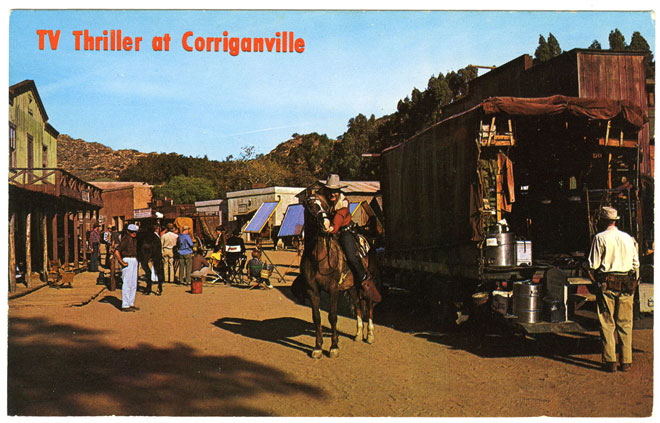
Did you know that Ventura County once hosted its own version of Knott’s Berry Farm? In this month’s Journal Flashback we’re sharing the story of Corriganville, which in fact predates Knott’s Berry Farm by a few years. The ranch served as both a popular amusement park and filming location. Owned and run by the colorful stuntman Western actor “Crash” Corrigan, the park offered a generation of Californians Western-theme entertainments until it was sold in the late 1960s. The site is now a public park that includes several hiking trails where numerous Westerns were filmed. The Park can be reached via the 118 freeway and Exit 30 for Kuehner Drive.
Postcard depicting television production at Corriganville. A television crew is on the left, an actor is on a horse in the middle, and a truck filled with equipment is on the right. 21795 PC, MVC Research and Library collections.
By William J. Ehrheart
May 1999 commemorates the Fiftieth Anniversary of the public’s first view beyond the wagon wheel gates of the Ray Corrigan Movie Ranch in eastern Simi Valley, a tilted landscape of weathered rock, accentuated by huge boulders fringed by groves of coastal and California live oaks, and surrounded by artesian springs and long-traveled byways. A historic Southern California landscape? A Hollywood dreamscape? Both. History, legend and fantasy all came together at the Ray Corrigan Movie Ranch, known to the public as “Corriganville.”
One of approximately forty movie ranches in Southern California that regularly provided scenery and sets for Hollywood’s classic movies and television productions, Corriganville was the only movie ranch that allowed the public to view its operations. Popular western movie hero Ray “Crash” Corrigan provided scheduled western entertainment that drew large crowds. Corriganville became as well known as Knott’s Berry Farm, attracting visitors from across the nation and even from overseas.
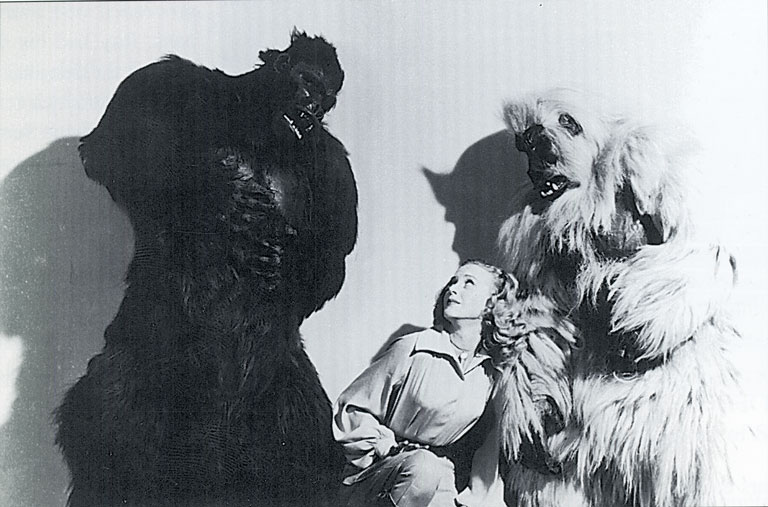
Ray Corrigan’s custom black and white gorilla suits; the actress is Maris Wrixon in White Pongo (1945). Courtesy Sam Sherman, MVC Quarterly Vol. 43, No. 1-2, 1999.
The founder and namesake of Corriganville was born Ray (not Raymond) Benard in a cottage on the grounds of the Joseph Schlitz Brewery Company in Milwaukee, Wisconsin, on February 14, 1902. Here, his father, Bernard A. Benard, served as caretaker. “Bernie,” his wife, Ida, and Ray eventually moved west to Denver, Colorado. By the age of fourteen, Ray Benard was working at a furniture company while studying electronics. He would later have his own electrical business where he experimented with and subsequently developed a number of electrical products. Eventually, he would hold patents on more than twenty electrical inventions.
Ray Corrigan arrived in Hollywood from Denver in 1922, looking not for work in one of the film studios, but rather for Bernarr Macfadden, the naturist, who ran the Hollywood Gym and who printed publications on naturalistic health and body building.1 Ray had a noticeable double curvature of the spine that detracted from his appearance, causing a loss of height and hampering his mobility. Macfadden had been successful in treating this condition in young men. After a year’s course from Macfadden, Ray had the physique of a front-cover Adonis. In order to afford his correctional treatments, Ray worked for a while in Long Beach as a real estate salesman. He temporarily owned a block-sized area of Signal Hill, but sold it before its oil potential was realized. His broker, John Mills, had real estate transactions with the legendary Wyatt Earp.2
Now a capable body-builder in his own right, Ray worked for Macfadden as a director-trainer and was later invited to work at Metro Goldwyn Mayer Studio’s gymnasium, improving the appearance of valuable movie stars and starlets like Ruth Chatterton, Joan Blondell, Joan Crawford and Dolores Del Rio. Del Rio had experienced a lengthy bout of depression that threatened her contract with MGM. The studio decided she should take Ray’s naturalistic health exercises. This therapy seemed to work. As Dolores emerged from her doldrums and returned to acting. It was her husband, MGM’s art director, Cedric Gibbons, who gave Ray a two-year contract as a stunt man. Ray was no stranger to the play-acting environment. He had been involved with local theater in Denver and had chosen to participate again at the Hollywood Community Theatre while working with Macfadden. Ray’s parents had moved to Hollywood, where his father procured a job at Western Costume Company.3
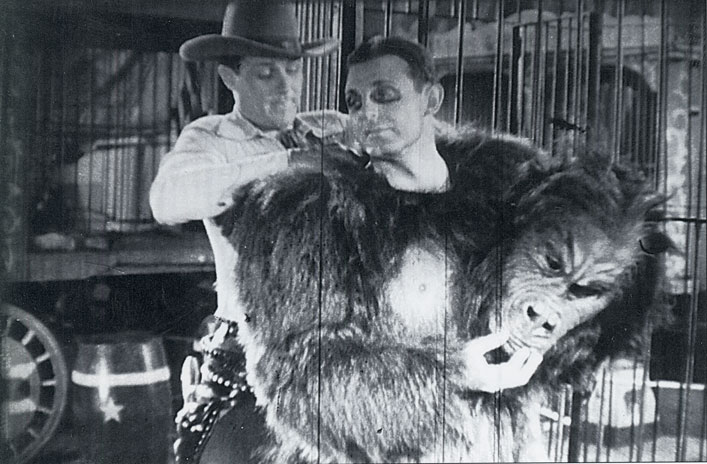
Bob Livingston helping Corrigan into his ape suit for Come On Cowboys (1937). Courtesy Sam Sherman, MVC Quarterly Vol. 43, No. 1-2, 1999.
At the beginning of his career as a movie stunt specialist at MGM Studios, he kept the name Ray Benard.4 During this same time jungle adventure movies were gaining popularity. King Kong (1933) whet the public appetite for movies in this vein.5 Consequently, from 1934 until 1954, part of Ray’s Hollywood heritage was to portray gorillas in adventure, comedy and horror movies. To do this, he needed a strong, muscular physique. Ray spent his free time in early 1934 studying the mannerisms of larger primates at the San Diego Zoo. Shortly thereafter, Ray Benard/Corrigan was encased in the hot and stifling interior of one of his five expensive, handmade gorilla suits, aping his way through classic Hollywood features. (His name was missing from the cast of characters in these features. It would have detracted, he believed, from his role as a Western hero.) In two films, Come On, Cowboys (Republic, May 1937) and Three Texas Steers (Republic, May 1939), Ray appeared as both ape and hero. Corrigan “monkeyed around” all through the 1940s and 1950s, playing a hairy opponent to the likes of Boris Karloff and the Three Stooges.6
Ray stunted in thirty-one movies for MGM. He first accomplished aerial vine-swinging and underwater rubber alligator wrestling scenes for the studio, leaving Tarzan’s Johnny Weissmuller the surface-swimming chores. For MGM’s Mutiny on the Bounty (November 1935), Ray fell off a ship’s high yardarm, a stunt that killed an actor on a previous attempt.7
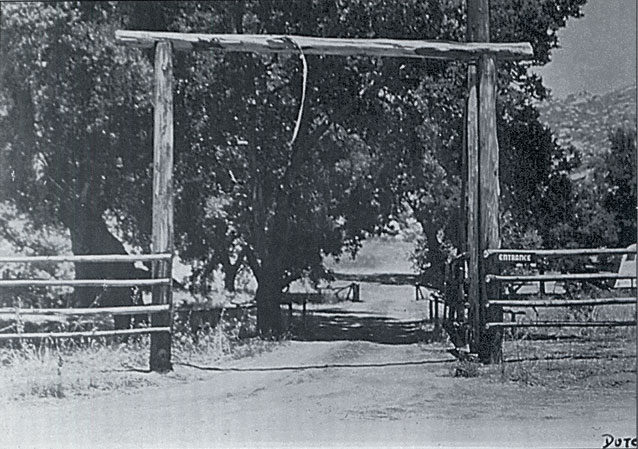
The Scott Ranch gate on Smith Road, 1937. Courtesy Marc Wanamaker, Bison Archives, MVC Quarterly Vol. 43, No. 1-2, 1999.
After his two-year MGM contract expired, Ray soon evolved into supporting roles and later leading actor roles in budget adventure movies and serials for other studios. Prior to his promotion by Republic Studios to a Saturday matinee Western movie hero in September 1936, he filled a supporting role in the Gene Autry Western, The Singing Vagabond (Republic, December 1935) filmed at the Iverson Movie Ranch in Chatsworth—located on the east side of Santa Susana Pass. During a break in the filming, Ray’s friend, actor Clark Gable from MGM, arrived to take him hunting. The duo proceeded west, over the pass. Ray had his first look at the Jonathan R. Scott cattle ranch at the foot of the Santa Susana (west) side of the grade. He saw past the clutter residents of the San Fernando Valley had deposited there and envisioned an active movie ranch that could equal or out-perform the neighboring Iverson Ranch location, which had had its beginnings twenty-five years earlier. Ray noticed that the unusual and dramatic geological formations of the Scott ranch were similar to the formations on the Iverson property—features that attracted the film studios. The ranch was for sale at $11,354, and Ray paid $1,000 down, plus payments of $1,000 a month. He then began clearing away the debris. An era of Hollywood movie ranch history and, eventually of rare public entertainment was about to begin.8
CORRIGANVILLE
Art often imitates life in Hollywood. Many feel it even exceeds and leads. Eastern Ventura County embraced this scenic location where fable repeatedly embellished historical fact and left a public record for all to see: hundreds of movies and thousands of television episodes, along with a myriad of live Western stunt show reenactments—all were created at the Ray “Crash” Corrigan Movie Ranch, later known as the Corriganville Movie Ranch.
Around, through and over the endless boulders, rock-falls, caves and cliffs, good guys and bad guys confronted each other at the ranch, almost never stopping to reload their six-guns. Indian tepees circled the shore of Corriganville’s placid lake adjacent to a five-acre oak forest. At other times, the forest would echo with the sounds of cavaliers or cowboys doing battle. The many trails of the picturesque ranch were pounded to dust as groups of horsemen, stagecoaches, wagons and other conveyances went around and around in front of cameras. Well trained stunt men would tumble off roofs or “bite the dust” in front of a wide-eyed public, setting a precedent for future historical reenactments throughout the western states.
THE PAST AS PROLOGUE
Art imitating life: outlaws on the run in Silvertown in Gun Duel in Durango (1957). Courtesy Marc Wanamaker, Bison Archives, MVC Quarterly Vol. 43, No. 1-2, 1999.
Long before the establishment of the Spanish El Camino Real or the Yankee stage lines that followed, the sheltered grounds had appealed to the native inhabitants of the region. Several Chumash sites have been located on the ranch property. With the arrival of Spanish inhabitants, the area would become part of the land grant known as San Jose de Gracia de Simi, first granted in 1795.9
In the same way that New England states boast about the number of places where George Washington purportedly slept, Central and Southern California can recount ad infinitum locations where the notorious Tiburcio Vasquez (1835- 1875) and his fellow bandits were said to have hidden and buried their treasure. Legend says Corriganville was one of these locations.10 Its protected location at the east end of the ten-mile-long Simi Valley, tightly bordered by the Santa Susana Mountains and the Simi Hills, and adjacent to a dense oak forest with nearby artesian springs, made an ideal retreat for bandits threatening travelers on the Camino Real route between the missions of San Fernando del Rey and San Buenaventura.
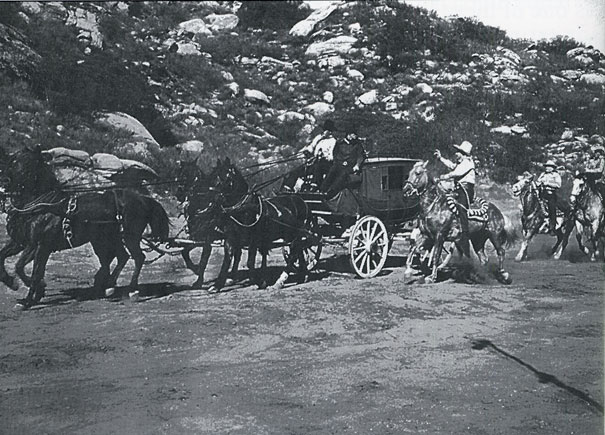
“Crash” Corrigan alerting a stagecoach in Corriganville. Courtesy Marc Wanamaker, Bison Archives, MVC Quarterly Vol. 43, No. 1-2, 1999.
Tiburcio Vasquez was said to have visited Larry’s Stage Station, or the Mountain Station, on the west side of the steep and rocky Santa Susana Pass. Proprietor Lawrence Howard, an Irishman whose resourcefulness and survival instincts matched the nefarious intensity of the cutthroats, thieves, murderers and desperadoes who shadowed these stage stations of the Coast Lines, once purportedly placed a woman passenger, her baby, and her driver out of harm’s way late on a spring night in 1871. Larry bedded them down with blankets and pillows in a corner of the front yard under the oaks, in spite of their entreaties to use the comforts of the inn. About midnight, Vasquez and his company of bandits rode noisily into the yard. They dismounted and went directly into the inn. Afraid of discovery, the fearful travelers gathered horse and buggy hastily and fled away in the darkness, up and over the pass toward Encino, thankful for their lives. The site of Larry’s Station was later included in early Western action at the movie ranch.11
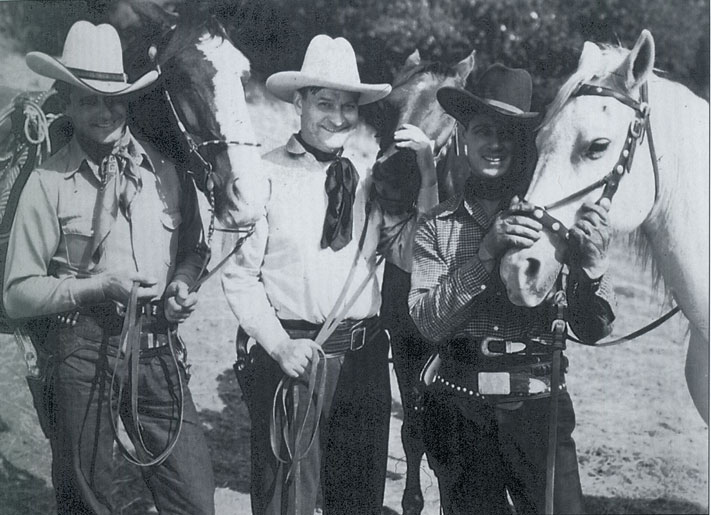
The Three Mesquiteers: Ray Corrigan, Max Terhune, and Bob Livingston. Courtesy of Marc Wanamaker, Bison Archives, MVC Quarterly Vol. 43, No. 1-2, 1999.
The Coast Line stage road (1861-1875) approximated the route of El Camino Real after the outbreak of the Civil War, at which time the southerly Butterfield Overland stage route, which ran from Tipton, Missouri, to San Diego, was closed. After that, mail, newspapers and freight transported by Wells Fargo & Company came from the north via the new Butterfield Overland terminus located at Placerville. The route over the rocky Santa Susana Pass, located between San Fernando and San Buenaventura, was no more than a horse and foot trail until a vehicle road was blasted through to accommodate the Coast Line stagecoaches.12
Where Jonathan Scott had once grazed his livestock, Ray Corrigan kept about thirty-five head of Hereford cattle on his movie ranch as one of many conveniences for the studios. Leo Carrillo, who frequently filmed “Cisco Kid” episodes at Corriganville, recounted that his brother, Edward (Jack) Carrillo, an assistant engineer and foreman for the Southern Pacific Railroad, had blasted the tunnel under the Santa Susana Pass at the turn of the century with a Chinese work crew – a dangerous task that took four years to complete. The western exit of the tunnel bordered the southern edge of Corrigan’s ranch, just north of the site of Larry’s Station.13
Ray Benard “Crash” Corrigan and Elaine DuPont Corrigan. Courtesy Stanley A. Martin, MVC Quarterly Vol. 43, No. 1-2, 1999.
Still another blend of history and Hollywood involved the Jonathan R. Scott ranch house. Ray and his second wife,14 the former Rita Jane Smeal, made it their residence in mid-1938. All three of their children were born there: Tommy Ray on July 7, 1944, Joyce Christine on July 10, 1945, and Patricia Ann on July 12, 1946. (When the children were young, their collective birthdays were celebrated on July 7.) The ranch house was the western-most building of the Silvertown movie street. While the children played, Hollywood was recording their home on film as a stage depot, a telegraph office or a pony express way station, as well as a ranch house. The children would sometimes amuse themselves by discovering cowboy pistols left among the boulders during rigorous movie action scenes.
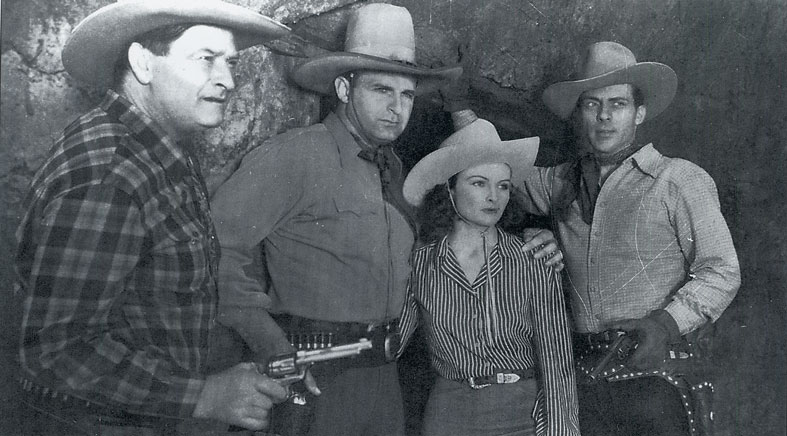
By the end of 1936, fledgling Republic Studio’s new Western film series featured three characters that reached the Saturday matinee theaters: Stoney Brooke, Tucson Smith and Lullaby Joslin; Ray Corrigan played Tucson Smith. Together they were the “Three Mesquiteers,” a parody of the famous Three Musketeers. Because of good production values, exciting and innovative story lines, and music that matched the action, the new series was an instant box office hit with kids across the country.
“CRASH” CORRIGAN
Earlier that year Ray Benard had legally changed his name to Ray Benard Corrigan with the success of his lead role in an Atlantean adventure serial titled Undersea Kingdom (Republic, May 1936). His character in the serial was named “Crash” Corrigan. It was Ray “Crash” Corrigan whose name now appeared on movie posters and lobby cards. Ray’s new public recognition and his Republic Studio contract permitted him to make personal stage appearances at theaters across America to promote his films. In the company of one or more Western entertainers, Ray would perform stunt routines, sometimes interacting with a movie screen image, and would tell how movies were made. Audiences turned out in large numbers. Theater managers were supportive, and Ray now had extra income to pay off his movie ranch. Ray continued these seasonal appearances between his filming schedules into 1943, while finishing out his contract with Monogram Studios as lead member of their Western trio series, the “Range Busters.” Ray was also sought out to endorse consumer products for national advertising. He was the first public figure to sponsor the breakfast cereal Wheaties.
In 1937, while on a late summer tour of the Eastern states with his future wife, Rita, Ray neglected to send in a scheduled ranch payment on time. With the contract thus violated, the ranch owner, a lawyer who had originally received the Scott property as payment for a debt, demanded an additional $3,600 or a forfeiture. This necessitated a scramble for extra funds (enter the agitato music with the action). Ray and his partner, cowboy singing star Eddie Dean, left Kentucky with the funds in hand, and drove nonstop to California in their abused and belabored Packard. They arrived at the ranch on the day payment was due, much after the fashion of a Western movie plot. Even Gene Autry came to the rescue with one hundred dollars.15
Main ranch house complex, new livery stables, 1937. Courtesy Marc Wanamaker, Bison Archives, MVC Quarterly Vol. 43, No. 1-2, 1999.
Title to the 1,829.74-acre ranch now belonged to Ray Corrigan.16 Raoul Walsh, assistant director to early motion picture producer D.W. Griffith, had filmed some one- and two-reel silent Westerns in 1912 among the rocks at the ranch, but Ray now set out to transform this former cattle ranch, stage stop, and purported bandit hideout into a major movie location that would be attractive to numerous Hollywood production companies.17
Ray hired the well-known firm of A.S. Grinnel Company of Los Angeles to lay out new roads and widen others. The bulldozers cleared rock and brush from Table Mountain, Ray’s name for the fifteen-acre plateau on which the Fort Apache set would one day be built.18 Ray also contracted with major studios over the years to construct semi-permanent sets on the ranch. The originating studio would have exclusive use of the set for a year. Thereafter, other studios could rent the set.
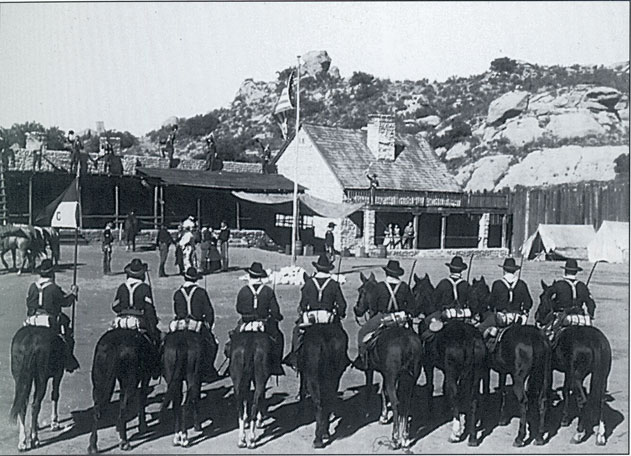
Caption: Cavalry on alert at Fort Apache, 1954. Courtesy Marc Wanamaker, Bison Archives, MVC Quarterly Vol. 43, No. 1-2, 1999.
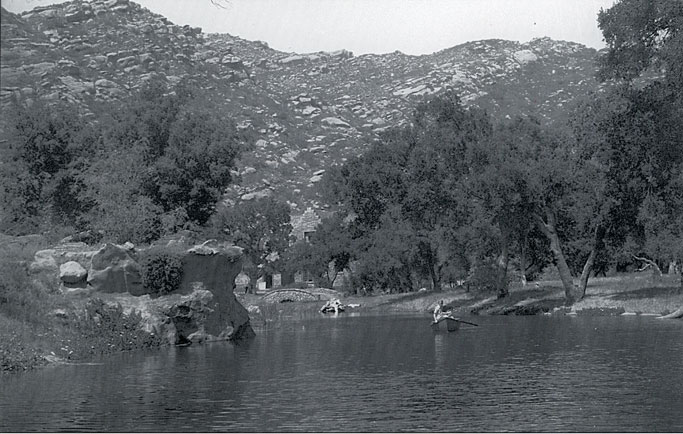
Columbia Studios was first. With Ray’s additional expertise as a gunite contractor, Columbia paid for the construction of an elongated body of water variously described as a lake, lagoon or swimming pool. The northwest edge of the lake featured a flat-topped diving rock that would allow a horse and rider or horse-drawn vehicle to approach from a higher slope behind the rock and plunge from its edge into the water. This rock was piped to provide a waterfall on demand. A recirculating stream fed by one of the original artesian wells supplied the lake. An arched, cement bridge crossed the lake end of the stream. Two movie trails forded the upper length of the stream. At the dam’s end, underwater viewing ports permitted cameras to film submerged action scenes. Ray had the Arroyo Simi below the dam cement-channeled to control seasonal run-off.
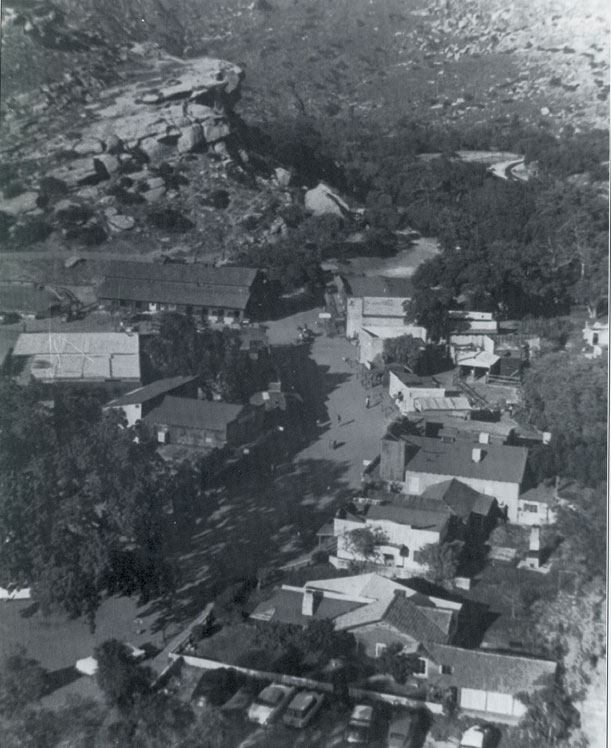
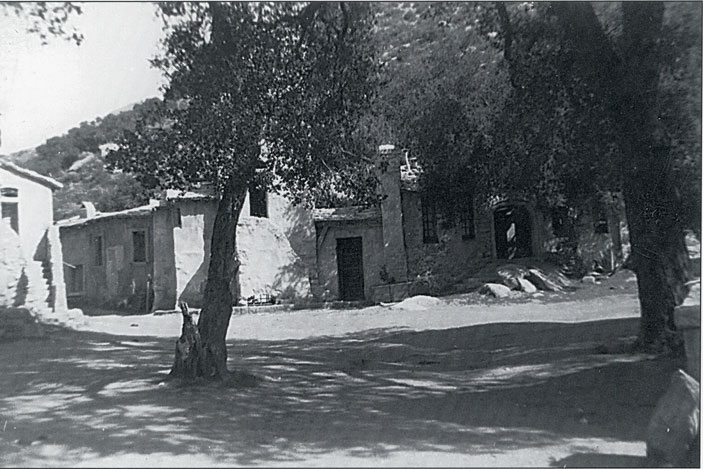
At the southwestern edge of the ranch, the Arroyo Simi was covered over to permit more room for an intended Western town and workshops for ranch maintenance. This was the most level area of the ranch. Ray constructed bunkhouses for workers and cowboys, and erected a large livery stable to accommodate movie horses, which he later rented to the public. Ordinary folk could ride the trails their Western heroes rode. Warner Brothers’ Studios helped trim the trees of the five-acre oak forest. Three “insert’” or running roads – over a mile in length – ran from the headquarters area into the oak forest, where the trails merged. Camera cars would travel a smoothly paved road while shooting the action on the dusty trail across the arroyo.19
A body of water created on the ranch that was described as a lake, lagoon, or swimming pool. Courtesy Wm. H. Appleton, MVC Quarterly Vol. 43, No. 1-2, 1999.
The first movie filmed at the new Ray Corrigan Movie Ranch was RKO’s Gun Law starring George O’Brien, released in May 1938. Western movie nostalgia hobbyists, however, are certain earlier sound films were completed there while Ray was setting up operations. Corrigan had chosen a propitious time and place to organize his movie ranch. The high volume, theater-going habit of the American public, brought about by escapism laid at the door of the Great Depression, continued throughout the 1930s once the problems of introducing sound to movies had been solved. Two years, 1937 and 1939, were the peak attendance years for movies of that decade. The public sought the fast action adventure movies that Corrigan Ranch scenery was so good at supporting. With a little help from the studios, different parts of the ranch could resemble almost any location in the world: an island in the South Seas, an African jungle, the Burma Road, the Northwest woods, a Sonoran desert, the American West, a European forest, or a vista of green meadows by a sylvan lake. In addition, the ranch’s location close to Hollywood appealed to the budget-minded studios.20
No letdown in attendance by the movie-watching public occurred during most of the 1940s, although their motivation had changed to escape from the rigors of World War II. Some Westerns even had modernist Allied and Axis war plots woven into their scripts. The Ray Corrigan Movie Ranch was a busy, busy location during the war years. Corrigan could accommodate five different production companies at once. Knowing his ranch intimately, he could show the directors and cameramen where to get their desired scenes, from what angle, and at the best time of day. In doing this, the studios could economize and have much of their footage shot at Corrigan’s ranch, although most movies contained scenes from multiple outdoor locations.21
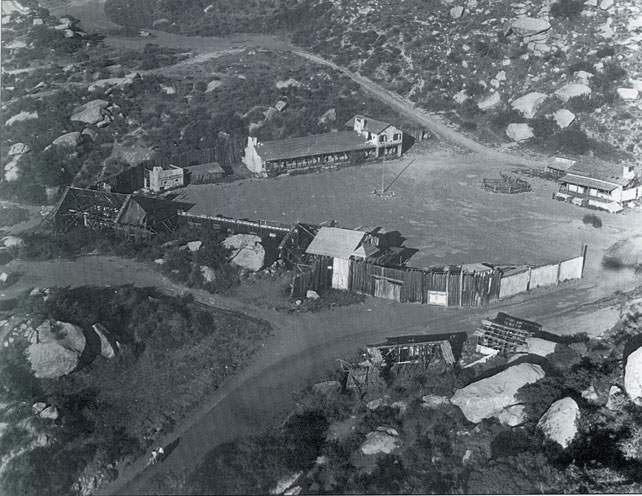
Image of Silvertown at Ray Corrigan Movie Ranch. Courtesy of Gregg Anderson, MVC Quarterly Vol. 43, No. 1-2, 1999.
The income from his frequent gorilla roles permitted Ray to build the Western town that he envisioned for his ranch, one building at a time. Western buildings appeared in other areas of the ranch, but the first use of the ranch buildings was a Western movie street called Silvertown, which appeared during the 1943 filming year. The town continued to grow into the period when the public would be invited, sprouting useful interiors for public utilization, much like Walter Knott’s Ghost Town panorama.
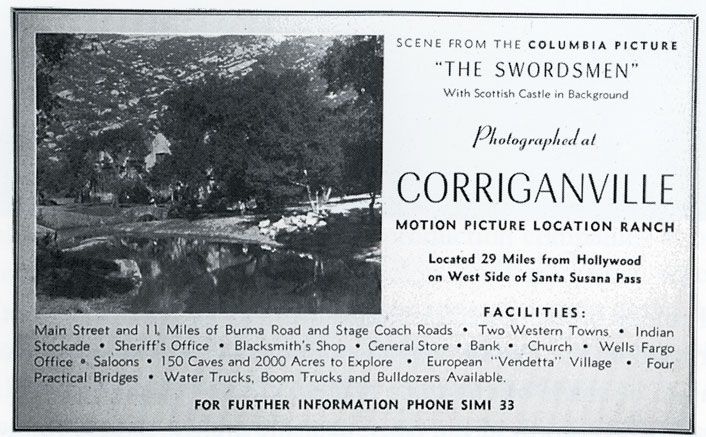
The large sets at the ranch were constructed in the mid- and late 1940s, before the public was admitted. Howard Hughes built an extensive Corsican peasant village for his movie Vendetta (RKO, filmed 1946, released March 1951) against the west edge of the ranch’s largest sandstone ridge, between the Table Mountain plateau and Silvertown, at a cost of $103,000. This set saw much usage as a “third world” village, facilitated by the changing of minor props. Director John Ford had his Fort Apache (RKO, May 1948) set constructed on the plateau at a cost of $65,000. A two-story Scottish manor house, appearing to be made of cut-stone and called the “Swordsman’s Castle,” was located in a meadow just north of the oaks, near the arched bridge. In the vicinity of “Tonto’s Cave,” along the south edge of the big sandstone ridge, there was once a large “Jungle Jim” pagan temple set, complete with papier-mache Banyan trees and trailing vines. Johnny Weissmuller fulfilled a number of Jungle Jim episodes at the ranch. The Bomba the Jungle Boy television series also used the ranch, but not one Tarzan movie was ever filmed at Corriganville – in spite of newspaper accounts to the contrary. For The Man from Colorado (Columbia, November 1948), a second complete Western town was constructed at the ranch, and then burned to the ground to satisfy the story line.22
Howard Hughes’ Corsican village, between Silvertown and Fort Apache. Courtesy Stanley A. Martin, MVC Quarterly Vol. 43, No. 1-2, 1999.
Before the years of public access, Ray had a gaming room accessible to front-rank Hollywood stars such as George Raft. He also offered a dude ranch club membership to one hundred select members who had the use of sleeping facilities, a well-equipped private gymnasium, and an indoor barbecue pit and kitchen. Deer, rabbit, quail and pheasant resided within the borders of the ranch. Members could ride horses, swim, go hunting or use archery, rifle or skeet shooting ranges. These activities attracted Hollywood actors who wanted to “disappear” for a while.23
Attendance during the Golden Era of movies (1934-1955) peaked in 1946. After that year, movie production took a long, gradual downward slide. Budget films belied their name. They became too costly to produce for shrinking audiences. Quality Westerns from the ’30s and ’40s that were sold to television further depressed the market for new B Westerns. Hollywood’s professionals continued to be a mainstay of the California economy—down to our present day—but the circumstances surrounding that steadiness changed.
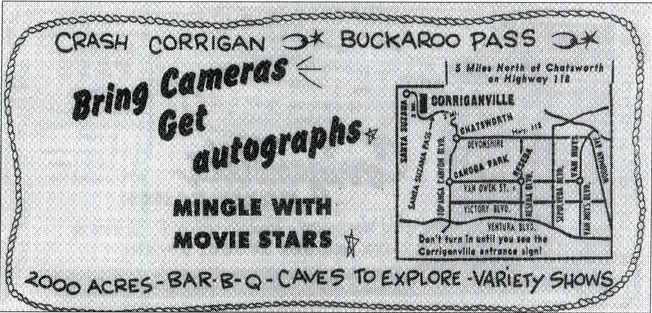
An advertisement for Corriganville featured in the newspaper Daily Variety. Courtesy Marc Wanamaker, Bison Archives, Quarterly Vol. 43, No. 1-2, 1999.
POSTWAR RECREATION & TELEVISION
The Range Busters: Max Terhune, Ray Corrigan and Dennis Moore, with Evelyn Finley. Courtesy Don Creacy, MVC Quarterly Vol. 43, No. 1-2, 1999.
Through federal anti-trust legislation, the dissolution of the old mogul system of studio autocracy took place about the time of the popularization of television. After World War II, the public had greater incentive to explore the out-of-doors. A recreation evolution took place: tent camping led to car beds, small travel trailers and station wagon camping, and then to the eventual introduction of the true recreational vehicle. By 1951, motorlogue travel guides reappeared in Los Angeles-area Sunday newspapers for the first time since the War. The little television screen slowly grew larger over the years, proportional to more sophisticated programming. The Saturday movie matinee phenomenon was to fade and disappear. Budget movies decreased in frequency, with color movies of an A- or B+ quality taking their place. Eventually, Hollywood did what it had to do – embrace television production.24
Ray Corrigan understood this shift towards television and prepared for it in two ways. He organized his ranch for the onslaught of numerous television production companies, and got ready to invite the public to see how movies and television sequences were made. Several major studio ranches in or near the thirty-mile limit from Hollywood—imposed by actors’ and technicians’ guilds—had the advantage of being able to afford their own technical production equipment. The newer, less-endowed television production companies did not always have this ready advantage. Ray made filming on his ranch more attractive by providing the necessary production equipment. Official Corriganville Ranch stationery—in this case a letter dated May 1, 1952—listed features that would entice production companies and also attract the public: complete sets, production facilities and sound stage, Western street, Mexican street, Western fort, Spanish village, country church (and school), Robin Hood Lake, Robin Hood Forest, insert roads, jungle, caves, six miles of Burma Road and meadows, hideout cabins, ranch house, twenty hotel rooms, restaurant (90 seats), chuck wagons, trading post, Western merchandise, a thirty-horse barn, saddle horses, lighting (1500 amps), machine shop, woodworking mill, portable generators, crane boom trucks, powered water trucks, fire trucks, motor grader, skip loaders, bulldozers, and camera cars. Ray also designed and built an aluminum food-catering trailer to use on location at the ranch. By contrast, all that the neighboring, long-time popular Iverson Movie Ranch could offer in the way of equipment was … a water wagon. (Even in a Western, there could be too much dust.)25 Ray charged each film company $650 a day for the use of his ranch. By checking the new movie production schedules conveniently listed in the Daily Variety and The Hollywood Reporter, Ray noted that nearly half of all Hollywood Westerns filmed between 1937 and 1951 had logged in at the Corrigan Movie Ranch.
Tickets and passes sold for Corriganville. From author’s collection, MVC Quarterly Vol. 43, No. 1-2, 1999.
Tickets and passes sold for Corriganville. From author’s collection, MVC Quarterly Vol. 43, No. 1-2, 1999.
Corriganville was first and foremost a movie ranch and continued as such to the end of its working days. Ray realized that frequent visitors to Southern California had universally expressed disappointment at not being able to view the inside workings of a Hollywood studio. Visitors at Universal Studios during the Silent Movie Era could make all the noise they wanted, eating their 25-cent box lunches. That is, until the studio evicted them in 1928 with the advent of sound. Tourists would not re-enter Universal until 1964, when the studio reopened for modest tours. During this thirty-six year interval, not one studio or movie ranch permitted the public to view its interior operations until Corrigan decided to invite them to his ranch. If Hollywood would drive out to Corriganville, so would tourists and Southern Californians for such a privileged opportunity.26
Ray Corrigan, like Walter Knott, kept adding to his Western town—Ray, for the production companies and later for the public, Walter, for his chicken dinner patrons. Neither Corrigan nor Knott clearly realized their operations were becoming amusement or theme parks. Today’s corporate Knott’s Berry Farm claims to be the world’s first public theme park.27 If spokespersons were available for the now defunct Corriganville Movie Ranch, they could more authoritatively make that same claim. Knott’s bases its claim on the positioning of a pioneer hotel building from Prescott, Arizona behind its restaurant in 1940, rather than the opening of the restaurant or the purchase of their farm.28 Corrigan’s Western town began with the livery stable he erected in 1937, or even with the earlier ranch house. Corrigan was first to enclose his property, charge general admission, provide rides, and add various entertainments and activities. Corrigan also showed a special sensitivity for the disadvantaged, and entertained busloads of physically and mentally challenged children at the ranch. Ray had a special regard for children with disabilities due to his own prior physical problems.
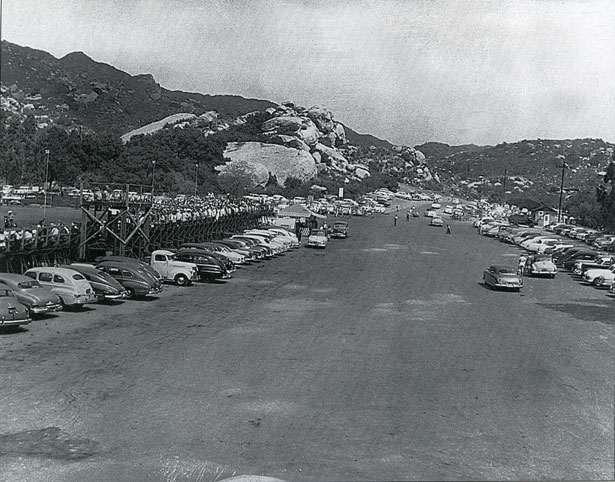
Rodeo arena and adjacent parking at Corriganville in the late 1950s. Courtesy Tom Corrigan Collection, MVC Quarterly Vol. 43, No. 1-2, 1999.
Ray decided to open his wrought-iron wagon wheel gates at the end of Smith Road to the public on May 1, 1949. He renamed the acreage the Corriganville Movie Ranch. On opening day—always a Sunday at first—the ranch was inundated with hundreds of cars, due to advance promotion that offered free admission with the presentation of a specially printed Dixie Cup ice cream lid. Ray had to turn many visitors away. Additional parking areas were marked out around the Western town in a spring 1950 refurbishing. As many as ten thousand visitors on a Sunday became normal, running as high as twenty thousand for special events. In May 1953, Corrigan purchased the sixty-acre Touvin Ranch, just south of the Hall Turkey Ranch, increasing the ranch size to 2,000 acres. This gave him frontage on Los Angeles Avenue, now Kuehner Drive. The addition provided room for a five-lane entrance gate, unpaved parking for twenty thousand cars, and room left over for the construction of a rodeo arena, grandstand seating for four thousand, and a food concession.29
The arena scheduled not only rodeos, but also Wild West, equestrian stunt and horse shows. Ray would have celebrity Western actors appear as Grand Marshals for each rodeo parade. Ray’s earlier experience with the Los Angeles-based Clyde Beatty Circus (1943-1954), where he performed equestrian stunts as a cowboy hero, as well as impersonating a “trained” ape, had made the versatile stunt man quite a showman.30 The stunts at the arena included rescues from a burning stagecoach in motion, transfers, falls and remounts from a runaway stage, and an Apache flaming arrow attack on covered wagons. The Sunday afternoon rodeo was broadcast from Los Angeles television station KNBH in 1953 under the title “Crash Corrigan’s Round-Up.” Two earlier television shows organized by Ray were “Crash Corrigan’s Ranch” (KECA, summer 1950), a weekly children’s show, and “Crash Corrigan” (KTTV, April 1951), on which his son, Tommy, appeared. With the advent of the rodeo shows, Ray invited the public in on Saturdays as well. Corrigan had a large billboard image of the Silvertown Western street mounted next to the ticket office over the ranch entrance. It was captioned at the bottom for all to see: “Through these gates pass the world’s most famous people.”31
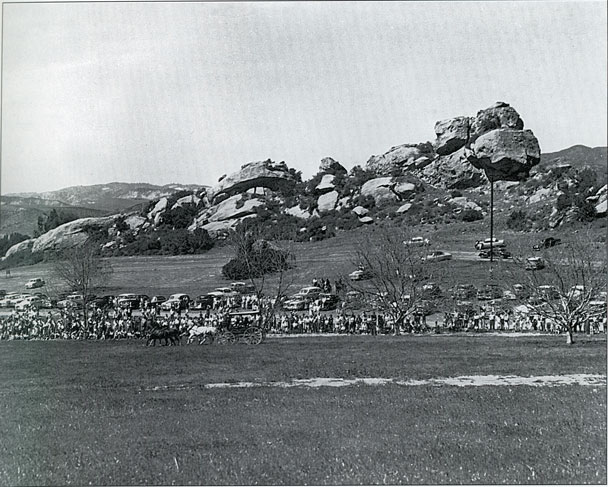
Spectators line up to watch a stagecoach ride at the Corriganville Movie Ranch, circa 1950. Courtesy Tom Corrigan Collection, MVC Quarterly Vol. 43, No. 1-2, 1999.
Tractor or horse-drawn trams and eventually buses were waiting at the parking lot staging area to bring visitors into the interior of the ranch. You could stay on for the grand tour or be deposited at major sites around the ranch. There was much to see and do at Silvertown. Ray kept a cadre of stunt men employed at the ranch to provide live thrills for visitors who now had a steady diet of television Westerns. They acted out stories from the Old West on Silvertown’s Main Street in scenes that were choreographed and performed to a taped narration, every half-hour, all day long. These performances have inspired countless Western reenactment stunt shows ever since.
Ray’s third wife, formerly Elaine Zazueta DuPont and today Elaine Calhoun, was heavily involved in the ranch’s entertainment schedule from 1952 until Corrigan sold out in 1965. (Elaine also managed an acting career in both movies and television.) She recalls that forty different stunt routines were catalogued.32 A typical day’s program in the ranch’s newspaper, The Corriganville Gazette, would look like this: “Dalton brothers’ bank holdup at Coffeyville,” “the beating of Joaquin Murietta,” “Billy the Kid becomes an outlaw,” “gunfight at the O.K. Corral,” “the hanging of Henry Plummer,” “the shooting of Belle Starr,” “the killing of Bill Tilghman,” “Billy the Kid breaks jail,” “Doc Holiday in Colorado,” “the Johnson County cattle war,” interspersed with movie plot stunts, fights, pistol twirling, rope drags and roof falls. Ranch advertising announced, “The Last of the Old West.” In the early 1950s, Western “old timers” from Knott’s Berry Farm came to Corriganville to learn stunt routines.33
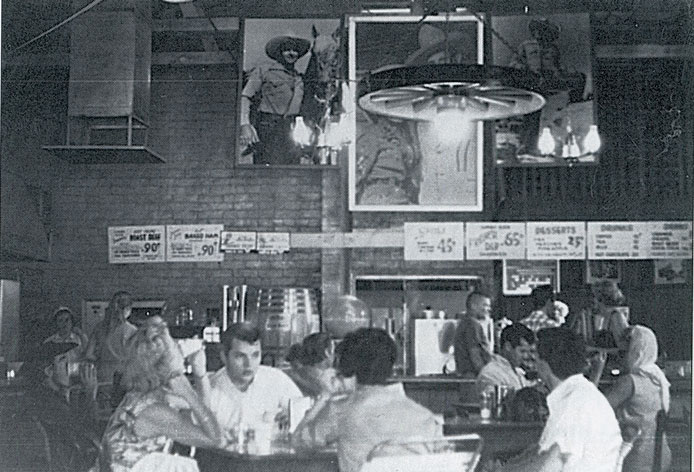
Interior of Last Frontier Café at Corriganville, 1962. Courtesy Sam Sherman, MVC Quarterly Vol. 43, No. 1-2, 1999.
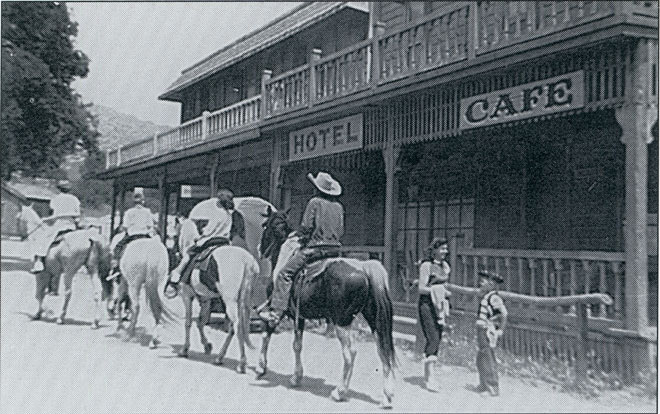
Silvertown was thought out in a manner akin to Knott’s Ghost Town. Some buildings had Old West fake frontage, with the majority containing merchandising interiors to accommodate the public. A special 1962 edition of The Corriganville Gazette detailed what to expect: “Silver Dollar Saloon…draft beer, soft drinks, .05 cent salami sandwiches and performing dance hall girls; Last Frontier Cafe…quality food, reasonable prices, eat with the stars; Photo Shop… ‘have your pitcher took’ with movie and TV stars; Trading Post…Western wear, novelties, souvenirs, leather craftsman and glass blower; The Corriganville Gazette’s Newspaper Office…your name in headlines; Country (general) Store…assorted merchandising, auction, live Western music, Max Terhune and his dummy show; Merchandising Outlet novelty shop…with grandma and grandpa; and Chuck Wagons…snacks and drinks.”34 In addition, there was a blacksmith’s shop, hotel/soundstage with production numbers and public dancing, old-time movie theatre, a cafeteria, a photographer’s supply shop, a gunsmith shop with a gun collection, and an undertaker’s parlor and hanging tree. At the east end of town sat a double purpose church-schoolhouse, depending upon which end of the building was being filmed. Disguised bathrooms were available at both ends of town.
The Gazette listed features apart from the Western town buildings including: “the Livery Stable and Corriganville Fun Corral…most unusual Western rides in the world; Wells Fargo Stage Line, the Corriganville Express…departing every hour; The Frontier Railroad Company’s C.P Huntington locomotive and cars…1 ½ miles of scenic ride from Silvertown to Robin Hood Lake, over deep canyons, through the giant oaks of Robin Hood Forest; Robin Hood Lake and Forest area… hundreds of picnic tables with barbecue pits and broilers, plus other picnic sites around the ranch.” Ray rotated and updated the instrumentalists, singing groups and guest performers that were billed at Corriganville. Music was provided for ballroom, country western and square dancing. Ray also provided singing engagements for his ranch performers at other locations in the Los Angeles Basin.35
“Crash” Corrigan doing his act in which he was “covered”. Courtesy Stanley A. Martin, MVC Quarterly Vol. 43, No. 1-2, 1999.
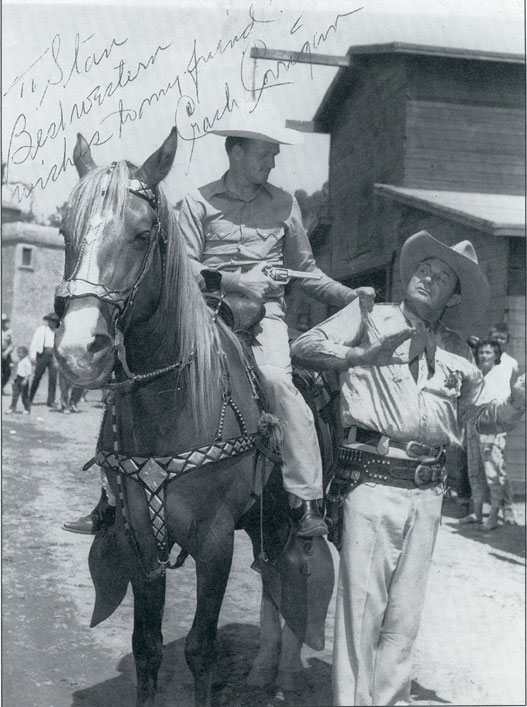
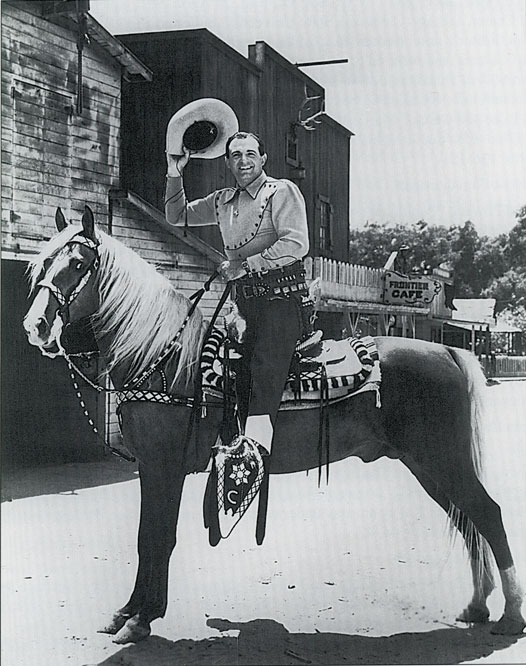
In addition, there were eleven miles of hiking and riding trails at Corriganville. Visitors could explore the caves, find planted arrowheads, view movie sets and hideout cabins, and sometimes see location filming. Youngsters could pose for one-dollar pictures with “Crash” Corrigan, hold his six-shooters, and sit on his horse “Flash.” “Crash” would raise both hands up when he was “covered,” something he did thousands of times for impressed fans. Then he would comply with a sea of autograph signing requests. A “Crash” Corrigan Fan Club of 220,000 youthful members was organized, complete with “Crash” Corrigan photo I.D. cards. In the 1950s, Tanner Gray Line Tours of Los Angeles scheduled motor coach tours of Corriganville. Their five-hour Wild West Movies Tour at $5.75 included a chuck wagon lunch. Benevolent societies, fraternal and social organizations rented Corriganville for group gatherings.36
Corrigan’s successes attracted investors. In early 1955, Ray contracted a long-term lease with Outdoor Amusements, Inc. to manage operations at the ranch. Ray was to receive a $3,000-a-month rental fee and serve as an advisor and technical consultant. He retained ownership and control of his other enterprises, which included a gunite swimming pool construction company, his Sultana soft drink company (which made an Orange Julius-like beverage), and his real estate investments. Under the new management, facilities at Corriganville were expanded, new attractions were added to Silvertown, and additional movie sets and production equipment were provided.37
A tourist group riding past the hotel/soundstage at Silvertown. Courtesy Stanley A. Martin, MVC Quarterly Vol. 43, No. 1-2, 1999.
On August 3, 1954, the Jack Wrather Corporation of Dallas, Texas purchased all rights to “The Lone Ranger” television series from the George Trendle interests for $3 million. Wrather immediately upgraded this popular black and white series with color programming, and included location travel to ten scenic areas in California and Utah. Thirty-nine new programs in the series were produced for the 1956-57 television season. The series location headquarters was established at Corriganville. Wrather, whose investments were in radio, television and hotel enterprises, gained temporary control of Outdoor Amusements, Inc. As majority stockholder, he leveraged a name change for the Corriganville Movie Ranch from January 1957 until May 3, 1958, calling it the Lone Ranger Ranch. The only time Clayton Moore ever showed a hint of fear in his role as the Lone Ranger was at Corriganville, where several thousand kids charged at him during a rare public appearance on the Silvertown Main Street.
During this period, General Mills, Inc., sponsor of the radio and now television series, printed color cut-out images of Western town buildings on their Wheaties and Cheerios cereal boxes advertising the Lone Ranger Movie Ranch Wild West Town. Children could also send for a four-piece color map that was a flat landscape for the cardboard town buildings.38
An autograph photo of the Lone Ranger (Clayton Moore), with Stanley Martin, at the rear of the livery stables, 1957. Courtesy Stanley A. Martin, MVC Quarterly Vol. 43, No. 1-2, 1999.
Wrather’s control of Corriganville was terminated through a lawsuit by the Corrigans, who showed that Wrather was violating his contract by not keeping up physical appearances at the ranch and allowing the aged oak trees to die out. Some fire and flood damage was sustained at Corriganville in 1957. By summer 1958, the ranch was retitled “Corriganville: World’s Most Famous Movie Ranch.” Ray celebrated by opening Corriganville to the public all week long. Other promotional phrases over the years described it as a “nationally renowned movie and TV location site,” “The Old West,” “only location for the public to see movies being made,” “one of America’s top ten most interesting places,” and declared “over 3,500 pictures filmed at Corriganville.” In May 1962, Ray encouraged on-site camping at Corriganville, be it tent, camper or trailer.39
In the early 1960s, Corrigan’s expertise facilitated the founding of a movie industry workshop on the ranch. Called the Corriganville Academy of Motion Picture and Theatre Arts, it was more than a stunt school. It provided a training ground for potential actors in all phases of thespian techniques. The school offered live productions and workshops in stage management, and in equipment and set handling. The ten-week course covered “method” acting, character building, body movement, voice, diction, and constant participation in scenes, plays, set management and stunt routines. Placement help and a screen test film were also provided. After Corriganville closed, the dispersed stunt men/actors went on to do shows at Knott’s Berry Farm, and to create the stunt show program at Universal Studios. Corporate managers who worked for Ray took the skills learned at Corriganville and applied them to leadership positions at Disneyland and Universal Studios. (Previously, Universal had wanted to buy Corriganville as an appendage studio and tourist attraction.)40
Corriganville was a financial success throughout Ray’s twenty-nine year administration. Even the sensational front-page news coverage preceding Rita Jane and Ray’s divorce trial in 1954 failed to affect the earnings stability of the ranch. Ray had been eyeing his co-performer at the ranch, Elaine DuPont, while his foreman, Moses (“Bud”) Stiltz, was giving Ray’s wife Rita ardent personal attention. Eventually both parties legally obtained the objects of their desire. After the trial, Rita was awarded a continuing half-interest in the property, and she received an equal share of the net profits. (Ray’s rental fee from Outdoor Amusements was his alone.)
The “Three Mesquiteers” Bob Livingston, “Crash” Corrigan, and Max Terhune question a suspect. Courtesy Tom Corrigan Collection, MVC Quarterly Vol. 43, No. 1-2, 1999.
By April 1959, Ray had considered an additional $5 million expansion of Corriganville facilities, but when the State of California indicated its intention to route its 118 Freeway along the upper ranch property, such plans were set aside forever.41 The results would spoil numerous camera angles for the studios. The same fate befell the Iverson Ranch, which was breached fairly in the middle by the freeway. Further, Ray had also had a warning heart attack.
Other pressing reasons were associated with the costly overhead expenses of running a large ranch, including the payroll for a stable-full of cowboy stunt men, and the ongoing repairs. Ray and Elaine had to pay all of their debts from gate receipts, whereas other corporate theme parks had separate investments that served to defray their expenses.
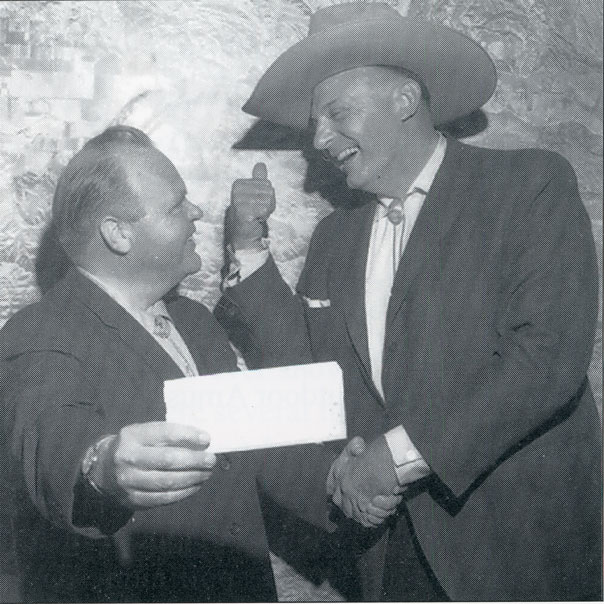
Ray Corrigan points to the location of his ranch on a map behind him as Ventura County Supervisor J.K. McDonald displays a check for Corrigan’s share of the sale of the property to comedian Bob Hope, April 1965. Ventura Star-Free Press, MVC Quarterly Vol. 43, No. 1-2, 1999.
Personal and regional problems aside, times were changing. Now, in the cynical sixties, cowboy heroes were vacating center stage to civil rights, flower children, hippies, Peter, Paul and Mary, and the Beatles. Cowboy actors were digesting spaghetti canned in Italy or Spain, instead of rare beef steaks. (The new diet made them mean and ornery and readily willing to wear nondescript brown clothing.) As a result, interest in traditional Western entertainment flagged by the early sixties. Corrigan made non-traditional attempts to recapture the public’s interest. He constructed a moto-cross motorcycle dirt track endurance course in a clearing above the lake, with trails that extended down toward the rodeo arena. This attempt brought crowds for a couple of years. Attendance at the rodeo dropped off, so Ray reworked the arena into a go-cart track, but the Simi Valley city council refused to issue an operating permit for the revised usage.42 When the ranch was sold for $2,800,000 to Bob Hope in 1965, Rita and Ray each pocketed a half-interest.43 The preeminent reason Ray had for selling the ranch was Rita’s desire to receive that check.
Bob Hope’s managers kept the movie ranch open to the public until 1967. The property name change to “Hopetown” was ill planned. It did not carry the same public recognition factor as the title “Corriganville.” The movie ranch remained accessible to the studios for commercials and movies, but on September 25 and 26, 1970, a major firestorm swept down from the Saugus-Newhall area, burning structures on the Iverson and Spahn movie ranches, then flaring over the pass to consume the large sets and most of the Silvertown buildings at Hopetown/Corriganville before moving on to Moorpark. Hope hung out a “closed” sign, locked the gates and walked away to wait out appreciating real estate values.44 He had acquired the ranch from Corrigan intending to carry on its Hollywood traditions, knowing that other movie ranches in Southern California had been sold, subdivided and forgotten. Hope did not want the same fate to befall Corriganville, which became, in essence, suspended in time, waiting for the desires of others to shape its future.
There was only one movie ranch like Corriganville as far as the public was concerned. Universal Studios would later conduct glitzy high-tech tours. “Old Tucson,” Arizona’s commercial movie ranch, would have its Spaghetti Western-like sepia-toned desert wasteland environment, but Corriganville fits comfortably in the well-worn pocket of memories that contain other treasures like the Saturday matinee, old radio programs and the original Ghost Town at Knott’s Berry Farm.
THE CORRIGANS AFTER CORRIGANVILLE
After their marriage on April 7, 1956, Elaine and Ray Corrigan had taken up residence in Northridge. The old Silvertown ranch house became headquarters for the ranch foreman. Elaine was cowgirl to “Crash” Corrigan’s cowboy role. Whenever Ray was called out to be Grand Marshal of a Southern California community parade, which he frequently was, he had a built-in queen to ride with him. After the sale of Corriganville, Ray and Elaine built a new 8,000 square foot home in Encino. Elaine, as “keeper of the dust” at Corriganville, managed to add a full-time career in professional banking, eventually becoming an institutional vice-president.45
Ray and Elaine had one daughter, Colleen Suzanne, born in 1961. Elaine had many well-placed friends and associates in both the financial and entertainment worlds. The gap between Ray and Elaine’s birthdays amounted to twenty-six years. In 1967, Elaine weighed the factors, including her husband’s sometimes mercurial personality, and asked Ray for a “friendly” divorce. Divorced on a Tuesday, they rode together with their daughter Colleen the following day in the 1967 Hollywood Santa Claus Lane Parade. Elaine later married Robert Calhoun and they had one daughter, Heather, born in 1973. Ray never remarried.46
Ray and Elaine sold the Encino house and Ray moved to Washington State in 1971. Here he considered developing a new public theme park in the San Juan Islands, the American soil closest to Vancouver Island and Victoria, British Colombia. He chose a high-traffic tourist location, but backed out due to its cost and prolonged development projection.
Ray “Crash” Corrigan and his horse “Flash” greet visitors to Corriganville. Courtesy Tom Corrigan Collection, MVC Quarterly Vol. 43, No. 1-2, 1999.
Ray then moved to Brookings, Oregon, just north of the California line, to a life of semi-retirement. He sold recreational vehicles, mobile homes, went fishing and jaunted off to Western film conventions where he was graciously greeted by admiring fans. An Oregon woman named Irene had made up her mind to become the next Mrs. Corrigan, but Ray permitted no legal ties. In May 1976, Ray was honored as Grand Marshal in Brookings’ Azalea Festival parade. But Corrigan, a constantly active man, was getting bored. He thought of moving back to Los Angeles to make personal appearances, go on talk shows, and considered doing character roles in Hollywood.
Corrigan came down to Los Angeles to participate in the one-time, four-day Western Film Festival held at the Biltmore Hotel on June 16-19, 1976. While in town, he had a chance to visit his daughter Pat in Canoga Park and to see his newborn granddaughter, Tricia, for the first time. Ray also visited his son Tom in Thousand Oaks. They talked about family, old times, the legacy of the ranch and about future plans, including Ray’s idea about returning to Los Angeles. They visited the ranch site together. Ray was depressed by its run-down appearance.
The movie ranch had a newspaper and this clipping is from the paper. The headline reads “Ray Corrigan Host as Movie Ranch.” MVC Quarterly Vol. 43, No. 1-2, 1999.
Back home again in Brookings, Ray got a call from the area Cadillac dealer. The new sedan he ordered had arrived. Would he come down and take delivery? Ray walked out the door and onto the lawn and collapsed with a fatal heart attack. It was August 10, 1976. Open-heart surgery was not a common practice then. Ray had avoided doctors. He was a self-treating naturopath in concept and practice, perhaps as an outgrowth of his training under Bernarr Macfadden.47
Because of his association with Hollywood, Ray Corrigan had a remarkable and complex career spanning four decades. He was in the public eye for twenty-two years after his last appearance in a regular movie series, and he retained his popularity throughout. The management of his movie ranch and other enterprises kept him visible and available, while other western movie heroes often just rode off into the sunset.
AFTER RAY CORRIGAN
With the blossoming of Simi Valley as a bedroom community in the 1960s, Corriganville was largely forgotten. The 1970s were a time of emptiness and abandonment for the Hopetown property, except for an occasional moto-cross cycle race scheduled to keep a county permit alive. The 1970s had opened with a devastating fire that destroyed most of the ranch’s standing structures. The decade closed in a like manner. Halloween vandals set another fire in 1979 that eliminated the hotel/soundstage and related buildings, and leveled the combustible portion of the livery stable. Now only furtive wanderers tread the trails of the abandoned ranch, with the exception of an occasional Western movie fan trying to recover past glories. A firing range was constructed for the Simi Valley Police Department adjacent to the old Fort Apache site on the ranch. It was in use from late 1975 to August 1987.
The 1980s became years of administrative resurrection for the original Corriganville. Eyes began to turn toward the secluded Bob Hope property for various reasons. Residential crowding demanded more green space. Voices were raised on behalf of migratory animal corridors, the protection of rare plant habitats, leaving the property “as is,” and, of course, real estate development. These various voices all spoke out when the development firm of Griffin Homes purchased an option on the entire remaining ranch site in 1983 from Bob Hope for $4.6 million. Public hearings were held by the City of Simi Valley. Strong public support existed for the preservation of the main ranch areas as a public recreational park. The City stepped in and allowed Griffin Homes to purchase the ranch’s western-most sixty acres, to be used for a development comprised of single-family homes. Griffin’s remaining 172 acres of the ranch were purchased by the City for a regional park, with local and State resources provided by the City, the Rancho Simi Recreation and Park District, and the Santa Monica Mountains Conservancy. Eventually, 225 acres of the area once known as Corriganville were secured.48
The set of Fort Apache on the movie ranch. Courtesy Gregg Anderson, MVC Quarterly Vol. 43, No. 1-2, 1999.
Once the deed to the property was obtained in April 1988, the City of Simi Valley organized the Rancho Simi Open Space Conservation Agency (RSOSCA) board to govern the affairs of the newly acquired regional park. By December 1988, RSOSCA’s Master Plan was published, containing the best conservative development ideas the community had rallied around in the previous few years. Phase I of the plan was structured to install the basic physical fixtures and accommodations of a public park, including a visitor’s center. Phase II addressed reconstruction of the major features of the historic movie ranch: the Silvertown street, the lake, a Fort Apache structure, trimming of Robin Hood Forest, greening of the meadows, and restoration of the trails. The name “Corriganville Park” was also legally restored to the ranch.49
Since 1985, various Simi Valley citizens’ groups have been organized to promote Corriganville as a historic reminder of Hollywood’s earlier movie making days, and to recall the public’s enjoyable visits to the ranch. The first of these groups to appear was the Simi Valley Cultural Association, then came the Corriganville Preservation Committee, followed by the Corriganville Movie Ranch Restoration organization. These dedicated groups tried to raise monies at the local level to allow for the reconstruction of structures addressed in Phase II. Another local group interested in promoting old Corriganville’s welfare is the Trail Riders of the West, whose members are saving Hollywood Western memorabilia for a museum at the Park’s visitors’ center.50
The 1990s have come and are nearly gone. Clean-up and restoration funding has proven too difficult to raise, either at the official City level with grant proposals or ballot propositions, or at the citizens’ support level, with event-oriented fund raising. The various construction projects in both Phases I and II of the Park’s Master Plan are still awaiting funding.
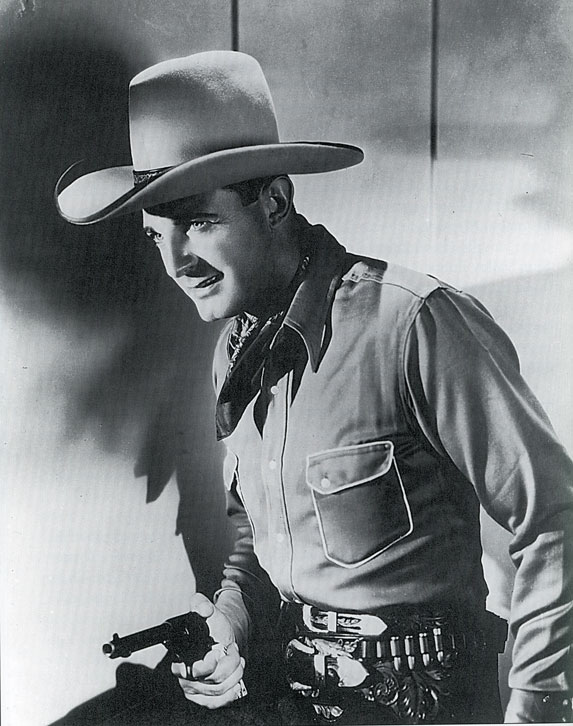
Ray “Crash” Corrigan in a studio promotional still about 1936, when he was appearing as one of the “Three Mesquiteers”. Courtesy Tom Corrigan Collection, MVC Quarterly Vol. 43, No. 1-2, 1999.
The memory of Corriganville is still strong, kept alive by those who visited the movie ranch during the eighteen years it was open to the public. Yesterday’s child visitors are today’s business people, corporate executives and other interested parties. This potential advocacy group could be encouraged to support Corriganville’s rebirth through, among other options, structured giving plans. Visits to the ranch by Hollywood production companies anxiously looking for new vistas and additional sound stages could do wonders for the ranch’s progress. As the fiftieth anniversary of Corriganville’s public debut dawns, $6.4 million in reconstruction funds still need to be raised. Focusing on avenues of support that can provide the largest return is a recommended resolution for the new century.
The grounds of Corriganville, with limited improvements in place, are now open to the public once more. Gone will be its former genial host, Ray “Crash” Corrigan, who often personally greeted his guests at the ranch entrance with “Howdy, Pardner.” The present owners will have to proceed without the expertise, showmanship and public affability of our movie cowboy hero. Former visitors returning to Corriganville today, though, can tell them all about it. They’ve been there before.
Make History!
Support The Museum of Ventura County!
Your donation will help support our online initiatives, keep exhibitions open and evolving, protect collections, and support education programs.