Daily Report – Bitcoin and Market Update (June 20 2022) – The Birb Nest

HTF 1W:

The weekly chart printed a major break-through session for BTCUSD, taking it among the deepest historical corrections.

Finding support at the cyclical AVWAP ~ $17800, an intraweek bounce was recorded, following a major decrease, forcing many firms, and funds to go bankrupt, or insolvent. Also, well-known and largest crypto funds suffered from overwhelming losses, forcing liquidations. It remarks financial distress stage of the market cycle.

The main long-term support is also provided by the 200-week average at the 22500 USD area. While it is not set in stone that BTCUSD does not slip below those averages, historically bitcoin rarely stayed at those prices for long-term.

Historical records of bitcoin’s cycles typically show 80-90% drawdowns off the peaks. Now, when BTC is at -75% retracement depth, there might in theory be more flush ahead. This historical evidence gives empirical frequency and probability, which is relatively high and in favor of BTC reversal within the 80-90% drawdown range. However, one should not anticipate to catch the perfect bottom.

The main resistance seems to be within the 26500-28500 USD territory, based on the price action analysis – the polarity change principle.

The correlation coefficient has also increased up to 0.87 or 87%. It suggests strong dependence of bitcoin price movements on the price action of S&P 500.

Furthermore, the Relative Rotation Graphs – RRG – chart analysis shows long tail on the far left, oriented to the downside corner. This confirms relative underperformance by a lot against the benchmark – S&P 500 – both in terms of relative momentum, and relative strength. For this, sector rotation does not support portfolios being overweight crypto.

HTF 12H:

The middaily chart shows BTCUSD is attempting to build a base in the upper $19000s.

With the downwards acceleration, the CTF Trailer has been downwards-adjusted. As such, the Stop level at $21341 is the main invalidation level for the bears, and a solid threshold to break above for the bulls, in order to re-gain the control over the market. Until that happens, the bears remain to have the upper hand and are in control.

The pre-breakdown support territory of 28000 USD should turn into a resistance now, also on the self-fulfilling prophecy basis. Traders tend to display “magical thinking” and heuristics (rule of thumbs), where the support and the resistance switch the roles interchangeably.

Until a decent follow through 23141 USD occurs, the bears may continue to panic sell into the lows, contributing to further downwards price movements.

MTF 4H:

The MTF chart shows an attempt of a breakout above the main trend threshold at 21000 USD.

The CTF Trailer has converged downwards with the price, and bitcoin is knocking right on the resistance of the CTF Trailer Stop level. If broken to the upside, bitcoin may get a momentum kick to empower further upwards continuation toward the 25200 USD area. A failure to close above 21000 USD brings higher chances for a deeper retest into the 17000 USD area.

Apart from the support at $17104, the BPRO Level Lines define resistances are projected at following anchors:

32588
29758
25179

These levels could be anticipated to serve as level-to-level references. In other words, when one level is breached, the next one in the direction of the movement

LTF 1H:

The short-term price action shows some local consequence in the upwards trajectory, for the first time in a while.

The upwards sloping price movement is recognized as the series of higher highs and higher lows. However, note that the momentum is not the most apparent in there. The vertical distance between the peaks and troughs is not large, which makes the price action rather condensed. This congestion suggests that the upwards trend gets exhausted relatively fast and may lose the steam sooner than later.

Otherwise, if the up-trend line maintains the slope, I would argue that the next resistance may be the very HTF Stop (12H CTF Trailer Stop) at $23141. If this HTF level is reclaimed, short-term price action may also promote to develop on that.

A trend line breakdown may add to short-term range pattern and switch the upwards trajectory to neutral sideways with more chop to follow.

FEAR/GREED INDEX:

A visual comparison of the most recent capitulation setup resembles the other instances of this cycle: the bear market depression of 2018, as well as the covid crash in March 2020.

While it is not set in stone for BTCUSD to revert upwards immediately after the sentiment pulls the historical lows, the mean-reverters and contrarians may consider current prices attractive on the contrary opinion basis. It is, knowing that the underinformed crowds are always wrong at the market extremes, and reversals.

Now, at 9 points on the sentiment scale out of 100, BTC could be considered to be inside the “cheap territory”. It is NOT, however, a timing indicator. So, it should not be associated with a complete trading system (entries, exits, stops, profit targets, triggers).

Regardless, obvjectively speaking bitcoin seems to be providing historical opportunities around these days and one should note for the sentiment readings to create a deeper understanding about the market context.

Bitcoin: Net Unrealized Profit/Loss (NUPL)

Quoting the CryptoQuant’s definition, “Net Unrealized Profit and Loss (NUPL) is the difference between market cap and realized cap divided by market cap. Assuming that the latest coin movement is the result of a purchase, NUPL indicates the total amount of profit/loss in all the coins represented as a ratio. It could be interpreted as the ratio of investors who are in profit. Values over ‘0’ indicate investors are in profit and an increasing trend in value means more investors are beginning to be in profit. This phase indicates the increasing reason to take profit which leads to an increase in sell pressure.”

The NUPL ratio is currently at the territory defined by the -0.19 to -0.1 boundaries. It is an unprecedented depth for this metric, which typically aligns with attractive return-to-risk ratios for the long-term investors, scaling into larger positions. More often than not, those buyers are the bottom-buyers in the hindsight.

Based on the records above, I choose to personally employ a partial long-term purchase – addition to my long-term stack in my already well-diversified portfolio of different assets.

More in-depth explanation I’ve added in premium video reports.

Hope it helps. God bless

P.S. Right or wrong, history often rhymes: https://twitter.com/crypto_birb/status/1538889025569931265?s=20

Exclusive | Kayla Harrison Explains Larissa Pacheco Beef, Says Pacheco Would “Beat Cyborg”

Kayla Harrison Larissa Pacheco Beef

Olympic gold medalist and undefeated mixed martial artist Kayla Harrison recently took the time to chat with us here at LowKick MMA. Discussing how she misses training with Amanda Nunes, plans on winning a third straight PFL title, and elaborated on the rivalry between her and Larissa Pacheco.

With 14 consecutive victories in a row, and two PFL titles under her belt, it’s safe to say Harrison’s transition from being an Olympic Judo gold medalist to being a full-time fighter has been a huge success. After making waves as a free agent on the open market, she’s resigned with the PFL and is looking to make history.

“She’s a good fighter. She’s a great fighter,” Kayla Harrison began, speaking to LowKick MMA’s Mike Owens. “I think that right now, she would beat Cyborg. And I think that she would give Amanda (Nunes) a really tough time. I think I’m gonna go ahead and put her at #2 for 145lbs and up. I think she’s the second-best fighter 145lbs and up.”

Kayla Harrison On Larissa Pacheco Beef

“I know she likes to talk a little sh*t and say I’m one-dimensional. I get it… She wants to get popular, she wants to build something. I understand that.” Kayla Harrison said.

“She’s tough… She’s seasoned… She’s got knockout power,” Harrison continued. The discussion turned to the fact that a lot of people overlook the achievement of defeating Pacheco twice, due to people just not knowing who she is. “I just don’t think they know… They have no idea… And unless she fought a Cyborg or an Amanda (Nunes), or she went back to the UFC, they wouldn’t understand. She’s made a lot of progress #1, she’s put on a ton of weight, muscle, and size. And #2, she’s gotten better. She’s more experienced, more mature.”

“…They just don’t know. And it’s ok, because I know, and I’m preparing for her, and I’m ready for her.” Kayla Harrison said. “And the very best version of Larissa Pacheco will still not beat the worst version of Kayla Harrison. It doesn’t matter how good of a knockout artist you are, you don’t knock anybody out from your back.”

Resolute in her conviction about besting Pacheco on any day, Kayla Harrison is supremely confident and assured heading into the 2022 PFL playoffs where she looks to capture her third consecutive $1 million dollar prize and PFL title in a row.

Do you agree with Kayla Harrison saying Larissa Pacheco is the “second best” fighter at 145lbs and up?

Verrat und Liebe | Among Us

► Stream täglich ab 20 Uhr: http://www.twitch.tv/vlesk

► Discord auf dem ihr Among Us Gruppen findet: https://discord.gg/vlesk

► Twitter: https://www.twitter.com/vlesk
► Instagram: https://www.instagram.com/vlesk

► Among Us Playlist: https://www.youtube.com/playlist?list=PLFHLVQtsIFSpdEcY4trwOjZGI-XJj9zDF

▬▬▬▬▬▬▬▬▬▬▬▬▬▬▬▬▬▬▬▬▬▬▬▬▬▬▬▬▬

Mit dabei:
► @Varion
► @Timit
► @Shortytv
► @Dona Spock
► Paarzival: https://twitch.tv/paarzival
► Baso: https://twitch.tv/baso
► Franz: https://twitch.tv/freshfriendz
► RxZ: : https://twitch.tv/rxzworld
► Karuzo: https://twitch.tv/karuzo1g
▬▬▬▬▬▬▬▬▬▬▬▬▬▬▬▬▬▬▬▬▬▬▬▬▬▬▬▬▬

Among Us spielen: https://store.steampowered.com/app/94…

Ein Spiel um Teamwork und Verrat….und das im Weltraum. Löst die Aufgaben und findet raus, wer der Verräter unter euch ist. Passt nur auf, dass ihr nicht erledigt werdet…

Girls lacrosse All-Scholastics and league All-Stars

GIRLS LACROSSE ALL-SCHOLASTICS
Anna Affolter (Newburyport)

Shea Berigan (Hingham)
Alex Blake (Medfield)
Kelly Blake (Medfield)

Kaitlyn Carney (Franklin)
Kate Deehan (Westwood)
Rebecca Dibble (Concord-Carlisle)

Lindsey Diomede (Westwood)
Nicola Donlan (Lincoln-Sudbury)
Alanna Dumalac (Wellesley)
Isabella Fisher (Duxbury)
Julia Fortier (Concord-Carlisle)
Tessa Geddes (Winchester)

Haley Hamilton (Hamilton-Wenham)
Riley Harrington (Westwood)
Jane Hilsabeck (Notre Dame)
Mikaela Johnson (Norwell)
Alexa Kenney (Notre Dame)

Sorelle Lawton (Dartmouth)

Lana Mickelson (Pentucket)

Samantha Morry (Mashpee)
Reagan O’Brien (Boston Latin)
Kate O’Rourke (Franklin)

Molly Stephens (Cohasset)
Julia Trainor (Billerica)
Hadley Wales (Marblehead)
Caroline Whelan (Walpole)
Alexandra Zorn (Bedford)

ALL-SCHOLASTICS

ANNA AFFOLTER

NEWBURYPORT

During her junior season, Affolter buried 58 goals to go with nine assists, helping Newburyport dominate the Cape Ann League. She was co-MVP of the league, and a First Team CAL All-Star. The midfielder was also selected as a second-team EMGLCA All-Star for the second straight season. Affolter is a member of the National Honor Society, and plays lacrosse for the Middlesex Bears in her spare time.

SHEA BERIGAN

HINGHAM

Berigan stood out as one of the top offensive players in the commonwealth this past year, as she racked up 105 points, including 79 goals. The senior also registered 36 caused turnovers and 33 draw controls to help lead Hingham to the Div. 1 Round of 16. Berigan will continue her lacrosse journey at Monmouth University.

ALEX BLAKE

MEDFIELD

Blake saved her heroics for the playoffs, as she played a primary role in guiding Medfield to a Div. 3 state title, the first championship for the program since 2012. The junior finished with 56 goals and 18 assists, with 56 draw controls as well. A Northwestern commit, Blake also has also played for Mass Elite Lacrosse, and boasts a 4.03 GPA.

KELLY BLAKE

MEDFIELD

Blake proved to be a sophomore sensation for Medfield during its championship-winning season, as she exploded for an incredible 159 points (101 goals, 58 assists). She tallied 177 draw controls, netted 43 ground balls, and caused 51 turnovers. She is a member of the 2021 U16 USA National Team.

KAITLYN CARNEY

FRANKLIN

Carney had 60 goals this past campaign, and dished out 19 assists. The junior also had a career-high 46 draw controls, as Franklin embarked on a trip to the Div. 1 Round of 8. An honor roll student, Carney is already committed to playing lacrosse at James Madison University, where she plans on studying art, architecture and design.

KATE DEEHAN

WESTWOOD

Deehan was the ultimate scoring option for Westwood, as the Wolverines captured their second consecutive Div. 1 girls lacrosse title this past June. She sniped 79 goals and added 19 assists, while accumulating 68 draw controls and 42 ground balls. She was selected as an EMGLCA First Team All-Star for her performances. She has verbally committed to Tufts in the fall of 2023.

REBECCA DIBBLE

CONCORD-CARLISLE

A first team Eastern Mass. All-Star, Dibble helped Concord-Carlisle reach the Div. 1 Round of 8 in 2022. She was selected as a Dual County League All-Star as well. Dibble will continue her lacrosse career in the NESCAC, as she is committed to Wesleyan University for next year.

LINDSEY DIOMEDE

WESTWOOD

Diomede closed her fantastic career at Westwood with a Div. 1 state championship, and she was one of the key reasons why. She tallied 106 points (72 goals, 34 assists) and notched 61 draw controls. The Wesleyan-bound senior also was a pest defensively, hauling in 40 ground balls while causing 35 turnovers, as the Wolverines capped a perfect season (while riding a 48-game winning streak). Diomede plays for the Mass Elite club team, and enjoys traveling and volunteering.

NICOLA DONLAN

LINCOLN-SUDBURY

A midfielder, Donlan was a scoring threat (60 goals, 12 assists), but also came through in the clutch by creating plenty of possessions with 82 draw controls. The senior had 50 ground balls and 29 caused turnovers, good enough to be selected as an EMGLCA First Team All-Star. Donlan is the recipient of the National Merit Scholarship, and a member of the Cum Laude Society. Donlan is heading to Tufts University next, where she will continue to play lacrosse.

ALANNA DUMALAC

WELLESLEY

Dumalac delivered by carrying Wellesley to an appearance in the Div. 1 girls lacrosse title bout. The senior had a career-high 85 goals and added 29 assists. She was one of the most dominant playmakers in the state, as she collected 130 draw controls and 24 caused turnovers. A two-time Boston Herald All-Scholastic and Bay State Conference All-Star, Dumalac is committed to Davidson College.

ISABELLA FISHER

DUXBURY

Fisher registered an 82-point campaign (64 goals, 18 assists) for Duxbury during its journey to the Div. 1 Final Four. She added 113 draw controls, and corralled 20 ground balls in the process. The recent graduate enjoys wakeboarding as a hobby during the summer. She will continue to play lacrosse for Saint Francis University.

JULIA FORTIER

CONCORD-CARLISLE

During the course of her senior season, Fortier came away with 143 saves, with a percentage of 50%. The goaltender was named an EMGLCA First Team All-Star for the second straight year. Fortier finished with high honors every term of her high school career, finishing with an outstanding GPA of 4.45. A member of the National Honor Society, Fortier will attend Dartmouth College.

TESSA GEDDES

WINCHESTER

Geddes erupted for 92 goals. The junior also added nine assists in addition to 100 draw controls and 26 caused turnovers. She was named the MVP of the Middlesex League (Liberty Division), and an EMGLCA All-Star. A First Team US Lacrosse All-American in her own right, Geddes also holds Winchester High’s indoor track record in the 300-meter dash. She is committed to Boston University for lacrosse.

HALEY HAMILTON

HAMILTON-WENHAM

Hamilton netted 141 goals in addition to winning 60 draw controls, and was selected as the Cape Ann League Player of the Year. She was named a CAL First Team All-Star, and EMGLCA Second Team All-Star on top of things. Hamilton also enjoyed a stellar soccer career at Hamilton-Wenham, which featured a Div. 4 state championship in 2021. She is off to Middlebury College, where she will stick with lacrosse

RILEY HARRINGTON

WESTWOOD

A Quinnipiac commit, Harrington recorded 95 saves (52%) in 2022, and finished a state champion with Westwood. She added 11 ground balls and five caused turnovers, and was named an EMGLCA All-Star. The junior has also starred for Westwood’s field hockey program, and is a member of both the National Honor Society as well as the National Spanish Honor Society. During her downtime, Harrington also plays for the Mass Elite club organization.

JANE HILSABECK

NOTRE DAME

She may have only been a sophomore, but Hilsabeck played like a seasoned veteran for Notre Dame (Hingham) during its dominant run to a Div. 2 girls lacrosse crown. She was one of the top scoring threats for the Cougars (64 goals, 21 assists) in 2022, and hauled in 42 ground balls. Hilsabeck also finished with 22 draw controls to go with 12 caused turnovers.

MIKAELA JOHNSON

NORWELL

The 2022 South Shore League (Sullivan Division) Player of the Year, Johnson went on to score 39 goals while dishing out 17 assists. She accumulated a team-high 43 ground balls for Norwell this past season as well. Johnson is a member of the National Honor Society, the Foreign Language Honor Society, and the Student Athlete Advisory Committee in addition to serving as a peer educator. She will be attending Boston College.

ALEXA KENNEY

NOTRE DAME

Already committed to Boston College, Kenney propelled Notre Dame (Hingham) to a Div. 2 state title by sniping 85 goals to go with 17 assists. The junior corralled 23 ground balls, and was named an EMGLCA First Team All-Star. Outside of lacrosse, Kenney also is a team captain for Notre Dame’s cross country program.

SORELLE LAWTON

DARTMOUTH

The Southeast Conference was dominated by Lawton this spring, as she racked up an incredible 111 goals, 14 of which came during the course of three state playoff games. The Cornell commit netted 20 assists as well, helping to power Dartmouth (20-2) to the Div. 2 Round of 8, the best finish in program history. Lawton also has a knack for volleyball, having been named a Boston Herald All-Scholastic twice.

LANA MICKELSON

PENTUCKET

Mickelson emerged as one of the Cape Ann League’s premier goal-scorers in 2022, finishing with 70 overall to go along with 28 assists. Mickelson is a very active member of her community, having coached youth programs as a volunteer while also serving as a counselor at Cedardale Summer Camp. Mickelson was also selected to the Revolution Lacrosse Black Team (highest honor) this past year. She will attend Iona next, where she will continue her playing career.

SAMANTHA MORRY

MASHPEE

Eclipsing 100 points in a season is pretty impressive. 169? That’s next-level, and that’s precisely what Morry put forth (105 goals, 64 assists) this year. The two-year captain was named an Eastern Mass. Coaches Association All-Star for the second time. Morry recently served as President of the National Technical Honor Society at Mashpee, and is a member of the National Honor Society. She will attend UMass-Lowell next, where she will continue to play lacrosse while majoring in nursing.

REAGAN O’BRIEN

BOSTON LATIN

A first team EMGLCA selection, O’Brien amassed 141 goals and 42 assists for 183 points to go along with 108 ground balls and 134 draw control. For her career, O’Brien finished with 507 goals and 206 assists for 713 points. She will play college lacrosse at Johns Hopkins.

KATE O’ROURKE

FRANKLIN

O’Rourke was MVP of the Hockomock League in 2022, and it was pretty clear why. The senior captain buried 46 goals and notched 15 assists. She registered 66 draw controls, and was chosen as an EMGLCA First Team All-Star. A US lacrosse All-American, O’Rourke is bound for the University of New Hampshire.

MOLLY STEPHENS

COHASSET

After battling injuries in recent years, Stephens returned to full strength this past spring and immediately returned to incredible form. The senior finished with 110 points (81 goals, 29 assists), and had a whopping 104 draw controls. She also hauled in 59 ground balls to go with 33 caused turnovers, as Cohasset embarked on a journey to the Div. 3 championship game. A nine-year member of the Laxachusetts club team, Stephens is committed to Brown University.

JULIA TRAINOR

BILLERICA

The Merrimack Valley Conference Player of the Year was a Swiss Army Knife for Billerica. She proved to be a scorer (80 goals,  47 assists), but also left her mark defensively with 72 ground balls. The senior midfielder had 140 draw controls as well, and was named to the All-Eastern Mass. Lacrosse Conference First Team. Trainor is committed to Long Island University, where she plans on studying nursing.

HADLEY WALES

MARBLEHEAD

Wales erupted for 53 goals and 24 assists this season, and was named the Northeastern Conference’s Most Valuable Player. She was named an EMGLCA First Team All-Star, as Marblehead enjoyed a run to the Div. 2 Round of 8. A longtime standout with Marblehead’s girls hockey program and a member of the National Honor Society, Wales is headed off to Villanova next year.

CAROLINE WHELAN

WALPOLE

Whelan was the catalyst for Walpole during a historic season, in which the top-seeded Timberwolves embarked on a trip to the Div. 1 Final Four. She sniped 87 goals while dishing out 46 assists, and finished with 111 draw controls. Whelan concludes her high school career as a two-time EMGLCA First Team All-Star. She is committed to UMass, where she expects to study business.

ALEXANDRA ZORN

BEDFORD

Zorn netted 86 goals to go with 36 assists and 22 caused turnovers this year, helping Bedford reach the Div. 2 title game (the first trip to a state championship in the program’s history). Zorn has also stood out for Bedford’s girls basketball program, having been named a 2022 Dual County League All-Star. A recipient of the Wellesley College Book Award, Zorn is committed to Tufts, where she will play lacrosse.

ALL-STARS

BAY STATE CONFERENCE

Alanna Dumalac, Lydia Carr, Kaitlyn Uller, Eliza Chapman, Taylor Read (Wellesley); Caroline Whelan, Jessica Tosone, Maggie Mahoney, Brigid Welch (Walpole); Megan Doyle, Cameron Flaherty, Molly Higgins (Weymouth); Lily Schmalz, Ellie Thomas, Grace Yonchak (Needham); Olivia Norchi, Hannah Lawrence (Natick); Maggie Burchill, Callie Burchill (Braintree); Gabby Yerardi (Newton North); Grace deBenedictis (Milton)

MVP: Alanna Dumalac, Caroline Whelan

CAPE AND ISLANDS

ATLANTIC: Claire Moniz, Riley Morrison, Ryan Cobban, Sophia Visceglio, Emma Dintino (Sandwich); Anna Fernandez, Natalie Bosselman, Camdyn Swain, Cate Charette, Charlotte Davis (Falmouth); Gabby Foster, Brady Deschamps, Sienna Reeves (Nauset); Deirdre Mullin, Reagan Hicks, Annie Kennedy, Lindsay Jones (Barnstable)

MVP: Claire Moniz

LIGHTHOUSE: Bailey Lower, Hannah Evens, Cydney Mosscrop, Emerson Pekarcik, Ava Mosscrop (Nantucket); Ella Bartolomei, Tilly Crosby, Mavis O’Neil, Elle Murray (Cape Cod Academy); Lucy Mawn, Kate Gabri, Karah Deveau, Lexie Hyora (Monomoy); Tara O’Reilly, Shannon Donahue (Dennis-Yarmouth); Hadley Crosby, Maggie Crofford (St. John Paul); Jillian Greene, Claire Hagerty (Sturgis West)

MVP: Bailey Lower

CAPE ANN LEAGUE

Anna Affolter, Kate Keller, Olivia McDonald, Isabella Rosa (Newburyport); Brianne Slattery (North Reading); Audrey Conover, Lana Mickelson (Pentucket); Kate Trojan (Triton); Haley Hamilton, Kara O’Shea (Hamilton-Wenham); Ashton Flather, Lexi Wright (Ipswich); Brigid Carovillano, Ella Chafe, Hadley Levendusky, Mercedes O’Neil (Manchester-Essex); Mary Surette (Georgetown)

PLAYER OF THE YEAR: Lana Mickelson, Anna Affolter, Haley Hamilton

CATHOLIC CENTRAL LEAGUE

Betsy Norko, Kristy Norko, Sam Buonaccorsi, Charlotte Wymes, Keira Cronin (Bishop Feehan); Molly Vana, Amber Boardman, Maddie Vittands, Brooke Brennan (Austin Prep); Karaline O’Toole, Clare O’Keefe, Abigail Dunn (Archbishop Williams); Nicole Mann, Brenna Sullivan, Kelly Cunha, Julie Tremblay (Arlington Catholic); Karina Gyllenhaal, Samantha Montecalvo (Bishop Fenwick); Payton Quirk, Saribelle Diaz (St. Mary’s); Leah Katz, Hannah LaFrance (Bishop Stang); Kathryn Lysko, Elle Murphy (Cardinal Spellman); McKenna Wech, Charlotte Walters, Mary McElroy (St. Joseph); Brynn MacPherson (Matignon)

DUAL COUNTY LEAGUE

Nicola Donlan, Christine Kinzfogl, Lucy Davis, Katie Wolin, Claire Jones, Sofia Trevino (Lincoln-Sudbury); Julia Fortier, Rebecca Dibble, Audrey Mirak, Cailin Morrissey, Finley Griswold (Lincoln-Sudbury); Samantha Johnson, Deidre Brown, Kat Taxiarchis, Jessica Feist (Wayland); Claire Kearney, Alexis Thermidor, Keira Baglio (Acton-Boxboro); Kassidy Carmichael, Carley Watson (Westford Academy); Allie Zorn, Sophie Morrissey, Abby Morrissey, Gaby Zovko, Anna Luongo, Shannon Young (Bedford); Reed Van Ogtrop, June Trodden, Emma Scully Power, Kendal Parker, Lily Kacyvenski (Weston); Reagan O’Brien, Caitlin McDonough, Allie Golden (Boston Latin); Katy Blanusa, Ella Szymanski (Newton South); Alessia Visocchi, Ainslie LaForest (Waltham); Ellie Harmon (Cambridge)

MVP: Reagan O’Brien

GREATER BOSTON LEAGUE

Kate Joslin, Zoe Kalaw, Gianna Scarpetti, Emily Finnegan (Medford); Skyla DeSimone, Zoey LeGrand, Angela Huynh, Mariah Rogers (Revere); Holly Schmidt, Violet Stickgold (Somerville); Makenzie Jenkins, Hajar Azegza, Jeslyn San (Malden)

MVP: Skyla DeSimone

HOCKOMOCK LEAGUE

Addison Papagolos (Attleboro); Emily McCabe, Devan Spinale (Canton); Meghan Burke , Paige Curran, Mya Waryas (Foxboro); Kenzie Baker, Kaitlyn Carney, Anna Grasso, Jackie O’Neil, Kate O’Rourke, Katie Peterson, Stella Regan (Franklin); Lily Brown, Julia Marsden, McKenzie McDevitt (King Philip); Ava Adams (Mansfield); Caitlyn Bangert, Aislinn Bennett (Milford); Summer Doherty, Taylor McMath (North Attleboro); Georgia Costello, Catie Wilson (Oliver Ames)

MVP: Katie O’Rourke

MAYFLOWER ATHLETIC CONFERENCE

Delilah Barton, Adryanna Turner, Hayley King, Meredith Connor (Upper Cape); Meghan O’Shaughnessy, Sophia Rodriques, Noelle Kennedy (Tri-County); Sophie Bovill, Peyton Mathisen (South Shore); Abby Pitts (Old Colony); Mackenzie O’Leary, Elauna Bradford (Bristol-Plymouth); May Munro (Southeastern); Jade Holmes (Bristol Aggie)

MVP: Delilah Barton, Abby Pitts

MERRIMACK VALLEY CONFERENCE

FIRST TEAM: Julia Trainor, Sara MacLeod, Paige Murphy Billerica (Billerica); Alex Bushey (Haverhill); Haley Carver, Tess Gobiel, Rose MacLean (Andover); Kerri Finneran, Nicolette Licare, Grace Lydon (Central Catholic); Taija Bell, Maggie Loeber,

Jill Martin (Chelmsford); Caleigh Applegate, Janie Papell (North Andover)

PLAYER OF THE YEAR: Julia Trainor, Alex Bushey

MIDDLESEX LEAGUE

LIBERTY: Julia Barbato, Megan Shanahan, Kiki Gohr, Caroline Jadul, Libby Quinn, Ali Silveria (Reading); Tessa Geddes, Claire Book, Maria Martignetti, Annie Ettenhofer, Charlotte DeLucia (Winchester); Jillian Hinck, Grace Corsetti, Molly Conneely (Arlington); Samdy Raman, Annie O’Brien, Claire Pak (Lexington); Layne Doherty, Mary Mullan (Belmont); Amber Hayden, Riley Morgan (Woburn)

MVP: Tessa Geddes

FREEDOM: Jolene Russo, Charlize Collins, Bella Colozzi, Becca Ferguson, Anna Otis (Burlington); Isabella DiMare, Juliana Spaulding, Katherine Taylor, Grace Seabury (Wakefield); Ally Maguire, Meg Casey, Sophia Hitchman (Melrose); Emma Fallon, Madison Cummings (Watertown); Jenna Moore, Jessica Collins (Wilmington); Jill Spinali, Sabrina Sacco (Stoneham)

MVP: Jolene Russo, Isabella DiMare

NORTHEASTERN CONFERENCE

ALL-CONFERENCE: Eliana Anderson (Danvers); Jolie Dalton, Taylor Bovardi, Emmy Clark (Masconomet); Sierra Clawson (Salem); Coco Clapton (Swampscott); Kayleigh Crowell, Lily Shea (Beverly); Mikayla Fisher, Brook Lomasney (Peabody); Brohan Laundry (Swampscott); Mia Martucci (Winthrop); Hadley Wales (Marblehead)

MVP: Hadley Wales

PATRIOT LEAGUE

KEENAN: Shea Berigan, Kyle Wilson, Ellie Fabbro, Kenzie Wilson, Morgan Beighley, Grace Maroney (Hingham); Bella Fisher, Ellie Wall, Campbell Johnston, Sophia Prouty, Lily Sparrow (Duxbury); Annika Pyy, Addie Pyy, Maddy Fratus (Plymouth North); Maija Kastrud, Alli Andrew (Marshfield); Maggie Keller (Silver Lake); Ella Nagle (Whitman-Hanson)

MVP: Shea Berigan

FISHER: Charlotte Spaulding, Katie Tarsala, Mia Donahue, Emily Quinn, Kate Stone, Tess Railton (Scituate); Kylie Campbell, Meghan Enos, Eva Kelliher, Sam Burke (Hanover); Maddie Bailey, Kathleen Higgins, Alex Kane (Quincy); Megan Dorsey, Meaghan Holmes (Pembroke); Teresa Sheedy (North Quincy); Keira Flynn, Grace Mallahgan (Plymouth South)

MVP: Charlotte Spaulding

SOUTH COAST CONFERENCE

Riley Levrault, Abby Vincent, Emilia Keane (Apponequet); Brooke Lunedei, Madigan Kelly (Bourne); Cassie Lunghi, Karina Bosco (Dighton-Rehoboth); Neely Francis, Carly Francis, Emerson Bourgault (Fairhaven); Alannah Paiva (Greater New Bedford); Madeline Wright, Kelly Quinlain, Ellie Maxwell (Old Rochester); Cam Loomis (Seekonk)

MVP: Madeline Wright

SOUTHEAST CONFERENCE

Sorelle Lawton, Meredith Sylvia, Molly Rioux, Kathleen Lamothe, Ava Crane, Hannah Sullivan (Dartmouth); Kennedy Franklin, Nora Blanchard, Tatum Reis, Calista Pacheco (New Bedford); Lauren Monahan, Sophia Perry (Bridgewater-Raynham); Cheyanne Frazier (Brockton)

SOUTH SHORE LEAGUE

SULLIVAN: Mika Johnson, Jane Smith, Maddie McDonald, Danielle Cox, Anna Kirchner (Norwell); Lila Peddie, Hannah St. John, Carly Quill, Makayla Robicheau (Middleboro); Olivia Maguire, Natalie Van Luling, Rebecca Rix (Abington); Allie Pechulis (East Bridgewater)

MVP: Mika Johnson

TOBIN: Laney Larson, Kira Fulton, Aizza Chase, Molly Stephens, Bridget Mahoney (Cohasset); Samantha Morry, Callia Eaton, Ava Gonsalves, Julia Tenore (Mashpee); Grace Grosso, Nina Tiani, Faye Lofgren (Hull); Jessica Esposito (Rockland)

MVP: Molly Stephens

TRI-VALLEY LEAGUE

Anna Magennis, Avery Dinsdale, Sophie Brandt (Ashland); Bridget Glynn, Abby Glynn (Holliston); Emily Hayward (Hopkinton); Kelly Blake, Alex Blake, Grenne Campbell, Isabella Iannone, Alex Proefrock (Medfield); Olivia Lodge (Norwood); Kate Deehan, Lindsey Diomede, Lil Hancock, Ava Connaughton, Kella McGrail, Riley Harrington (Westwood); Kai Abbett, Elo Luczkow, Magdelena Rieper (Dover-Sherborn); Erin Shipos (Medway); Emma Cochrane (Norton)

MVP: Kate Deehan, Magdelena Rieper

Umgekehrte Umgekehrte Psychologie | Among Us

► Stream täglich ab 20 Uhr: http://www.twitch.tv/vlesk

► Discord auf dem ihr Among Us Gruppen findet: https://discord.gg/vlesk

► Twitter: https://www.twitter.com/vlesk
► Instagram: https://www.instagram.com/vlesk

► Among Us Playlist: https://www.youtube.com/playlist?list=PLFHLVQtsIFSpdEcY4trwOjZGI-XJj9zDF

▬▬▬▬▬▬▬▬▬▬▬▬▬▬▬▬▬▬▬▬▬▬▬▬▬▬▬▬▬

Mit dabei:
► @TimHorus
► @BehaartMitBart
► @Shortytv
► @Timit
► Karuzo: https://twitch.tv/karuzo1g
► Shantao: https://twitch.tv/shantao
► Lumenti: https://twitch.tv/lumenti
►Jiburi: https://.twitch.tv/jiburi_
► Franz: https://twitch.tv/freshfriendz
► RxZ: : https://twitch.tv/rxzworld

▬▬▬▬▬▬▬▬▬▬▬▬▬▬▬▬▬▬▬▬▬▬▬▬▬▬▬▬▬

Among Us spielen: https://store.steampowered.com/app/94…

Ein Spiel um Teamwork und Verrat….und das im Weltraum. Löst die Aufgaben und findet raus, wer der Verräter unter euch ist. Passt nur auf, dass ihr nicht erledigt werdet…

DEWALT 20V Max Cordless Drill / Driver Kit, Compact, 1/2-Inch (DCD771C2) Only $99 + Free Shipping From Amazon (was $159)! – Kollel Budget

Amazon has the DEWALT 20V Max Cordless Drill / Driver Kit, Compact, 1/2-Inch (DCD771C2) marked down to only $99 + Free shipping (was $159)! Dewalt drill has compact and lightweight design that fits into tight areas High performance motor of the power drill delivers 300 unit watts out (UWO) of power ability completing a wide […]

This content was originally published here.

Daily Report – Bitcoin and Market Update (June 29 2022) – The Birb Nest

HTF 12H:

The middaily chart continues to print new bars in the local rejection theme, off the 21900 USD highs.

As explained before, the overthrow at the peak marks the resistance area from 21700 USD to 21900 USD. This should be considered a supply zone, coming from the resistances clustering. Price action wise, BTCUSD is also nearing local support area, at the swing lows of 19700 USD. A clean break below may suggest further downside continuation, which may be still the dominant assumption.

The CTF Trailer remains on the bearish side, meaning that the bears hold the upper hand in the market. The critical threshold rests at $23061. As long as this level is not reclaimed by the bulls, the prevailing theme is oriented to the downside.

The first significant sign of strength could come with BTCUSD breaking above the resistance cluster at 22.4-23k USD. A proper reclaim over the 200-week average should add confluence to the upwards reversal pattern breakout, potentially aiming for higher objectives.

MTF 4H:

The MTF chart has recorded BTC to flip on the bearish mode per the BPRO after breaking below 20600 USD.

The CTF Trailer has switched the polarity to the bearish side, and now the bears hold the upper hand in the market, for the short-term – until the $20878 level is reclaimed back to the upside. This increases the chances that the near-term bears may take BTC prices in the lower area of the pattern range (17.5k-21.9k USD).

The price action based support is at the prior swing lows at 19700 USD. In case this level is broken, the lower price objectives unfold.

However, a more relevant support rests at $17104 as given by the BPRO. At the same time, the BPRO Level Lines define resistances at following anchors:

32760
29702
28481
21440

These levels could be anticipated to serve as level-to-level references. In other words, when one level is breached, the next one in the direction of the movement

LTF 1H:

The short-term price action is approaching the swing low support, at the low end of the range pattern.

Coming off 21900 USD, BTC has now retested the low area at 19800-20000 USD.

The overthrown peak boosts the chances for a potential support failure. It is, because failed patterns tend to perform better than the regular patterns, in the opposite direction than the one anticipated on the breakout direction itself. For that, a support break at 19700 USD might accelerate the downwards selling pressure into the 18500 USD area.

The range pattern holds a 2000 USD base size. This means, that the downwards breakout could also imply a price objective based on the measured rule at 17700 USD. The proximity of the swing lows at 17500 USD may be of significance at that region – meaning that there is a chance BTC gets a similar overthrow at the bottom to revert back right after. While it is not certain or set in stone, one may need to account for such a possibility.

Overall, it is clear that after breaking down the upwards trend line, BTC keeps searching for a new, more sustainable trend line – slope of the trend. A crucial confirmation, for the current price action, could be brought with a reclaim over the 20700-21000 USD resistance – the mid range area.

FEAR/GREED INDEX:

Little update to the sentiment side of the market, as the index hand points at 13 units out of 100. The ratio remains in the capitulation stage, as the extreme fear conditions barely improve on the daily basis. Historically, buying into extreme fear or panic selling of the capitulation stage have brought more returns than for the sellers. The hopelessness in the market is dominant and apparent. While it may take some time (this is NOT a timing indicator!), the contrarians are more likely to be correct at anticipating a mean-reverting move to the upside in the long-term.

Bitcoin: Net Unrealized Profit/Loss (NUPL)

The NUPL ratio has decreased slightly to -0.10. The ratio belongs under the “capitulation” category, and should be considered such. While it does not make any promise that the prices may not go any lower, it rather hints on the potential profitability of BTC purchases in this zone. If history is of any lesson, then the revulsion themes provide the highest potential return with relatively low risk (low price distance to the lows).

IMPORTANT: While making any purchases on any of the indicators above, it is essential to understand that for a limited time, one’s entry may get underwater. As any other momentum based indicator, it anticipates trend reversal based on overextension of the prior trend. Because trends have the tendency to persist, one consents to enter the position counter the market trend. Without risk management, no investing tactic may need to be profitable.

Hope it helps.
God bless

P.S. Access more & premium details in my exclusive video report. Claim 10% off membership linked below.

Red birb🍅ah—wa—….wuewuewuewue

I do live streaming every Sunday at 11am(Japan time).Please come and watch.

👕 T-shirts and goods
https://www.zazzle.com/store/saori_utsumi

☎️Push↯Phone⁸⁶
https://www.youtube.com/channel/UCOrYPn4PGuiH-lbCpiK0tEw

🐦Twitter
https://twitter.com/hideaki_utsumi/

🌅Instagram
https://www.instagram.com/hideaki_utsumi/

🌲TikTok

@hideaki_utsumi

🎼SoundCloud
https://soundcloud.com/hideaki-utsumi/

#redbirb

Nature-based solutions: How can they work for climate, biodiversity and people?

Experts gathered in Oxford this month to discuss how “nature-based solutions” can be used to tackle the twin threats of climate change and biodiversity loss.

Over three days at the Oxford University Museum of Natural History, the Nature-based Solutions Conference considered techniques such as forest creation or mangrove restoration, which are increasingly appearing in climate strategies.

In theory, such projects could also help to reverse the loss of wildlife, provide economic boosts to local communities and strengthen resilience against climate impacts. 

But the topic can be highly contentious and the conference provided a space for critics to outline their objections to nature-based solutions. Speakers took aim at companies and governments “greenwashing” and treating the natural world as a commodity.

In her opening address, conference organiser and founder of the Nature-based Solutions Initiative at the University of Oxford, Prof Nathalie Seddon, posed the central question of the event:

“How do we ensure that nature-based solutions support thriving human societies and ecosystems without compromising efforts to keep fossil fuels in the ground?”

Carbon Brief was at the conference, and in this piece draws together some of the key themes that emerged from the scientists, Indigenous representatives, policy experts and activists who spoke there.

What are nature-based solutions?

When they began planning the conference two years ago, Seddon said her team had intended to explore the underlying evidence – the “why” of nature-based solutions.

(For more on what nature-based solutions are, see Carbon Brief’s explainer on the topic.)

In the intervening time, the topic had quickly evolved, she said, so instead the talks focused more on how to implement such solutions effectively.

Stewart Maginnis, global director of the Nature-based Solutions Group at the International Union for Conservation of Nature (IUCN) referred in his presentation to a resolution of the World Conservation Conference, which defines nature-based solutions as “actions to protect, sustainably manage, and restore natural or modified ecosystems, that address societal challenges effectively and adaptively, simultaneously providing human wellbeing and biodiversity benefits”. 

Inger Andersen, executive director of the UN Environment Programme, told the conference in a pre-recorded message that nature-based solutions can provide 40% of the climate mitigation efforts until 2030 (presumably referencing a 2017 paper that showed they could  cover 37% of “cost-effective CO2 mitigation” to keep warming below 2C).

However, as Maginnis pointed out, nature-based solutions have the potential to do more than just reduce emissions.

“I am worried that carbon markets are poisoning the nature-based solutions well” says Stewart Maginnis, who leads on NbS @IUCN

Emphasises that these solutions can be used to tackle lots of societal challenges, not just cutting carbon.#NbSConference2022 pic.twitter.com/yFTWzHtZIn

— Josh Gabbatiss (@Josh_Gabbatiss) July 6, 2022

As several attendees noted, they can also lessen the harmful effects of climate change on people and the environment by reducing the impact of disasters and fostering community resilience, as well as assisting in addressing biodiversity loss. 

In her keynote address on the first day, Dr Pamela McElwee from Rutgers University explained some of the trade-offs that can take place when considering nature-based solutions. 

“Just about everything we do for biodiversity is generally good for the climate, but the same can’t be said for the reverse. A lot of things we might do for climate have negative biodiversity outcomes” says @PamMcElwee #NbSConference2022 pic.twitter.com/ZW1fanU4G7

— Josh Gabbatiss (@Josh_Gabbatiss) July 5, 2022

Then Mathias Bertram from the German Corporation for International Cooperation (GIZ) showed how the concept of nature-based solutions has historically crystallised out of the “ecosystem approach” first declared at the COP5 biodiversity summit in 2004.

Mathias Bertram from @giz_gmbh highlights the road map to #cop15, and the history of ecosystem-based approaches, and key events that have taken place over the past 2 decades #nbsconference2022 #naturebasedsolutions pic.twitter.com/VWCPn6YdpN

— Nature-based Solutions Initiative, Oxford (@NatureBasedSols) July 5, 2022

Back to top

What are the biggest concerns around nature-based solutions?

While nature-based solutions could play a crucial role over the coming decades, the conference also highlighted challenges around their implementation and framing.

Marina Melanidis – founder and development director of Youth4Nature – explained the conflicting narratives around nature-based solutions in the first morning of the conference. The dominant narrative – held by governments and large organisations – is to view nature-based solutions as a “useful tool” for leveraging nature to suit our needs, she said.

However, she added that among Indigenous communities and non-governmental organisations, they are often seen as a “dangerous distraction” from the need to cut emissions from fossil fuel use, which can perpetuate the existing “unjust status quo”.

Are nature based solutions a “powerful” tool, or a “dangerous distraction”?

Brilliant talk from @marinamelanidis on narratives and power dynamics in the nature based solutions conversation. pic.twitter.com/02A5JKulyu

— Ayesha Tandon (@AyeshaTandon) July 5, 2022

In a session entitled “understanding and overcoming obstacles”, Forrest Fleischman – associate professor at the University of Minnesota’s Department of Forest Resources –  told attendees that since the 1970s, the Indian government had put “huge” investment into tree planting. However, he said these measures have largely failed due to the “colonial” government legacy.

“The Indian government is unlikely to deliver on its nature-based climate solutions potential without significant reform,” Fleischman said. Instead, he suggested putting more money into community-run forest projects, which are often better managed.

“Indian forest departments are colonial enterprises, originally designed to extract profits out of Indian forests for the benefit of the UK”@ForrestFleisch1 on why Indian reforestation projects have been broadly ineffective to date.#NbSConference2022

— Ayesha Tandon (@AyeshaTandon) July 6, 2022

Meanwhile, Dr Linjun Xie from the University of Nottingham, Ningbo, explained that urban nature-based solutions in China often prioritise “green” over “eco”.

In a separate session, Diego Pacheco – head of the Bolivian delegation to the UNFCCC – warned against the “commodification” of nature. He told attendees that the 21st century has seen a shift towards a market-centred “green economy”, which is based on a western paradigm and exploits nature for human gain.

Instead, Pacheco proposed a “Mother Earth” approach, which strengthens the links between people and nature and is based on the views of Indigenous people.

Diego Pacheco warns that a market-centred “green economy” can exploit nature for human gain, and is based on a western paradigm.

He invites the Nature Based Solution community to focus on “mother earth centred actions” – based on indigenous peoples’ views.#NbSConference2022 pic.twitter.com/mabZqUUlcP

— Ayesha Tandon (@AyeshaTandon) July 6, 2022

Back to top

How can nature-based solutions be scaled up effectively and fairly?

Much of the conference’s focus was on how nature-based solutions could be governed and expanded effectively.any of the speakers made it clear that this would require engagement with those living in targeted areas.

One session that focused on “fostering inclusive and restorative land use governance” began with a talk by Dr Constance McDermott from Oxford’s Environmental Change Institute, who discussed the various ambitious, global targets for the sector – a recent example being the zero deforestation pledge made at COP26.

McDermott drew on years of field work, explaining how local circumstances and numerous interacting – and sometimes conflicting – factors can compromise these kinds of international goals. She said:

“Those targets, if they don’t more seriously take into account issues of equity than they have so far, are more than likely to miss their mark.” 

“We need to urgently stop offloading the costs and burdens of sustainable initiatives onto those not at the table”

Constance McDermott from @uniofoxford emphasises the need to consider equity when setting big targets (eg. zero deforestation by 2030)#NbSConference2022 pic.twitter.com/mvFXJsey19

— Josh Gabbatiss (@Josh_Gabbatiss) July 6, 2022

Other speakers continued on this theme, emphasising the need to work with and understand the needs of people on the ground, before embarking on nature-based solutions.

Noting that people already manage around three-quarters of the planet’s surface, Prof Rachael Garrett from ETH Zurich pointed out the need to appreciate trade-offs when planning nature-based solutions, citing case studies involving cattle farming in Brazil and forest restoration in Malawi:

“Embedded in the conversation over the last day has been an assumption that there’s always co-benefits. That may not be the case.” 

Yellow areas are ideal for restoring nature but also have lots of people living there – so are they actually ideal?@rach_garr points out the need to centre people on nature-based solutions.#NbSConference2022 pic.twitter.com/l4rmYxpz8P

— Josh Gabbatiss (@Josh_Gabbatiss) July 6, 2022

Dr Eric Kumeh Mensah of the Natural Resources Institute Finland provided a detailed example of this in practice, illustrating some of the issues that arose over the course of an agroforestry project in Ghana.

An example of this from @KumehMensahE, who explains problems with a project delivering cocoa agroforestry in Ghana 🇬🇭

There’s a sense that the project has prioritised ecosystems over livelihoods. Lots of responsibility on local people, with few incentives.#NbSConference2022 https://t.co/X1iLgwa8dz pic.twitter.com/0GheCsQBjM

— Josh Gabbatiss (@Josh_Gabbatiss) July 6, 2022

The final day saw numerous speakers discuss how to scale up nature-based solutions in the UK, with representatives from farming, NGOs, business and the civil service pitching in on the role that the government should play in supporting those involved.

Laying out a vision for a joined-up, functioning policy landscape for the UK, Alexandre Chausson from the Nature-based Solutions Initiative said that nature-based solutions could address 33 of the 34 climate risks identified as requiring urgent attention in last year’s UK climate change risk assessment from the Climate Change Committee (CCC).

Back to top

Who should pay for nature-based solutions?

One of the most popular questions from the audience was about who should pay for the implementation of nature-based solutions. 

According to Vanessa Perez-Cirera, chief economist at the World Resources Institute, an additional $824bn per year of investment into nature is needed. She referred to this as the “nature funding gap”. She noted that considering carbon markets or offsetting as tools that could fill this gap, is “a misconception”.

Meanwhile, Helen Magata, communications officer of an indigenous peoples’ organisation  Tebtebba, mentioned that nature-based solutions are part of “daily rhythm” for indigenous people. However, reports suggest that less than 1% of climate finance actually reaches them. 

Speakers were broadly united by the idea that nature-based solutions should be financed by joint efforts of public, private, international and domestic sources. 

However, when summarising the key conclusions from the financing session at the end of the second day, the organisers stated that “overarching constraints in unlocking private finance remain due to lack of capacity to ensure social safeguards materialise on the ground as well as lack of investor risk appetite”.

In his talk, economist Prof Edward Barbier from Colorado State University highlighted the high potential for economic returns from investing in nature.

💰“For every $ spent on conservation, almost $7 more are generated in the economy after just 5 years” in low-middle income countries.

Huge economic returns from investing in nature highlighted by Ed Barbier, #NbSConference2022 pic.twitter.com/6lvxoUz1LR

— Ayesha Tandon (@AyeshaTandon) July 7, 2022

He concluded that “there is something fundamentally wrong with our economic approach to nature” showing a slide summarising environmentally harmful subsidies in the US.  

The total value of environmental harmful subsidies globally – $1.8 trillion US/yr – is the same as what Canada produces in total economic goods and services each year highlights Prof Ed Barbier – @ColoradoStateU, @CSULiberalArts #nbsconference2022 pic.twitter.com/hAabvpMb4S

— Alexandre (@AChausson) July 7, 2022

The day before, Dr Rhian-Mari Thomas, chief executive of the Green Finance Institute, provided another illustration of profitable investment in nature. She brought up the Tropical Asia Forest Fund 2 project example, in which about £100m is invested. The project is expected to yield returns of up to 16%, Thomas said.

Back to top

What is the role of Indigenous and local communities?

In her opening address, Seddon said the growing recognition of the “deep interdependency” between societal wellbeing and ecosystems shows that “western science has finally caught up with that which Indigenous people have known for a long time”. This was a running theme throughout the three-day conference.

In a session dedicated to the crucial role of Indigenous and local people, Musonda Kapena, director at Namfumu Conservation Trust in Zambia, told attendees that she is known as “mother of caterpillars” in her local community.

Women and children in her community harvest caterpillars – which are a delicacy in the region – she explained. As caterpillars become increasingly popular abroad, she explained that respecting local knowledge is crucial to managing the caterpillar harvest sustainably.

Musonda Mumba on the importance of local and indigenous knowledge for #naturebasedsolutions: when an old man dies, a library burns to the ground#nbsconference2022 @naturebasedsols pic.twitter.com/yiSRcA02qs

— ECI_bio (@ECI_bio) July 6, 2022

In the same session, Dr Yiching Song outlined the Farmer Seed Network that she leads in China. She explained that farmers share seeds and knowledge through the network, allowing them to document Indigenous knowledge and create links between communities.

The session also featured Dismas Partalala Meitaya, from Tanzania’s Ujamaa Community Resource Team. He explained the importance of Indigenous land conservation and community land ownership, using a case study of the Hadzabe community, which is one of the last hunter gatherer groups in the world.

Meitaya and his team helped the community to secure more than 100,500 hectares of land and natural resources. This has improved both livelihoods for the community and biodiversity in the area. “Without land rights, everything else fails”, he told the conference.

However, issues with promoting nature-based solutions in Indigeonous communities were also raised in this session.

Nature based solutions are part of “daily rhythm” for Indigenous people, says @HelenMagata

But we don’t know how much climate finance is going directly to Indigenous groups – reports suggest less than 1% reaching them #NbSConference2022 pic.twitter.com/9AqVDeT32o

— Josh Gabbatiss (@Josh_Gabbatiss) July 6, 2022

Marisol García – a Kichwa youth leader from Peru – told the conference that the current model of nature-based solutions “violates” Indigenous rights. She added:

“We don’t think that nature-based solutions are anything new. Rather, this is a model of life that our ancestors have been promoting over hundreds of years. And now unfortunately, these are seen as a way to legalise pollution and generate wealth in our forests for a few very privileged people.”

Back to top

How can nature-based solutions avoid ‘greenwashing’?

“There are major concerns that nature-based solutions are being used in greenwashing,” said Seddon at the start of the conference, emphasising – as many attendees did – that “nature-based solutions are not an alternative to keeping fossil fuels in the ground”.

Attendees aired their critiques of companies harming local communities by buying up land and of governments in developed countries relying on developing nations to offset their emissions. 

Big concerns about corporations buying up land and slapping trees all over it, shutting people out, says @KathrynABrown

“The idea of rewilding is getting quite a bad reputation, because of that”

She adds there is growing appetite for projects to include community engagement pic.twitter.com/OsbXsUiztE

— Josh Gabbatiss (@Josh_Gabbatiss) July 7, 2022

One session in particular aimed to address these concerns around nature-based solutions head on, focusing on their role in achieving net-zero. Dr Steve Smith, executive director of Oxford Net Zero, opened it up by asking what the role of companies and government could be:

“How do we make sure that this net-zero momentum we’re seeing is focused into real action…and not diverted into greenwashing?”

Dr Stephanie Roe, climate lead at WWF and a lead author for the IPCC sixth assessment report, laid out the potential of nature-based solutions to contribute to climate mitigation.

“Are these countries going to give their emission reductions to other countries with higher residual emissions? Are they going to give them to companies?” she asks

— Josh Gabbatiss (@Josh_Gabbatiss) July 5, 2022

During the same session, Dr Aline Soterroni highlighted the shortcomings of the Brazilian government’s climate policies. Her team’s modelling highlighted the gulf between Brazil’s “unambitious” new climate plan and its 2050 net-zero target, which she said the nation would not meet unless it addressed deforestation.

Modelling by @alinesoterroni of deforestation in Brazil shows that by 2050:

“Baseline” scenario with no policies to curb deforestation will see area size of 🇫🇷 cut down

Even a scenario where Forest Code is followed will see area size of 🇮🇹 legally cut down#NbSConference2022

— Josh Gabbatiss (@Josh_Gabbatiss) July 5, 2022

With the audience primed on the potential for nature-based solutions, Kaya Axelsson, a net-zero policy engagement fellow at University of Oxford, reflected on her conversations with companies about net-zero. 

She noted that while the Net Zero Tracker  – an initiative documenting the adoption of net-zero targets – has recorded a strong upward trend in firms setting such goals, around two-fifths have no conditions on the quality of the offsets they intend to use. Some told her this was due to a lack of clarity and fear of criticism:

“One company in particular told me they felt it was a circular firing squad…when you announce how you’re offsetting or what credits you’re investing in.”

Axelsson also explained the Oxford principles for net-zero aligned offsetting, which were established to ensure only high-quality offsets are employed.

Principles for aligning the (currently pretty dodgy) offset market with net-zero, from @KayaAxelsson. Firms should:

🏭Prioritise reducing their own emissions
↩Shift to CO2 removal rather than avoided emissions
🪨Shift to long-live storage eg. geological#NbSConference2022
— Josh Gabbatiss (@Josh_Gabbatiss) July 5, 2022

Later in the conference, there was some pushback against the principles as Lorenzo Bernasconi, who works in financing forest projects at Lombard Odier Investment Managers, said they hampered investment in high-quality nature-based solutions. 

Back to top

Can nature-based solutions be effectively implemented?

While there are many issues with the implementation of nature-based solutions and hurdles to be overcome, the conference was also full of examples of success stories.

During a panel about governing nature-based solutions, Chairil Abdini from the Indonesian Academy of Sciences, spoke about the negative environmental impact of palm oil industry in Indonesia, which affects high carbon stock forests and peatlands. 

Expert analysis direct to your inbox.

Get a round-up of all the important articles and papers selected by Carbon Brief by email. Find out more about our newsletters here.
By entering your email address you agree for your data to be handled in accordance with our Privacy Policy.

Your data will be handled in accordance with our Privacy Policy.


However, he said the Indonesian ministry of environment had started a project for rehabilitation of land and forest in Tesso Nilo national park with strong community involvement. Afterwards, noted Abdini, “the villagers admitted that the land and forest rehabilitation program really touched and empowered the community so that it brought economic benefits”.

Having focussed on farming and rural solutions for most of the conference, the final session turned to urban nature-based solutions. Rob Carr explained how the UK Environment Agency “nibbles away” at a range of smaller projects through what he called “urban tinkering” – rather than attempting large-scale, time-consuming projects.

For example, he told attendees that 98% of salt marsh along the Tyne estuary has disappeared over the past few centuries – so the team organised a project to increase sedimentation there. He also presented plans for “floating ecosystems” to be installed along the river. These interventions improve not only nature, but livelihoods in the area, he said.

“Floating ecosystems” will be installed in the River Tyne, at Newcastle, next week

A great example of urban nature based solutions by the Rob Carr, @EnvAgency #NbSConference2022 pic.twitter.com/TPQFD3Tnd2

— Ayesha Tandon (@AyeshaTandon) July 7, 2022

In the panel discussion that followed, the speakers agreed that holding out for large-scale, transformative changes can halt progress, and so all scales of solution – including “nibbling, tinkering and planning” are important.

Meanwhile, Carr told the conference that “envy” between cities can be an important driver of progress, encouraging city planners to learn from one another to implement nature-based solutions that work well.

Back to top

What is the role of nature-based solutions in international negotiations?

Attendees discussed the rise to prominence of nature-based solutions in international negotiations on climate change and biodiversity. 

Stewart Maginnis from the International Union for Conservation of Nature (IUCN) said that over the past few years a “solid foundational basis” for nature-based solutions had been built.

However, he said that the appearance of nature-based solutions in the multilateral framework would help to scale them up and provide investor confidence. He also said it helped to boost recognition for the links between climate and biodiversity:

“Only a few years ago we were told: biodiversity is over here, climate over there, never the twain shall meet…that is now clearly not the case.”

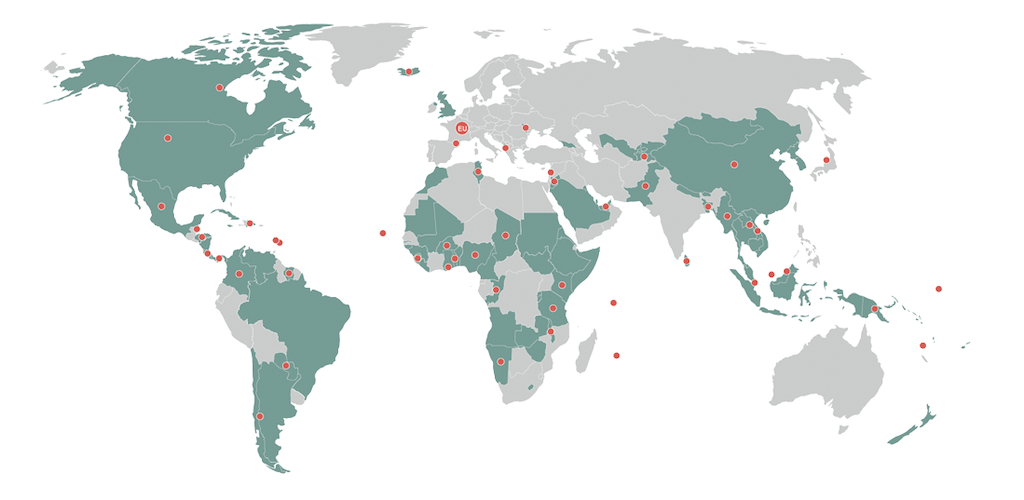
Nature-based solutions are referenced in 105 of the updated climate plans that countries have submitted under the Paris Agreement, according to the Nature-based Solutions Policy Platform. This is shown in the map below.

Nationally determined contributions that include nature-based solutions
Updated nationally determined contributions (NDCs) that include nature-based solutions (green), with red dots denoting NDCs in which the term “nature-based” is explicitly mentioned. Source: Nature-based Solutions Policy Platform.

After a concerted effort to make it part of the final Glasgow Climate Pact, in the final days of COP26 the term “nature-based solutions” was removed from the text. In her opening address, Seddon told the audience this was evidence of the “discomfort” that remains around the term.

Manuel Pulgar-Vidal, former Peruvian environment minister and COP20 president, also highlighted the resistance to nature-based solutions that he witnessed at recent UN biodiversity negotiations in Nairobi.

At UN biodiversity talks, @manupulgarvidal says he saw lots of resistance to nature based solutions – people concerned that they will turn nature into a commodity, undermining concepts of Mother Earth and Buen Vivir.

Says “credibility gap” must be addressed#NbSConference2022 pic.twitter.com/4KwxIVNke5

— Josh Gabbatiss (@Josh_Gabbatiss) July 5, 2022

Some of this opposition could be seen in the talk given by the Bolivian lead negotiator Diego Pacheco. His nation has long opposed what it views as the commodification of nature in international negotiations.

UK environment minister Lord Zac Goldsmith spoke highly of nature-based solutions in his address and told attendees that “perhaps the most important thing we must all do is make the UN biodiversity conference [COP15 in Montreal] a Paris moment for nature – we need an ambitious new framework”.

Maginnis discussed the possibility of nature-based solutions being included in a final text from either biodiversity or climate UN negotiations, noting that there had already been an official UN “decision” using the term from the COP15 UN Convention to Combat Desertification (UNCCD) meeting in Abidjan, Ivory Coast. 

However, he said the world might have to be “prepared for the long game”, as the term might not be established in the final texts that emerge from COP27 climate talks in Sharm el-Sheikh this November or the COP15 biodiversity summit in Montreal.

Back to top

The post Nature-based solutions: How can they work for climate, biodiversity and people? appeared first on Carbon Brief.

[Full Video] Flat Cute Chocolate Decoration for Cakes | Basic & Application | For Beginners

***For chocolate****
Results may vary depending on the environment, but in my case there was no problem with use, so I skipped tempering.
Tempering the chocolate is recommended for a more glossy and less melting result.
Or use chocolate that doesn’t require tempering.

00:00 Intro
00:14 Flat basic
03:27 Application | Cute & Lovely
05:52 How to storage
06:17 Points to notes

[Notice]
1. I used a compound dark chocolate.
2. Use the cookie cutter you have.
3. The narrow cookie cutter is fragile, so avoid it.
4. IMPORTANT
– Don’t harden too hard.
– It’s easy to break when you remove it from the cookie cutter. 6:17
– I used melted chocolate after refrigeration for about 4 to 5 minutes.
– Refrigeration time may vary depending on room temperature.
– It is appropriate to harden enough to leave a hand print on the surface of the chocolate.
– Work quickly because chocolate keeps hardening while you’re working.
– If it is too hard, melt it and start again.
5. See how to store it in the video. 5:52
6. Failed or leftover chocolate can be stored and used again later.

* Since each work environment is different, it is recommended that you test it yourself.
#cute_lovely #Beginners #Homemade_cakes
—— Used Music —————————————
📍Catwoman piano
Pachebel- Canon variation in D (piano)

——————————————————————

« Previous Page — Next Page »