John Downs, the NCA’s President & CEO, will outline many of the issues facing the industry in his keynote address, slated for Monday. As regular delegates are aware, Downs leads from the front in guiding the industry and his voice and upbeat tone will register far beyond the plush environs of the JW Marriott Miami Turnberry, the location for this year’s conference.
He is expected to stress the need for greater collaboration. Afterall, SOTIC’s 2023 theme is ‘Better Together’ with the industry successfully bouncing back from a global pandemic and enjoying a meteoric rise across all confectionery categories in the past 12 months or so.
But there are still issues affecting the confectionery industry, particularly in the US, with supply chain disruption, workforce shortages, sustainability, and health issues surrounding chocolate and candy.
Workforce shortages
Workforce shortages are seen as a new and growing threat to the industry due to societal changes in the aftermath of the pandemic and there will be at least a couple of sessions slated over the three days to deal with employee welfare and keeping staff motivated.
By the NCA’s own estimations, the US confectionery industry generates more than $42 billion in retail sales each year and the industry employs nearly 58,000 workers in more than 1,600 chocolate, candy, gum and mints manufacturing facilities across all 50 states.
Rachel Pacheco, Author and Professor, Georgetown University’s McDonough School of Business, has been invited to present a session on helping companies deal with the fall-out from resignations, burnout and remote working requests.
Nick Bloom, Professor of Economics, Stanford University, will also look at how the past three years have radically changed the way we work and the long-term consequences of the largely hybrid environment most employers have cultivated for professional staff. Is this arrangement here to stay? Delegates at SOTIC will come back with answers and a fresh perspective on their employment policies.
2023 State of Treating
The NCA will also unveil its 2023 State of Treating report on Monday, which provides a timely snapshot of category performance over the past year including a look at the seasons, and pairs that data up with an analysis of chocolate and candy consumers’ attitudes and behaviours.
“The State of the Industry Conference is our industry’s family reunion. There’s nothing like this annual gathering that serves as an opportunity to learn, build business and most importantly – connect and reconnect with others in the industry,” Carly Schildhaus, Senior Manager of Public Affairs, told ConfectioneryNews.
*Follow us on social media!*
Instagram: https://www.instagram.com/AlexTheHonkingBird
Twitter: https://twitter.com/AlexTheHonk
Facebook: https://www.facebook.com/AlexTheHonkingBird
www.tiktok.com/@dommi_son_of_alexthehonk
*We have a PO Box!*
PO Box 2305
Brookside Centre QLD 4053
Australia
Noch ein Rezept von meiner Oma! Super leckere und gesunde Hühnersuppe mit Sellerie! Nicht jeder kennt die Vorteile von Hühnersuppe, aber Selleriesuppe ist viel schmackhafter und hat einen reichhaltigeren Geschmack. Wie man Hühnersuppe kocht, heute zeige ich Ihnen das Rezept meiner Großmutter, die diese Suppe oft für mich gekocht hat, aber die Wahrheit ist von hausgemachtem Hühnchen. Das Rezept für Hühnersuppe hat einen reichen Geschmack und ein unübertroffenes Aroma. Das Rezept für Suppe mit Sellerie kann jeder kochen, alles ist in Minuten gekocht. Ein schnelles Suppenrezept, das jeden am Tisch überraschen wird, Hauptsache mit Liebe gekocht und alles klappt!
Rezept und Zutaten:
1 mittelgroße Zwiebel hacken!
30 g Butter schmelzen.
1 Karotte fein hacken.
3 Stangen Sellerie fein gehackt.
3 Knoblauchzehen fein hacken.
bei mittlerer Hitze 5 Min. kochen.
1 Liter Wasser und 1 Würfel Hühnerbrühe und 10 Minuten kochen lassen.
1 Hähnchenfilet in Würfel schneiden.
frischer Rosmarin und Thymian.
Hähnchen 5 Minuten kochen.
Salz, Pfeffer und Lorbeerblatt.
50 gr Nudeln und weitere 10 Minuten kochen!
Guten Appetit!
https://www.patreon.com/schnell_lecker Danke
Freunde, wenn dir das Video gefallen hat, kannst du dem Kanal helfen:
📢 Teile dieses Video mit deinen Freunden in sozialen Netzwerken. Netzwerk + Rezept wird auf Ihrer Seite gespeichert!
👍 BEWERTEN SIE DAS VIDEO! 👍 – das ist angenehm für mich und wichtig für die Entwicklung des Kanals!
SCHREIBEN SIE EINEN KOMMENTAR oder zumindest ein Smiley. Es ist nicht schwer für dich, aber ich werde sehr glücklich sein!
Abonnieren Sie schnell lecker
@https://www.youtube.com/channel/UCd7PBPD6Ymg3mI1por-_baw/sub_confirmation=1
Bereits abonniert? ▶ Schalten Sie den Klingelton ein 🔔, um Benachrichtigungen über neue Videos zu erhalten!
Diego Pacheco wants to be recognised as a contender rather than a prospect once he knocks out Jack Cullen in their WBO International Super-Middleweight Title showdown at the M&S Bank Arena Liverpool this Saturday March 11, live on DAZN (excluding Australia and New Zealand).
The undefeated 22-year-old sensation, who fights in the UK for the first time in his career this weekend, is eager to make a big impression in front of Liverpool fight fans by stopping ‘Little Lever’s Meat Cleaver’ in what will now be the co-headline bout following Callum Smith’s injury.
“Jack Cullen I feel is a good opponent, finally someone that the fans know I guess,” said Pacheco. “If I beat him then it’s going to be like, ‘he beat this guy’, and I hope people are going to start believing in me a little bit more.
“After I get this win, I do feel that people will start recognising me more as a contender than a prospect. He’s tall and he has a lot of heart, but I’m a way better fighter than him. I see myself stopping him. He won’t be able to take my power. Once I see the opening, I’ll take it.
“I think this fight is really important for my career. It’s really important that I put on a good performance. I wanna knock him out, I wanna stop him. In whatever round it comes in, whether it’s a body shot or a head shot, I just wanna to stop him.”
Pacheco trains in Seattle, USA under the guidance of Jose Benavidez Sr alongside the likes of two-time World Champion David Benavidez, who is preparing for a March 25 WBC Interim World Title fight with Caleb Plant, and the Los Angeles youngster says he is feeling the benefits from countless rounds of world class sparring.
“I’ve been part of David Benavidez’ last five fights. Every camp here is really tough. It’s good work, it doesn’t get better than this. The first time I ever came down here, David reached out to me on the DMs. It was after my Saudi Arabia fight. He was like, ‘oh I was watching that, you’re really good, do you wanna come down and work with me?’. I was like ‘hell yeah’.
“That’s what has gotten me the great wins, the great knockouts – the preparation I’ve been doing. That’s the reason I’m here working with them. There are other great sparring partners in here as well and I’m preparing better than ever for this fight. The sparring doesn’t get better than this so I’m really thankful for that.
“Obviously it is really tough, David Benavidez is a really good fighter. Every time I’m in there with him I learn something new. He pushes me more than anyone else. That’s exactly what I need.”
Pacheco vs. Cullen is part of a big night of action in Liverpool, local Super-Lightweight Robbie Davies Jr (23-3, 15 KOs) takes onDarragh Foley (21-4-1, 9 KOs) over ten rounds, Romford Heavyweight sensation Johnny Fisher (7-0, 6 KOs) takes ‘The Romford Bull’ Army to Liverpool for the first time as he faces Italy’s Alfonso Damiani (6-2, 2 KOs) over eight rounds and decorated amateur star turned Super-Bantamweight prospect Peter McGrail (6-0, 5 KOs) makes his highly anticipated Matchroom debut against Argentina’s Nicolas Nahuel Botelli (14-7, 8 KOs).
Warrington Lightweight talent Rhiannon Dixon (7-0) squares off with Wombourne’s Vicky Wilkinson (5-0-1) for the Commonwealth Title, Oldham’s Aqib Fiaz (10-0) takes on Yeovil’s Dean Dodge (9-2-1, 3 KOs) over eight rounds at Super-Featherweight, plus there’s for Hyde’s Campbell Hatton (9-0, 3 KOs), Chester Middleweight Paddy Lacey (7-0, 1 KO) and Billericay Middleweight George Liddard (1-0, 1 KO).
Limited remaining tickets for Pacheco vs. Cullen can be purchased via Stage Front and the M&S Bank Arena.
CEBU CITY — The Orchard Golf and Country Club turned to its pair of junior golfers to take the fight out of its closest pursuers and capture the Founders division in the 74th Philippine Airlines Men’s Interclub golf team championships on Saturday.
Just two points ahead of Alabang and Riviera with two more teams within six points before the start of the final round, the Orchard drew a tournament-best 40 points from Zachary Castro and 33 from Tristan Jefferson Padilla to shut the door.
Castro went 4-under at the back where he started before adding two more against two bogeys coming home.
With Hongzheng Lu and Beejay Chua adding 32 and 25, the Orchard amassed 130 points to cruise to a seven-point victory.
Riviera Golf Club struck through Eric Gozo’s 35 and Michael Mendoza’s 34 to take second place with 463 points. Other scorers were King Stehmeier and Richard Salcedo with 28 apiece.
Forest Hills settled for third with 455, drawing a pair of 32s from Augusto Pacheco and Jose Inigo Raymundo, a 31 from Joshua Nicolas Buenaventura and 26 from James Bryan Gosiaco.
It was also a close fight in the third-tier Aviator class with Alta Vista emerging on top with 425 points after closing with 103 points at Club Filipino de Cebu.
Cebu Country Club Team 2 came in second with 421 while Zamboanga took third with 417.
In the Sportswriters bracket, Club Filipino de Cebu posted a runaway 22-point win over South Cotabato, totaling 386 points. Third place went to San Juanico Golf Park with 357 points.
Alta Vista made it two in a row after its second team ruled the Friendship class with 326 points, 27 points ahead of Liloan Golf Club. Apo Golf Orogold Club placed third with 298.
Manila Southwoods captured the championship division for the eighth time.
The annual event, held with the theme “Back to Ignite,” was supported by platinum sponsors ABS-CBN Global, Asian Journal, Airbus, and NUSTAR Resort and Casino.
Gold sponsors include Radio Mindanao Network, Mastercard, “Memories FM 89.9 Cebu,” University of Mindanao Broadcasting Network, PLDT/Smart and Konsulta MD.
Joining the event as silver sponsors were Philippine National Bank, Biocostech and VISA.
Minor sponsors were Bollore Logistics, Manila Standard, Tanduay Brands International, and Asia Brewery while donors are the Department of Tourism, Ogawa, Newport World Resorts, Rolls Royce and Boeing.
The final standings:
Championship — Manila Southwoods 534 (141-133-127-133), Eastridge 521 (127-135-120.139), Cebu 498 (126-130-120-122), Del Monte 482 (113-127-119-123), Tagaytay Highlands 475 (119-113-119-124), Sta Elena 442 (114-88-120-120), Pueblo de Oro 417 (111-101-88-117)
Founders — The Orchard 470 (113-112-115-130), Riviera 463 (114-105-119-125), Forest Hills 456 (111-113-111-121), Negros Occidental 455 (116-94-119-126), Alabang 451 (120-113-105-113), Wack Wack 445 (107-108-119-111), Villamor Air Base 434 (110-102-102-120), Camp John Hay 406 (99-101-100-106), Camp Aguinaldo 399 (120-91-82-106), Team Brookside 386 (99-103-86-100), 89), Apo 377 (90-99-86-102), Southern California Redhawks 377 (109-99-82-102)
Aviators — Alta Vista 425 (101-116-105-103), Cebu Team 2 421 (96-113-115-97), Zamboanga 417 (101-102-108-106), Summit Point 404 (94-103-105-102), Eagle Ridge 390 (86-108-109-87), Rancho Palos Verde 1 385 (76-98-109-102), Manila 380 (95-103-95-91), Tagaytay Midlands 373 (76-98-95-104), Britanikka 1 370 (79-105-94-92), Sherwood Hills 363 (97-94-87-85), Bacolod 337 (61-86-92-98), Fairways and Bluewater 329 (79-91-84-75), Filam Hawaii 329(71-73-96-89), Filam Fairfield 316 (54-89-87-86), Fil-Am Fairway 1 313 (68-84-77-84), Up Tee Jots 311 (82-8573-71), Guinhalaran 310 (72-77-95-66), Iligan 299 (63-81-87-70), Lumbia 288 (65-92-75-56), Golden Gate 283 (73-71-85-54)
Sportswriters — Club Filipino INC de Cebu 386 (102-92-94-98), South Cotabato 364 (83-88-88-105), San Juanico 357 (71-75-95-116), Camp Evangelista 350 (94-82-89-85), Davao City 349 (105-78-73-93), Sarangani Golf 346 (85-96-66-99), South Pacific Davao 344 (77-79-93-95), West Highlands 339 (81-86-84-88), Negros Intl 339 (80-78-89-92), Seattle 335 (75-103-81-76), Filam LA 1 317 (86-79-65-87), The Firm Eagle Ridge 317 (81-85-78-73), Leyte 312 (94-63-82-73), Lanang 309 (72-72-77-88), Filipino in the Middle East Dubai 300 (98-41-91-70), MSU Golf 282 (66-59-66-91), Silicon Valley 227 (59-77-58-83), PGA British Columbia 245 (66-57-59-73), Pearl Kai Hawaii 213 (55-35-57-66), Yokohama Eagles 163 (44-32-47-40)
Friendship — Alta Vista Team 2 326 (81-90-84-71), Liloan 299 (62-81-89-69), Apo Golf Orogold Club 298 (80-71-74-73), Eagle Ridge Lagitek 289 (80-62-65-82), Edwin Andrews Air Base285 (65-76-77-67), Davao Team B 275 (71-70-78-58), Veterans 263 (66-67-70-62), Baguio 259 (59-55-73-72), Paraiso Golf Players Association Team B 247 (68-58-64-59), Van City 246 (75-66-62-43), Green Tee Clun Riyadh245 (52-51-78-66), Filipino Golfers in the Middle East UAE 245 (58-55-83-49), Cotabato 238 (49-70-83-36), Paraiso Golf Players Association 230 (35-60-59-76), Greenhills West 212 (61-62-50-41), Fil-Am Golf Sacramento 211 (40-44-55-72), UAE Filgolfers AUH 202 (41-46-59-56), Mt Malindang 198 (55-49-45-51), Caaga 174 (45-34-42-53), Fil Oz Sydney 64 (16-12-18-18).
SUBSCRIBE to @Thought Fresh™ and join me in the Journey to learn something new every day
Let’s Learn together 🤝 ▶ SUBSCRIBE NOW: @Thought Fresh™ __________________________________________________________________
*Copyright Disclaimer Under Section 107 of the Copyright Act 1976, allowance is made for “fair use” for purposes such as criticism, commenting, news reporting, teaching, scholarship, and research. Fair use is a use permitted by copyright statutes that might otherwise be infringing. Non-profit, educational, or personal use tips the balance in favor of fair use. This content doesn’t belong to thought_fresh, it is edited and shared only for the purpose of awareness, and if the content OWNERS (visual/audio) of this content have any issue, we request you to directly message to this page, So That we sort out the outcome. Regards,
Thought fresh _________________________________
Tag : #explore #youtubeshorts #shortsfeed #thought_fresh #english
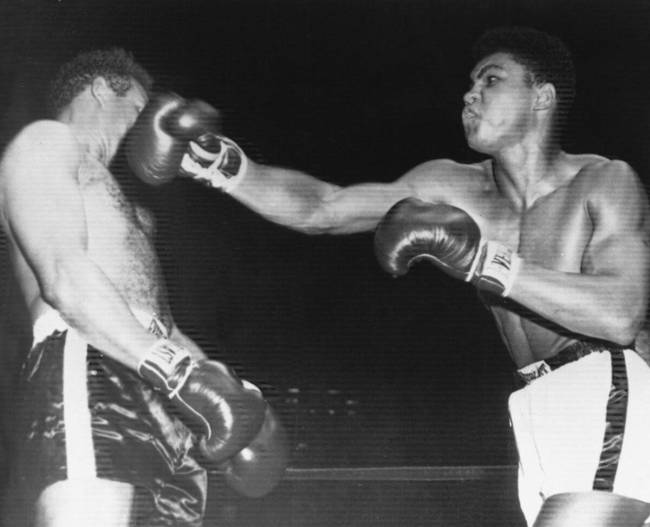
Muhammad Ali moves in with a series of smashes to the face of challenger Floyd Patterson in the sixth round of their title fight at Las Vegas, Nevada on Nov. 22, 1965. (The Associated Press)
“I am in Texas, which is followed by more Texas, which is followed by still more Texas. A massive cross dwarves a small church. Are the voices rising with the light? Do they have a prayer for the rebels of this world, the ones who did not win their fame, or maybe even their freedom?” (Kerry Candaele)
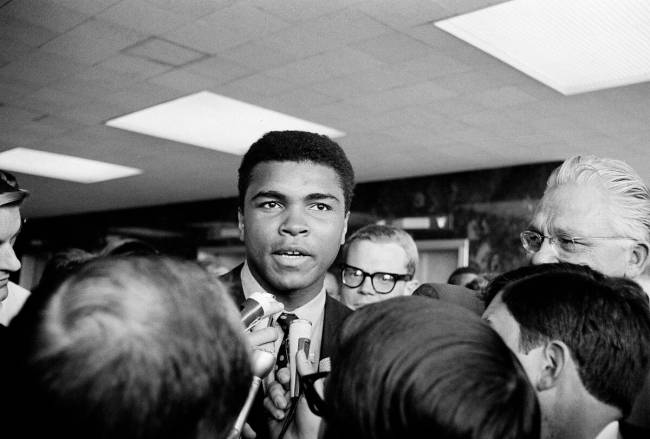
Muhammad Ali, heavyweight champion, buttons his lip as he appears before Illinois Athletic Commission in Chicago, Feb. 25, 1966. Previously, he?d said imminent army induction was unfair – touching off series of events leading to the commission reconsidering its sanction of Clay?s scheduled title defense later this month. (The Associated Press)
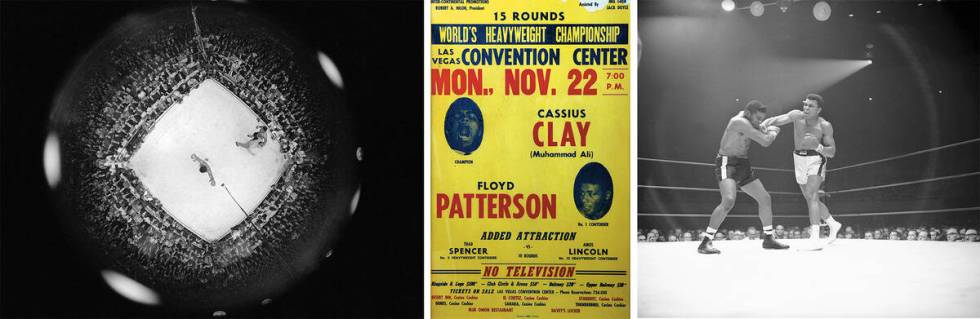
A poster advertises the World’s Heavyweight Championship fight between Muhammad Ali (Cassius Clay) and Floyd Patterson at the Las Vegas Convention Center for November 22, 1965. (Las Vegas Review-Journal file)
This ?fish-eye? camera view from the rafters shows the scene as referee Harry Krauch ended the heavyweight title fight on a 12th round technical knockout in Las Vegas, Nevada on Nov. 22, 1965. He is waving challenger Floyd Patterson away, as the still-champion Muhammad Ali ( Cassius Clay) raises his own hands in victory at ring?s center. (The Associated Press)
Heavyweight champion Muhammad Ali ( Cassius Clay) moves in with a series of amsshes to the face of challenger Floyd Patterson in the sixth round of their title fight at Las Vegas, Nevada on Nov. 22, 1965. (The Associated Press)
Muhammad Ali (Cassius Clay) punches the heavy bag in one of his daily workouts at Miami Beach for the Feb. 25 championship bout with heavyweight Sonny Liston in Miami Beach, Fla., on Jan. 10, 1964. (AP Photo)
Heavyweight champion Muhammad Ali stands over fallen challenger Sonny Liston, shouting and gesturing shortly after dropping Liston with a short hard right to the jaw on May 25, 1965, in Lewiston, Maine. The bout lasted only one minute into the first round. Ali is the only man ever to win the world heavyweight boxing championship three times. He also won a gold medal in the light-heavyweight division at the 1960 Summer Olympic Games in Rome as a member of the U.S. Olympic boxing team. In 1964 he dropped the name Cassius Clay and adopted the Muslim name Muhammad Ali. (AP Photo/John Rooney) JOHN ROONEY
Heavyweight champion Muhammad Ali stands over fallen challenger Sonny Liston, shouting and gesturing shortly after dropping Liston with a short hard right to the jaw on May 25, 1965, in Lewiston, Maine. The bout lasted only one minute into the first round. Ali is the only man ever to win the world heavyweight boxing championship three times. He also won a gold medal in the light-heavyweight division at the 1960 Summer Olympic Games in Rome as a member of the U.S. Olympic boxing team. In 1964 he dropped the name Cassius Clay and adopted the Muslim name Muhammad Ali. (AP Photo/John Rooney)
Ali had changed his name in 1964, but it was still reduced to a parenthetical on posters for his November 22, 1965, bout with Floyd Patterson at the Las Vegas Convention Center. Ali had the last laugh with a 12th-round TKO.
RJ FILE*** LOCAL – A poster advertises the World’s Heavyweight Championship fight between Muhammad Ali (Cassius Clay) and Floyd Patterson at the Las Vegas Convention Center for November 22, 1965. FILE PHOTO
Muhammad Ali speaks before the Illinois Athletic Commission in Chicago on February 25, 1966. in Chicago. Illinois Gov. Otto Kerner While Illinois Athletic Commission listened, heavyweight champion Muhammad Ali speaks, Feb. 25, 1966 in Chicago. He attended commission meeting as a result of Illinois Gov. Otto Kerner?s request that the commission members reconsider permission for Clay to defend title later this month. Ali had criticized his imminent army draft. (The Associated Press)
Heavyweight champion Muhammad Ali ponders a question during his news conference after his arrival in Houston, Jan. 11, 1967. Ali, who is now 1-A after he lost his bid to be classified as a conscientious objector, had been notified of the decision before the news conference. He is scheduled to take on Ernie Terrell Feb. 6 to clear up the heavyweight title difference. At right is Judge Roy Hofheinz. Man at left is unidentified. (AP Photo/Ed Kolenovsky)
City driving is an exercise in boredom, danger and anger. We stop, we go, we turn and turn again, a short stretch of speed, stop again, look at that idiot who doesn’t use a blinker and ought to have his license revoked, same with the texting jerk who just cut me off. Jack Kerouac, this is not. Driving across America, however, is a more delightful matter altogether, a paradoxical high-speed rebellion against the pace of American life — the practice of patience at 70 miles per hour. I’m not looking for some big breakthrough on the road, just the chance to see with my eyes, feel my body behind the wheel, listen to the chapters of a good book, catch the ambiguous sensation of a slow and ageless landmass and a country swiftly passing me by. As rebellions go, it’s low-cost, high-yield, and in my case, as I set off across the desert and beyond, it fits the purpose of this pilgrimage across flats and peaks, long stretches of high-grass prairie, through forests and then hilly southern Indiana and finally to the Muhammad Ali Center in Louisville, Kentucky. I’m off to commune with the hero of my youth, the avatar of flow and grace and brutality, The Greatest himself, Muhammad Ali.
I’ve got a lot of miles ahead of me, but I don’t like flying. And this legend is worth the drive, the time to think: a man who left a meaningful legacy for the ring, the world, and the city of Las Vegas. He lives on with particular vividness for those of us who lived through the clamorous ’60s, the glam and bewildered ’70s, and the ’80s, when our hero grew suddenly old in the ring and my generation’s revolutionary energy finally gave out.
Has Vegas is in my rearview now; I am heading south, taking the long, long road through Flagstaff, Arizona, then New Mexico and Texas. But the lights behind me are telling me stories about Ali near the end, when a great career ended but a desert boxing capital of the world was born.
In 1961, Ali was 19 years old, coming off an Olympic gold medal, and still known to the world as Cassius Clay. On June 26, he had his first professional fight in Las Vegas, defeating Hawaii’s Duke Sabedong. (The Associated Press)
Ali’s first fight in Las Vegas was a 10-round decision over Duke Sabedong on June 26, 1961. It was his first professional fight to take place neither in his hometown of Louisville nor his training headquarters of Miami. He’d won the Olympic gold medal in Rome in 1960 and arrived in Las Vegas a hot 6-0, with quick hands, a mouth to match, and plenty of doubters that a heavyweight could be both pretty and brutal. The next time he fought in Las Vegas, he was 21-0 and the Heavyweight Champion of the World.
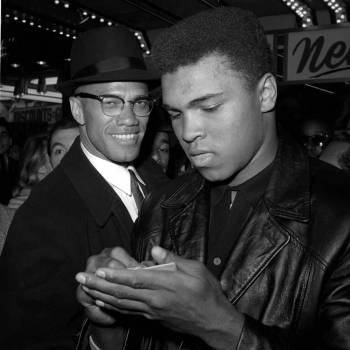
Ali speaks with Malcolm X in 1964 after joining the Nation of Islam. (The Associated Press)
On November 22, 1965, Ali took on Floyd Patterson at the Las Vegas Convention Center. The fight was two years to the day from the assassination of John F. Kennedy; it was taking place not only in a changing city, but in a swiftly changing America, one in which a Louisville kid named Cassius Clay had 18 months earlier crushed the heavily favored Sonny Liston and taken his championship belt, then promptly announced that he’d joined the Nation of Islam and changed his name to Muhammad Ali. In a just a few moves, Clay had gone from an underrated pretty face with quick hands, quick wit, and and a gold medal from the 1960 Olympic games to a brutal fighting machine and bona fide American rebel villain. In the run-up to the fight, Patterson said Ali had been misled into joining the Nation of Islam and insisted on continuing to call him Clay. This was fuel for the young champ, who hammered and stung and dissected Patterson for 12 rounds of a technical knockout, mocking him all the while as an Uncle Tom. “Come on, white American,” Ali said to Patterson, who was Black, “Come on!” Another punch. And another.
Ali had changed his name in 1964, but it was still reduced to a parenthetical on posters for his November 22, 1965, bout with Floyd Patterson at the Las Vegas Convention Center. Ali had the last laugh with a 12th-round TKO. (The Associated Press / Las Vegas Review-Journal)
High desert, scrubby cacti, red-tipped ocotillo. Small, odd, lonely houses sitting isolated, as if unconcerned by the amenities and securities we moderns require — hospitals, pharmacies, corner markets, payday loan shops. Who lives in these outposts, these little revolts against the logic of the urban? If one looks left or right, the landscape is captured in a flash, as if from the eyes of a swift animal scanning the surroundings in search of predators. Looking forward, the horizon opens up in the distance and the world is seen in another way, wide and slow like staring at a landscape painting from a Dutch master, but with the floor moving quickly underneath like an out-of-control treadmill. This is not urban time, but highway time and space, at once fast and slow. At last the landscape changes, and I’m deep into Interstate 40, just a few dozen miles from Flagstaff. I begin to roll alongside the BNSF Railway — formerly the Atchison, Topeka and Santa Fe, of Judy Garland fame — pulling mostly long lines of boxcars through eastern Arizona, out to Albuquerque, across northern Texas before taking a turn toward Chicago, almost my precise directions.
At the peak of a mountain pass I hit a fierce thunderstorm and drop from 75 down to 20 as lightning flares all around. I founder through the water wake of an 18-wheeler that moves along grudgingly, sullenly. Passing a truck like this in a bad storm is like inching through a car wash with the wall moving closer on the right, except in this instance my small station wagon is lifting off the ground. If the lightning comes close, I think, it’s going to strike that big truck with the metal sheath. These trucks and their drivers don’t give up their share of the road easily. I saw the aftermath of three encounters between a car and a big rig, with the smaller of the two always on the bad end of the deal.
Soon I am heading into eastern New Mexico. It is the kind of West that puts one in mind of the movies, but the movies, of course, had it all wrong. The great Hollywood story about the West, where Europeans were turned into Americans by access to a homestead, easy freedom, and a short, sharp, and ugly victory over native peoples — that story had been transformed by the labor of historians. The land I am driving through is a fractured geographical area, where in Colorado, Arizona and Nevada mine workers violently battled mine owners after the romance of panning for gold nuggets shifted in the “mineral west” to corporate mines with absentee owners, mining engineers, shafts, tunnels, tracks, cages 2,000 feet below ground, hoists and blasting equipment. The ground, the water on and in it, the cattle, the new towns, the politics — all of it was a dramatically contested business. The railroad business too, despite the nostalgic image one can conjure up, was hardly the refuge from industrialism.
For me, growing up in the working-class-and-federal-prison coastal California town of Lompoc, the son of a charismatic alcoholic devoted union laborer and an iron-willed former professional baseball player, Ali was part of an emerging consciousness in a world where the game was unfair but the fight for something better — we didn’t know what to call it but some nebulous variant of the much-abused word “freedom” — was deliciously enticing. My four brothers and I grew up fierce, mischievous, relentless. Our front-yard basketball hoop was the local all-comers battleground, the place where the boys of our town became the best of enemies and the most ruthless of friends. We were lovers of sport, of confrontation, of the burial of dead rules and the rise of rock ’n’ roll. Of course, if we ever got out of line, my mom, Helen Callaghan, slight and often saddened by her own confrontations with a hard life, struggled to be the toughest of us all. She was the ballplayer, by the way, a pioneer of the World War II-era All-American Girls Professional Baseball League, later made famous by the film A League of Their Own, which was based on a documentary film of the same name that my twin brother made. So, yes, we were born with some fight in us.
In April 1967, when I was 13, the United States government made Muhammad Ali my hero. Or to put in the affirmative, Ali made himself a hero by refusing to be drafted into the Army. He refused to step forward, to move, when his name was called out in the Houston examination office, a step that would have him join a fighting force carrying out nearly unprecedented violence in the bloody quagmire of Vietnam.
Ali’s title was taken from him, and for 3½ years he could not fight in the ring. He knew in his bones that this battle could not be won, but he told the country that his real enemy was here in the United States, those who attacked black people with fire hoses and dogs on the streets of Birmingham:
Muhammad Ali speaks to newsmen after he posted bond on a Federal Grand Jury indictment on a charge of refusing to be drafted into the Armed Forces, May 8, 1967. Ali pleaded “not guilty” to the charge. (Ed Kolenovsky/The Associated Press)
“Why should they ask me to put on a uniform and go 10,000 miles from home and drop bombs and bullets on brown people in Vietnam while so-called Negro people in Louisville are treated like dogs and denied simple human rights? No, I’m not going 10,000 miles from home to help murder and burn another poor nation simply to continue the domination of white slave masters of the darker people the world over. This is the day when such evils must come to an end. I have been warned that to take such a stand would cost me millions of dollars. But I have said it once and I will say it again: The real enemy of my people is here. I will not disgrace my religion, my people or myself by becoming a tool to enslave those who are fighting for their own justice, freedom and equality. … If I thought the war was going to bring freedom and equality to 22 million of my people, they wouldn’t have to draft me, I’d join tomorrow. I have nothing to lose by standing up for my beliefs. So I’ll go to jail, so what? We’ve been in jail for 400 years.”
A fighter who wouldn’t fight? Millions of white Americans hated the man. My brothers and I loved him.
Ali returned to the ring in 1970 with a three-round TKO of Jerry Quarry. A year later, he got his title shot against the new champ, Joe Frazier, in New York City but lost in a 15-round decision. Later in 1971, he captured the North American Boxing Federation heavyweight title with a win over Jimmy Ellis. On June 27, 1972, he returned to Las Vegas to defend his NABF title against Quarry. Ali was once again the King of Vegas, knocking out Quarry in seven rounds. Six months later, on Valentine’s Day 1973, Ali was again in Las Vegas, showing no love to Joe Bugner, who valiantly went the distance in defeat and inspired the creation of a character named Rocky Balboa who, as crazy as it sounds, eventually transforms himself into an Ali-like boxer. Before Ali’s next Las Vegas bout on May 16, 1975, he predicted an eighth-round knockout of Ron Lyle but had to settle for an 11-round TKO at the Convention Center. Ali’s fights during this period tended to last; there was an epic quality even to the lesser bouts. The fights gave room for stories to be told.
It was an age of giants in the heavyweight ranks — Joe Frazier, Ken Norton and George Foreman were all battling at the same time, walking the path Ali had helped clear for them to global fame and extraordinary fortune. Ali was stalking the world title, the one that had been taken away not in the ring but in the boardroom. None of Ali’s legendary fights against that trio took place in Las Vegas —Ali knocked out Foreman in Zaire in eight rounds ’74; in ’75 he TKO’d Frazier in 14 rounds in the Philippines. (The Norton fights in 1973 — first a loss for Ali, then a win — took place in less exotic Southern California.) But the fact that Ali, the giant among giants, had made Las Vegas one of his boxing homes helped put the city on the global sports map.
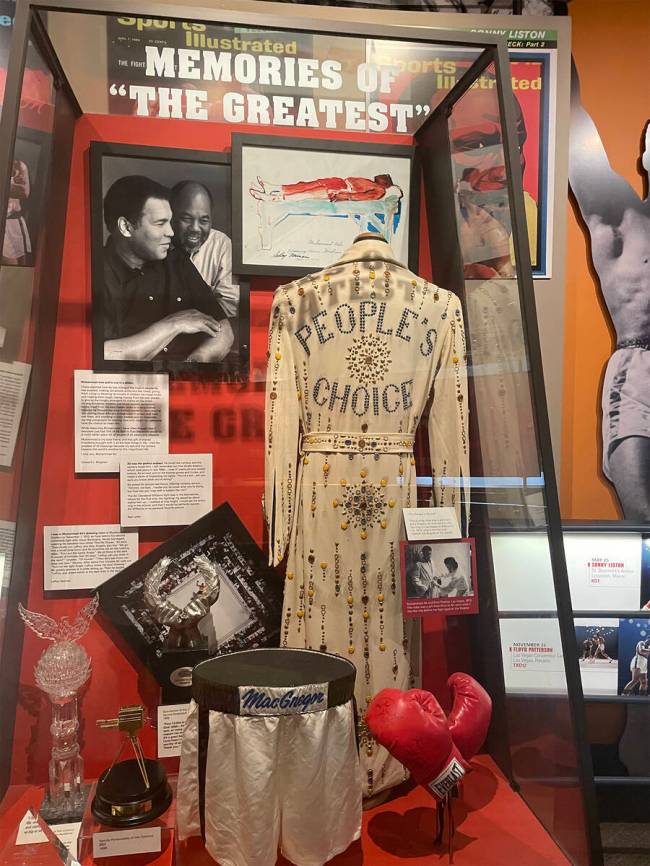
The robe that Elvis Presley gave to Muhammad Ali, on display at the Ali Center in Louisville. (Kerry Candaele)
In many ways, Ali fused with the aesthetic of the Vegas ’70s — showmanship, excess, outlandishness, a dollop of kitsch. It was the Las Vegas of Liberace and Wayne Newton in all his crooning glory. It was, above all, for a few years before the excess became too excessive and tragedy struck, the Las Vegas of Elvis. Elvis loved Ali, and Ali loved Elvis. The singer considered Ali the Elvis of boxing, and the boxer considered Elvis the Ali of music. Both of them had reinvented their arts and built the tallest platforms in the world, dressing themselves in swagger and making themselves open targets as they bobbed and weaved and changed in ways that were not always to everyone’s liking. Elvis had been an earlier hero of mine, but had lost me by this time: Blue Hawaii and sequins had somehow overflowed the memory of Jailhouse Rock. But Ali was astute in seeing that even Vegas Elvis was an American original, a rebel, a man unwilling to compromise even when they told him he’d become a parody of himself. They met in Las Vegas in 1973. Ali gave Elvis a pair of boxing gloves on which he wrote that Elvis was the greatest. Elvis gave Ali a sequined boxing robe. Ali wore it once, and lost.
An 18-wheeler, mistaking itself for a roadster, passes me on the right. The 18-wheeler is the enemy of the casual driver just wanting to make it across the country alive. But if I am brutally honest with myself — and why shouldn’t I be, out here alone? — the 18-wheelers are the essence of the road, one of the reasons for the existence of the interstate highway system. Their job is to turn products into money by way of diesel power. When was the last time I ate something that did not, in some way, arrive by a truck? I dream that everything I need comes on my beloved trains, but that’s just a dream. None of this makes me like 18-wheelers any better as they pull out surprisingly to pass another, slower, hauler of toys, or neckties, or frozen steaks, to a warehouse in Memphis or Chicago or Philadelphia.
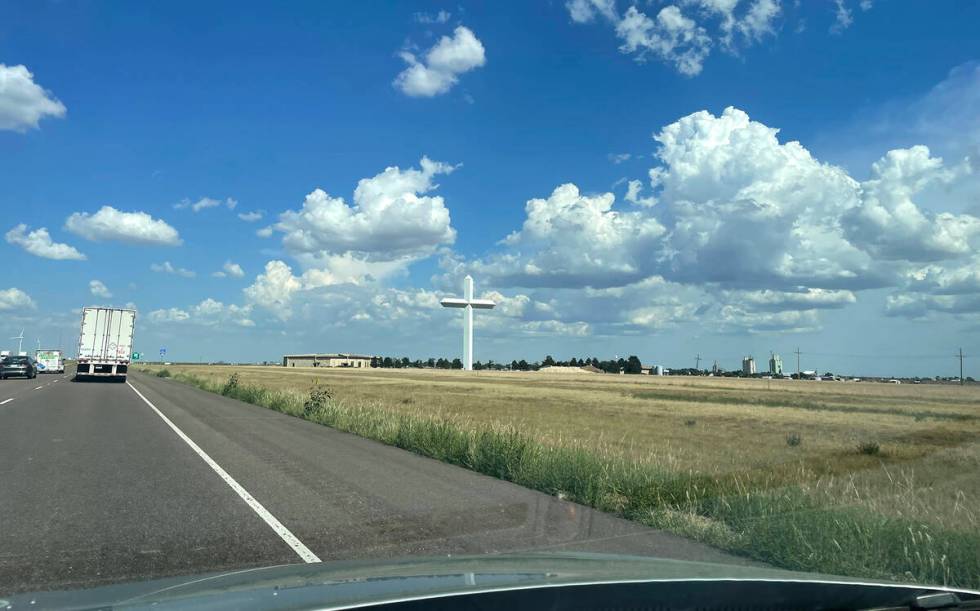
“I am in Texas, which is followed by more Texas, which is followed by still more Texas. A massive cross dwarves a small church. Are the voices rising with the light? Do they have a prayer for the rebels of this world, the ones who did not win their fame, or maybe even their freedom?” (Kerry Candaele)
I am in Texas, which is followed by more Texas, which is followed by still more Texas. Why am I out here? Am I doing it for my rebel hero? How deep is my devotion, how deeply can a son of a churchless home be devoted? Very, as it turns out. In north Texas, a massive cross dwarfs a small church. Are the voices rising with the light? Do they have a prayer for the rebels of this world, the ones who did not win their fame, or maybe even their freedom? What becomes of the meek who tire of meekness? Do they become champions of the world? Or do they simply dream, a powerful thing in itself?
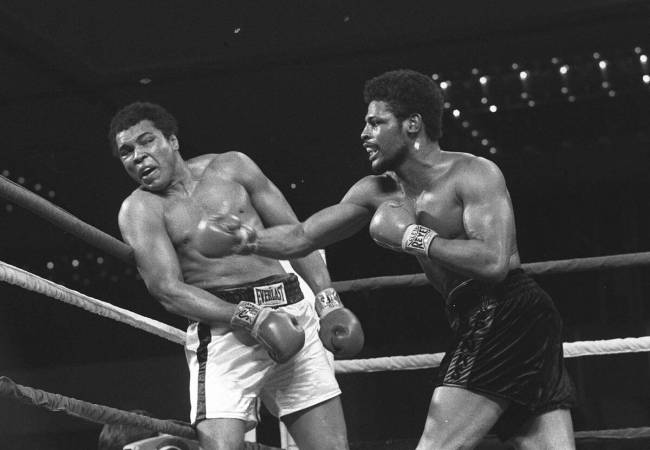
On February 15, 1978, Ali took on 1976 Olympic gold medal winner Leon Spinks at the Las Vegas Hilton. After 15 rounds Spinks emerged, shockingly, the winner and inheritor of Ali’s World Boxing Association heavyweight crown. That fight was a tragedy that I cannot bear to watch ever again, no matter how much YouTube suggests it to me.
In Feburary 1978, 24-year-old Leon Spinks came to Las Vegas and shocked the boxing world with a 15-round upset of Ali. Though Ali later avenged the loss, it was a sign that his skills were eroding. Ali lost just twice in seven fights in Las Vegas over 19 years. (The Associated Press)
The other story, if we want to put a positive spin on that bleak day, was that the spectacle of The Greatest fighting at the Hilton helped establish casino properties as not only plausible but preeminent sites for major title bouts. (Ali’s previous Las Vegas fights had been at the Convention Center.) Though the sold-out venue held only 5,300 seats, it paved the way for the megafights of the 1980s featuring such stars as Sugar Ray Leonard, Thomas Hearns, Marvin Hagler and Roberto Duran, not to mention 1990s bouts featuring the likes of Mike Tyson, Evander Holyfield, and that piece of Holyfield’s ear.
Later in 1978, Ali would avenge the loss and retake his title, wringing out Spinks in 15 rounds before more than 63,000 fans in the New Orleans Superdome. The massive crowd was a sign that Las Vegas needed bigger, grander venues. So when Ali returned to fight in Las Vegas one last time on October 2, 1980, Caesars Palace constructed a 24,800-seat temporary venue in the parking lot, an enduring strategy in the years before Las Vegas became home to massive arenas on every block. The fight was a sad epitaph to Ali’s brilliant career, as Holmes defeated a cliché, a man playing at being the fierce boxer of old, a self-parody of the nimble “dancing Ali” (“the old Ali is back,” a ringside commentator said hopefully, foolishly). With Ali, self-deception and foolish hope was easy. He knew we wanted something important from him, something to satisfy our need to escape boredom, to ally with someone with deep commitments, someone going places, a person who would sacrifice himself for our pleasure, our well-being. Ali could sometimes score points simply by presenting a younger Ali, his own heroic self-image as seen in the eyes of others. But not that night. Larry Holmes did this deeply admired man a favor by not knocking his brains around inside his skull. He could have, but he didn’t. Holmes later said, “I’m prouder of sparring with him when he was young than I am of beating him when he is old.”
Do we grow from defeat, get stronger because of it? Ali often seemed to. Losing to Frazier in their first fight, toughened him in the ring. Losing — at least on the surface — to the U.S. government toughened him in his convictions. But defeat can also just make us weak. It can even destroy us.
Ali could have died in the ring on that October night in 1980 against Holmes. Ferdie Pacheco, Ali’s physician, thought so and said so. That philosophical nostrum “that which does not destroy me makes me stronger” is nonsense. Near-destruction changes us. Ali should have known, but the king is the last to see the chinks in the armor. Maybe the payday and pageantry blinded him — and us, too. The great man, we thought, would always be great in the ways that mattered, in the ring.
Ali fought only one more time, losing to Trevor Berbick in 10 rounds in the Bahamas on December 11, 1981. Some can bear their sorrows and afflictions better than others. They have resources others don’t have. Ali was that type, born to bear afflictions. And his resources were many. His commitment to his religion, to his god, provided him solace and emotional stability long before his hands began to tremble.
Onward I roll, through the red-soil Choctaw country of southeastern Oklahoma, onward to Oklahoma City and then to Tulsa, where I pay my respects to another of my cultural heroes at the Bob Dylan Museum. Dylan, by the way, was an admirer of Ali, though he sang playfully of getting in the ring with him in his “I Shall Be Free No. 10” on the 1964 album Another Side of Bob Dylan. I checked out Dylan’s notebooks, photographed the guitar from Blood on the Tracks, reflected on Dylan’s words when Ali died in 2016: “If the measure of greatness is to gladden the heart of every human being on the face of the earth, then he truly was the greatest.” Two men, born eight months apart, both bound to challenge and confound and, to the extent the musicians and boxers can do such a thing, change the world. I get back on the road, taking my time, rolling across Missouri and Illinois, past New Harmony, Indiana, where a utopian socialist colony rose in 1825 and fell in 1827. This is the pathos of dreams. They rise, they fall. Some leave a trace; most do not. Suddenly I realize that the time will change when I reach the Kentucky border, and that I might not reach my destination before closing time. So I drive hard, and illegally. And I make it.
The Ali Center sits along the Ohio River in Louisville, not far from the baseball bat factory where another kind of slugger is made. For those familiar with similar places — Jefferson’s Monticello, the Elvis Museum in Memphis, Liberace’s defunct place in Las Vegas — a lot of what is expected is on offer. The photos and words and old boxing trunks in big plastic cases, boxing footage projected on a canvas ring, the awards, the testimonials from friends and family and opponents. There is a familiar storyline, something of a black Horatio Alger: Cassius Clay struggling against all odds, Louisville poor and understanding prejudice, overcoming it, meeting a police sergeant named Joe Martin who teaches him a thing or two about the ring. Then the bootstraps, the success, the revelation that brings transformation into a new being, from Clay to Ali. The continuing struggle against great odds and the great power of his own government, then success again, growth, enlightenment. A changing man meets a changing world and the rebel becomes an example to us all. He lights a torch. He dies loved by the world. I know the story, its ending, its message. I’m just happy to be here, to revisit and revise my understanding of the object that is Ali. I might not get another chance to pay homage to a man who taught me a thing or two about having to get up after being knocked to the ground.
Of course, his beautiful athletic physicality is on display, his impossible and dangerous measuring of the minute space between a man’s fast-moving fist and his face. Of course, his brilliant lines of attack and evasion were on display in the footage, against Cleveland “Cat” Williams, against Ernie Shavers, against Henry Cooper. But also on display, the Center’s credit, is his deep attachment until the mid-1970s to the Nation of Islam and its hard-line separatist leaders, whose ardor often bordered on gangsterism. And so too are interviews where Ali, early on, denigrates other religions, subjects women to ugly crudities and stereotypes, his refusing to let his first wife speak in front of the cameras. We get a glimpse of an Ali who was no ideological friend to liberal sensibilities of the time. Ali left the Nation of Islam in 1975 for mainstream Islam; at the end of the video, Billy Crystal appears to tell us the obvious: Ali changed over time; he became more tolerant, more open to the world and its complexities, interested in the spiritual needs of others, a man more generous in his embrace of the flawed and ugly and beautiful human tapestry around him.
So the pulverized veins, the crushed eye sockets, the blood-covered trunks, the whole ruthless business that is boxing is placed side by side with the wistful affection that nostalgia brings. First, the footage, after Ali knocked the hell out of Chuck Wepner for 15 rounds, of the vanquished opponent dragged back to his corner, as one ringside commentator put it, like a dead bull. Then images of Ali in motion, the “poetic” boxer, the only fighter whom intellectuals like Norman Mailer could love. How elegant was his calculating violent beautiful brutality! Yes, we loved it.
Ali was celebrated and criticized for his brash and beautiful style, but this display at the Ali Center in Louisville pays tribute to the extraordinary work ethic behind his success. (Kerry Candaele)
That’s the trick, the magic of Muhammad Ali. Even students of all things refined, prone to disdain aggression, loved Ali’s fierce and distinctive gladiatorial violence, the subtlety of it. The style and bravado brought us into Ali’s tent, where death-defying feats would be mastered, miracles performed before your very eyes. He beat the U.S. government, didn’t he? Of course he would beat George Foreman in Zaire, that rumble in Kinshasa, where he was only a 4-1 underdog — he’d been an 8-1 underdog against Sonny Liston the first time around.
When everything in the world seemed horrible — the Vietnam War, assassinations of political leaders across the globe, black Americans beaten in the streets for demanding equal rights — when a generation of young men and women considered their odds of a decent life in a decent society at 4-1, Ali was a delightful and forceful tonic, idiosyncratic, boisterous, comic, deeply serious, original in 121 ways. After the initial carnival barking routine he learned from the “professional wrestler” Gorgeous George, Muhammed Ali got down to the thing that was essential to his success: discipline. He ran the miles, skipped the rope, worked the speed bag, sparred the rounds, shaped the body and the body’s senses better and more vigorously than his challengers. Ali did not place himself counter to the culture of his time that in theory respected hard work and self-discipline. Ali admired upward mobility — his own, most importantly — and, while he was renowned for rejecting authority, he respected it when he considered it to be justifiably earned, in the ring or on social and political battlefields everywhere. Ali earned his authority. As I walk the halls of the Ali Center, pausing at exhibits, watching him on film, alive in the ring once more, I can think for a moment, absurdly, that, no, it wasn’t Johnson or Nixon or Kissinger calling the shots during the “years of hope, the days of rage” that were the 1960s and 1970s. It was Muhammad Ali. ◆
Here’s Where to Watch ‘Pacheco vs Cullen’ (Free) Live Streaming on Reddit & Crackstreams
Boxingstreams/ Reddit!! Check all options to listen or Watch Diego Pacheco vs Jack Cullen Live streaming for free on Reddit, Crackstreams One of the biggest bouts Boxing history took place on Saturday, March 11, 2023. Lets see below between Pacheco vs Cullen live where and how to watch free from any location
Diego Pacheco can expect a stern test from Jack Cullen tonight.
The spotlight will shine on Diego Pacheco tonight as the American star makes his British debut against Jack Cullen.
Pacheco is seen as one of boxing’s brightest prospects and he can enhance that status by defeating Cullen.
Here’s everything you need to know ahead of Pacheco vs. Cullen.
When is Pacheco vs Cullen? Date, Start Time
Date: Saturday, March 11
Time: 7 p.m. GMT / 2 p.m. ET
Main event ringwalks (approx): 10:20 p.m. GMT / 5:20 p.m. ET
The main card is set to get underway at 7 p.m. GMT / 2 p.m. ET with the main event ringwalks scheduled for 10:20 p.m. GMT / 5:20 p.m. ET. These timings could change due to the length of the undercard fights.
What Channel can I Watch Stream Pacheco vs Cullen
DAZN is available on web browsers at DAZN.com (except Argentina, Chile and Colombia) and also has apps available for all of the following TV and streaming devices:
iPhone, iPadAmazon Fire TVPlaystation 4
Android phones, tabletsAmazon Fire TV StickPlaystation 5
Apple TVXBox Series X | S
LG Smart TV, Smartcast
Where is The Pacheco vs Cullen Fight
The fight will take place at the M&S Bank Arena in Liverpool, England.
Diego Pacheco Record And Bio
Date of birth: March 8, 2001
Height: 6′ 4″
Record: 17-0 (14 KOs)
Date of birth: November 7, 1993
Height: 6′ 3″
Reach: 78″
Record: 21-3-1 (9 KOs)
Diego Pacheco vs Jack Cullen Fight Card
Diego Pacheco vs. Jack Cullen; Super middleweight
Robbie Davies Jr vs. Darragh Foley; Super lightweight
Johnny Fisher vs. Alfonso Damiani; Heavyweight
Peter McGrail vs. Nicolas Nahuel Botelli; Super bantamweight
Rhiannon Dixon vs. Vicky Wilkinson; Women’s lightweight
Aqib Fiaz vs. Dean Dodge; Super featherweight
Campbell Hatton vs. Michael Gonxhe; Super lightweight
Paddy Lacey vs. James McCarthy; Middleweight
George Liddard vs. Daniel Przewieslik; Middleweight
Pacheco vs Cullen Live Stream in the US
You’re going to need ESPN+ to watch the Pacheco vs Cullen fight in the U.S.. DAZN costs $9.99 per month and $99 per year.You’re gonna need DAZN for Pacheco vs Cullen
Pacheco vs Cullen Live Stream in the UK
Pacheco vs Cullen live streams, unlike the UFC PPVs, are at a decent time of day no matter if you’re across the pond or down under.In the U.K., you’ll likely see Pacheco vs Cullen ring walks at around 10 p.m. GMT, an even earlier time of day than American fans usually get it. It’s live on Apple TV where it costs £19.95.
Pacheco vs Cullen Live Stream in the AUS
In Australia, Pacheco vs Cullen is live on Sunday at 5 a.m. AEDT on Kayo where it costs AU$$29.95 — but you don’t need a Kayo subscription to stream the event.
How to Watch Pacheco vs Cullen Live Stream
The card will stream live on DAZN in over 200 countries across the globe (except Australia and New Zealand). You can sign up for a subscription here .
However if you are in Argentina, Chile and Colombia you must download the DAZN app from the Apple App Store or Android Google Play store and then sign up from there, rather than via web browser..
Fight fans in the U.S. and Canada can watch the fight on DAZN, more information can be found here.
Boxing fans in the UK can watch Jake Paul vs Tommy Fury exclusively through Sky Sports. There are more options if you live in Australia. You can watch Joyce vs Parker through the Main Event on Foxtel PPV. You can also watch on the Boxing website or using its app. You can even order using your PlayStation or using the Boxing app on your Xbox.
the available options for live streaming Boxing include:
Fans in the US can watch the Pacheco vs Cullen Fight on DAZN. It is the main telecast rights holder. The Boxing Fight can also be live-streamed on the website of DAZN. You can watch the match via a PPV basis.
The price for the Pay Per View is about $6.99 but you will have to create a PPV account in order to access the match.
Direct TV:
Direct TV is another channel to watch the Pacheco vs Cullen match. The users can watch over 65 channels to watch on your preferred device. But for that, you will be required to have an internet connection which should be fast. Users of the Direct TV cable services can subscribe directly to the services and there are a lot of channels along with DAZN
Sling TV:
Sling TV is another platform to watch the Pacheco vs Cullen Fight. The online streaming platform provides its users with several TV channels to watch. Sling TV has many packages and has all the channels in all the packages. But when you sign for a particular package make sure it has all the channels that you
need. ESPN+ is also included in the package and fans should make sure that they are able to access it.
PS Vue:
PlayStation Vue is the channel for live streaming that is aided by the gaming company PlayStation. For a monthly price of $45, users will get all their favorite TV channels to watch on their favorite devices. The channel offers a 5-day free trial where Boxing fans gain benefits to getting access to the DAZN channel. Fans have to pay to access PS Vue as it is available on PPV.
YouTube TV:
Next channel to watch the Pacheco vs Cullen Fight The channel provides access to all the top channels in the US. These channels include ABC, Fox, CBS, ESPN, NBC, ESPN+, and a lot of other channels. The channel also has a facility to record content that has been missed to watch at a later time. Make sure the ESPN+ is available in the package before subscribing.
Unruly ACs, toilets, and water heaters have been wreaking havoc on homes all across Central Texas… No one was able to take them on… until a hero emerged…Team Radiant, unite!
For all your plumbing, AC, and drain needs, just #callradiant