Pliocene goodeid from Mexico

Article number: 26.2.a30
https://doi.org/10.26879/1259
Copyright Paleontological Society, August 2023

The splitfin fossil species Paleocharacodon guzmanae gen. and sp. nov. is erected based on the osteological study of 14 fossil male and female specimens recovered in the Pliocene deposits of the Paleolake Amajac, in Sanctórum, Hidalgo, Mexico. This new cyprinodontiform fish exhibits the diagnostic features of the family Goodeidae and subfamily Goodeinae; like all the goodeids, its premaxilla has a straight distal end, and its premaxillary ascending process is small; and, like the goodeines, this new species was viviparous, its first anal fin ray is rudimentary, and the males show an andropodium. Although P. guzmanae displays numerous primitive features, it is not possible to place it in any of the goodeine tribes, which currently are vaguely defined by osteological features. This new species seems to be closely related to Characodon; both share a peculiar osteological character; the articular facet for the quadrate is a donut-like structure, in which the retroarticular forms the central region, and a couple of semicircular anguloarticular processes form the surrounding part. This species differs from other goodeids mainly in two features; it has a posttemporal bone with small anteroventral processes, and the openings of its supraorbital canal show the formula1-2a, 2b-3a, 3b-4a, 4b-5a, and 5b-7. The discovery of this extinct goodeid species in the great Pánuco-Salado Basin on the eastern slope of Mexican territory represents an unexpected historical element.

Carmen Caballero-Viñas. Departamento de Paleontología, Instituto de Geología, Universidad Nacional Autónoma de México. Circuito de la Investigación S/N, Ciudad Universitaria, Coyoacán, Ciudad de México, 04510, Mexico.
Jesús Alvarado-Ortega. Departamento de Paleontología, Instituto de Geología, Universidad Nacional Autónoma de México. Circuito de la Investigación S/N, Ciudad Universitaria, Coyoacán, Ciudad de México, 04510, México.
Kleyton Magno Cantalice Severiano. Departamento de Paleontología, Instituto de Geología, Universidad Nacional Autónoma de México. Circuito de la Investigación S/N, Ciudad Universitaria, Coyoacán, Ciudad de México, 04510, México.

Keywords: new genus; new species; goodeids; Pliocene; fossil; Mexico

Final citation: Caballero-Viñas, Carmen, Alvarado-Ortega, Jesús, and Magno Cantalice Severiano, Kleyton. 2023. A Pliocene goodeid fish of the Paleolake Amajac, Sanctórum, Hidalgo, Mexico. Palaeontologia Electronica, 26(2):a30.
https://doi.org/10.26879/1259
palaeo-electronica.org/content/2023/3919-pliocene-goodeid-from-mexico

Copyright: August 2023 Paleontological Society.
This is an open access article distributed under the terms of Attribution-NonCommercial-ShareAlike 4.0 International (CC BY-NC-SA 4.0), which permits users to copy and redistribute the material in any medium or format, provided it is not used for commercial purposes and the original author and source are credited, with indications if any changes are made.
creativecommons.org/licenses/by-nc-sa/4.0/

https://zoobank.org/DD338EE2-B59D-4A46-877D-8675A5543BA8

Jordan and Gilbert (1883) erected the family Goodeidae to include the “splitfins.” This group of small freshwater cyprinodontiforms fishes is endemic to the United States of America (USA) and Mexico (Doadrio and Domínguez, 2004). This family comprises two geographically disjunct subfamilies (Foster and Piller, 2018). The subfamily Empetrichthyinae consists of four living species gathered into two genera, which are oviparous and opportunistic omnivores fishes that inhabit springs and pools restricted to the south-western Great Basin of the USA (Williams and Williams, 1982). In contrast, the subfamily Goodeinae consists of about 18 genera and 44 species of viviparous fishes that have different eating habits and inhabit lakes, creeks, marshes, canals, and large rivers of the Mesa Central of Mexico and adjacent regions (Webb et al., 2004; Domínguez-Domínguez et al., 2010). The empetrichthyines, once included in the Cyprinodontidae family and now considered part of Goodeidae (Parenti, 1981), are oviparous organisms with no pelvic fins. In contrast, goodeines are viviparous, have internal fertilization, exhibit embryonic feeding by matrotrophy through trophotaeniae, and the males develop an elaborate courtship (Deacon and Williams, 1984; Doadrio and Domínguez, 2004; Domínguez-Domínguez et al., 2010). In recent studies, Goodeidae and Profundulidae are closely related (Costa, 1998; Webb et al., 2004; Nelson et al., 2016; Piller et al., 2022).

Although the origin of Goodeidae dates to the early Miocene (Foster and Piller, 2018, fig. 2), the fossil record of these fishes is relatively scarce and usually involves skeletal remains, often so fragmentary and isolated that their taxonomic identity is hardly determinable. In Mexico, fossil remains of living species have been recovered in the Neogene lacustrine and fluvial deposits scattered within the Trans-Mexican Volcanic Belt (TMVB), like those of the middle Pliocene and Plio-Pleistocene age near the Chapala and Zacoalco lakes, in the Jocotepec and Zacoalco municipalities, Jalisco, and those of Pleistocene age discovered in the Tlapacoya Municipality, Estado de Mexico (Smith, 1980; Guzmán and Polaco, 2009; Guzmán, 2015).

Up to now, only two fossil species of goodeid have been described based on complete and relatively well-preserved specimens. Empetrichthys erdisi Uyeno and Miller, 1962, is an empetrichthyine recovered from the Pliocene deposits of Santa Clara River Valley in the Piru Mountains, Ventura County, southwestern California, USA. Tapatia occidentalis Álvarez and Arriola-Longoria, 1972, is a goodeine from the Miocene lacustrine deposits at the Santa Rosa Ravin, Amatitán Municipality, Jalisco (Miller and Smith, 1986; Guzmán et al., 1998). At the beginning of this century, Becerra Martínez et al. (2002) reported complete goodeid specimens from the Pliocene strata of the Amajac Paleolake belonging to the Atotonilco El Grande Formation that outcrop in Sanctórum village within the Atotonilco El Grande Municipality, Hidalgo, central Mexico. Later, Becerra Martínez (2003) suggested the presence of two species among these fossils, an indeterminate Goodeidae and a possible member of the genus Goodea Jordan, 1880.

Despite its importance in understanding the history and composition of the North American continental fish communities, studying fossil freshwater fishes from Mexico still needs to be completed. Therefore, the authors of this work launched a project to recover and study these fossils, an effort that now has some achievements (Alvarado-Ortega and Carranza-Castañeda, 2002a-c; Alvarado-Ortega et al., 2006; Espinosa-Arrubarrena et al., 2009; Mendoza-Reynosa and Alvarado-Ortega, 2015; Mendoza-Reynosa et al., 2013). Today, we are studying the Pliocene ichthyofauna of Sanctórum; hence, the present manuscript aims to determine the taxonomical identity of that fish previously referred to as an indeterminate Goodeidae species by Becerra Martínez (2003).
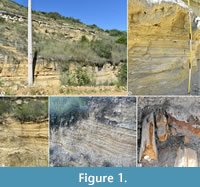
s figure1The fossil goodeids studied in this work are from the lacustrine deposits of volcanic ashes and clays that outcrop within the Sanctórum village, located between the coordinates 20°18ʹ16ʺN, 98°45ʹ51ʺW (Figure 1), about 34 km northeast of the city of Pachuca (Arellano-Gil et al., 2005). The fossiliferous sequence of Sanctórum was discovered in the 1980s by Dr. Oscar Carranza Castañeda and Mr. Gerardo Álvarez Reyes, paleontologists from the Instituto de Geology (Igl) of the National Autonomous University of Mexico (UNAM). In 2008, the second of the authors of the present work began a systematic collection in a small outcrop on the outskirts of this town, called “Sanctórum-JAO site” (Figure 2), registered as a locality IGM-loc in the Colección Nacional de Paleontología at Igl-UNAM. These strata belong to the Atotonilco El Grande Formation, a lithostratigraphic unit described by Segerstrom (1961) as a sequence of clastic rocks and limestone lenses, covered or locally interspersed by basalt currents, which together are 500 to 600 m thick and were deposited into the basins of the Metztitlán and Amajac rivers.
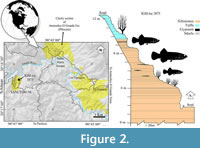
s figure2The oldest lithostratigraphic units in the Atotonilco El Grande region are the El Doctor Formation Albian-Cenomanian limestones and the Mendez Formation Campanian-Maastrichtian marls. Such Cretaceous strata are discordantly covered by sediments of the Pachuca Group, which consists of the basal Eocene-Oligocene Amajac conglomerates that are gradually replaced by the Miocene-Pliocene strata of sandstones and silt-sandy intercalated by limonite, loamy shale, and loams. Above these lies the Pliocene-Pleistocene lacustrine and volcano-sedimentary sequence of the Atotonilco El Grande Formation. Finally, the youngest local sediments are Quaternary alluviums (Beltrán-Romero and Luna-Gómez, 1994; Kowallis et al., 1998; Salvador-Flores, 2001). The Pliocene section of the Atotonilco El Grande Formation consists of fine-grained lacustrine sediments deposited under high altitude, shallow, and low energy conditions, which allow the fossil preservation of plants, invertebrates, coprolites, and vertebrates (Arellano-Gil et al., 2005). The fossil assemblage of Sanctórum includes impressions of terrestrial and aquatic plants, charophytes, silicified wood fragments, insects, ostracods, gastropods, coprolites, frogs, salamanders, as well as a rodent jaw, a snake, and numerous fishes (Beltrán-Romero and Luna-Gómez, 1994; Velasco-de León et al., 2000; Reyes-Torres et al., 2002; Velasco-de León and Aguilar-Arellano, 2002; Zaragoza-Caballero and Velasco-de León, 2003; Palma-Ramírez et al., 2012; Avendaño Pazos, 2020; among others).

MATERIAL AND METHODS

Institutional abbreviations. The acronyms of the institutions involved with this work include CMR, Colección de Materiales Recientes (a subcollection into the Colección Nacional de Paleontología). CPUM, Colección de Peces, Universidad Michoacana de San Nicolás de Hidalgo, Michoacán. ENCB, Escuela Nacional de Ciencias Biológicas, Instituto Politécnico Nacional, Ciudad de México.IGM, Colección Nacional de Paleontología, Instituto de Geología (previously Instituto Geológico de México) of the Universidad Nacional Autónoma de México, Ciudad de México. LaNaBio, Laboratorio Nacional de Biodiversidad, Instituto de Biología, UNAM. LUMIR, Laboratorio Universitario de Microtomografía de Rayos X, Centro de Geociencias of UNAM, Campus Juriquilla, Querétaro.

Preparation methods. All the fish specimens described here belong to the Colección Nacional de Paleontología. These are housed in the Museo María del Carmen Perrilliat M. belonging to the Igl-UNAM. These fossils are mechanically prepared. Under a binocular stereoscopic microscope, fine needles helped to remove the small patches of sediments and uncover the fossil osseous structures. When necessary, a solution of plexigum and methacrylate acetate, applied with fine brushes, glued hardened the fossil bones. The specimens were, directly and indirectly, observed under a stereoscopic microscope and a collection of high-quality photographs obtained in a Low Vacuum Scanning Electron Microscope (SEM). We got digital photographs with a single-lens reflex Camara (SLR) under different illumination conditions, including the natural, white, and long-wave UV (254 nm) lights, as well as with a Confocal Laser Scanning Microscope (CLSM). We obtained virtual micro-computed tomographies (μCT) of recent and fossil specimens. We generated a total of 1200 images with a voxels size of 21.86 μm of each treated fish under a protocol of 110kV, 72 μA, and 500 ms (the electronic files obtained so far will be available for further research because they will be delivered and will be part of the electronic files housed in the Colección Nacional de Paleontología). As noted below, different individuals of living species were cleared and stained according to the technique of Dingerkus and Uhler (1977). The disarticulated dry skeletons of recent goodeids included in this study were obtained by alkaline digestion when complete specimens were immersed in a saturated solution of KOH for 3 hrs and subsequently washed in clean water for 24 hrs. Bones were separated from the soft tissue debris using dissection needles under the microscope and left to dry in the shade at room temperature.

Comparative materials. CPUM donated recent females and males of 34 Mexican goodeid species are used here for comparative purposes. These specimens include Ameca splendens Miller and Fitzsimons, 1971: Complete specimens cleared and stained, CMR 1247, a male of 41.75 mm SL; CMR 1248, a female of 43.3 mm of SL. Characodon audax Smith and Miller, 1986: Complete specimens cleared and stained, CMR 1249, a male of 36.88 mm of SL; CMR 1250, a female of 37.97 mm of SL. Characodon lateralis Günter, 1866: Complete specimens cleared and stained, CMR 1251, a male of 35.83 mm of SL; CMR 1252, a female of 38.38 mm of SL. Goodea atripinnis Jordan, 1880: Disarticulated dry skeleton including CMR 1253, a male of 58 mm of SL; CMR 1254, a female of 64 mm of SL; complete specimens cleared and stained, CMR 1255, a male of 35.97 mm of SL; CMR 1256, a female of 65.74 mm of SL. Hubbsina turneri De Buen, 1940: CMR 1257, a female of 46.70 mm of SL; CMR 1258, a pregnant female of 35.08 mm of SL. Tapatia occidentalis Álvarez and Arriola-Longoria, 1972: P 3661, holotype, a complete specimen of 15.93 mm of SL (deposited in the collection of the Escuela Nacional de Ciencias Biológicas, Instituto Politécnico Nacional); IGM 7966, a complete specimen.

Anatomical nomenclature and abbreviations. The osteological nomenclature, abbreviations, and measurements considered in this manuscript and its figures and tables follow that of previous similar studies (e.g., Costa, 1998; Webb, 1998; Kobelkowsky, 2005).

SYSTEMATIC PALEONTOLOGY

Order Cyprinodontiformes Berg, 1940.
Family Goodeidae sensu Parenti, 1981.
Subfamily Goodeinae Jordan and Gilbert, 1883.
Tribe indeterminate
Genus Paleocharacodon gen. nov.
zoobank.org/AB23EFF9-A960-46BE-9BE6-53BB556A50C0

Species included. Paleocharacodon guzmanae sp. nov., described below.

Etymology. The genus name derives from “paleo” or “ancient” in Greek, plus “Characodon” in reference to the genus named by Günther (1886).

Diagnosis. As in the type and unique species of the genus, see below.
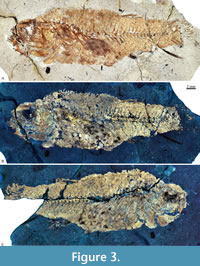
s figure3Holotype. IGM 13117, a complete female specimen of 37.29 mm of standard length, preserved in part and counterpart (Figure 3, Table 1).

Paratypes. IGM 13118, IGM 13119, IGM 13120 (Figure 4A), and IGM 13121 (Figure 4B) are almost complete and articulated males. IGM 13122 and IGM 13123 are incomplete and significantly disarticulated males. IGM 13124 and IGM 13125 (Figure 4C) are almost entirely well-preserved females. IGM 13126, IGM 13127, IGM 13128, IGM 13129, and IGM 13130 are incomplete specimens of unknown sex (Table 1).

Type locality and age horizon. Sanctórum-JAO site (recorded as IGM-loc 3875 in the Colección Nacional de Paleontología, Igl-UNAM), Atotonilco El Grande Municipality, Hidalgo, Mexico. Pliocene lacustrine deposits of the Paleolake Amajac belonging to the Atotonilco el Grande Formation (Figure 1 and Figure 2).

Etymology. The species epithet honors our colleague, Dr. Ana Fabiola Guzmán Camacho, who passed away in 2022, for her contributions to Mexican archaeozoology and paleoichthyology. Together the genus and species names mean “the Guzmán’s ancient Characodon fish.”

Diagnosis. Goodeinae fish with a unique combination of characters and a maximum total length is near to 60 mm, the body is elongated; slightly humped behind the head; fins rounded; pelvic fin rising at the beginning of the posterior half of the body at 57.3% of SL in males and 64.8% of SL in females, and in both cases its rear edge does not reach the anterior end of the dorsal fin base; unpaired fins opposed to each other, located far back of the body, and behind the 69% of SL; total vertebrae 35 in males including 15 abdominals plus 20 caudals while there are 31-32 in females including 14 abdominals and 17-18 caudals; anal fin rays typically 16; in males the most anterior anal rays is rudimentary and this and the following five forms the andropodium; dorsal fin rays 15 in males and 12 in females; pectoral rays 12 in males and 13-14 in females; pelvic rays 6 in both sexes; ribs 15 in males and 12-13 in females; the lateral edges of the anterior end of the parasphenoid are parallel and have no lateral wings; jaws shows a dental battery composed of a labial row of long and robust teeth distally bicuspid and acute with bases co-ossified with the bone plus smaller conic and unicuspid teeth are located lingually; the palatoquadrate arch is anteriorly inclined; the articular facet for the quadrate is donut-like with the central part formed by the retroarticular, and the surrounding region is formed by a couple of curved processes of the anguloarticular; the palatine head has an anterolateral projection; the ventroposterior end of coracoid is convex and has the posterior edge vertically tilted and notched. This species is unique in having the posttemporal with a small anteroventral process, and the openings of the supraorbital canal show the formula 1-2a, 2b-3a, 3b-4a, 4b-5a, 5b-7.

Body shape and general proportions. Table 1 shows the body measurements and proportions of Paleocharacodon guzmanae gen. and sp. nov. The fossil fishes from Sanctórum show different modes of conservation. Occasionally, their bones are totally or partially disarticulated and dispersed. Although it is common to find them relatively complete, well-articulated, and resting, showing one of the body flanks, in general, the bones of the anterior part of the head, the jaws, the nape, and the abdominal region are a little dislocated causing some imprecision in the body measurements. The present description is based on the holotype and added data observed in the paratypes. The larger specimens are the female IGM 13117 (its total and standard lengths are 48.27 and 37.29 mm) and IGM 13130, a sex-undefined and incomplete individual that may be near 100 mm of SL (not included in Table 1).
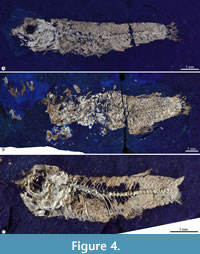
s figure4This elongated fish has a triangular head, almost as high as long, in which the snout is terminal. The maximum body height (MBH) is allometrically variable in the predorsal region of the trunk, in which the back becomes a kind of hump in the larger specimens (Table 1; Figure 3, Figure 4). Compared with females, males’ bodies and heads are shorter and lower (the SL range is 21.88-40.32 mm vs. 25.38-37.29 mm). Regarding the SL, the MBH is 16.65-22.79% vs. 28.94-35.66%; the head length is 26.66-28.01% vs. 28.77-36.12%; and the head height is 21.67-27.23% vs. 27.39-30.08%). All fins have round terminal margins. The pectoral fin extends in the first third of the abdominal region and rises between the vertebral column and the ventral edge of the body. The pelvic fin is short, located in the posterior half of the body (57.3% of SL in males and 64.8% of SL in females), and its distal ends extension does not reach the cloaca. The unpaired fins are short (concerning the SL, the dorsal fin length is 69.3% in males and 71.87% in females while the anal fin length is 70.56% in males and 73.26% in females), opposite to each other, placed on the last third of the body, and represent about 10 to 15% of SL. The caudal peduncle is robust. The caudal fin is entirely round, its base is as high as the caudal peduncle, and its shorter rays are about half its longest.
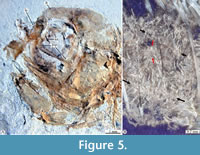
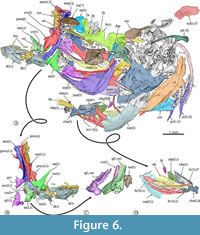
s figure5Skull. In most specimens studied here, the skull bones are so crushed or fragmented and isolated that it is difficult to recognize them accurately. Despite this situation, these exhibit the following details (Figure 5, Figure 6, Figure 7).

In the dorsal view, the skull is trapezoidal with no medial fontanels, in which the interfrontal suture is a somewhat sinuous interfrontal suture, and the frontals and supraoccipital bones are in contact separating the parietals. s figure6Anteriorly, each nasal is a flat oval bone with a large pore near its anterior that may correspond to pore 1 of the supraorbital sensory canal (Figure 6, Figure 8A). Each lateral ethmoid bone is a robust, complex C-shaped bone attached to the anterior ventral region of the respective frontal and extends up to the anterior end of the orbital part of the parasphenoid (Figure 6, Figure 7, Figure 8A).
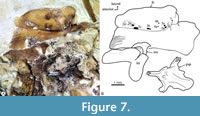
s figure7Each frontal is laminar dorsally expanded and axe-shaped, which forms 70% of the skull length, and markedly broad in its anterior two-thirds. The surface of each frontal shows three sections or low domes joined by inconspicuous ventral ridges, in which the bone thickens (Figure 7). The medial section of the frontal is the largest, dorsally smooth, and ventrally has a series of anterior parallel longitudinal ridges in which the respective lateral ethmoid bone attaches. The lateral section of this bone is roughly triangular and displays a series of 10 large pores alongside its borders with the medial and posterior sections, which corresponds to the pores 2b, 3a, 3b, 4a, 4b, 5a, 5b, 6, and 7 of the supraorbital sensory canal (Figure 6, Figure 7). Since pores 1 and 2 of this sensory canal open in the nasal bone, the formula of these openings is 1-2a, 2b-3a, 3b-4a, 4b-5a, and 5b-7. Remarkably, the 2b of these sensory pores is complex; this opens into a broad depression in which at least two other associated pores open (Figure 7). The posterior section of the frontal is the smallest, has a triangular shape, and is behind the lateral section. Near its posteromedial limit, the lateral section has a pair of conspicuous, laminar, and parallel ridges forming a bony canal projected lateromedially, which opens dorsally, encloses pore 6, and ends right where pore 7 opens. In the most posterior part of the frontal, where this bone bends ventrally and exposes more laterally, there is a wide shallow depression that seems to be the dorsal end of the dilator fossa (Figure 6).

Each parietal is a small and smooth rectangular bone that joins the rear of the frontal and the lateral edge of the supraoccipital (Figure 6). The supraoccipital bone is an oblong, laminar, and dorsally convex bone with a large posterior crest that is bifid and expanded posteriorly (Figure 6). The basioccipital bone is triangular, anteriorly tapered, as high as its vertebral articulation, and hardly expanded laterally. In the dorsal view, the sphenotic bone is rectangular with a stout lateral process. The epiotic is a small oblong bone located in the posterior region of the skull that bears a straight posterior thick process (Figure 6).
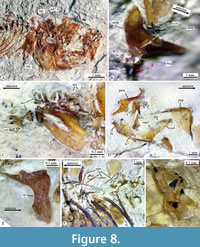
s figure8The parasphenoid is a complex unpaired bone that is expanded laterally in its otic region, whereas its orbital part forms a rod-like structure, evenly straight. The anterior end of parasphenoid becomes dorsoventrally flat and bifid. The middle orbital section of this bone changes allometrically; in small individuals, its transversal section is “+” shaped because it has low wings expanded dorsal, ventral, and laterally whereas, in large specimens, the cross-section becomes T-shaped because the dorsal wing disappears (Figure 6, Figure 7, Figure 8A). This bone displays a triangular basipterygoid process projected dorsally and laterally at the union of its orbital and otic sections.

Otoliths. Although some specimens studied show remains of the three pairs of otoliths, only the sagittal otolith is well-preserved (Figure 8A, Figure 9, Table 2). In life, these inner ear stones are solid crystalline structures of calcium carbonate; however, the otoliths of our fossils have a grainy appearance, probably due to the partial dissolution of their calcium carbonate.
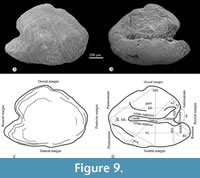
s figure9The sagittal otolith is a thick lenticular structure crudely resembling an arrowhead pointing backward, in which the ventral section is a little longer than the dorsal one (Figure 9). Its lateral surface is smooth, has a hardly protruding middle region, and peripherical concentric growth lines. On the contrary, its medial surface is irregular; it has two longitudinal grooves, one corresponding to an expanded deep concave dorsal area, and the other is a slender medial sulcus, dorsally and ventrally bordered by the cristae superior and inferior, respectively.

The contour of the sagittal otolith is slightly sinuous all around except for a conspicuous notch in the middle of the dorsal margin (Figure 9). In the rostral margin, the rostrum and antirostrum are prominent convex projections deeply separated by a very open exisura that rises from a sharp notch. In the posterior margin, the middle part is a noticeable convex process projected beyond the postrostrum and pararostrum, which are inconspicuous convex projections.

Table 2 summarizes the measurements and proportion observed in the left sagittal otolith obtained in specimen IGM 13119. This inner ear stone has 1237.1 μm of total length. Its ratio total length/maximum height is 1.36 (the maximum height is 73.3% of its total length). Its ratio ventral length/maximum heigh is 1.01 (the ventral length is 74.3% of its total length). Its relative dorsal length (DL/VL) is 98.5. Its relative medial length (ML/VL) is 1.08. Its relative antirostrum height (AH/MH) and length (AL/VL) are 0.385 and 0.099, respectively. Its relative rostrum height (RH/MH) and length (RL/VL) are 0.401 and 0.263, respectively. The exisura opens about 90°, and the posterior and postventral angles are 60 and 128°, respectively.

Circumorbital series. The circumorbital series is highly reduced and only consists of the lacrimal and dermosphenotic bones. The lacrimal bone is somewhat rectangular, about twice higher as long (Figure 5); unfortunately, none of the specimens studied here has a lacrimal that clearly shows the trajectory or the number of pores of the preorbital sensory canal. The dermosphenotic is smooth and thickened tubular bone, ventrodorsally projected, which ends with a blunt tip and borders the dorsoposterior region of the orbit. The dermosphenotic is hollow, carries the postorbital branch of the supraorbital sensory canal, and has at least four pores of that sensory canal (Figure 6).
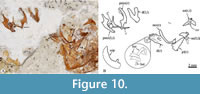
s figure10Upper jaw. Each limb of this jaw consists of the premaxilla and the maxilla. In lateral view, the premaxilla is a sinuous bone divided into two parts. The anterior half of this bone corresponds to its toothed section, a stout bar, homogenously high, and ventrally and medially curved, in which the proximal end becomes thick, dorsally expanded, and forms a straight inter-premaxillary articular surface and a short triangular ascending process. In contrast, the untoothed section of the premaxilla is a rhomboidal-like expanded structure that includes a rectangular and flat ventral process, a short dorsal spine posteriorly projected, and a straight posterior process (Figure 6, Figure 8D, Figure 10).

The maxilla is a long, curved, untoothed bone (Figure 6A-B, Figure 7, Figure 10). In this bone, the anterior third is cylindrical, medially bent, and ends in an expanded rounded structure with two globular dorsal processes and an elongated triangular dorsal process with an acute tip. The posterior half of this bone becomes straight, flat, and broader.
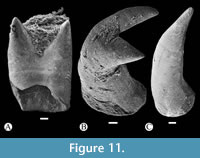
s figure11In toothed elements of jaws are the premaxilla in the upper jaw and dentary in the lower jaw; these bones show two kinds of teeth, bicuspid or bifid sharp teeth and unicuspid acute teeth (Figure 6, Figure 8, Figure 10). The toothed surface of the premaxilla is broad and shows a labial or principal tooth row that consists of eight or nine bicuspid teeth that are long, thick, and have a stake-like base co-ossified with the bone. In these bifid teeth, the base is ovoid, expanded, and laterally compressed; the middle part is progressively thinner; and the terminal end becomes labio-lingually flat, broader, and divided into two symmetrical acute triangular tips with lateral slightly curved edges (Figure 11). Additionally, numerous secondary teeth are in a lingual position; these are conic, unicuspid, smaller, and shorter. Although many teeth of the principal row have the tips broken, their bases are with the dentary and premaxillary (Figure 8). Secondary teeth appear to be just tightly attached to the surface of the bone.

Lower jaw. Each limb of the lower jaw consists of four bones, the dentary, anguloarticular, retroarticular, and coronomeckelian. The dentary is a trapezoidal bone in which the coronoid process is absent, and the posterior end is expanded and deeply bifid. In this bone, the anterior and ventral edges bend medially, the ventral edge is notched, and the symphysis is straight and high (Figure 6A, Figure 8B-D, Figure 10). Here, the toothed border is straight and extended about the anterior two-thirds of this bone. The mandibular sensory canal runs alongside the ventral edge of the dentary and opens through at least four large pores; among these, the second and third pores are the most extensive and form long and wide grooves.

The anguloarticular is a small boomerang-like structure that shows limbs slightly differently shaped, forming an interior angle somewhat obtuse. This bone has a small articular process protruding in the base of its posterior edge and has a trapezoidal ventral process near its rear that sutures with the anterior border of the retroarticular (Figure 6A-C, Figure 8B, Figure 10). Here, the anterior and dorsal processes form an interior angle of about 110-120°; the anterior process has straight edges, shows an acute tip, and is about 1.3 longer, whereas the dorsal process shows somewhat convex edges and a rounded tip. This bone does not carry the mandibular sensory canal. At the base of the retroarticular articular process, the anguloarticular and retroarticular forms part of the articular facet for the quadrate. This facet is a shallow and ovoidal depression with a donut-like configuration, in which the retroarticular’s dorsal surface forms the central region of such facet, while the anguloarticular has two curved or C-shaped processes forming the surrounding part of this articular surface. The tips of these surrounding processes extend almost to join at the back of the retroarticular (Figure 6A-C, Figure 8B, Figure 10).

The retroarticular is a pyramidal and stout bone (Figure 6). This bone forms the ventroposterior end of the lower jaw because it is attached laterally between the articular and ventral processes of the anguloarticular bone. In most of the specimens studied here, the retroarticular and anguloarticular are disarticulated, suggesting that these bones showed cartilaginous sutures in life. The coronomeckelian is a small, flat, untoothed, and comma-shaped bone medially attached to the anterior process near the interior angle of the anguloarticular (Figure 6, Figure 8B, Figure 10).

The toothed surface of the dentary shows teeth similarly shaped and ordered as those described in the premaxilla (Figure 6A-C, Figure 8B, Figure 10, Figure 11). This bone also has two kinds of teeth; six or seven long bicuspid teeth, thick and stake-like based along the labial or principal row, and an indeterminate number of smaller unicuspid teeth forming a lingual or secondary tooth patch (Figure 8C, Figure 10, Figure 11).

Suspensorium. IGM 13123 shows the bones of the suspensorium series complete and articulated (Figure 8D). This comprises the palatine, quadrate, hyomandibula, symplectic, and endopterygoid. These bones are ordered, forming an U-shaped structure. The metapterygoid and ectopterygoid bones are absent. Here, the palatoquadrate arch, formed on the anterior edge and between the heads of the quadrate and palatine, is straight and strongly tilted vertically. The palatine is a triangular laminar bone, about two times higher than long, smooth, with an imbricated suture for the quadrate and endopterygoid. The palatine articular head is narrow and has a small dorsal process protruding anterolaterally (Figure 6A, Figure 8D).

The quadrate bone is a triangular bone. Its posterior edge is somewhat concave, whereas its ventral and anterior edges are relatively straight, form an obtuse angle close to 115°, and join the base of the mandibular articular head. This head is robust, slightly protuberant forward, and bicondylar, in which the medial condyle is larger than the lateral one. The incisura for the symplectic is broad and deep and separates the laminar body of this bone from its posterior process, which is markedly thicker and has a sharp tip.

The symplectic is a long triangular bone, anteriorly acute, posteriorly expanded, and dorsoposteriorly projected (Figure 6A). It is almost two times longer than the quadrate and joins at the base of the hyomandibular. The endopterygoid [also identified as mesopterygoid by Kobelkowsky (2005, fig. 2) and ectopterygoid by Smith (1980, fig. 15)] is a weak laminar and oblong bone, ventrally expanded, and dorsally tapered. The posteroventral part of the endopterygoid occupies the quadrate’s posterior notch, and its anterodorsal end is attached to the base of the rear edge of the palatine. The hyomandibular is an axe-shaped bone with a short handle, an expanded rectangular body, and two long articular facets (Figure 8D). The opercular process barely projects near the middle of the posterior edge of the hyomandibula.

Opercular bones. This bone series includes the opercle, preopercle, subopercle, and interopercle (Figure 6). The opercle is a triangular bone laminar, slightly longer than high, and superficially convex; in which the dorsal edge is slightly concave; the anterior border is straight and thick; and the posterodorsal end becomes narrow, somewhat elongated, and rounded. Anterodorsally, the opercle exhibits a short rectangular articular process (= preopercular arm) that protrudes anterodorsally and forms an obtuse angle of about 130-140° with the anterior edge of the bone. On the contrary, in the medial surface of this bone, near its anterior border and at the base of its articular facet (=opercular facet), is a shallow and semispherical concavity that occupies the center of a superficial and oblong structure that protrudes medially.

The preopercle shows the typical inverted L-shape with the horizontal and vertical limbs similarly shaped, forming an angle of about 90° plus a well-developed medial shelf, uniformly expanded, and a rounded anterior edge (Figure 6A, Figure 8D). Alongside the ventral and posterior edge, this bone displays a deep groove roofed by a thin laminar shelf, in which four or five pores of the preopercular sensory canal open, three of them in the horizontal limb and the others in the vertical one (these pores are visible under the microscope with the specimen wet with alcohol).

The subopercle is a sickle-shaped laminar bone with an anterior ascending process that is small, thorn-like, and subterminal (Figure 6, Figure 10). This bone and the posteroventral edge of the opercle are equally long. In the subopercle, the anterior border is high and convex, the dorsal and ventral edges are harmoniously curved, and the posterior end is acute. The interopercle is a long triangular bone, slightly curved dorsally, rounded posteriorly, and sharp anteriorly (Figure 6). The preopercle covers a large part of the interopercle; however, its anterior tip is so long that it almost reaches the articular head of the quadrate.

Hyoid arch and branchial apparatus. IGM 13127 shows the bones of the hyoid arch and branchial apparatus (Figure 6A, D). The ventral hypohyal is a solid pyramidal structure anteriorly pointed. Behind this, the anterior ceratohyal is an unpierced rectangular bone, lateromedially flattened, slightly constrained in its anterior half, and expanded in its anterior and posterior ends. The posterior ceratohyal is a solid triangular bone, probably equally longer than high. The anterior ceratohyal is anteriorly and posteriorly tightly attached to the respective ventral hypohyal and posterior ceratohyal. The urohyal is a long bone with a slight anterior articular head plus two triangular longitudinal wings posteriorly projected; the horizontal one forms the ventral edge of the bone, and the vertical one projects dorsally.

Although sometimes poorly preserved, in this fish, there are always five pairs of branchiostegal rays (Figure 6A, D). The shape of these laminar, long, and curved bones varies in anteroposterior order, from thread-like to saber-like structures. Among these bones, the anterior four are proximally joining the anterior ceratohyal, while the posterior one does this with the posterior ceratohyal.

Numerous elements of the branchial apparatus are obscured or poorly preserved in the fossils studied here. In IGM 00024 (Figure 6A, D), the basihyal is a long bone, trapezoidal, somewhat slender and expanded anteriorly, and has a small posterior articular head. The same specimen also shows a minute thorn-like interhyal bone; however, this does not preserve the basibranchial bones that once separated the basihyal and interhyal bones.

Other bones of the branchial apparatus, such as the hypobranchials, ceratobranchials, epibranchials, pharyngobranchials, and gill rakers, seem present in different specimens studied herein; however, these are so cracked and incomplete that their identification and description are difficult. These include at least a lower and an upper pair of expanded gracile-toothed pharyngobranchial plates and associated posterior branchial bones. In these plates, the teeth are conic, very robust, and irregularly sized, with the tip curved backward and implanted in shallow sockets (Figure 8G). Although these teeth are usually unattached and dispersed between the medial surfaces of the opercular bones, those placed in the middle are so high that they equal or exceed the thickness of such plates.

Axial skeleton. The numbers of centra and ribs vary slightly in males and females (Table 1). In males, the vertebral column consists of 34-35 total centra, including 15 abdominals and 20 caudals. On the contrary, females have 31-32 total centra, 13-14 abdominals centra, and 17-89 caudals. The rib pairs are 15 in males and 12-13 in females. All the centra are autogenous, but the last three fuse into the caudal complex (Figure 14).

All centra are hollow, deep amphycelic, and hourglass-shaped; these are constrained in the middle, equally expanded anterior and posterior, and show circular intervertebral surfaces. Although it is difficult to determine if most anterior abdominal vertebrae have unfused neural arches, all the other centra fuse with the respective hemal and neural arches. At least four abdominal centra (probably the 2 to 5) show neural crests expanded, rectangular, and laminar. The ribs are long, thin, and slightly curved, enclosing almost the entire abdominal cavity; these join the dorsal surface of the paraphyses (= transverse processes in Kobelkowsky, 2005, figure 4), which are straight, long spiny-like structures projected laterally from the dorsal part of the centra, that show a lateromedial groove in its dorsal surface. At least, the anterior half of the ribs are associated with thin epineural bones, which are about two centra long and lie horizontally (Figure 8F).

Pectoral fin and girdle. The pectoral fin is rounded and has 12 rays in males and 13-14 in females (Table 1). These rays are distally branched and segmented, uniformly thin, and extend, covering the anterior third of the abdominal region. At least four rectangular radials support this fin.

The posttemporal is a long triradial bone (Figure 6A). This bone is oblong, thin, short, and posteroventrally projected. In contrast, its anteroventral process is small and triangular, while its anterodorsal limb is a bar-like structure, uniformly wide, curved dorsoventrally, slightly flattened, and about four times longer than the anteroventral process. The supracleithrum is a flat bone, short and drop-like, that rests above the dorsoposterior end of the cleithrum. Since the highly compressed preservation of the specimens studied here, only the lateral surface of the cleithrum is identifiable; this thin bone is crescent- shaped and bears a laminar posterior extension with a slightly curved edge. Two postcleithra are present; the first is an ovoid plate in the rear corner of the cleithrum, and the other is a sinuous rod-like structure projected ventrally. The posterior wing of the cleithrum covers a large part of the scapula; however, its rear surface is exposed, showing its articulation with the pelvic radials. Otherwise, only the lateral surface of the coracoid appears as an elongated laminar and triangular structure that is posteriorly expanded and has a ventroposterior end convex, with a posterior margin vertically tilted and anteriorly limited by a narrow and deep notch (Figure 6A).
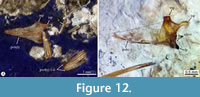
s figure12Pelvic fin and girdle. The pelvic fin is entirely opposed to the predorsal region of the trunk. It rises in the posterior half of the body, at 57.3 SL in males and 64.8% of SL in females. The posterior edge of the fin does not reach the origin of the dorsal fin. This small and rounded fin consists of six pelvic rays that are distally segmented, branched, and have bifid articular heads (Table 1, Figure 12). There are no pelvic radials.

The pelvic bone is triangular, about two times longer than wide, laterally and medially almost straight, and anteriorly acute. The dorsal surface of this bone bears a middle thickening bar or keel. The posterior edge of the pelvic bone is concave and shows small facets to join the pelvic rays. In small specimens, this bone shows a shallow posterior notch and three processes relatively small, including an inconspicuous lateral process, a small and rounded medial process, and a stout triangular ischial process (Figure 12A). On the contrary, the pelvic bone of larger fishes has a posterior notch conspicuous, a lateral process wider and rectangular, and a long thick medial process that is somewhat sinuous (Figure 12B).
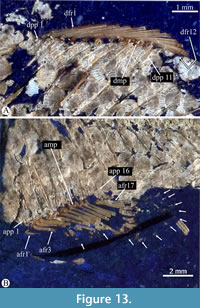
s figure13Dorsal fin. The dorsal fin is rounded, long, and about equally high than long (Figure 13A). The number of rays from this fin is sexually variable; males have 15 dorsal rays, while females show only 12. The dorsal rays are uniformly thin and distally branched and segmented. Here, the first three and last rays are comparatively smaller than the others.

A series of long and straight dorsal proximal pterygiophores support the dorsal fin rays in a numerical relation 1:1. The series has no distal pterygiophores but includes small square-like medial dorsal pterygiophores in at least three anterior quarters of the dorsal fin. Along the series, the size of the proximal dorsal pterygiophores is almost the same and are so long that they penetrate the interneural spaces present immediately below.

Anal fin. The anal fin is high, long, and rounded; in general, this is a little smaller and located slightly behind the dorsal fin (Figure 13B, Table 1). This fin comprises around 16 rays (between 15 and 18) in both sexes; the first ray is rudimentary. In males, the subsequent six rays form the andropodium; these rays are segmented, unbranched, shorter than the posteriors, and crowded together. Due to the difference in size, the andropodial rays are separated from the subsequent by a small notch. Posterior anal rays are distally segmented, branched, and at least 20 % longer than the last andropoidal rays. The rear three anal rays decrease in length progressively.

A series of proximal pterygiophores internally support the anal fin. These rod-like bones are straight, and so elongated that they penetrate the interhemal spaces. In extreme cases, these proximal pterygiophores cover three-quarters of the distance between the vertebral column and the base of the fin (Figure 13B). The numerical relation between anal rays and proximal pterygiophores is 1:1, except for the first pterygiophore that joins the first two anal rays. There are no distal pterygiophores. The anterior medial pterygiophores are absent or probably fused with the articular head of the anterior seven proximal pterygiophores, which are close-set, mainly the first five; therefore, these proximal pterygiophores are the only ones supporting the andropodial rays. Beyond, a robust rectangular medial pterygiophore is present between the posterior proximal pterygiophores.
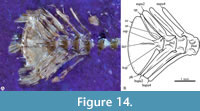
s figure14Caudal fin. The caudal skeleton involves the neural and hemal spines of the preural 1-3 plus those bones associated with the ural centra (Figure 14). These spines become thicker, broader, and slightly less tilted than those of previous centra. The parhypural and the hemal spines of preural centra 2 and 3 are so broad that they are in contact. The parhypural has a wide proximal tip, probably fused with preural 1. A single wide epural fills the space between the most posterior neural spine and the ural plate. As in other cyprinodontiforms, the end of the vertebral column, the caudal complex involves the fusion of the preural 1, urals 1, and an undetermined number of hypurals (see Thieme et al., 2021). The hypurals form a fan structure with a long conspicuous interhypural foramen longitudinally bordered by two shallow ridges. Near its base, this caudal complex shows three small processes; the urostyle is a small and rectangular anterordorsal process that is projected upward and seems to embrace the anterior tip of the epural; in the base of the hypural plate, there is a small spine-shaped process and a keel-shaped process laterally expanded in dorsal and ventral position, respectively.

The caudal fin is rounded and posteriorly expanded. Its dorsal and ventral lobes form a harmonious convex profile, while the ventral and dorsal edges of the fin are straight. This fin is relatively short, and its length is about 1.2 times the postanal length of the trunk. Regarding those caudal rays anteriorly associated with the caudal complex, the caudal formula is vi+ I+9—8+I+v. In both lobes, the procurrent rays become longer and thicker in anterior to posterior order.

Scales. The scales cover the whole body, head, jaws, and caudal skeleton 8 (Figure 3, Figure 4, Figure Figure 5, Figure 8F, Figure 13, Figure 14). These are cycloid scales, rounded to slightly ovoid, in which the center half is smooth. The surrounding scale surface has 4-9 concentric circuli that are sinuous, unbranched, and evenly separated. Additionally, most scales covering the anterior third of the trunk have 3-12 straight, horizontal, and parallel radii. In small specimens, only a few scales of the middle part of the trunk show radii, while in larger fishes, the radii are present in more scales. Regardless of the size of the specimens, the scales on the head and jaw have no radii. On the trunk, scales are evenly sized; however, those on the occiput and the head become smaller. Middle longitudinal scale lines on the skull extend symmetrically on each side up to the frontal-mesethmoid contact. Nine to 10 scale rows probably cover the height of the trunk, and about 32 rows extend above the vertebral column between the head and the anterior tips of the caudal fin rays.

Coloration pattern. UV light allows us to recognize some details of the color pattern of Paleocharacodon guzmanae gen. and sp. nov., which are invisible under white light. IGM 13117 shows 14 wide dark color spots covering the posterior surface of the abdominal cavity, four behind the pectoral girdle and over the first vertebrae, and at least another five or six (barely observable in the specimen) forming a longitudinal row above the vertebral column, between the pectoral girdle to the middle part of the anal fin. Additionally, a large dark color spot is present along the basal half of the anal fin (Figure 3).

Such spots of color are not present in all the fishes of Sanctórum, probably because the multiple taphonomic factors that controlled and allowed their conservation did not affect all individuals uniformly. Otherwise, the rare preservation of these color spots could respond to the fact that, when collected, many of these fish open in half and therefore do not show their exterior surface details.

Reproduction. Skeletal remains attributable to unborn small fishes preserved in the abdominal cavity of some of the females, as IGM 13117 and IGM 13125 (Figure 5B), evidence the viviparity of Paleocharacodon guzmanae gen. and sp. nov. Although it is challenging to identify complete individuals in these remains, here, we rule out the possibility that these remains represent stomach contents because these do not show any signs of decay by digestion.
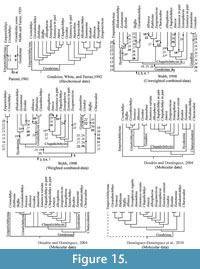
s figure15For almost 150 years, at the same time as the knowledge of the taxonomic diversity of fishes now included in the family Goodeidae increased, different authors discussed their possible interrelationships under both pre and post-Hennigan considerations (Figure 15). Unfortunately, in most of these efforts, the evidence considered is non-osteological, with unverifiable attributes in fossil specimens. These first studies only considered general phenotypic body traits and soft structures, particularly those linked to their reproductive strategies (Hubbs and Turner, 1939; Gosline, 1949; Fitzsimons, 1981). Subsequently, the phylogenetic studies carried out in the last 25 years involved molecular data of alloenzymes and different genetic materials, show somewhat contradictory results (Grudzien et al., 1992; Webb, 1998; Doadrio and Domínguez, 2004; Domínguez-Domínguez, 2010; Parker, 2017; Parker et al., 2019). Today, determining the taxonomic identity and the phylogenetic relationships of fossil goodeids, such as Paleocharacodon guzmanae gen. and sp. nov. and Tapatia occidentalis, are complex tasks because the osteological features of these extinct fishes have been unnoticed in such studies. Therefore, the present authors have begun an osteological descriptive and comparative analysis of members of the family Goodeidae, which now gathers about 21 genera and 50 species (Table 3), an effort that will still take us several years. Despite this restrictive scenario, those osteological features of fossils and extant goodeids previously discussed by different authors (e.g., Miller and Fitzsimons, 1971; Smith, 1980; Parenti, 1981; Webb, 1998), together with the results of our observations on recent specimens, are used here to recognize the taxonomical peculiarity and affinities of P. guzmanae.

Webb (1998) performed a phylogenetic study of Goodeidae, combining molecular and morphological data. He identified five Goodeinae tribes, including Characodontini (Characodon), Goodiini (Goodea and Ataenobius), Ilyodontini (Ilyodon, Allodontichthys, and Xenotaenia), Girardichthyini (Girardinichthys, Allotoca, and Hubbsina), and Chapalichthyini (Chapalichthys, Allophorus, Ameca, Xenotoca, Xenoophorus, and Xanotaenia) (Figure 15); additionally, in his hypotheses, Skiffia and Zoogoneticus are like jumping-joker cards because their relationships are problematic. Currently, such tribe names are used even though, in the most recent hypotheses (Figure 15), the groups obtained are not always those of Webb’s. In this manuscript, we consider these tribe names.

Paleocharacodon guzmanae, a New Goodeidae

Smith (1980) divided Goodeidae into two large groups. His Characodon-group shares two features, the anguloarticular bone (=articular-angular) has a dorsal process projected almost vertically, forming a nearly right angle with the anterior process, and the articular head of the quadrate is comparatively short and hardly protrudes from the anterior edge of the palatopterygoid complex. On the contrary, in his Goodea-group, the anguloarticular has a dorsal process strongly projected backward beyond the articular process and forming an obtuse angle with the anterior process; additionally, here, the articular head of the quadrate is comparatively longer and projects in advance of the anterior edge of the palatopterygoid complex (Smith, 1980, figures 16, 17). Although Smith (1980) considered Ameca, Hubbsina, and Tapatia occidentalis as goodeids of uncertain position, the subsequent reviews of these taxa reveal that their anguloarticulars have a vertical dorsal process (Guzmán 2010, figure 4b; Webb, 1998), suggesting that these may form part of his Characodon-group.

In this context, it is impossible to include Paleocharacodon guzmanae gen. and sp. nov. in any of the goodeid groups proposed by Smith (1980). This Mexican fossil fish shows the condition of the anguloarticular described in the Characodon-group, as well as the quadrate having an articular head comparatively long and protruding forward as in the Goodea-group (Figure 6, Figure 8D). Additionally, Tapatia occidentalis and P. guzmanae differ in the shape of the anguloarticular and jaw teeth. In T. occidentalis, the length of the anguloarticular anterior process is at least 2.5 times the height of its dorsal process. The teeth in the frontal rows of jaws show a bicuspid or bifid shape, end in two square lobes loosely separated, and are distally truncated or straight (Guzmán, 2010, figures 4b, 5 c”). On the contrary, in P. guzmanae, the proportions of the anguloarticular are less contrasting. That length is just about 1.3 times such height, and the teeth of principal rows have bicuspid and sharp ends (Figure 6, Figure 10, Figure 11).

Also, Paleocharacodon guzmanae differs from Hubbsina and Ameca in the size and position of the dorsal fin. In P. guzmanae, the dorsal fin is short, has 12-15 rays, and is entirely opposed to the anal fin (Table 1, Figure 13). Although the dorsal fin in Ameca is short and has only 13-14 rays, in Hubssina, this fin is peculiarly long and consists of 29-37 rays; in both cases, the dorsal fin is placed more to the front and opposes the anal fin only in part (De Buen, 1940; Miller and Fitzsimons, 1971; Domínguez-Domínguez et al., 2005, p. 540, 552). As a result, P. guzmanae is considered a new genus and species.

Unfortunately, after the efforts of Parenti (1981) and Webb (1998), who included some osteological features to define the naturalness of the family Goodeidae and recognize its interrelations under the cladistic scope (Figure 15), this type of data ceased to be considered in phylogenetic assays. Therefore, under these conditions, it is necessary to analyze, recognize and assess the possible osteological differences between these fishes, a task already in progress that will take a few more years to be helpful. In this paper, we explore the affinities of Paleocharacodon guzmanae gen. and sp. nov. within Goodeidae, analyzing the distribution of its osteological features along the branches of those hypotheses proposed by these authors. Table 4 summarizes the comparative analysis of P. guzmanae and other extant and extinct goodeid taxa.

In the restructuring of Goodeidae suggested by Parenti (1981, p. 515-516) to include the subfamilies Goodeinae and Empetrichtyinae, she noted that these fishes share four diagnostic features (1-4 below and in Figure 15). Later, Webb (1998) discovered other distinctive features of the family (5-7 in this paragraph and Figure 15); however, among these features, only two are synapomorphies (3 and 5). In this context, Paleocharacodon guzmanae gen. and sp. nov. is an unquestionable member of Goodeidae because it shows six of these diagnostic features (Figure 15):

1) In the anal fin, the most anterior 2 to 7 medial pterygiophores (= middle radials) are absent as autogenous bones because these are fused with the respective proximal pterygiophores (= proximal radials of Parenti, 1981, figure 83, node A) (Figure 13).

2) The dorsal process of the maxilla is strongly reduced (Parenti, 1981, figure 83, node A) (Figure 6, Figure 8D).

3) The distal arm of the premaxilla is straight (Smith, 1980; Parenti, 1981, figures 40C, 83 node A) (Figure 6A-B; Figure 8D); according to Webb (1998, ch. 649), this is a synapomorphy.

4) The anguloarticular (=articular in Parenti, 1981, p. 406, figures 33B, C, D, and node A in figure 83) is significantly reduced, and its medial extension does not carry the mandibular sensory canal.

5) In lateral view, the lacrimal bone is somewhat rectangular and at least twice as higher as long; according to Webb (1998, figures III.22B, ch. 658) is a synapomorphy (Figure 5).

6) The ascending process of the premaxilla is small or reduced (Parenti, 1981, figure 39C; Webb, 1998, ch. 650) (Figure 6). In goodeids, in dorsal view, the pterotic (=autopterotic) bones show a narrow autopterotic fossa

7) in Figure 15), in which the otic sensory canal runs (Uyeno and Miller, 1962; Parenti, 1981; Webb, 1998, figures III.12B, ch. 641); unfortunately, any of the specimens of P. guzmanae herein studied show that fossa.

Paleocharacodon guzmanae, a New Goodeinae

Paleocharacodon guzmanae gen. and sp. nov. is also an undeniable member of Goodeinae because it was a viviparous species and shows both the homoplasy and synapomorphy that support this subfamily (8 and 9 in Figure 15, Table 4). Following the numbering of the anterior paragraph, these features include:

8) The anterior anal fin ray is rudimentary (Parenti, 1981, figure 83, node B) (Figure 13).

9) The andropodium or pseudophallus is present and formed by the unbranched anterior anal-fin rays that crowd together (Figure 13), separated by a notch from the rest of the fin, and reduced between 50-80% concerning the subsequent posterior rays; Webb (1998, p. 75, ch. 684 in part) discovered this remarkable osteological synapomorphy. Additionally, Webb (1998, p. 61 and 92, ch. 637) suggested that the appearance of a shallow neurocranium (in which the height is equal to or less than half of its width) also supports the Goodeinae monophyly; however, this condition may represent a plesiomorphy because it is present in Empetrichthyinae and other Cyprinodontiformes, too.

Eight osteological features support the naturalness of Empetrichthyinae. These include four synapomorphies (11-18 in Figure 15, Table 4), previously noticed by Parenti (1981) and Webb (1998). Paleocharacodon guzmanae gen. and sp. nov. differ from Empetrichthyinae because it does not have any of its diagnostic features. Following the numbering of the anterior paragraphs, these features include:

10) The lack of the pelvic fin and girdle (Parenti,1981, node C in figure 83; Webb, 1998, ch. 673). On the contrary, the pelvic fin and girdle are well-developed in P. guzmanae (Figure 12).

11) The epibranchial 1 is nearly Y-shaped, notched at its base, and has a lateral process (Parenti, 1981, node C in figure 83 and figure 47B; Webb, 1998, ch. 668). Unfortunately, the epibranchials are unknown in P. guzmanae, but among goodeines this bone is rod-shaped.

12) The surface of neurocranial, suspensorium, and hypural bones are rugose and irregular due to pits and ridges (Webb, 1998, ch. 643). On the contrary, these bones are superficially smooth in P. guzmanae (Figure 3, Figure 4, Figure 5, Figure 6, Figure 7, Figure 8D, Figure 14).

13) The anterior margin of the vomer is abruptly concave medially (Uyeno and Miller, 1962; Webb, 1998, figure III.9C, ch. 629). Sadly, the vomer is unknown in P. guzmanae.

14 and 15). The frontal has a supraorbital canal partially ossified and does not show the break 4a-4b (Gosline, 1949; Fitzsimons, 1981; Webb, 1998, chs. 632 and 634) (Figure 15). On the contrary, as in other goodeines, in P. guzmanae, the frontal bone entirely encloses the supraorbital canal that shows the break 4a-4b (Figure 7).

16) The dorsal and ventral pharyngobranchials are relatively robust; their bases are deep, ossified, and higher than their teeth (Webb, 1998, ch. 667). Although in P. guzmanae, the toothed pharyngobranchial plates are not well-exposed, in this species, such plates are rather gracile and bear large teeth of varying size, usually rest unattached and scattered; here, the most prominent pharyngobranchial teeth are higher than the pharyngobranchial plates.

17) Third postcleithrum with a posteriorly directed laminar plate at its mid-length (Webb, 1998, ch. 672). P. guzmanae has only two postcleithra.

Palaocharacodon guzmanae and Other Goodeines

Paleocharacodon guzmanae gen. and sp. nov., Goodiini, Characodon, Xenotaenia, and some species of Allotoca share a primitive feature; the dorsal fin is far in the back of the body (the predorsal length is equal or greater than 67% of SL). Hence, P. guzmanae differs from Ilyodontini, Girardichthyini (less some species of Allotoca), Chapalichthyini (including Zoogoneticus and less Xenotaenia), and Skiffia that have the dorsal fin located not so far back (the predorsal length is equal or less than 67% of SL)

18) (in Figure 15, Table 4) (Miller, 1948; Webb, 1998, p. 77, ch. 689).

According to Webb (1998, p. 61, ch. 637), all goodeines except Goodiini, Ilyodontini, and Alloophorus show a neurocranium primitively low; in the posterior view, its height/width ratio is 0.45 to 0.52. On the contrary, in other goodeines, the neurocranium shows a higher derived condition, and the range of such proportion is 0.58 to 0.66

19) (in Figure 15, Table 4). This character had a regressive change to the shallow state in Ilyodontini and Alloophorus (19* in Figure 15). Unfortunately, the neurocranial proportions of Paleocharacodon guzmanae gen. and sp. nov. and Tapatia occidentalis are unknown.

Into Goodeidae, only Goodiini and Empetrichthyinae possess rostral cartilages (Webb, 1998, p. 63, ch. 644). Other goodeids have no rostral cartilage

(20 in Figure 15, Table 4). The presence or absence of this cartilage is unknown in Paleocharacodon guzmanae gen. and sp. nov. and Tapatia occidentalis.

According to Webb (1998), Goodea and Ataenobius form the tribe Goodiini. In one of his hypotheses, this tribe is the sister group of other goodeines, while in the other, this constitutes a natural group with Skiffia. Two unambiguous characters, a synapomorphy, and a homoplasy, support this tribe in Webb’s hypotheses. The first is the presence of lateral wings in the anterior end of the parasphenoid

21) (in Figure 15 and Table 4; Webb, 1998, p. 61, ch. 638). The homoplasy is the presence of a pelvic fin relatively short because its posterior edge does not reach the dorsal fin origin

22) (in Figure 15 and Table 4; Webb, 1998, p. 72, ch. 675). A short pelvic fin is also present in Characodon and Allotoca (see Domínguez- Domínguez et al., 2005, p. 545, 547). In other goodeids, the parasphenoid has no wings because its anterior lateral edges are parallel, and the pelvic fin is long and goes beyond the dorsal fin origin. Although the pelvic fin of Paleocharacodon guzmanae gen. and sp. nov. is short, it is recognized as non-Goodiini fish because its parasphenoid is not winged.

In Webb’s (1998) hypotheses, the long and well-developed posterior process in the epioccipital bone represents a derived condition of Goodiini and Skiffia

23) (in Figure 15 and Table 4; Webb, 1998, p. 62, ch. 640). These taxa, Ilyodontiini (except Allodontichthys polylepis, A. tamazulae, and A, zonistius), Ameca, and Xenoophorus have 20 to 54 gill rackers on the first branchial arch

24) (in Figure 15 and Table 4); Webb, 1998, p. 70, ch. 665). In other goodeids, the epioccipital process is tiny, and the first branchial arch has only 9 to 19 gill rackers. Unfortunately, Paleocharacodon guzmanae gen. and sp. nov. and Tapatia occidentalis do not expose either of these features.

25 and 26) (in Figure 15 and Table 4; Webb, 1998, chs. 645-647, respectively). The crowns of primary jaw teeth are distally flattened, bicuspid, and straight or broadly blunted, and its bases are loosely attached to the jaws by cartilage in Goodiini, Skiffia, Ilyodon, and Xenoophorus also shows (e.g. Hubbs and Turner, 1939). On the contrary, other goodeids and Paleocharacodon guzmanae gen. and sp. nov. (Figures 8, 10, 11) have primary jaw teeth bicuspid, acute, which bases are co-ossified with the bone of jaws. According to Webb (1998), Allodontichthys shows tricuspid or shouldered teeth and large specimens of Skiffia multipunctata also have strong tooth attachments.

Additionally, Goodiini, Skiffia, and Ilyodon share a derived condition of the anguloarticular bone; its dorsal process projects backward, forming an angle of about 180°

27) (in Figure 15; Smith, 1980, figure 17B; Guzmán, 2010, figure 9; Webb, 1998, p. 66, ch. 654). On the contrary, Paleocharacodon guzmanae gen. and sp. nov. and other goodeids show the alternative primitive condition of this bone; its dorsal process is projected dorsally and forms an angle of about 90° with its anterior process (Figure 6, Figure 8B, Figure 10).

Among goodeids the ventroposterior coracoid region is variable (Webb, 1998, p. 71-72, ch. 671). This region shows a straight angle in Empetrichthyinae, most Goodeiinae, and probably in Tapatia occidentalis; on the contrary, in Skiffia, this is broadly convex

28) (in Figure 15 and Table 4), and in Ilyodon varies between straight and convex. Only in Ameca, Xenotoca variata, and now Paleocharacodon guzmanae gen. and sp. nov, this region is convex, has a posterior margin vertically tilted, and is anteriorly limited by a narrow and deep notch (Figure 6; Webb, 1998, figure III.27). In this case, the condition shared by Ameca, X. variata, and P. guzmanae seem an evolutive convergence.

Furthermore, Webb (1998, p. 67-68, ch. 657) noted that in Goodiini and Skiffia, the palatoquadrate arch (between the articular heads of the palatine and quadrate bones is about vertically inclined

29) (in Figure 15 and Table 4). On the contrary, this arch is bent forward in other goodeids, including Paleocharacodon guzmanae gen. and sp. nov. (Figure 8D).

Likewise, Goodiini, Skiffia, Ilyodon, and Ameca share a homoplasic and derived feature, the retroarticular bone forms the lingual part of the articular facet for the quadrate

30) (in Figure 15 and Table 4; Webb, 1998, p. 67, ch. 655). On the contrary, this bone does not form that facet in other goodeids. In Paleocharacodon guzmanae gen. and sp. nov., that facet has a donut-like configuration in which the retroarticular forms its central region and the anguloarticular has two curved processes forming its surrounding part (Figure 6, Figure 8B). Although this donut-like configuration of the articular facet for the quadrate (added in this work as

character 31 (in Figure 15 and Table 4) was observed only in specimens of Characodon, additional observations are required to clarify its possible occurrence in other goodeids.

Based on Webb’s hypotheses, among goodeids, there is a primitive anterolateral projection in the palatine head of Empetrichthyinae, Goodiini, Ilyiodontini, and most Chapalichthyini (except for Alloophorus, Zoogoneticus, and Skiffia francesae). A convergent derived state of these characters, the lack of such projection in the palatine occurs in Characodontini, Girardinichthyini, Alloophorus, Zoogoneticus, and S. francesae

32) (in Figure 15 and Table 4, Webb, 1998, p. 67, ch. 656). Herein, Paleocharacodon guzmanae gen. and sp. nov. and is excluded from Chacarondontini and Girardinichthyini because it shows the primitive anterolateral projection of the palatine.

Herein, we identify that Paleocharacodon guzmanae gen. sp. nov. and Characodon spp. Differ from each other in at least three different features. In the last, the openings of the supraorbital canal show a formula—1-2a, 2b-7— as in some Allodontichthys species (Fitzsimons, 1981, table 1); its posttemporal is unforked because the anteroventral process is absent as in Empetrichthyinae, Girardichthyini, and Zoogoneticus (33 in Figure 15 and Table 4; Webb, 1998, p. 71, ch. 669); and the parasphenoid bone shows outstanding dorsal wings extended in its orbital part. On the contrary, in the fossil species, the openings of the supraorbital canal show a formula never recorded before among goodeids—1-2a, 2b-3a, 3b-4a, 4b-5a, 5b-7—(Figure 7); its parasphenoid bone shows tiny ventral and lateral wings in its orbital part, (Figure 6); and its posttemporal bone shows a small anteroventral process that may be an intermediate condition observed in other goodeids (Figure 6).

Unfortunately, in his hypotheses, Webb (1998), most no-Goodiini, and no-Characodontini groups do not have osteological supporting features. Therefore, it is not easy to compare the anatomy of such groups with those features observed here in Paleocharacodon guzmanae gen. sp. nov. In the present context, after mapping the osteological features of P. guzmanae into Webb’s hypotheses, it is possible to point out that this fossil is part of the family Goodeidae and the subfamily Goodeinae (it shows the characters 1-6, 8-9 in Figure 15). In addition, the mixture of characters of this fossil goodeid does not allow us to recognize it as part of any of the tribes of Goodeinae. Besides, this fossil goodeid does not share features with the tribes and shows different characters to those that support such tribes or groups of tribes (numbers in italics in Figure 15). On the other hand, this fossil and the tribe Characodontini shared more features (numbers in bold in Figure 15), but it shows significative differences with its single member, Characodon. Therefore, the species described here was included in its genus, Paleocharacodon, to highlight its similarity with Characodon, including a feature observed for the first time, the donut-like articular facet for the quadrate.

Phylogenetic and Biogeographic Implications

Despite numerous recently published hypotheses (Doadrio and Domínguez, 2004; Webb et al., 2004; Domínguez-Domínguez et al., 2010; Foster and Piller, 2018), the phylogenetic and biogeographic relationships of Goodeidae are still unclear (Figure 15). This situation probably results from the lack of suitable fossil evidence that allows us to recognize the history of the morphological changes of Goodeidae, as well as the geological-environmental conditions in which they occurred. The discovery of Paleocharacodon guzmanae gen. and sp. nov. not only complements our knowledge about the diversity of the family, but it also reveals itself as an element to consider in future biogeography studies.

The accurate osteological description of living goodeids is a pending task that avoids the comparison of its extinct and recent species. Despite this, the analysis of Paleocharacodon guzmanae gen. and sp. nov. and some data published of other goodeids reveals that this new fish does not belong to any goodeine tribes. The putative primitive features of P. guzmanae suggest that it may represent a primitive goodeinae. Such observation is congruent since P. guzmanae is a Pliocene species of at least 4 Mya. In any case, assessing the relationships of fossil goodeids, such as P. guzmanae, Goodea-like from Sanctórum, and Tapatia occidentalis requires a comprehensive phylogenetic study involving osteological data of recent and fossil goodeids.
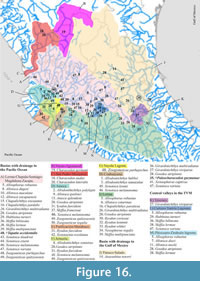
s figure16In the biogeographic hypotheses of Goodeidae so far proposed, Goodeinae arose in the northwestern region of Mexico and had different episodes of diversification in the central part of this country. Such diversification seems more successful in rivers and lakes of the western and southern of the country, which today concentrate most of the known species. Later, some of its genera experienced exchanges between these regions (Gesundheit and Macías, 2005; Domínguez-Domínguez et al., 2006, 2010; Pérez‐Rodríguez et al., 2015, Foster and Piller, 2018; among others). The finding of Paleocharacodon guzmanae gen. and sp. nov. and his contemporary Goodea-like in Sanctórum is significant. The Pliocene strata of the extinct Paleolake Amajac are within the domains of the Pánuco-Salado Basin on the eastern side of Mexico, where there are only six recent species (Table 3, Figure 16). The contrasting diversity of goodeids between the western-southern and eastern regions of Mexico seems linked to the geological-environmental history of the country. On the one hand, during the Neogene, the development of the TMVB strongly and continuously affected its western and southern regions, while the eastern area occupied by the Pánuco-Salado basin was relatively more stable. For now, the uncertain relationships of P. guzmanae within the goodeids hinder the recognition of whether this supports or rejects the biogeographic hypotheses already proposed; however, our study suggests that this extinct species of the eastern slope of Mexico is not directly related to any species from the Pánuco-Salado Basin.

Additionally, divergence dates in the Goodeidae evolution are available in the most recent phylogenetic studies (Figure 15); Foster and Piller, 2018; however, the discovery of Paleocharacodon guzmanae gen and sp. nov. suggests that a different goodeinae lineage without living representatives must have existed. According to these data, the family Goodeidae and the subfamilies Goodeinae and Empetrichthyinae rose during the early Miocene, before 15 Mya; in the later 5 My and during the middle Miocene, between 15 and 10 Mya, the goodeines tribes separated; and finally, since then the diversification of these fishes led to the establishment of all genera and species hitherto known. As demonstrated in the previous section, the available evidence from Tapatia occidentalis and P. guzmanae indicates that these Miocene and Pliocene fossil species are part of Goodeinae. However, their inclusion at the tribe level is impossible and may represent unknown members of other lineages.

The situations described in the two previous paragraphs suggest that the biogeographic history of goodeids is more complex than those described so far. Such a process may include at least two alternative early scenarios: A) Early goodeids were widely distributed in Mexico and B) The eastern slope of Mexico received an ancient group of goodeids from the northwest region, subsequently displaced by more recent species.

The geographic distributions of Goodeidae and Profundulidae are disjoint, adjacent, and separated by the Sierra Madre del Sur. The first family inhabits the north, between the southwestern USA and the Mesa Central of Mexico, plus its neighboring regions. At the same time, Profundulidae is found further south, from the Pacific slope of the Sierra Madre del Sur and the Mixtec Basin to Guatemala, El Salvador, and Honduras (Morcillo Alonso, 2004, figure 1). Such distributional patterns respond to the development of TMVB, which began 10-20 million years ago. In this scenario, fossils of Paleocharacodon guzmanae gen. and sp. nov. are geographically nearer to the current distribution of Profundulidae and temporally closer to the origin of TMVB; however, its importance in the effort to understand the separation of these two families is minimal because Profundulidae has no fossil record.

The review of the Pliocene fish from the Paleolake Amajac deposits in Sanctórum, Hidalgo, Mexico, reveals that these represent two species of the family Goodeidae and subfamily Goodeinae. Here, one is described and named Paleocharacodon gu zmanae gen. and sp. nov.; the other, still poorly known, resembles Goodea (Becerra Martínez, 2003). The principal jaw teeth of P. guzmanae, with bicuspid and symmetrical acute-ends, noticeably differ from those of other Mexican goodeid fossils, Tapatia occidentalis and the Goodea-like of Sanctórum, in which bicuspid teeth have wide spatula-ends. A unique combination of non-exclusive and exclusive features shared with other goodeids supports the singularity of P. guzmanae. These features include the unpaired fins opposed and located far back of the body, behind the 69% of SL; the rudimentary anterior anal ray; the andropodium of males; the strong jaw teeth with distal acute and bicuspid ends; and the donut-like articular facet for the quadrate. The exclusive features of the species include the small anteroventral process of posttemporal and the formula 1-2a, 2b-3a, 3b-4a, 4b-5a, 5b-7 of the supraorbital canal openings.

As its name implies, Paleocharacodon gen. nov. shares some osteological similarities with Characodon; however, the mapping of the osteological features of this fish into the different branches of the phylogenetic hypotheses published by Webb (1998) allows us to recognize that this does not belong to any tribe of the subfamily Goodeinae. Developing a phylogenetic study of Goodeidae based on osteological data, which enables the inclusion of fossil species such as P. guzmanae or Tapatia occidentalis, still requires the accurate characterization of most of the living species of this family. Meanwhile, the inclusion of P. guzmanae in any tribe is unfounded.

The discovery of Paleocharacodon guzmanae gen. nov. in a restricted area within the Great Pánuco-Salado Basin is significant because it will provide new data for future phylogenetic and biogeographic investigations. On the one hand, this new species shares some osteological characteristics (mainly primitive) previously observed in other specimens; however, at the same time, it shows osteological novelties that may represent the key to improving our understanding of the evolution of goodeids. The recovery of this and other fossils in different Miocene-Pleistocene Mexican sites is a tempting invitation to review the skeletal anatomy of the extant and extinct goodeids and seek new evidence of their phylogenetic biogeographic interrelationships. On the other hand, the finding of P. guzmanae and Goodea-like of Sanctórum forces us to reconsider the phylogenetic and biogeographic hypotheses already published. These Mexican fossils encourage us to visualize new possible scenarios where the distribution of extinct goodeids may indicate that the origin or, at least some episodes of the early diversification of this clade, have occurred on the eastern slope of central Mexico, closer to the south of the country, where the sister group of Goodeidae, the family Profundulidae inhabits.

We are deeply indebted to Mrs. E. Liberto Álvarez and her family, inhabitants of Sanctórum and owners of the land of the Sanctórum paleontological site. The UNAM entirely funded this work through the postdoctoral scholarship of DGAPA assigned to CCV and the subventions DGAPA-PAPIIT IN115223 and IN209017 assigned to JAO and KMC. We thank Mr. J.M. Contreras for his work in the obtention of part of the photographs illustrated in this work, Biol. S. Guzmán Gómez of LaNaBio-UNAM, for her technical assistance in photography through the multifocal microscope; Dr. A.M.Reyes Salas and Chem. B.S. Angeles García of the LANGEM-UNAM and Igl-UNAM for their help using and obtention photographs in the SEM; and M. in Sc. D. Arteaga Martínez of LUMIR, Centro de Geociencias-UNAM Juriquilla, for the microtomography images included in this study. We thank G. Arratia and H.P. Shultz from the University of Kansas; Mr. G. Alvarez Reyes and C. Nuñez Alfaro, technicians of the Laboratorio de Paleontología de Vertebrados at the IGl-UNAM; as well as volunteers, undergraduate, and graduate students of both the Facultad de Ciencias and the Posgrado en Ciencias Biológicas of the UNAM, including A. Guadarrama Pérez, B. Carranza Becerra, D.P. Heredia Jiménez, E. Sánchez Fernández, E. Mendoza-Roynosa, J.J. Avedaño Pazos, M. del Pilar Melgarejo Damián. O. Hilario Bautista, P. Moctezuma Ducloud, S. Pacheco Ordaz, and T. Mejía Farfán for their invaluable help during the fieldwork in Sanctórum. Finally, we greatly appreciate the annotations of two anonymous reviewers whose reviews and comments improved this manuscript.

Aguilar-Arellano, F.J. and Velasco-de León, M.P. 2002. El clima durante el Plioceno en la región de Santa María Amajac, Hidalgo, México. Boletín de la Sociedad Botánica de México, 71:71-81.

Alvarado-Ortega, J. and Carranza-Castañeda, O. 2002a. Los peces fósiles de la región de Tula, Hidalgo, p. 25. In VIII Congreso Nacional de Paleontología. Guadalajara, Jalisco.

Alvarado-Ortega, J. and Castañeda-Carranza, O. 2002b. Evidencias fósiles de la Presencia de un Lago durante el Plioceno en las cercanías de Tula, Hidalgo, p. 304-305. In III Reunión Nacional de Ciencias de la Tierra (IIIRNCT), Puerto Vallarta, Jalisco.

Alvarado-Ortega, J. and Castañeda-Carranza, O. 2002c. The fossil fishes from Pliocene localities near Tula de Allende, Hidalgo, México. Journal of Vertebrate Paleontology, 22 (Supplement to No. 3):32A.

Alvarado-Ortega, J., Carranza Castañeda O., and Álvarez Reyes, G. 2006. A new fossil species of Ictiobus (Teleostei: Catostomidae) from Pliocene lacustrine sediments near Tula de Allende, Hidalgo, México. Journal of Paleontology, 80:993-1008.
https://doi.org/10.1666/0022-3360(2006)80[993:ANFSOI]2.0.CO;2

Álvarez, J. 1959. Contribución al conocimiento del género Neoophorus (Pisc., Goodeidae). Ciencia, México, 19:13-22.

Álvarez, J. 1963. Ictiologia Michoacána. III. Los peces de San Juanico y de Tocumbo. Anales de la Escuela Nacional de Ciencias Biológicas, 12:111-138.

Álvarez, J. and Arriola-Longoria, J. 1972. Primer goodeido fósil procedente del Plioceno jalisciense (Pisces: Teleostomi). Boletín de la Sociedad de Ciencias Naturales de Jalisco, 6:6-15.

Arellano-Gil, J., Velasco-de Léon, P., Silva-Pineda, A., Salvador-Flores, R., and Beltrán-Romero, F. 2005. Origen y características geológicas del paleo-Lago de Amajac, Hidalgo. Revista Mexicana de Ciencias Geológicas, 22:199-211.

Avendaño Pazos, J.J. 2020, Determinación taxonómica de una serpiente fósil del plioceno de Sanctórum, Hidalgo, México. Unpublished Bachelor Thesis, Universidad Nacional Autónoma de México, Ciudad de México, México.

Bean, T. 1887. Descriptions of five new species of fishes sent by Prof. A. Dugès from the Province of Guanajuato, Mexico. Proceeding of the United States National Museum, 10:370-375.

Bean, T. 1892. Notes on fishes collected in Mexico by Prof. Alfredo Dugès, with descriptions of new species. Proceeding of the United States National Museum, 15:283-287.

Bean, T. 1898. Notes on a collection of fishes from Mexico, with description of a new species of Platypoecilus. Proceeding of the United States National Museum, 21:539-542.

Becerra Martínez, C.A. 2003. Estudio anatómico de las aletas impares de los goodeidos fósiles procedentes de Sanctórum (Formación Atotonilco El Grande), Hidalgo. Unpublished Bachelor Thesis, Universidad Nacional Autónoma de México, Distrito Federal, México.

Becerra Martínez, C.A., Guzmán, A.F., and Velasco de León, M.P. 2002. First fossil record of Goodeidae from Hidalgo State, p. 20-21. In Grier, H. and Uribe, M.C. (eds.), Proceedings of the II International Symposium of Live-bearing Fishes. Querétaro, Mexico.

Beltrán-Romero, F. and Luna-Gómez, P. 1994. Estudio geológico de la región de Santa María Amajac, Municipio de Atotonilco el Grande, Estado de Hidalgo. Unpublished Bachelor Thesis, Universidad Nacional Autónoma de México, Distrito Federal, México.

Berg, L.S. 1940. Classification of fishes, both Recent and fossil. Trudy Zoologicheskogo Instituta Akademii Nauk SSSR, 5:85-517.

Bustamante, M. 1837. Cyprinus viviparus (Vulgo) Mexclapique. El Mosaico Mexicano, 2:116.

Costa, W.J.E.M. 1998. Phylogeny and classification of the Cyprinodontiformes (Euteleostei: Atherinomorpha): A reappraisal, p. 519-536. In Malabarba, L.R., Reis, R.E., Vari, R.P., Lucena, Z.M., and Lucena, C.A.S. (eds.), Phylogeny and Classification of Neotropical Fishes. Edipucrs, Porto Alegre.

De Buen, F. 1940. Lista de los Peces de Agua Dulce de México. En Preparación de su Catálogo. Departamento de la Marina Nacional. Departamento de Pesca e Industrias Marítimas. Estación Limnológica de Pátzcuaro, Pátzcuaro, Michoacán, México.

De Buen, F. 1942. Los peces de agua dulce de la familia Goodeidae. Boletín Biológico. Universidad de Puebla, 2(3):111-148.

Deacon, J.E. and Williams, J.E. 1984. Annotated list of the fishes of Nevada. Proceedings of the Biological Society of Washington, 97(1):103-118.

Dingerkus, G. and Uhler, L.D. 1977. Enzyme clearing of alcian blue stained whole small vertebrates for demonstration of cartilage. Stain Technology, 52(4):229-232.
https://doi.org/10.3109/10520297709116780

Doadrio, I. and Domínguez, O. 2004. Phylogenetic relationships within the fish family Goodeidae based on cytochrome b sequence data. Molecular Phylogenetics and Evolution, 31(2):416-430.
https://doi.org/10.1016/j.ympev.2003.08.022

Domínguez-Domínguez, O., Bernal-Zuñiga, D.M., and Piller, K.R. 2016. Two new species of the genus Xenotoca Hubbs and Turner, 1939 (Teleostei, Goodeidae) from central-western Mexico. Zootaxa, 4189(1):81-98.
https://doi.org/10.11646/zootaxa.4189.1.3

Domínguez‐Domínguez, O., Doadrio, I., and Pérez‐Ponce de León, G. 2006. Historical biogeography of some river basins in central Mexico evidenced by their goodeine freshwater fishes: a preliminary hypothesis using secondary Brooks parsimony analysis. Journal of Biogeography, 33(8):1437-1447.
https://doi.org/10.1111/j.1365-2699.2006.01526.x

Domínguez-Domínguez, O., Mercado-Silva, N., Lyons, J., Grier, and Harry, J. 2005. The viviparous goodeid species, p. 525-569. In Uribe, M.C. and Grier, H.J. (eds.), Viviparous Fishes. New Life Publications, Mexico.

Domínguez-Domínguez, O., Pedraza-Lara, C., Gurrola-Sánchez, N., Pérez-Rodríguez, R., Israde-Alcántara, I., Garduño-Monroy, V.H., Doadrio, I., Pérez-Ponce de León, G., and Brooks, D.R. 2010. Historical biogeography of the Goodeinae (Cyprinodontiforms), p. 33-74. In Uribe, M.C. and Grier, H.J. (eds.), Viviparous Fishes II. New Life Publications, Mexico.

Domínguez-Domínguez, O., Pérez-Rodríguez, R., and Doadrio, I. 2008. Morphological and genetic comparative analyses of populations of Zoogoneticus quitzeoensis (Cyprinodontiformes: Goodeidae) from Central Mexico, with description of a new species. Revista Mexicana de Biodiversidad, 79:373-383.

Espinosa-Arrubarrena L., Alvarado-Ortega, J., Castañeda Posadas, C., and Núñez Utrilla, J.P. 2009. El registro mexicano del pez fósil Ictiobus, incluyendo un ejemplar casi completo, p. 21. In XI Congreso Nacional de Paleontología, Juriquilla, Queretaro. México.

Fitzsimons, J.M. 1972. A revision of two genera of goodeid fishes (Cyprinodontiformes, Osteichthyes) from the Mexican Plateau. Copeia, 1972(4):728-756.

Fitzsimons, J.M. 1981. Sensory head pores and canals in goodeid fishes. Occasional Papers of the of Natural Science, Louisiana State University, 60(1):1-10.
https://doi.org/10.31390/opmns.060

Foster, K.L. and Piller, K.R. 2018. Disentangling the drivers of diversification in an imperiled group of freshwater fishes (Cyprinodontiformes: Goodeidae). BMC Evolutionary Biology, 18:116.
https://doi.org/10.1186/s12862-018-1220-3

Gesundheit, P. and Macías, C. 2005. Biogeografía cladística de la familia Goodeidae (Cyprinodontiformes), p. 319-338. In Llorente-Bousquets, J. and Morrone, J.J. (eds.), Regionalización biogeográfica en Iberoamérica y tópicos afines. Facultad de Ciencias, Universidad Nacional Autónoma de México.

Gilbert, C.H. 1893. Report on the fishes of the Death Valley expedition collected in southern California and Nevada in 1891, with descriptions of new species. North American Fauna, 7 (2):229-384.

Gosline, W.A. 1949. The sensory canals of the head in some cyprinodont fishes, with reference to the genus Fundulus. Occasional Papers of the Museum of Zoology, University of Michigan, 519:1-17.

Grudzien, T.A., White, M.M., and Turner, B.J. 1992. Biochemical systematics of the viviparous fish family Goodeidae. Journal of Fish Biology, 40(5):801-814.
https://doi.org/10.1111/j.1095-8649.1992.tb02626.x

Günther, A.1866. Catalogue of the Physostomi, containing the families Salmonidae, Percopsidae, Galaxidae, Mormyridae, Gymnarchidae, Esocidae, Umbridae, Scombresocidae, Cyprinodontidae, in the collection of the British Museum. Catalogue of the fishes in the British Museum, 6:1-368.

Guzmán, A.F. 2010. Microscopical analysis of the fossil goodeid Tapatia occidentalis, p. 75-86. In Uribe, M.C. and Grier, H.J. (eds.), Viviparous fishes II. New Life Publications, Mexico.

Guzmán, A.F. 2015. El registro fósil de los peces mexicanos de agua dulce. Revista Mexicana de Biodiversidad, 86(3): 661-673.
https://doi.org/10.1016/j.rmb.2015.05.003

Guzmán, A.F. and Polaco, O.J. 2009. Peces fósiles mexicanos de agua dulce, p. 316-340. In Ortega Reyes, J., Sedeño Díaz, J.E., and López López, E., (compilators), Setenta y cinco años de la Escuela Nacional de Ciencias Biológicas. Instituto Politécnico Nacional, México.

Guzmán, A.F., Stinnesbeck, W., Robles-Camacho, J., and Polaco, O.J. 1998. El paleolago de Amatitán Jalisco: estratigrafía, sedimentología y paleontología de la localidad tipo de Tapatia occidentalis (Osteichthyes: Goodeidae). Revista de la Sociedad Mexicana de Paleontología, 8(2):127-134.

Hubbs, C.L. 1924. Studies of the fishes of the Order Cyprinodontes. V. Notes on species of Goodea and Skiffia. Occasional Papers of the Museum of Zoology University of Michigan, 148:1-8.

Hubbs, C.L. 1932. Studies of the fishes of the order Cyprinodontes, XII: A new genus related to Empetrichthys. Occasional Papers of the Museum of Zoology, University of Michigan, 252:1-5.

Hubbs, C.L. and Turner, C.L. 1939. Studies of the fishes of the order Cyprinodontes. XVI. A revision of the Goodeidae. Miscellaneous Publications, Museum of Zoology, University of Michigan, 42:1-80.

Jordan, D.S. 1880. Notes on a collection of fishes obtained in the streams of Guanajuato and in Chapala Lake, Mexico, by Prof. A. Dugès. Proceedings of the United States National Museum, 2(94):298-301.
https://doi.org/10.5479/si.00963801.94.298

Jordan, D.S. and Evermann, B.W. 1898. The fishes of North and Middle America: a descriptive catalogue of the species of fish-like vertebrates found in the waters of North America north of the Isthmus of Panama. Part III. Bulletin of the United States National Museum, 47:2183-3136.
https://doi.org/10.5962/bhl.title.46755

Jordan, D.S. and Gilbert, C.H. 1882. Catalogue of fishes collected by Mr. John Xantus at Cape San Lucas, which are now in the U.S. National Museum, with descriptions of eight new species. Proceedings of the United States National Museum, 5:353-371.
https://doi.org/10.5479/si.00963801.5-290.353

Jordan, D.S. and Gilbert, C.H. 1883. Synopsis of the fishes of North America. Bulletin of the United States National Museum, 16:1-1018.
https://doi.org/10.5479/si.03629236.16.i

Jordan, D.S. and Snyder, J.O. 1899. Notes on a collection of fishes from the rivers of Mexico, with description of twenty new species. Bulletin of the United States Fisheries Commission, 19:115-147.

Kingston, D.I. 1978. Skiffia francesae, a new species of goodeid fish from western Mexico. Copeia, 1978(3):503-508.
https://doi.org/10.2307/1443618

Kobelkowsky, A. 2005. General anatomy and sexual dimorphism of Goodea atripinnis (Teleostei: Goodeidae), p. 483-498. In Uribe, M.C. and Grier, H.J. (eds.), Viviparous fishes. New Life Publications, Mexico.

Kowallis, B.J., Carl, C.S., Carranza-Castañeda, O., Millar, W.E., and Tingey, D.G. 1998. Fission-track and single-crystal 40Ar/39Ar laser-fusion ages from volcanic ash layers in fossil-bearing Pliocene sediments in Central México. Revista Mexicana de Ciencias Geológicas,15(2):157-160.

Meek, S.E. 1902. A contribution to the ichthyology of Mexico. Field Columbian Museum Publication, Zoological Series, 3(6):63-128.

Meek, S.E. 1904. The fresh-water fishes of Mexico north of the Isthmus of Tehuantepec. Field Columbian Museum Publication, 5(93):136-144.

Mendoza-Reynosa, E. and Alvarado-Ortega, J. 2015. La importancia del goodeido fósil de Sanctorúm, Hidalgo en la Historia evolutiva de la familia Goodeidae. Paleontología Mexicana, 1:46.

Mendoza-Reynosa, E., Alvarado-Ortega, J., and Domínguez-Domínguez, O. 2013. Los goodeidos fósiles (Cyprinidintiformes: Goodeidae) de Sanctórum, Hidalgo vs. Goodea atripinnis, p. 65. In VIII Congreso Latinoamericano de Paleontología & XIII Congreso Nacional de Paleontología. Guanajuato, México.

Meyer, M.K. and Förster, W. 1983. Eine neue Ilyodon-Art aus Guerrero, Mexiko (Osteichthys, Goodeidae). Zoologische Abhandlungen (Dresden), 38(16):257-263.

Meyer, M.K., Radda, A.C., and Domínguez, O.D. 2001. Notes on the genera Neoophorus Hubbs & Turner, 1937 and Allotoca Hubbs & Turner, 1937, with a description of a new species of Allotoca from Laguna de Zacapu, Michoacán, Mexico (Teleostei, Cyprinodontiformes: Goodeidae). Annalen des Naturhistorischen Museums in Wien, Serie B für Botanik und Zoologie, 2001:453-460.

Miller, R.R. 1948. The cyprinodont fishes of the Death Valley System of eastern California and southwestern Nevada. Miscellaneous Publications, Museum of Zoology, University of Michigan, 68:1-5.

Miller, R.R. and Fitzsimons, J.M. 1971. Ameca splendens, a new genus and species of goodeid fish from western Mexico, with remarks on the classification of the Goodeidae. Copeia, 1971(1):1-13.

Miller, R.R. and Uyeno, T. 1980. Allodontichthys hubbsi, a new species of goodeid fish from southwestern Mexico. Occasional Papers of the Museum of Zoology, University of Michigan, 692:1-13.

Miller, R.R. and Smith, M.L. 1986. Origin and geography of the fishes of Central Mexico, p. 487-517. In Hocutt, C.H. and Wiley, E.O. (eds.), The Zoogeography of North American freshwater fishes. John Wiley and Sons, New York, USA.

Miranda, R., Galicia, D., Monks, S., and Pulido-Flores, G., 2010. First record of Goodea atripinnis (Cyprinodontiformes: Goodeidae) in the state of Hidalgo (Mexico) and some considerations about its taxonomic position. Hidrobiológica, 20:185-190.

Morcillo Alonso, F. 2004. El género Profundulus Hubbs, 1924 (Actinopterygii: Profundulidae): sistemática, filogenia y biogeografía. Tesis Doctoral. Facultad de Ciencias, Universidad Autónoma de Madrid, España.

Nelson, J.S., Grande, T.C., and Wilson, M.V.H. 2016. Fishes of the World. John Wiley & Sons, Hoboken, New Jersey, USA.

Palma-Ramírez, A., Morer, E.L.P., and Santamaría, J.J.V. 2012. Datos paleomagnéticos preliminares del paleolago Plio-Pleistoceno de Santa María Amajac (Hidalgo, Mexico). Geotemas, 13:1216-1219.

Parenti, L.R. 1981. A phylogenetic and biogeographic analysis of cyprinodontiform fishes (Teleostei, Atherinomorpha). Bulletin of the American Museum of Natural History, 168(4):335-557.

Parker, E. 2017. Molecular Phylogenetics and Biogeography of the Subfamily Goodeinae (Cyprinodontiformes: Goodeidae). Unpublished Master Thesis, Southeastern Louisiana University at Hammond, Louisiana, USA.

Parker, E., Dornburg, A., Domínguez-Domínguez, O., and Piller, K.R. 2019. Assessing phylogenetic information to reveal uncertainty in historical data: an example using Goodeinae (Teleostei: Cyprinodontiformes: Goodeidae). Molecular Phylogenetics and Evolution, 134:282-290.
https://doi.org/10.1016/j.ympev.2019.01.025

Paulo-Maya, J. and Trujillo-Jiménez, P. 2000. Nueva especie de Ilyodon (Cyprinodontiformes: Goodeidae) de la cuenca del río Balsas, México. Revista de Biología Tropical, 48:465-472.

Pellegrin, J. 1901. Poissons recueillis par M. L. Diguet dans l’État de Jalisco (Mexique). Bulletin du Muséum National d’Histoire Naturelle, 7:204-207.

Pérez‐Rodríguez, R., Domínguez‐Domínguez, O., Doadrio, I., Cuevas‐García, E., and Pérez‐Ponce de León, G. 2015. Comparative historical biogeography of three groups of Nearctic freshwater fishes across central Mexico. Journal of Fish Biology, 86(3):993-1015.
https://doi.org/10.1111/jfb.12611

Piller, K.R., Parker, E., Lemmon, A.R., and Lemmon, E.M. 2022. Investigating the utility of Anchored Hybrid Enrichment data to investigate the relationships among the Killifishes (Actinopterygii: Cyprinodontiformes), a globally distributed group of fishes. Molecular Phylogenetics and Evolution, 173:107482.
https://doi.org/10.1016/j.ympev.2022.107482

Rauchenberger, M. 1988. A new species of Allodontichthys (Cyprinodontiformes: Goodeidae), with comparative morphometrics for the genus. Copeia, 1988(2):433-441.

Reyes-Torres, A., Vázquez-Rodríguez, S.D., Carreño, A.L., and Velasco-de León, M.P. 2002. Ostrácodos lacustres del Plioceno-Pleistoceno inferior de la Formación Atotonilco El Grande, Hidalgo, México, p. 128. In VIII Congreso Nacional de Paleontología, Guadalajara, Jalisco.

Rutter, C.L. 1896. Notes on freshwater fishes of the Pacific slope of North America. Proceedings of the California Academy of Sciences, 6:245-267.

Salvador-Flores R. 2001. Origen sedimentológico y estratigrafía del Paleolago de Amajac, Hidalgo. Unpublished Bachelor Thesis, Universidad Nacional Autónoma de México. Distrito Federal, México.

Segerstrom, K. 1961. Geología del suroeste del estado de Hidalgo y del noreste del estado de México. Boletín de la Asociación Mexicana de Geológos Petroleros, 13:147-168.

Smith, M.L. 1980. The evolutionary and ecological history of the fish fauna of the Rio Lerma basin, Mexico. Unpublished PhD Thesis, University of Michigan at Ann Arbor, Michigan, USA.

Smith, M.L. and Miller, R.R. 1980. Allotoca maculata, a new species of goodeid fish from western Mexico, with comments on Allotoca dugesi. Copeia, 1980(3):408-417.

Smith, M.L. and Miller, R.R. 1986. Mexican goodeid fishes of the genus Characodon, with a description of a new species. American Museum Novitates, 2851:1-14.

Smith, M.L. and Miller, R.R. 1987. Allotoca goslinei, a new species of goodeid fish from Jalisco, Mexico. Copeia, 1987(3):610-616.

Thieme, P., Warth, P., and Moritz, T. 2021. Development of the caudal-fin skeleton reveals multiple convergent fusions within Atherinomorpha. Frontiers in Zoology, 18:20.
https://doi.org/10.1186/s12983-021-00408-x

Turner, C.L. 1946. A contribution to the taxonomy and zoogeography of the goodeid fishes. Occasional Papers of the Museum of Zoology, University of Michigan, 495:1-13.

Uyeno, T. and Miller, R.R. 1962. Relationships of Empetrichthys erdisi, a Pliocene cyprinodontid fish from California, with remarks on the Fundulinae and Cyprinodontinae. Copeia, 1962(3):20-532.

Velasco-de León, M.P. and Aguilar-Arellano, F.J. 2002. La fisonomía foliar y el paleoclima de Santa María Amajac, Hidalgo, p. 83. In VIII Congreso Latinoamericano de Botánica & II Congreso Colombiano de Botánica, Cartagena de Indias, Colombia.

Velasco-de León, M.P. and Arellano-Gil, J., Silva-Pineda A. 2000, La secuencia lacustre y su biota de la Formación Atotonilco El Grande de Santa María Amajac, en el Estado de Hidalgo. GEOS, 20(3):302.

Webb, S.A. 1998. A phylogenetic analysis of the Goodeidae (Teleostei: Cyprinodontiformes). Unpublished PhD Thesis, University of Michigan at Ann Arbor, Michigan, USA.

Webb, S.A. and Miller, R.R. 1998. Zoogoneticus tequila, a new goodeid fish (Cyprinodontiformes) from the Ameca drainage of Mexico, and a rediagnosis of the genus. Occasional Papers of the Museum of Zoology, University of Michigan, 725:1-23.

Webb, S.A., Graves, J.A., Macias-Garcia, C., Magurran, A.E., Foighil, D.Ó., and Ritchie, M.G., 2004. Molecular phylogeny of the live-bearing Goodeidae (Cyprinodontiformes). Molecular Phylogenetics and Evolution, 30(3):527-544.
https://doi.org/10.1016/S1055-7903(03)00257-4

Williams, C.D. and Williams, J.E. 1982. Summer food habits of fishes from two springs in east-Central Nevada. Southwest Naturalists, 27:437-445.
https://doi.org/10.2307/3670718

Zaragoza-Caballero, S. and Velasco-de León, P. 2003. Una especie nueva de Epicauta (Coleoptera: Meloidae) del Plioceno del estado de Hidalgo, México. Revista Mexicana de Ciencias Geológicas, 20(2):154-159.

12 Most Important Fantastic Four Moments That Still Define Marvel History

The Fantastic Four are an iconic foursome that has been an important Marvel Comics property. The original Fantastic Four series helped bolster Marvel from a relatively small publisher to the behemoth it is today. The Fantastic Four is responsible for a lot of firsts for the company, including being the first Marvel superhero team.

SCREENRANT VIDEO OF THE DAY

SCROLL TO CONTINUE WITH CONTENT

With adaptations into films, video games, and TV series, the Fantastic Four continues to be an important part of Marvel history. Given the importance of The Fantastic Four, the comic’s big, watershed moments span decades and creative teams. As a result, the book and team originate some integral moments in Marvel lore.

12 Fantastic Four’s First Appearance

1961’s The Fantastic Four #1 by Stan Lee and Jack Kirby is the comic that started it all, introducing audiences to the Fantastic Four team. Ben Grimm, Johnny Storm, Sue Storm, and Reed Richards are turned into the Thing, Human Torch, Invisible Girl (later Invisible Woman), and Mr. Fantastic after cosmic radiation exposure during a space mission. From the beginning, the Fantastic Four were not like any other superheroes: they do not hide their identities and enjoy both the perks of fame and the dangers of being known. The first superhero team created by Kirby and Lee, this book set in motion an iconic artistic partnership that would see more joint creations for years to come.

11 Skrulls Are Introduced To Marvel Lore

An integral part of Marvel storytelling, the Skrulls were first introduced in Fantastic Four #2 by Lee and Kirby. In this issue, the Skrulls shapeshift into the Fantastic Four and commit a number of foul deeds, hellbent on destroying the heroes’ reputation to make way for their invasion. The real team saves the day with some good old-fashioned trickery that thwarts the Skrulls and redeems their reputation. The Skrulls are now woven through the entirety of the Marvel Universe. Moreover, the Skrulls have had their own essential storylines, like Secret Invasion and Meet the Skrulls. The fictional alien race has also made an impact on the MCU, playing major parts Captain Marvel and Secret Invasion.

10 The Team Take On The Hulk

In Fantastic Four #25 and #26 by Lee and Kirby, the Fantastic Four assist the Avengers in stopping the Hulk as he rampages through New York. This is the first time the Fantastic Four and the Avengers work together, and they would go on to team-up many times throughout the years. This event also catalyzes the beginning of an enduring rivalry between Hulk and Thing. One would assume that, given how much the two characters have in common, they’d be fast friends. But given that their first exposure to each other includes pounding each other to a pulp, it’s easy to see why a rivalry was established. The Hulk ultimately wins this battle, but they clash frequently down the road.

9 Inhumans Introduced To Marvel Lore

The Inhumans debuted in a five-issue storyline that began in Fantastic Four #44 by Lee and Kirby. Through Medusa, the Fantastic Four meets the Royal Family of the genetically-engineered Inhumans. Johnny falls in love with Medusa’s sister Crystal, but the pair have to separate after the Inhuman’s home is torn apart, and Johnny and Crystal go their separate ways. Many seeds of future events were planted in this first meeting, and it leads to such events as the creation of the Atmo-Gun. Since their debut, the Inhumans have made their mark in their own storylines in both comics and movies alike.

8 The Team Turn Back Galactus And Redeem The Silver Surfer

The Fantastic Four’s villains are considered more cosmic than other Marvel antagonists. The important Galactus-Silver Surfer storyline — also known as the Galactus Trilogy — began with Fantastic Four #48 by Lee and Kirby. The story introduces Galactus as an extremely powerful being who consumes planets without a care. He does so only after sending his herald, the Silver Surfer, to scout out the new worlds. This backfires on Galactus when the Silver Surfer, with the Fantastic Four’s help, decides Earth is worth protecting and turns his back on his master. This storyline introduced two compelling characters who would go on to have major roles in Marvel’s larger story, with the Silver Surfer even receiving his own comic series.

7 Sue Storm And Reed Richards Have Children

The birth of Reed and Sue’s children, Franklin and Valeria, is a major milestone for the team. Franklin’s birth occurred in Fantastic Four Annual #6 by Lee and Kirby, but he did not receive his name until Fantastic Four #94 a few years later. Born a mutant, Franklin showed powers as a toddler, cementing a new character that made the team even more powerful than before. The addition of Franklin and Valeria adds to the unique quality of the Fantastic Four as a biological family. Not many superhero teams can say they’re related, but sets the Fantastic Four apart from other heroes.

6 Doctor Doom Becomes Valeria’s Godfather

The rivalry between Mr. Fantastic and Doctor Doom has shaped Marvel’s history. The twist of all twists occurred when Reed’s detested opponent became his daughter’s godfather, forever cemented as a bizarre member of the family in Fantastic Four #54 by Carlos Pacheco, Rafael Marin, Karl Kesel, Mark Bagley, Scott Koblish, Al Vey, Liquid!, Richard Starkings, and Albert Deschesne. After a series of mishaps, Valeria was delivered by Doctor Doom using both magic and medicine. Sue and Reed were so thankful, they allowed Doom to name the child and be her godfather. It would turn out to be a mistake: Doom put an enchantment on newborn Valeria that makes her his familiar, but hindsight is 20/20.

5 Council of the Reeds Takes the Stage

The Council of Reeds was introduced in Fantastic Four #570 by Jonathan Hickman, Dale Eaglesham, Paul Mounts, and Rus Wooton, which sees Earth-616 Reed use the Bridge to travel across multiverses. He’s then invited to join the Council, an organization composed entirely of alternate versions of Reeds who operate outside of time and space for the betterment of the universes. The establishing of the Council of Reeds laid the groundwork for how Marvel conceives of and depicts its multiverse. In fact, the Hulk even has his own Council of Reeds. Given that the Marvel multiverse has made its way into the MCU, perhaps fans will see the Council on the big screen before long.

4 Mr. Fantastic Saves and Rebuilds the Entire Multiverse

2015’s Secret Wars #1 by Jonathan Hickman, Esad Ribić, Ive Svorcina, and Chris Eliopoulos showed Reed as a high-ranking contender for the most powerful Marvel hero when he saved and rebuilt the entire multiverse. When the multiverse was destroyed, only Battleworld was inhabitable, but it was ruled by a Molecule Man-powered Doctor Doom. After an intense face-off, Molecule Man instead gave Reed the mythological-like powers. His new power upgrade not only allowed him to destroy Battleworld and rebuild the entire multiverse, but also return his dead family to life — among other feats. The 2015 Secret Wars storyline introduced the concept of realities colliding with one another — known as “incursions” — to Marvel lore.

3 The Thing And Alicia Marry After Years Of Upheaval

The Thing’s love story with Alicia Masters was not always easy. Alicia being impersonated by a Skrull — who only had eyes for Johnny Storm — was just one of their many hardships. However, this on-and-off couple finally got back together after Ben Grimm was lost in grief when he thought Reed and Sue were dead. Ben proposed, and the pair finally made things official when they married in a small ceremony in 2018’s Fantastic Four #5 By Dan Slott, Michael Allred, Aaron Kuder, Adam Hughes, Marte Gracia, Laura Allred, Erick Arciniega, and Joe Caramagna. This event neatly tied up a long-running relationship plot line that fans were happy to see get a happy ending.

2 The Thing Adopts Two Children

Jo-Venn and N’Kalla are a Kree child soldier and a Skrull child soldier, respectively, who were adopted by the Thing and his wife Alicia in Empyre Fallout: Fantastic Four #1 by Dan Slott, Sean Izaakse, Marcio Menyz, and Joe Caramagna. When the Profiteer tries to take back control of the kids after they catalyze the Skrull-Kree alliance, the emperor of the alliance, Emperor Hulkling, squashes her plans and gives guardianship of the kids to the Thing. Jo-Venn and N’Kalla have become new members of the team (and family) who each have their own powers that they bring to the table. Both children are master combatants and chronicles of their species.

1 Franklin’s Full Powers Manifest

Franklin starts off with immense powers from a young age that continued to grow as he got older. He has a reality-warping ability and the power to manipulate matter — in addition to a number of psionic abilities. Numerous characters have spoken of Franklin’s unfathomably powerful abilities. To name just a few, Eternity and Infinity have cited Franklin as having powers on par with the Celestials. Examples of his fortitude include his healing of Galactus in Fantastic Four #604 by Jonathan Hickman, Steve Epting, Rick Magyar, Paul Mounts, and Clayton Cowles and his ability to create pocket universes. The abilities that he has had since a young age make him Marvel’s most powerful hero.

From Scandal to Triumph: The Extraordinary Life of Don Francisco de la Vega y Trujillo

Title: The Extraordinary Life of Don Francisco de la Vega y Trujillo: Triumph Amidst Infamy

Introduction:
Born in 1799 into a noble Spanish family with a prestigious lineage that spanned centuries, Don Francisco de la Vega y Trujillo was destined for greatness. Nevertheless, his life took an unexpected turn when he became entangled in a scandal that precipitated an ultimatum: face the gallows or embark on a daring journey to the New World. This biography chronicles the remarkable story of how Don Francisco navigated treacherous waters and transformed adversity into triumph, leaving an indelible mark on history.

Early Life and Noble Heritage:
Don Francisco de la Vega y Trujillo was born into one of Spain’s most illustrious noble families on May 12, 1799. He hailed from an aristocratic bloodline deeply rooted in Spanish history, boasting ties to influential figures and important dynasties. His ancestors had played pivotal roles during the conquest of South America and held prominent positions within Spanish society.

Education and Prestigious Connections:
Don Francisco’s privileged upbringing facilitated access to quality education at esteemed institutions known for their emphasis on classical studies. Throughout his formative years, he distinguished himself as a diligent scholar with a sharp intellect. His academic prowess earned him recognition among his peers and faculty alike.

The Scandal:
Despite having all the privileges afforded by his noble birthright, fate dealt Don Francisco a bitter blow when he found himself embroiled in a scandal that threatened not only his reputation but also his very life. Details surrounding this unfortunate incident remain somewhat obscured by time; however, it is rumored that it involved allegations of covert espionage against the Spanish Crown.

Choosing the New World:
Faced with two equally grim choices—exile to the unfamiliar lands of the Americas or meeting an untimely demise at the hands of justice—Don Francisco exhibited astonishing courage by opting for the former. His decision to journey to the New World was fueled by a mix of desperation, determination, and an unwavering belief in his capacity to rebuild his life anew.

New Beginnings in the Americas:
In 1819, Don Francisco set sail across the vast Atlantic Ocean, leaving behind both his homeland and the comforts of a privileged existence. Arriving on unfamiliar shores shimmering with untapped potential, he dedicated himself to creating a fresh start from what seemed like insurmountable odds.

Adapting to Life in Exile:
Resilient and resourceful, Don Francisco leveraged his noble background and natural charisma as he endeavored to forge new alliances within Spanish American society. Drawing upon shrewd negotiation skills honed during his upbringing, he developed valuable connections with influential figures who recognized his talents.

Contributions and Legacy:
Don Francisco’s indomitable spirit brought forth numerous accomplishments over time. His keen intellect enabled him to engage actively in various intellectual circles of the time, sharing knowledge while simultaneously expanding his own horizons through encounters with great thinkers of the era.

A Melange of Cultural Fusion:
Furthermore, Don Francisco’s immersion into different cultures fostered an open-mindedness that allowed for greater appreciation of diversity. He became an avid patron of arts and letters within Spanish America—commissioning works from budding artists and cultivating relationships with renowned writers who were shaping this nascent post-colonial society.

Conclusion:
Don Francisco de la Vega y Trujillo’s journey from scandal-ridden nobleman to revered figure exemplified resilience under duress. By embracing exile rather than meeting a tragic end on his home soil, he transformed adversity into opportunity—pioneering new beginnings that ultimately shaped not only his own destiny but also left an indelible imprint on Spanish American history. Today, we honor Don Francisco as an emblematic figure whose remarkable story serves as a testament to endurance and redemption amid chaos.

Gelephu’s integrated vegetable shed nears completion after several delays

Lhakpa Quendren

Gelephu — After missing several deadlines, Gelephu’s integrated vegetable shed is finally nearing its completion, by the end of September this year.

The construction of the shed started in February 2021, with the completion date scheduled for January 2022. But the thromde had to extend the deadline three times after the contractor could not meet the deadline.

Despite several extensions, Chukha Construction Private Limited once again requested for an extension until the end of September from the latest deadline, which was scheduled for September 21.

Construction’s site supervisor Ganesh Tamang said that they would implement the work schedule for night shifts to ensure timely completion. “We have currently over 30 labourers working at the site.”

As of now, about 90 percent of the structure has been completed, and electrification works are underway. Painting and flooring works remain to be completed. 

Ganesh Tamang said that construction faced several challenges during the pandemic, including a shortage of labourers and an escalation of the cost of construction materials. “Even when the labourers were available, the wage for local labourers was high.”

“Initially, we employed about 50 Bhutanese labourers, including students, who were paid a daily wage of Nu 1,000 per person. But the progress remained very slow for almost a year due to lack of skilled workers in the local workforce,” he said, adding that the work progress improved only after lifting the restrictions, which allowed the import of labourers.

Heavy rainfall and the congested site with a big drain behind the construction site have also hampered the work progress.

“We requested for the extension till December of this year during the second deadline revision. But we were given only a four-month extension,” he said.

The payment schedule between the contractor and the thromde, with the thromde releasing funds only after the completion of specific stages of the project, also contributed to the delay, Ganesh Tamang said.

Gelephu Thrompon Tshering Norbu said that the construction took place during the pandemic period. “Despite these challenges, the contractor did not abandon the works.”

Loday Jamtsho, a vendor, said that they had been eagerly waiting for the new shed due to several issues associated with the current vegetable shed. Rain seeped in through the shed during the monsoon and the direct heat under the CIG sheet created discomfort for vendors. “Without CCTV cameras, shops are vulnerable to theft.”

At the deteriorating shed, he said, the dirty water from the waste, which is piled above the shed, enters during the rainy season, which makes the site unhygienic. “The new shed has all the facilities, including public toilets that are lacking at the old shed.”

Meanwhile, the owners of small businesses set up in the current vegetable market are worried about their businesses since the thromde plans to convert the vegetable shed into a parking space after the new integrated vegetable shed is complete.

Sonam Yangzom, who sells religious items, said that her business would not be able to survive if they were asked to vacate the space. “I have looked for space in the town before I established my business four months ago. But the monthly rent for a tiny space is Nu 18,000, which is much higher than what I earn from the business.”

Tshering Norbu said, “This is also our concern. We will try to accumulate as many as possible depending on the availability of spaces.”

The two-storeyed integrated vegetable shed, opposite the current shed has 64 compartments, along with meat shops, attached public toilets, and an unloading shed, among others.

The project is funded by the Government of India’s small grants project at Nu 44 million.

This content was originally published here.

2023 Tampa Pro Results — Hunter Labrada Wins

Hunter Labrada is the Men’s Open champion of the 2023 Tampa Pro. The contest took place in Tampa Bay, FL, on August 4-5, 2023. It featured 10 competitive divisions, and a victory for any meant the prize of an automatic berth in the 2023 Olympia competition. After recent changes to the Olympia qualification system, only past Olympia winners, the top 5 in the most recent edition, and winners of an International Federation of Bodybuilding and Fitness (IFBB) Pro League competition can qualify.

As for Labrada, the former fourth-place finisher (2021) at the Olympia can now begin his preparation for the Orlando, FL, contest this November in earnest. After a disappointing seventh-place result at the 2022 Olympia, Labrada had promised his best in a tour of redemption. With recent rigid training updates and this Tampa Pro victory, he appears to be making good on his word. A video below, courtesy of Mitchell Gilbert (@gilcoproductions on Instagram), features Labrada posing on stage at the 2023 Tampa Pro.

Here are the final standings for every division featured at the 2023 Tampa Pro:

Men’s Open

  1. Hunter Labrada
  2. Jonathan DeLaRosa
  3. Lewis Breed
  4. Joel Thomas 
  5. Brady King 
  6. Roy Evans 
  7. Nathan Spear 
  8. Fred Smalls 

212

  1. Mohamed Embaby
  2. Diego Montoya
  3. Jason Nguyen
  4. Robert Taylor
  5. Kevin Johnson 
  6. Toto Djong
  7. Yumon Eaton
  8. Leland DeVaughn Jr.
  9. David Robinson
  10. Pedro Encinosa
  11. Isaiah Hawthorne*
  12. Rachid Souki*

*Tied

Classic Physique

  1. Matthew Greggo 
  2. Carlos Dommar 
  3. Robert Waterhouse 
  4. Lucas Giaianni 
  5. Camilio Diaz Garzon 
  6. Jerark Toribio Perez 
  7. Dino Estrada 
  8. Jared Thompson
  9. Caleb Walker 
  10. Peter Sciallo 
  11. Ivan Cabrera 
  12. Logan Guthrie 
  13. Amit Roy 
  14. Lucas di Santi 
  15. Kelvin Hinde 

Tied for 16th place:

  • Krimo Ammari 
  • Dylan Bursey 
  • Rodrigo Coelho 
  • Billy Danh 
  • Corelle Draper 
  • Keith Holmes 
  • Christopher Mensah 
  • Eslam Mohamed 
  • Jesse Norris 
  • Antwoine Powers 
  • Caleb Robinson 
  • Bennett Streets
  • George Thibault

Men’s Physique

  1. Arya Saffaie
  2. Jeremiah Maxey
  3. Alexander Toplyn
  4. Kimani Victor
  5. Deke Walker
  6. John Stanley Sarmiento
  7. Aroldson Etienne
  8. Jemiase (Jay) Riggins
  9. Steven Cao
  10. Burak King

Women’s Bodybuilding

  1. Michaela Aycock
  2. Nicki Chartrand
  3. Theresa Ivancik
  4. Kyna Squarey
  5. Julia Foery
  6. Selyka Givan
  7. Cristina Arellano Goy
  8. Taylor Iraggi
  9. Patty Corbett
  10. Gabriela Pena De La Vega

Women’s Physique

  1. Jeannie Feldman
  2. Ivie Rhein
  3. Robyn Mays
  4. Mikaela Lindsey
  5. Marika Jones
  6. Heather Rigsby
  7. Isabelle Jackson
  8. Daphney Holmes
  9. Kristyn Lia
  10. Patricia Pizarro

Figure

  1. Queren Pacheco
  2. Oyku Basar
  3. Lena Ramsteiner
  4. Mariafernanda Laguna
  5. Danielle Rose
  6. Tamera Barrett
  7. Corrie Morales
  8. Edith Driver
  9. Jennifer Johnson
  10. Zulfiya Bitiyeva

Fitness

  1. Allison Kramer
  2. Aurika Tyrgale
  3. Kristin Pope
  4. Stacy Dawn
  5. Anna Fomina
  6. Stephanie Jones
  7. Michelle Gales
  8. Donnice Chow
  9. Danielle Chikeles
  10. Eileen Thomas

Bikini

  1. Ashlynn Little
  2. Arianna Brothers
  3. Tatiana Lanovenko
  4. India Paulino
  5. Jordan Brannon
  6. Liana Giannamore
  7. Tamekia Carter
  8. Sandra Merlo
  9. Lauren Dannenmiller
  10. Mary Ann Parks

Wellness

  1. Rayane Fogal
  2. Andrea Hrenko
  3. Marissa Andrews
  4. Quintaysia Goodley
  5. Angela White
  6. Devyn Cambre
  7. Maria Paulette
  8. Luz Stella Abinuman
  9. Yami Partridge
  10. Kim O’Connell

The 2023 Texas Pro is the next major IFBB contest on the calendar to look forward to for any athletes still seeking 2023 Olympia qualification. It will take place on August 19, 2023, in Arlington, TX.

Featured image: @gilcoproductions on Instagram

The post 2023 Tampa Pro Results — Hunter Labrada Wins appeared first on Breaking Muscle.

Is There Enough Lithium for Massive EV Adoption?

Electric vehicles require six times the mineral inputs of conventional cars, according to the International Energy Agency. The lithium required for the batteries that power those vehicles poses a challenge to the EV supply chain. Established mining companies currently don’t have enough lithium to supply the automotive industry.

The IEA estimated in a 2021 report that mineral demand for use in EVs and battery storage could grow 30 times by 2040.

General Motors, Volkswagen, Ford, BMW, and other large automakers plan for all their car sales to be electric by 2035. In the first quarter of 2023, according to Kelley Blue Book, sales of battery-powered cars, plug-in hybrids, and other electric vehicles in the U.S. rose 45 percent from last year.

Lithium prices rose more than 400 percent in 2021, stopping the rapid decrease of new battery costs. The largest  deposits of the metal are in countries such as Chile, Australia, Argentina, Bolivia, and China. Mining, transportation, and processing are the biggest challenges for the supply chain.

Lithium, after brine is treated to purge metals such as sodium and magnesium, precipitates as lithium carbonate.

Credit: Gladis Bravo

Lithium has become the subject of resource gambling in countries and regions such as China, the United States, Japan, Australia, and the European Union.

The most significant reserves of lithium ore are in South America, in the so-called Lithium Triangle, where Chile meets Bolivia and Argentina, a swath of remote desert and highlands that contains 53 percent of the world’s lithium deposits. The brine concentrates by evaporation. Lithium, after the brine is treated to purge metals such as sodium and magnesium, precipitates as lithium carbonate.

The largest area of the Triangle is in Chile, with more than 20,000 metric tons of lithium reserves. Currently, around 60 percent of the world’s lithium production comes from the brine evaporation ponds in the Triangle.

Bolivia could come second in reserves. Some estimates, including one from the U.S. Geological Survey, claim that the South American country could have over 21 million metric tons of lithium but, as yet, has almost no industrial production or commercially viable reserves. Bolivia may be rich in natural resources, but it is an impoverished country, which makes the chances of autonomously running lithium-mining projects slim.

That could change this year. Recently, Chinese battery maker CATL completed an agreement with Bolivia to invest $1.4 billion in two lithium projects. Companies have yet to show sustained interest in the country, known for its political instability.

The Chile factor

Of the three countries in the Triangle, Chile has the best technology and experience in mining minerals. It is also the world’s largest producer of copper. Chilean companies have recently reached mining agreements with Bolivia and Argentina to exploit its reserves.

U.S.-based Albemarle Corporation and Sociedad Química y Minera de Chile (SQM) are exploiting the brine deposits in the north.

SQM’s largest shareholder, Julio Ponce Lerou, amassed his fortune during the dictatorship of his former father-in-law Augusto Pinochet. During the military dictatorship, the government transferred the then-state company to Ponce Lerou for 20,300 million pesos by transferring 93 percent of the shares.

In April, Chilean President Gabriel Boric announced a new strategy that will put the state in a central role in developing the lithium industry as demand soared.

Codelco, the state-owned copper mining company, is looking at forming public-private partnerships for lithium extraction. Maximo Pacheco, Chile’s former energy minister and current chair of Codelco, wants a mandate for securing 51 percent stakes in consortiums with the existing producers. “Because of the sense of urgency we all have given the prices and demand for lithium in the world, I believe it’s something we should solve during this year,” he told the Financial Times.

“The policy will likely have the opposite effect,” said Juan Carlos Guajardo, executive director of Plusmining, a mining consulting firm in Chile. Investors will be put off by the central role given to state mining companies, slowing production. “Resource nationalism is spreading around the world, but in Latin America, it is quite strong,” Guajardo told the Wall Street Journal.

China’s lithium vulnerability: reliance on imports set to grow this decade

While China has some of the largest lithium deposits worldwide and is currently its largest producer, its demand for the metal is much greater than its production capacity and, according to industry experts, is expected to grow.

Established mining companies don’t have enough lithium to supply the industry as electric vehicle sales soar.

Mineral demand growth from new EV sales by scenario, 2040. IEA, Paris IEA. License: CC BY 4.0.

“Long-term changes in China’s ultimate recoverable lithium reserves would not significantly impact lithium supply chain security,” says a 2022 paper from the School of Economics and Management, Wuhan, and the Institute of Industrial Economics, Chinese Academy of Social Sciences, Beijing, China. “Contrary to this, the development of the EVs industry would result in a significant increase in China’s demand for lithium, which might adversely affect the security of the country’s supply chain for lithium in the future. The domestic lithium supply chain was able to withstand the short-term impact of the Pandemic, but overcapacity intensified as a result.”

Carmakers in the mining business

What impact will the limited supply of materials have on the future of EV adoption?

Lithium shortages have forced carmakers, which have deeper pockets, to directly acquire the essential metal and send it to battery factories, some owned by suppliers and others owned partly or entirely by the automakers.

Ford Motor has made deals with SQM, Albemarle, and Nemaska Lithium of Quebec. Tesla, which has built a supply chain for lithium and other raw materials over the years, has steadily gained market share in China, Europe, and the United States. It is now California’s second-largest seller of new cars after Toyota.

Automobile companies scramble to access exclusive access to smaller mines before others swoop in. But the strategy exposes them to the risky, boom-and-bust business of mining, sometimes in politically precarious countries with inadequate environmental protections. If they bet incorrectly, automakers could spend far more for lithium than it might sell for in a few years.

Dozens of companies are developing mines, and there may eventually be more than enough lithium to meet everybody’s needs. Global production could surge sooner than expected, leading to a collapse in the price of the material, something that has happened in the recent past.

Reusing lithium from spent batteries can help alleviate the demand

Millions of Li-ion batteries are discarded from computers, smartphones, used cars, and other battery-operated devices every year.

Lithium supply remains low compared to the rapidly growing demand, which has seriously threatened the sustainability of the new-energy industry. To overcome this problem, lithium recycling from the growing number of spent batteries has aroused public attention, which not only helps secure a steady supply of the metal but also reduces environmental pollution.

The post Is There Enough Lithium for Massive EV Adoption? appeared first on EPS News.

August buzzkill (hopefully the fall schedule will deliver)

We got two witness two excellent performances from the two best pound-for-pound fighters in our sport with Terence Crawford’s and Naoya Inoue’s superfights against Errol Spence Jr. and Stephen Fulton in the final week of July.

August figured to follow on from that with the heavyweight rematch between long-time rivals Anthony Joshua and Dillian Whyte, the all-Mexican junior lightweight firefight of Emanuel Navarrete-Oscar Valdez, and the light heavyweight shootout pairing of unified titleholder Artur Beterbiev and former super middleweight champ Callum Smith.

However, over the past week we were hit with two buzzkills. Firstly, Beterbiev-Smith was postponed when the defending champion had to have surgery on a bone infection in his jaw and Joshua-Whyte was canceled altogether a week out when Whyte failed a pre-fight drug test. It is believed Matchroom are looking for a late replacement to face Joshua.

It leaves the boxing schedule a little light over the rest of the month though we will also see the return of unified Ring Magazine heavyweight champ Oleksandr Usyk against Daniel Dubois on August 26.

The promoters will be working hard behind the scenes to fill out their fall schedules. So, what’s already announced for the next couple of months to get excited, you may ask?

September 2 – Liam Smith vs. Chris Eubank 2, Manchester Arena, Manchester, England – Several months after Smith shocked Eubank Jr. with a fourth-round stoppage win, these two will run things back again. Eubank will have the celebrated Brian McIntyre, fresh off Crawford’s greatest triumph, in his corner. But will that matter? It looks like an interesting promotion and a fight both can ill-afford to lose.

September 15 – Luis Alberto Lopez vs. Joet Gonzalez, American Bank Center, Corpus Christi, Texas – The manner in which “El Venado” eviscerated Michael Conlan on the road in the spring sent shivers through the featherweight division. Now, he’ll be back against the teak-tough Gonzalez, who is something of his era’s Oba Carr (who lost title shots to Felix Trinidad, Ike Quartey and Oscar De La Hoya) Gonzalez has lost to Shakur Stevenson and Emanuel Navarrete in title fights. Will Lopez continue to shine or can Gonzalez finally get over the hump?

September 18 – Kenshiro Teraji vs. Hekkie Budler, Ariake Arena, Tokyo, Japan – The premier junior flyweight in the world puts his Ring Magazine, WBA and WBC titles on the line against his WBC mandatory challenger, who is a former two-weight world champion and unified 108-pounder. This appears to be the last throw of the dice for the South African but that makes him all the more dangerous. However, you have to favor Teraji, at home and having stepped things up since avenging his lone loss as a professional.

Junto Nakatani vs. Argi Cortes – Nakatani looks like the next big thing out of Japan. He was dynamite last time out against Andrew Moloney and is faced by a very sturdy challenge in Cortes, who gave Ring/WBC champ Juan Francisco Estrada a tough outing last year. The hunch is Nakatani makes a statement and gets a late stoppage or wins handily on the scorecards.

September 23 – Zhilei Zhang vs. Joe Joyce, Wembley Arena, London, England – “The Juggernaut” ran into a speedbump in April when he was derailed by the Chinese southpaw. It’s nothing new to see Joyce get hit and hit hard but the damage his right eye took resulted in his being stopped in six rounds. Joyce decided to roll the dice and go for a direct rematch. It will be interesting to see what he can do different against Zhang. Repeat or Revenge?

September 30 – Canelo Alvarez vs. Jermell Charlo, TBA, Las Vegas – Canelo signed a three-fight deal with PBC to fight on Showtime. However, what nobody saw coming was that he’d face Jermell Charlo, the undisputed junior middleweight champion and not bigger brother Jermall (the WBC middleweight beltholder). That said Charlo is very big for 154-pounds and is actually taller and has a longer reach than Canelo. The downside to this undisputed vs. undisputed matchup is Charlo is coming off a 16-month layoff. He’ll be the underdog and it’ll be tough but if he can find his best form (think Erickson Lubin or Brian Castano 2 and not Castano 1 or Tony Harrison 1) and he could present some problems for the Mexican great.

October 7 – Leigh Wood vs. Josh Warrington, Sheffield Arena, Sheffield, England – These two long-time rivals are both two-time featherweight titlists in the later stages of their careers. They’re both big soccer fans and will bring that energy and atmosphere into the fight on neutral territory. This looks well matched and figures to be close. At this stage of their respective careers it’s something of a crossroads fight.

Admittedly not a great schedule but things will fill up over the next couple of months.

It’s not been a banner year for the higher weights with activity sparse. While WBC heavyweight champion Tyson Fury will take on Francis Ngannou, we hope to see Deontay Wilder return, as well as Ring Magazine/IBF cruiserweight champ Jai Opetaia (it’s been mentioned he may face his IBF mandatory challenger Richard Riakporhe) and pound-for-pound entrant and WBA light heavyweight ruler Dmitry Bivol.

As always, we can rely on the lighter weights to keep us entertained. Tim Tszyu, Jaron Ennis, Teofimo Lopez, Shakur Stevenson, Gervonta Davis all primed to return.

And rising stars such as Jared Anderson, Diego Pacheco, Xander Zayas and Keyshawn Davis have or are close to breaking into The Ring’s top 10 in their respective divisions. They have bright futures and will see action in the final quarter of the year.

We will also likely see Devin Haney step up to junior welterweight and face WBC titlist Regis Prograis in a potentially mouthwatering encounter that is tabbed for October 28. WBC/WBO 122-pound titleholder Inoue has agreed to meet IBF/WBA kingpin Marlon Tapales for the vacant Ring Magazine and undisputed championship before the end of the year. And WBO flyweight beltholder Jesse Rodriguez and IBF counterpart Sunny Edwards have agreed to meet in a unification.

So, while this past week disappointed, we have plenty to look forward to in the coming months.

Questions and/or comments can be sent to Anson at [email protected] and you can follow him on

Twitter@AnsonWainwright

GET THE LATEST ISSUE AT
THE RING SHOP (CLICK HERE)

The cover of the June-July 2023 Summer Special was painted by Richard Slone.


The post August buzzkill (hopefully the fall schedule will deliver) appeared first on The Ring.

Cenozoic rodent assemblages

Article number: 26.2.a29
https://doi.org/10.26879/1303
Copyright Paleontological Society, August 2023

Late Cenozoic rodent assemblages from western North America were added to a previous database limited to the central and eastern United States to develop a continental correlational system for the past 5 million years. Three hundred and twelve species representing 124 rodent assemblages were included, from which 12 Cenozoic Mammal Zones (CMZs) were constructed. Replacement chronologies for rodent assemblages based upon superposition, radiometric dates, paleomagnetic profiles, and evolutionary stages of dentitions from various depositional basins formed the skeleton for the chronological ordering of assemblages, and those lacking one or more information sources were sequenced based upon greatest concordance with available data. Arvicoline cricetids provided the most useful information for sequencing assemblages, followed by neotomine and sigmodontine cricetids and geomyids. The appearance of modern-sized cotton rats in CMZ 4, followed by the immigration of Allophaiomys across Beringia in CMZ 3, heralds the shift to the dominance of cotton rats and arhizodont voles in North American grassland ecosystems. No rapid bouts of significant turnover are associated with the beginning of the Pleistocene at 2.58 Ma (million years ago), but a pronounced turnover event was observed in the Meade Basin of southwestern Kansas immediately following the Huckleberry Ridge ash-fall at 2.07 Ma. Preliminary observations suggest two categories of rodent turnover; low-level background rotation determined by stochastic short-term regional and long-term global environmental change, and short-term turnover spikes mediated by catastrophic events such as volcanic eruptions.

Robert A. Martin. Department of Biological Sciences, Murray State University, Murray, Kentucky 42071, USA.
Thomas S. Kelly. Research Associate, Department of Vertebrate Paleontology, Natural History Museum of Los Angeles County, Los Angeles, California 90007, USA.

Keywords: North America, Neogene, Quaternary, mammal, rodent, biochronology

Final citation: Martin, Robert A. and Kelly, Thomas S. 2023. Biostratigraphy and biochronology of late Cenozoic North American rodent assemblages. Palaeontologia Electronica, 26(2):a29.
https://doi.org/10.26879/1303
palaeo-electronica.org/content/2023/3903-cenozoic-rodent-assemblages

Copyright: August 2023 Paleontological Society.
This is an open access article distributed under the terms of Attribution-NonCommercial-ShareAlike 4.0 International (CC BY-NC-SA 4.0), which permits users to copy and redistribute the material in any medium or format, provided it is not used for commercial purposes and the original author and source are credited, with indications if any changes are made.
creativecommons.org/licenses/by-nc-sa/4.0/

s figure1This study extends an earlier treatment of North American Late Neogene and Quaternary (~ last 5.0 My) fossil rodent assemblages from the eastern and central United States (Martin, 2019), adding regions of the continental United States, Canada and Mexico west of a line drawn roughly from western Texas north to western North Dakota (black line in Figure 1).

We recognize that in the future, paleontologists might choose to include other small or large mammal groups, and for that reason on the continental scale we have designated our categories as Cenozoic Mammal Zones (CMZs). Replacement chronologies for rodent assemblages based upon superposition, radiometric dates, paleomagnetic profiles, and evolutionary stages of dentitions from various depositional basins formed the skeleton for the chronological ordering of assemblages (Figure 2), and those lacking one or more information sources were sequenced based upon greatest concordance with available data. The use of many independently determined data sources minimized the amount of diachronism commonly associated with correlational unit boundaries (e.g., Ezquerro et al., 2022; Dam et al., 2023). Figure 1 provides locations of select pre-Rancholabrean rodent assemblages from the Supplementary Material table (color coding explained below). The primary purpose in developing a continental species-level rodent correlational scheme is to introduce into North American mammalian paleontology a system for the past five million years with at least the same refinement and utility as the MN/MQ Zones of Europe (Mein, 1975, 1976). A detailed chronology will provide a system within which mammalian assemblages without radiometric or paleomagnetic data may be tentatively sequenced and will consequently allow more accurate evaluation of mammal dispersal and evolutionary patterns.

s figure2bMartin (2019) reviewed the history, benefits, and limitations of previous mammalian biochronologic/biostratigraphic systems in North America, including North American Land Mammal Ages (NALMAs) and various regional and taxonomic systems (Schultz et al., 1977, 1978; Lundelius et al., 1987; Martin, 1979, 2003; Repenning, 1987; Bell, 2000; Woodburne, 2004a, b; Bell et al., 2004), and these studies can be consulted for comparison. The most complete depositional sequence in North America for the later Cenozoic is the Meade Basin system of southwestern Kansas (Figure 2), and that sequence is used as a primary base reference for North American continental correlations. While the stratigraphic positions of the Meade Basin fossil localities have been resolved, because of a lack of radiometric dates beneath the Huckleberry Ridge ash at 2.07 Ma (Singer, 2014) and minimal paleomagnetic refinement beneath the Blancan Bender site, ages of assemblages from older Pliocene sites have been determined primarily by biostratigraphic correlation. A particularly difficult issue has been the placement of a series of sites on the north bank of the Cimarron River, including Wiens, Vasquez/Newt, XIT1B, Raptor IC, and Ripley. The stratigraphic relationships of these localities are clear (Honey et al., 2005), but their placement in time is uncertain because all the sites and associated sediments display reversed paleomagnetic signatures. An argument based on biostratigraphy and field mapping suggested that the sites noted above could be allocated to C3n.2r of the Gilbert chron, between 4.48-4.30 Ma (Marcolini et al., 2008; Martin and Peláez-Campomanes, 2014). Recently, Lukens et al. (2019) plotted this set of sites at a younger date, in C2ar, between 4.30-3.60 Ma. Consequently, it is imperative to also consult other systems noted in Supplementary Material and Figure 2 that may have older levels of the Meade Basin better constrained.

Despite the relatively complete Meade Basin and other Central Great Plains records, evidence is accumulating for a more complicated set of rodent dispersals with northern origins that may not be completely represented in the Meade Basin system and may be better represented in northwestern localities (e.g., Barnosky and Bell, 2004; Withnell et al., 2021). Also, because dispersal was generally from west to east, species appearances and durations in the western states differed from those in the Meade Basin. As in the case of Florida Pleistocene localities, there may have also been considerable regional endemism. Consequently, it will continue to be helpful to construct replacement chronologies from the depositional basin scale through continental geographic scales. An example application of a North American regional depositional system was a rodent replacement chronology developed for Florida (Martin, 2005) based in part on the work of Morgan and Hulbert (1995) and Morgan and White (1995). The recently published rodent chronology for the late Neogene of Spain (Dam et al., 2023) provides a blueprint for the application of many data sources to establishment of a regional biochronologic system.

MATERIALS AND METHODS

General Considerations

The difficulties associated with identifying CMZ boundaries primarily include problems with determining accurate depositional times for localities without radiometric dates and separated by considerable distance, sampling bias, taxonomic inaccuracies, and diachronic evolution (mosaic evolution) and dispersal. Attempts have been made to mitigate error by first establishing species replacement patterns in depositional sequences with radiometric dates and/or extensive paleomagnetic profiles (Figure 2). Dated immigration events provided further refinement, such as the Promimomys immigration event between 5.8-5.3 Ma (Martin, 2010; J. Martin et al., 2018) and the Allophaiomys immigration event at about 2.0 Ma (Martin et al., 2008). Entire species communities were consulted rather than relying on single species for correlational purposes; consequently, each CMZ is characterized by more than one taxon.

Following Tedford (1970), Woodburne (2004a, p. xiii) defines a “local fauna” as “An aggregate of fossil vertebrate species from a limited distribution in time from a number of closely grouped localities in a limited geographic area…. A local fauna could be based on taxa from a single locality.” Woodburne (2004a) also indicates that a “fauna” is often composed of a number of local faunas. We provide these definitions because there is considerable variation in the stratigraphic occurrence of species in Supplementary Material depending on collecting approaches. In the Meade Basin record, each named level represents a single quarry, generally no more than 1 m in depth, from which all identified species were collected. On the other hand, species in Supplementary Material from the Glenns Ferry Formation were collected from hundreds of localities along the Snake River in Idaho. We assume the resulting faunal associations can be roughly considered as communities extant during their respective intervals, and thus useful for biochronologic and biological comparisons because they are relatively consistent in composition, but some ambiguity must remain because of vertical dispersion of collecting localities and specimens collected as float. For reviews of paleontological work on the Glenns Ferry Formation, see Zakrzewski (1969), Neville et al. (1979), Conrad (1980), Repenning et al. (1995), Hart and Brueseke (1999), Sankey (1996), Hearst (1999), Ruez (2007, 2009), Walkup et al. (2016, 2021), and Prassack et al. (2021). In this paper the term “assemblage” is considered synonymous with both local fauna and locality, as the names of the assemblages are the same as the locality designations.

Species in Supplementary Material were taken from the literature, updated to modern taxonomic usage. In some cases, we used our personal experience to modify or question species determinations. We are preparing a study describing the Microtodon sp. noted in the Supplementary Material table for Hoye Canyon, Nevada. Supplementary Material includes full rodent assemblage records for select localities from North America, and the assemblage axis (columns) is color coded as follows: light green = west U.S., yellow = east U.S. NALMA boundaries, dated ashes and paleomagnetic events are identified in clear boxes, and significant faunal changes are identified by light tan boxes. Taxa from each assemblage are provided on the row axis, color-coded as follows: light green = west U.S., yellow = east U.S., and clear = recorded from both or unidentified to species. The column axis in Supplementary Material for the west U.S. begins with McKay Reservoir of Oregon and Hoye Canyon of Nevada, localities in the western group recording the Promimomys and Microtodon immigration events (Shotwell, 1956; Martin, 2010; J. Martin et al., 2018). Supplementary Material is meant to include enough assemblages to delimit broad CMZs to be used for correlational purposes, not to be exhaustive in locality or species coverage. We have not included the majority of late Pleistocene (Rancholabrean) assemblages, some of which undoubtedly include extant and possibly extinct species unrecorded in Supplementary Material (e.g., Wilson, 1967; Domning, 1969; Saunders, 1977; Graham et al., 1987; Jefferson, 1991; Jefferson et al., 1994, 2004; Gillette et al., 1999; Smith and Cifelli, 2000; Hill, 2001; Harington, 2009, 2011; Ferrusquía-Villafranca et al., 2010; Harris, 2014; Morgan and Harris, 2015). Many late Pleistocene cavern and sinkhole localities have produced rich rodent assemblages (e.g., Reddick [Gut and Ray, 1963] and other sites from Florida), but without radiometric dates, paleomagnetic profiles, or superpositional relationships with other sites it is unclear where they fit in the Late Pleistocene, and consequently they were omitted from Supplementary Material. Counting archeological sites, more than 100 late Pleistocene mammalian assemblages with extinct species are known from the Great Basin alone (Grayson, 2006). This treasure of data should be developed into an independent chronologically refined late Pleistocene database.

The Supplementary Material also includes the Little Sioux/Wright assemblages associated with the Lava Creek B (LCB) ash in Iowa. The latter was not covered in Martin (2019) and is included because it provides a rare glimpse of rodent diversity both above and beneath the same ash. The rodent records from Leisey Shell Pit, Florida (Morgan and White, 1995) and the Gilliland assemblage of Texas (Dalquest and Carpenter, 1988) were also added. Thomomys orientalis was added to the Coleman 2A, Florida, assemblage following Wilkins (1985).

Most of the rodent assemblages included in Supplementary Material are not bracketed by radiometric dates, although a few are found in proximity to a dated volcanic level. The majority of the assemblages are sequenced based on a few radiometric anchoring points, paleomagnetic profiles, evolutionary stages represented by rodent dentitions, and, where present, stratigraphic superposition. Paleomagnetic data are absent or limited for some sites, and the latter are sequenced exclusively on the rodent species represented in the larger context of continental data. Consequently, the order of assemblages listed in Supplementary Material within a given CMZ, unless including two or more assemblages with stratigraphic data (e.g., 111 Ranch [lower]; 111 Ranch [upper] or any of the Meade Basin sites) should not be considered as a confirmed chronological sequence. The LSDs (lowest stratigraphic datums) and HSDs (highest stratigraphic datums) in Figure 2 represent depositional basin records, not North American limits, although that may be the case as well. Unless determined from a radiometric date or coinciding with a paleomagnetic boundary, CMZ and boundary dates are approximations.

Many of the late Pleistocene assemblages derive from isolated sites, predominantly caves, sinkholes, and rock shelters. If open for long time periods and structurally complex, depositional patterns can be difficult to decipher. For example, only recently has it been determined that deposition at Natural Trap Cave, Wyoming, was discontinuous, with an almost 50 Ky (thousand year) hiatus between depositional regimes (Lovelace et al., 2022). Thus, Williams’ (2009) mammal species lists for levels 1-3 in Supplementary Material are now considered together as late Wisconsinan (< 25 Ka [thousand years ago]), and level 6 is considered pre – Wisconsinan and > 132 Ka. The species lists for levels 4 and 5 were lumped by Williams (2009) and omitted from Supplementary Material because they consist of a mixture of depositional periods. Additionally, radiocarbon dates may be limited in number and, if done many years ago, less accurate than more recent dating based on bone collagen. Consequently, the dates provided in Supplementary Material, taken from the literature, must be accepted with some caution. They have also been rounded to the nearest Ka or 0.1 Ka in Supplementary Material depending on precision of the original report. Likewise, the rodent species list compiled for San Josecito Cave from Nuevo Leon, Mexico, by Jakway (1958), has been refined based on new excavations revealing multiple temporal levels (Arroyo-Cabrales et al., 2021).

Index taxa are provided for each CMZ, but the list for a given zone may not be inclusive of all species in Supplementary Material limited to that zone. The taxonomy of certain clades, such as the sciurids and heteromyids, has not been revised lately, and we do not feel comfortable using many of these species to define rodent zones; likewise with some species of better-studied clades, such as Peromyscus within the cricetids. CMZ index taxa represent the most taxonomically stable and phylogenetically determined taxa in Supplementary Material with chronological value. Index taxa fall into one of two categories: 1) species limited to an CMZ (no parenthetical abbreviations) and 2) either LSD or HSD species for that zone. The combination must be unique to that CMZ. Due to the vagaries of sampling and chronological range, some CMZs may include more index taxa than others and, as noted above, not all LSD or HSD species in Supplementary Material are listed as index species.

The data in Table 1 were generated from Supplementary Material within the following guidelines: 1) generic records not identified to species (genus sp.) were counted in species tallies only if the record was the sole representative of its genus, and 2) species with chronomorphs (representing phyletic evolution) were identified by their species taxonomy when determining presence or absence in a given geographic region (e.g., Sigmodon bakeri /libitinus and S. bakeri /bakeri were counted once in the eastern USA).

Taxonomic Considerations

The effectiveness of a biostratigraphic/biochronologic system is dependent to a great extent on the taxonomic accuracy of the species identifications in its constituent database. The authors of this study have personally studied much of the material that forms the basis for the database, but we have not made comprehensive continental-wide comparisons among all rodent groups. In most cases, we relied on published regional analyses, our personal observations, and opinions of experts in certain rodent clades to construct Supplementary Material. Because arvicoline rodents figure prominently in late Neogene biochronology, it is important to explain our taxonomic approach and philosophy regarding this group to some extent.

The database includes the use of Martin’s (1993) chronomorphs, roughly equivalent to the lineage segments of Krishtalka and Stucky (1985), to identify intermediates in presumed phyletic sequences. The philosophy behind this usage and its comparison with the subspecies concept can be found in Martin (1993, 1995, 2019). Unlike lineage segments, chronomorphs may overlap in time, representing intraspecific mosaic evolution, as is commonly encountered in arvicolines, both fossil and Recent (Barnosky, 1993; Gordon, 1999; Marcolini and Martin, 2008). We treat phyletic change as evolution, and no matter how much morphological or size change is recorded, we recognize only a single species lineage. Speciation is considered a branching process, and in order for speciation to be identified both an ancestral and descendant species must be recognized as sympatric or at least synchronic. Nevertheless, in some cases, related allochronic species are maintained because the evidence is not sufficient to conclude they represent a phyletic series or there is considerable time between them. Species recognition, always dependent ultimately on expert recognition of synapomorphies, is based on published knowledge of dental morphology showing there is considerable local as well as geographic shape and size variation, especially in first lower molars (e.g., Guthrie, 1965; Guilday, 1982; Davis, 1987; Nadachowski, 1990; Martin, 1993; Rekovets and Nadachowski, 1995; Martin and O’Bryan, 2014). We base species recognition on the presence of synapomorphies, not percentages of molar morphotypes. For example, the dominant m1 morphotype in the Trout Cave No. 2 population of Pedomys is similar to the advanced m1 morphotype of the Java species, but more than 25% of the Trout Cave No. 2 m1s display the advanced morphotype characteristic of P. ochrogaster (Pfaff, 1990). Consequently, we view the Trout Cave population as an archaic population of P. ochrogaster recognized as P. o. /llanensis.

In a series of papers ending with his review of Mimomys (Repenning, 2003), the late Charles Repenning developed a taxonomic framework for North American arvicolines that allocated all extinct arvicolines with rhizodont molars and an occlusal pattern similar to that of Old World Mimomys to the latter genus. Repenning’s concept of Mimomys included taxa previously named as distinct genera, such as Cosomys, Ophiomys, and Ogmodontomys, plus two early Pleistocene species considered today to be correctly allocated to Mimomys, M. virginianus, and M. dakotaensis. Repenning (2003) reviewed the publication history of these taxa, and that will not be repeated here. We accept Repenning’s argument that generic identity should not be determined on continental allopatry alone. We also agree with Repenning (2003) that the occlusal molar morphology of the above North American taxa bear similarity to that of Old World Mimomys. If one were to place inordinate weight on the generality of that pattern, it is not difficult to see why Repenning considered them to be congeneric. However, detailed analyses of the microscopic enamel banding pattern of North American archaic arvicoline molars, the schmelzmuster of von Koenigswald (1980), demonstrate differences between the North American taxa and Old World Mimomys (Mou, 1998; von Koenigswald and Martin, 1984; Martin et al., 2006). Cosomys has three layers on both leading and trailing triangle edges of lower molars (opposite on uppers), with a lamellar enamel layer on the entire leading edge, showing that it developed the lamellar layer independently of Old World Mimomys that have only two layers on the leading edges when lamellar enamel is present (von Koenigswald, 1980). Ophiomys and Ogmodontomys never developed the full lamellar layer on the leading triangle edges, expressing only occasional lamellar patches (Mou, 1998; Martin et al., 2009). In addition to a well-developed lamellar layer on the leading edges of lower triangles and a tangential layer on the trailing edges, almost all Mimomys molars express negative enamel differentiation, with the trailing edges on the lowers (and leading edges on the uppers), thicker than their leading edges and, with the exception only of the most primitive recognized Mimomys, M. davakosi (= M. vandermeuleni; Hordijk and de Bruijn, 2009), added cementum in the reentrant folds. Cosomys, Ogmodontomys, and Ophiomys only have undifferentiated enamel and never express cementum. Additionally, in all Ophiomys, Cosomys, and Ogmodontomys atolls on M3 are rare or disappear with early wear, whereas in the Old World Mimomys that resemble North American archaic genera, such as Mimomys davakosi, one or often two atolls remain in all wear stages except the most senile specimens (van de Weerd, 1979; Hordijk and de Bruijn, 2009). Mimomys davakosi is the only Mimomys without cementum in the reentrant folds, and it is so similar in all dental features to Promimomys cor that Hordijk and de Bruijn (2009) noted that separating some specimens of each species found in the Ptolemais lignitic sequence of Greece was difficult. Despite the general resemblance in occlusal morphology of archaic North American arvicoline molars to those of Mimomys, we conclude there is compelling evidence that Ophiomys, Cosomys, and Ogmodontomys represent a separate New World clade of arvicolines, originating from one or two ancestral species such as Ophiomys mcknighti (Gustafson, 1978) or O. panacaensis (= Mimomys panacaensis, Mou, 1997). There remain legitimate different interpretations of the taxonomy of North American archaic arvicoline populations (e.g., how many Ophiomys species are present in North America; what is the correct assignment of the archaic arvicoline from the Upper Alturas locality of California [Repenning, 2003], etc.), but resolution of these problems will require further study.

Although only one species, Microtus deceitensis, is recorded from the Ft. Selkirk locality in Supplementary Material, specimens were recovered from beneath a dated ash, and thus provide evidence for an early appearance of a vole with arhizodont molars and a Microtus -like dental pattern. Microtus deceitensis and a sample of molars from Hamilton Cave in West Virginia were referred by Repenning and Grady (1988) and Repenning (1992) to Lasiopodomys deceitensis because of a similarity of m1 patterns, but this taxonomic assessment has been challenged by Storer (2003) and Alexeeva et al. (2015). We accept the position of extant arvicolines as a subfamily of the Cricetidae following Steppan and Schenk (2017) and Galewski et al. (2021).

In their review of fossil woodrats and relatives, Martin and Zakrzewski (2019) suggested that an extinct woodrat (Tribe Neotomini, Subtribe Neotomina) from the Hemphillian Rancho el Ocote assemblage of Mexico referred by Carranza-Castañeda and Walton (1992) to Neotoma (Paraneotoma) sp. might represent an early species of the extant Xenomys. As noted by Carranza-Castañeda and Walton (1992), the m1s available were from juveniles, and the m3 of this woodrat was not preserved. After further examination, without going into detail, we now consider the Xenomys attribution uncertain, and in Supplementary Material we refer to this taxon as Neotomina sp.

CMZ 12 (5.8 – 5.3 Ma)

Index taxa. Promimomys mimus, Microtodon n. sp., Protorepomys mckayi, Marmota korthi, Perognathus sargenti, Prodipodomys griggsorum, P. idahoensis (LSD), Onychomys (LSD), mylagaulids (HSD), Parapliosaccomys oregonensis (HSD), Repomys (LSD).

Characteristic assemblages. McKay Reservoir, Hoye Canyon, Mailbox, Zwiebel Channel.

Remarks. Arvicoline rodents first entered North America between 5.8-5.3 Ma (J. Martin et al., 2018) as Promimomys mimus (= Prosomys mimus) and dispersed from the west coast to the northern Great Plains in Nebraska (Voorhies, 1990). An arvicoline-like cricetid, Microtodon, also appears at this time. Both were quickly supplanted by the arvicoline tribe Pliophenacomyini, including Protopliophenacomys, Pliophenacomys, Guildayomys, and Pliolemmus (L. Martin, 1979; Zakrzewski, 1984; Martin, 2008). J. Martin et al. (2018) recently resurrected Shotwell’s (1956) Prosomys, and the taxonomic status of the McKay arvicoline needs to be reconsidered if, as Martin (2008) proposed, it is ancestral to the Pliophenacomyini. This radiation primarily took place on the Great Plains, as these genera are rare in the western states (Supplementary Material). No extant cricetid genera are recognized from this zone.

CMZ 11 (5.3 – 5.0 Ma)

Index taxa. Protopliophenacomys parkeri, Paenemarmota mexicana (LSD), Parapliosaccomys (HSD), Postcopemys (LSD); Pliogeomys carranzai, Prosigmodon oroscoi (LSD), P. chihuahuensis (LSD), Bensonomys elachys (LSD), B. baskini (LSD), Baiomys kolbi (LSD), Neotoma cf sawrockensis (LSD).

Characteristic assemblages. Santee, Yepómera.

Remarks. CMZ 11 is characterized by the first appearance of hypsodont, rhizodont geomyids (Pliogeomys), Protopliophenacomys parkeri, and a southwestern radiation of the extinct neotomine Bensonomys (Lindsay and Jacobs, 1985; Voorhies, 1990; Carranza-Casteñeda and Walton, 1992). The giant ground squirrel Paenemarmota mexicana first appears during this interval (McDonald et al., 2022).

Although Yepómera and Concha have a number of species in common, their respective localities are chronologically separated. Localities at Yepómera span most all the Thvera subchron (= C3n.4n) of the Gilbert chron with one locality (Y39) extending into an overlying reversed interval (= C3n.3r), just above the boundary between C3n.4n/C3n.3r, a total range of about 5.2-4.95 Ma (Lindsay et al 2006). Localities at Concha span the Sidufjall subchron (= C3n.3n) of the Gilbert chron from just below its boundary with C3n.3r to just above its boundary with C3n.3r, a total range of about 4.9 – 4.8 Ma (Lindsay et al. 2006). Notably, arvicolines are absent from Yepómera, which can in part be explained by its southern position, but also by the likelihood that the Pliophenacomyini had not extensively radiated by this time.

CMZ 10 (5.0 – 4.75 Ma)

Index taxa. Ophiomys panacaensis, O. mcknighti, Pliophenacomys wilsoni, Prosigmodon ferrusquiai, P. tecolotum, P. oroscoi (HSD), P. chihuahuaensis (HSD), Repomys gustelyi, Bensonomys winklerorum, Ammospermophilus hanfordi, Paenemarmota mexicana (HSD), Prothomomys warrensis, Baiomys kolbi (HSD), Jacobsomys dailyi (LSD), Geomys minor (LSD), Peromyscus (LSD).

Characteristic assemblages. Panaca, White Bluffs, Rancho el Ocote, Concha, Warren.

Remarks. CMZ 10 spans the Hemphillian – Blancan boundary at about 4.9 Ma (Lindsay et al., 2002) and is best characterized north of Mexico by the LSD for Ophiomys panacaensis from the Panaca Formation of Nevada (Mou, 2011) and O. mcknighti from the Ringold Formation of Washington state (Gustafson, 1978). These records, the first for Ophiomys in North America, are likely near the time of the Ophiomys immigration event from the Old World, and thus provide data points for our understanding of arvicoline evolution and dispersal. As observed by Repenning (2003), the first lower molar of Mimomys antiquus (Zazhigin, 1980) from Peshniovo 3, western Siberia, bears a strong resemblance to that of early Ophiomys, and according to Vasilyn et al. (2017) is assigned a date of about 4.9 Ma.

CMZ 10 is constrained in the Mexican sections that produced the Concha and Rancho el Ocote assemblages. Based on radiometric dates and paleomagnetic profiles, both the latter sections span almost the entirety of the Sidufjall subchron of the Gilbert chron (Lindsay et al., 2006) and extend to reversely magnetized sediments above. An advanced Pliophenacomys, P. wilsoni, is found at Concha, associated with many of the rodent species from the nearby, earlier Yepómera section. At Concha we see the last association of a Pliogeomys with early Geomys.

A new species of Prosigmodon, P. tecolotum, was recently described from the upper level of sediments in the Jalteco 26 section from the Tecolotlán Basin of Jalisco, central Mexico (Pacheco-Castro et al., 2019; Ronez et al., 2021). Very similar to other Prosigmodon species, it differs primarily in retaining a mesoloph on M1-M2, a plesiomorphic condition. This species was recovered from a lens in the section directly above an ash that was dated at 4.89 ± 0.16 Ma.

CMZ 9 (4.75 – 4.5 Ma)

Index taxa. Paenemarmota barbouri (LSD), Ogmodontomys sawrockensis, O. pipecreekensis, O. poaphagus (LSD), Pliophenacomys koenigswaldi, Bensonomys hershkovitzi, B. stirtoni, B. elachys (HSD), Symmetrodontomys daamsi, ?Ictidomys pipecreekensis, Otospermophilus rexroadensis (LSD).

Characteristic assemblages. Saw Rock Canyon, Pipe Creek Sinkhole, Fox Canyon.

Remarks. Ophiomys, Ogmodontomys, and Cosomys comprise the Ogmodontomyini (Martin, 2008; Marcolini et al., 2008), and both Ogmodontomys and Cosomys likely originated from Ophiomys as the latter genus spread eastward, eventually reaching the Central Great Plains. CMZ 9 represents the initial appearance of Ogmodontomys in Kansas and Indiana and further eastward dispersal and dental development in Pliophenacomys, expressed by P. koenigswaldi. In the Meade Basin, CMZ 9 also includes Fallen Angel B and Argonaut, both with Ogmodontomys sawrockensis, that lie above Saw Rock Canyon and beneath Fox Canyon (Martin and Peláez-Campomanes, 2014). Fallen Angel B and Argonaut have produced meager remains of a primitive sigmodontine that Peláez-Campomanes and Martin (2005) referred to Sigmodon sp., and Martin et al. (2021) referred to S. minor, but could also represent Prosigmodon. The earliest confirmed record of S. minor is in CMZ 8. Fox Canyon includes the first appearances of some common Pliocene rodents in the Meade Basin plus a dentally derived Ogmodontomys referable to O. poaphagus. Fox Canyon, like Saw Rock Canyon, lacks cotton rats.

CMZ 8 (4.5 – 3.9 Ma)

Index taxa. Sigmodon minor (LSD), S. holocuspis, Jacobsomys verdensis, Geomys anzensis, Perognathus strigipes, Postcopemys repenningi, Neotoma vaughani, Ellesmereomys haringtoni.

Characteristic assemblages. Ripley B, Verde (House Mountain Loc. 318), Raptor 1C, Wiens/Vasquez-Newt, Layer Cake, Strathcona.

Remarks. This zone includes the earliest North American appearances of Sigmodon minor, a characteristic Pliocene rodent, and a modern-sized cotton rat, Sigmodon holocuspis. Sigmodon cf minor is first encountered in the Meade Basin at Ripley B, lying above Fox Canyon and just above the Bishop Gravel, a characteristic early Pliocene marker bed. Sigmodon holocuspis was described from House Mountain Loc. 318 in the Verde Formation of Arizona, in magnetically reversed sediments referred to the Gilbert chron, between 4.48-4.29 Ma (Czaplewski, 1990). For reasons noted in Marcolini and Martin (2008), we tentatively conclude that House Mountain Loc. 318 and Raptor 1C were deposited towards the end of this reversal. S. holocuspis has only been recovered in the Meade Basin from Raptor 1C and a contemporaneous locality, Keefe Canyon (Peláez-Campomanes and Martin, 2005), and the evidence appears to indicate S. holocuspis had a brief geological lifespan in North America, providing a useful chronological anchor for part of the early Blancan.

Ruez and Gensler (2008) reported an unexpected discovery of Mictomys vetus, an extinct lemming, from a level in the Glenns Ferry Formation dated to about 3.93 Ma. Tesakov and Bondarev (2021) pointed out how unlikely this record was to be valid when compared to the evolutionary history of lemming dental features. Consequently, we do not include this record as an LSD for CMZ 8, awaiting further collections for corroboration.

The presence of Ellesmereomys haringtoni at Strathcona, on Ellesmere Island in the Canadian Arctic, documents the second North American record of a primitive arvicoline-like cricetid, bounded above by a cosmogenic nuclide date of 3.9 + 1.5/ – 0.5 Ma (Fletcher et al., 2019; Martin and Zakrzewski, 2022).

CMZ 7 (3.9 – 3.1 Ma)

Index taxa. Ophiomys taylori (LSD), Ondatra zibethicus /minor, Procastoroides intermedius, P. idahoensis, P. sweeti (LSD), Oregonomys magnus.

Characteristic assemblages. Hagerman, Sand Point, Taunton, Beck Ranch, Benson.

Remarks. Hagerman and Sand Point represent lower outcrops of a long Pliocene-Pleistocene rodent record in the Glenns Ferry Formation of Idaho (Figure 2) running from about 3.93 Ma to about 1.6 Ma. These sections crop out along the Snake River at various points (Zakrzewski, 1967; Repenning et al., 1995). Ophiomys taylori and Cosomys primus evolved from the earlier O. panacaensis/O. mcknighti evolutionary grade, and the earliest muskrats (Ondatra) and giant beavers (Procastoroides) appear during this interval. The last continental record of a geomyid with rooted molars (Pliogeomys) occurs at Hagerman. The LSD for Cosomys is in the Hagerman section, occurring beneath an ash bed of ca. 3.84 Ma (Figure 2; Hart and Brueseke, 1999; Ruez, 2009).

CMZ 6 (3.1 – 2.8 Ma)

Index taxa. Paenemarmota barbouri (HSD), Ondatra zibethicus /meadensis, Procastoroides sweeti (HSD), Ophiomys taylori (HSD), O. parvus (LSD), Nebraskomys rexroadensis, Pliophenacomys primaevus, Pliolemmus antiquus (LSD), Hibbardomys skinneri, Geomys quinni (LSD).

Characteristic assemblages. Rexroad Loc. 3, Sand Draw, Deer Park, Birch Creek, Boyle Ditch, Mesa del Sol, Blanco.

Remarks. Nebraskomys (ancestral to the Pleistocene Atopomys), Pliolemmus, and Hibbardomys appear during CMZ 6. The relationships of Hibbardomys are obscure, but there is some resemblance of the Hibbardomys dentition to that of Phenacomys, and Martin (2008) included both in the arvicoline tribe Phenacomyini. Symmetrodontomys, Pliolemmus, and Ogmodontomys become extinct before CMZ 5. Ondatra zibethicus /meadensis is the characteristic muskrat chronomorph of CMZ 6. Ophiomys parvus originates from O. taylori in CMZ 6.

In their description of the new Zwiebel Channel Hemphillian locality from the Sand Draw area of Nebraska, Martin et al. (2017) suggested that localities with Ophiomys (e.g., O. magilli from UM Loc. 3-67) occurred higher in the stratigraphic section of the Sand Draw area than sites with Ogmodontomys poaphagus. Although there may be some stratigraphic differences in species occurrences, we now consider O. magilli a slightly advanced form of O. taylori, and the rodents from all localities listed by Hibbard (1972) from the Sand Draw region of Nebraska to be roughly equivalent in age to other localities with Pliolemmus, Nebraskomys, and Ogmodontomys poaphagus, such as Deer Park, Kansas.

CMZ 5 (2.8 – 2.2 Ma)

Index taxa. Thomomys carsonensis, Ondatra zibethicus /idahoensis, Ophiomys parvus (LSD), O. meadensis (LSD), Pliophenacomys osborni (LSD), Repomys arizonensis, Geomys floralindae (LSD).

Characteristic assemblages. Flatiron Butte, Grand View, 111 Ranch, Arroyo Seco, Sanders.

Remarks. This interval is characterized by the first appearance of Ondatra zibethicus /idahoensis, a chronomorph of the North American muskrat larger in size than O. z. /meadensis and with the first evidence of cementum in reentrant folds. There is also an increase in dental complexity in Ophiomys, leading from the last record of O. taylori at Flatiron Butte, ID to O. parvus at the Grand View/Ninefoot Rapids level (Conrad, 1980). A slightly more advanced Ophiomys currently recognized as O. meadensis appears during CMZ 5 on the Great Plains in Texas and Kansas.

CMZ 5 also includes the cold period that begins the Pleistocene epoch at 2.58 Ma. Although rodent species turnover and some evolutionary changes are observed, this does not seem to be a particularly dramatic period of flux as compared with, for example, change seen on the Central Great Plains in the Meade Basin following the Huckleberry Ridge ash-fall at 2.07 Ma (see Discussion).

CMZ 4 (2.2 – 2.0 Ma)

Index taxa. Geomys floralindae (HSD), Sigmodon hudspethensis, S. curtisi (LSD), Ophiomys meadensis (HSD), Plioctomys rinkeri, Hibbardomys fayae, H. voorhiesi, Reynoldsomys timoteoensis, Plioctomys rinkeri, Pliolemmus antiquus (HSD), Zapus sandersi (HSD).

Characteristic assemblages. Hudspeth, Cita Canyon, San Timoteo, Curtis Ranch, Borchers, Froman Ferry, Inglis 1A.

Remarks. CMZ 4 is characterized by the appearance of modern-sized cotton rats with advanced occlusal patterns, S. hudspethensis and S. curtisi (Strain, 1966; Akersten, 1970). Almost all the holdover “Pliocene fauna” of Great Plains rodents becomes extinct during this interval, mostly near its end, following the Huckleberry Ridge ash-fall at 2.07 Ma. With the exception of the immigration of Mimomys in CMZ 3, this interval represents the end of dominance in North America of arvicoline rodents with rooted molars. Myodes and Ondatra are the only extant rhizodont arvicolines, the former restricted to forest ecosystems and the latter to aquatic habitats.

CMZ 3 (2.0 – 1.29 Ma)

Index taxa. Ondatra zibethicus /annectens (LSD), Allophaiomys sp., Pedomys n. sp., Tyrranomys harkseni, Javazapus weeksi, Mimomys virginianus, M. dakotaensis, Atopomys texensis, Microtus (LSD).

Characteristic assemblages. Java, Short Haul, Aries A, Hamilton Cave, SAM Cave, Fyllan Cave, Sappa.

Remarks. This interval is well represented and constrained in the Meade Basin by several localities, radiometric dates, paleomagnetism, and biostratigraphy. The Allophaiomys immigration event across Beringia is considered to have occurred around 2.0 Ma, and defines the base of the Irvingtonian NALMA (Martin et al., 2008). This event represents the first wave of dispersal from Asia of arhizodont arvicoline rodents destined to become the dominant small grassland herbivores, later represented by various species of Microtus, Pedomys and Pitymys. A single m3 of an arhizodont arvicoline was recovered from a geologic core just above the Huckleberry Ridge ash (2.07 Ma) at Hansen Bluff, Colorado (Rogers et al. 1992). The age was estimated at about 1.89 Ma. While at this period of time the most likely arhizodont arvicoline with the m3 morphology illustrated by Rogers et al. (1992; fig. 9) would be Allophaiomys, identification cannot be made solely on the morphology of m3. Until records of Allophaiomys from Little Dell Dam, Utah (Gillette et al., 1999) and SAM Cave, Colorado (Rogers et al., 2000) can be confirmed with additional specimens or illustrations, Allophaiomys is otherwise absent from western sites prior to its appearance at Porcupine Cave in CMZ 2. This absence could be considered sampling bias, except that Allophaiomys has not been recovered from the San Timoteo, Glenns Ferry, Vallecito-Fish Creek, or San Pedro Valley lengthy sequences, and thus appears have first dispersed eastward through North America by a northern route, bypassing both the Rocky Mountain chain and arid western ecosystems. Later, perhaps during glacial advances, Allophaiomys moved briefly into some western states, mostly at high elevation. Atopomys texensis, an arvicoline descended from Nebraskomys, appears during this interval, associated with Allophaiomys at Fyllan Cave, Texas (Winkler and Grady, 1990; Winkler and Gose, 2003). The new species of Pedomys from Java listed in Supplementary Material includes many m1s with simple Allophaiomys morphotypes and thus likely represents a common ancestor for later North American Pedomys species.

An interesting combination of arvicolines is found at Hamilton Cave, West Virginia (Repenning and Grady, 1988; Repenning, 1992). The arhizodont component may include two or three species, one of which may be an early Pitymys retaining some Allophaiomys m1 morphotypes. If this identification is confirmed, the Hamilton Cave Pitymys could represent an ancestral grade for both later extinct and extant Pitymys.

The North American muskrat increases in size and becomes recognized as Ondatra zibethicus /annectens, extending through CMZ 2. The earliest record of the modern Great Plains Pocket Gopher, Geomys bursarius, is from this interval in the Meade Basin of Kansas (Martin et al., 2011; Martin, 2016). CMZ 3 is bounded on the young side by the Mesa Falls ash-fall from the Yellowstone caldera (Lanphere et al., 2002), correlative with the Coleridge ash of Nebraska (Boellstorff, 1978), directly overlying the Sappa local fauna of Kansas.

CMZ 2 (1.29 – 0.30 Ma)

Index taxa. Ondatra zibethicus /annectens (HSD), Microtus meadensis (HSD), M. paroperarius (HSD), M. morlani, Pedomys guildayi, P. australis, P. ochrogaster /llanensis (HSD), P. o. /ochrogaster (LSD), Pitymys aratai, P. cumberlandensis.

Characteristic assemblages. Hansen Bluff, Haile 16A, Cumberland Cave, Thistle Creek, Cudahy, Vera, Conard Fissure, Port Kennedy, Coleman 2A.

s figure3Remarks. This interval is characterized by an almost bewildering array of small arhizodont arvicolines, representing a combination of autochthonous radiations and continued dispersals across Beringia. Allophaiomys splits into the Pedomys complex, beginning with P. guildayi, P. australis, and P. ochrogaster, and the characteristic middle Pleistocene species Microtus paroperarius and M. meadensis first appear (Hibbard, 1944; Paulson, 1961; Martin, 1995). Microtus deceitensis and those earliest Microtus m1 specimens reported in the literature as displaying either the paroperarius or Lasiopodomys m1 morphotype (as at Hamilton Cave; Repenning and Grady [1988]), are variants of the pattern seen in the extant Alexandromys oeconomus, in which the anteroconid complex is asymmetrical, T 4-5 are alternate, LRA 4 is well-developed, BRA 3 is often shallow, and BRA 4 ranges from absent to modestly developed but usually without cementum when it is present (Figure 3). A. oeconomus (= Microtus operarius; hence M. paroperarius for the extinct species) is a tundra-steppe species, and fossil Microtus-like m1s with the paroperarius m1 morphotype tend to be found in the far north (Fort Selkirk, Yukon; Cape Deceit, Alaska), in mountain chain cavern localities (Hamilton Cave, WV; Porcupine Cave, CO), or on the Central Great Plains (Cudahy, KS; Vera, TX, etc.) only during glacial intervals, suggesting these species represent a distinct clade with northern origins, perhaps Alexandromys, separate from other Microtus (such as M. pennsylvanicus) that may also have had a northern origin, but at a later time, and are more temperate-adapted. It is instructive that cotton rats, genus Sigmodon, are absent from fossil localities with the M. paroperarius-like m1 morphotype throughout the continent, further supporting the hypothesis that species with an M. poaroperarius -like dental morphology represent a clade with northern environmental preferences.

In North America the earliest record of a Microtus species not referable to either the paroperarius group or M. meadensis is from Porcupine Cave, Colorado. Illustrations of this taxon, identified as Microtus sp., were provided by Bell and Barnosky (2000), and are similar to Microtus pennsylvanicus m1s with five triangles. Numerous molars from this species were recovered. The vast majority of Microtus sp. specimens (104/128 = 81%) were recovered from levels 1-2 in the Pit controlled excavations. Microtus meadensis specimens were also excavated from the same levels. A few M. paroperarius m1s were scattered relatively evenly through the first two levels. Allophaiomys pliocaenicus molars were found only in levels 4-6. Barnosky (2004) recognized this difference in relative abundance, and identified two depositional zones. He estimated the age of the Microtus sp. zone to at >0.60 – < 0.85 Ma and the Allophaiomys zone >0.78 – 1.0 Ma. Other records of this association, such as at Little Dell Dam locality in Utah (Gillette et al., 1999), SAM Cave, Colorado (Rogers et al., 2000), Hamilton Cave in West Virginia (Repenning and Grady, 1988) or Cathedral Cave, Nevada (Jass and Bell, 2011) cannot be confirmed based on published information.

The oldest association of Microtus paroperarius and M. meadensis may be from Hansen Bluff in Colorado, from sediments directly above the Bishop ash at 0.76 Ma (Rogers et al., 1985, 1992; Sarna-Wojcicki et. al., 2000). However, M. meadensis was recovered lower in the sections than M. paroperarius, and there could be as much as 50 thousand years between the levels. On the Central Great Plains these species are found together in a number of localities directly underneath the Lava Creek B ash at 0.64 Ma (Lanphere et al., 2002; Schultz, 2010). In none has a more advanced Microtus been securely documented; thus it appears Microtus pennsylvanicus, the dominant extant Microtus on the Great Plains, had not reached that region by 0.64 Ma, further suggesting that fossil Microtus morphologically referable to modern species from Porcupine Cave and elsewhere in the western United States are not likely much older than 0.64 Ma. The youngest records of Microtus paroperarius and M. meadensis may be from Salamander Cave in the Black Hills of South Dakota (Mead et al., 1993). Uranium series dates suggest a range from 0.15-0.45 Ma, and three of the four authors concluded they preferred a depositional date for the majority of the fossils at 0.25 Ma based on a Th/Pa ratio from an Equus phalanx from the main bone bed, while one of the authors (C.A. Repenning) preferred a date closer to 0.60 Ma based on previously known biochronology of the Salamander Cave arvicolines.

Continuing with the arvicolines, the earliest Pitymys, P. cumberlandensis, appears at Cumberland Cave, Maryland (van der Meulen, 1978). New U-series Electron Spin resonance dates from Cumberland Cave provided dates of 722 and 790 Ka for the deposits (Withnell et al., 2020). A middle Pleistocene Pitymys radiation apparently followed, culminating with the late Pleistocene P. aratai (Martin, 1974) and modern P. pinetorum and Mexican species such as P. quasiater (Martin, 1995). It is not likely P. cumberlandensis was ancestral to later pine vole species (Martin, 2014), but the Hamilton Cave populations mentioned in CMZ 3 could represent that evolutionary grade.

CMZ 1 (0.30 – 0.001 Ma)

Index taxa. Microtus pennsylvanicus (LSD), Pedomys parmaleei, dominance of modern species.

Characteristic assemblages. Kennewick, San Josecito Cave, Papago Springs Cave, Jinglebob, Cragin Quarry, Dry Cave, Natural Trap Cave, Jones.

Remarks. Microtus referable to modern species do not appear until the late Pleistocene, and because the timing of the modern Microtus radiation apparently began between the Lava Creek B ash-fall and the first radiocarbon-dated assemblages about 50 Ka, we have no trustworthy dates for this interval. A search for species of Pleistocene Microtus in the Neotoma (FAUNMAP) database reveals no published records prior to a flurry of specimens from extant species reported from localities younger than the 0.64 Ma Lava Creek B ash. Microtus, Pedomys, and Pitymys species become common components of North American late Pleistocene faunas, particularly during the Rancholabrean NALMA, and in the central and eastern states the most common species are the extant Microtus pennsylvanicus, Pedomys ochrogaster, and Pitymys pinetorum and the extinct Pedomys parmaleei. As noted by Murray et al. (2011) in the western states there are a number of Microtus species with overlapping dental morphology, and thus identification to species is often difficult. Nevertheless, extant species dominate Rancholabrean sites. From these observations we can generalize that the radiation of continental North American Microtus (not including Pitymys and Pedomys) into extant species likely began no earlier than the middle Pleistocene about 0.70 Ma, but the details of this radiation remain unknown.

On the Central Great Plains a regional rodent zone can be distinguished at 0.64 Ma, coincident with Lava Creek B ash deposition, because a number of rodent assemblages in Kansas and Texas with comparable rodent communities have been recovered from directly beneath this ash (Martin, 2019). None contain Allophaiomys, and it seems clear Allophaiomys had evolved into early Pedomys by this time, as the assemblages include Pedomys ochrogaster/llanensis (Supplementary Material). Extant populations and late Pleistocene samples of Pedomys ochrogaster occasionally display Allophaiomys m1 morphotypes (Harris, 1988; Martin, 1991). As noted above, Allophaiomys is rare in western North America, and its chronology there is not well constrained. Although deposits of Lava Creek B ash are found commonly in the western states, no rodent assemblages have been reported associated with them, and there is no record of extant or extinct Pedomys in western states prior to the late Pleistocene. These observations demonstrate the value of both regional and continental rodent databases in determining distributional and evolutionary patterns.

Table 1 provides a rough geographic breakdown of the 312 species in Supplementary Material. The list does not include many late Pleistocene sites and therefore many extant species. Nevertheless, the “pull of the Recent” probably produces a certain degree of bias. The totals, therefore, represent only a crude estimate of regional species richness over the last 5 million years, and should be examined chronologically to illuminate both regional and continental diversity dynamics. Western states appear to have had a greater richness of cricetids and heteromyids, and the absence of heteromyids from eastern states even during periods of aridity in which there was likely at least a patchy, arid corridor connecting Texas with the Gulf states (e.g., the late Irvingtonian Coleman 2A assemblage from Florida with Thomomys, Lepus, Conepatus, Felis onca, and Hydrochoerus; Martin, 1974; Wilkins, 1985), suggests heteromyids were limited throughout the late Cenozoic to the Great Plains and points west. Neotominin cricetid diversity (e.g., Neotoma, Repomys) has been consistently higher in western than central or eastern North America.

As noted above under CMZ 5, this interval spans the currently recognized beginning of the Pleistocene epoch at 2.58 Ma, also the base of the Matuyama chron. A logical question is to what extent the beginning of the Pleistocene affected rodent biogeography and evolution. The answer is probably best addressed through regional depositional basins where the base of the Matuyama paleomagnetic chron is recognized or assumed to be present because this boundary is roughly contemporaneous with the beginning of the Pleistocene. In North America basins spanning that time with superposed rodent assemblages are limited, but those available do not demonstrate enhanced rates of rodent species turnover at the advent of the Pleistocene, though changes in other mammal groups may provide additional information. In the extensive Vallecito-Fish Creek (VFC) sequence of southern California (Cassiliano, 1999), change in the rodent contingent above the onset of the Pleistocene is limited only to the appearance of a large cotton rat, Sigmodon lindsayi and, at the top of the sequence, a Microtus near M. deceitensis (with a likely northern origin). In the VFC sequence there are some notable early Pleistocene shifts in other mammal groups, including extinction of ancient lagomorphs such as Hypolagus and Nekrolagus and the appearance of Sylvilagus. The sloths, Megalonyx, Nothrotheriops, and Glossotherium first appear almost coeval with the base of the Matuyama. However, these are not new South American immigrants, as Megalonyx is likely a descendant of the much earlier immigrant Pliometanastes (Morgan, 2005), and Glossotherium was present in Mexico 4.6-4.8 Ma (Carranza-Casteñeda and Miller, 2004). Nothrotheriops is an Irvingtonian immigrant, appearing in North America about 1.3 Ma at Leisey 1A in Florida (McDonald, 1995).

In the western and Great Plains states, many characteristic Pliocene species, such as Sigmodon minor, Bensonomys arizonae, Prodipodomys idahoensis, and Pliophenacomys osborni, continue through CMZ 5 into CMZ 4. Unfortunately, only the Sanders assemblage in the Meade Basin of Kansas lies at the approximate base of the Matuyama/earliest Pleistocene boundary and its rodent contingent is sparse. Notably present is the advanced arvicoline Ophiomys meadensis, replacing the earlier Ogmodontomys poaphagus, but there is an absence of fossil localities between Sanders and Margaret, the latter lying beneath Borchers and the Huckleberry Ridge ash (older than 2.07 Ma). In the Duncan Basin of Arizona, the 111 Ranch rodent sequence extends from the end of the Gauss through the early Matuyama chrons. Tomida (1987) conveniently broke the faunal list into lower (presumably prior to the Gauss-Matuyama boundary) and upper units. Other than the disappearance of Repomys arizonae and Pliophenacomys primaevus from the lower level, both representing global extinctions, there is little difference between the two assemblages. The lemming Mictomys vetus is limited to the lower beds, but it is a common element of younger continental deposits elsewhere, so it is difficult to ascribe any particular significance to its absence in the upper quarries.

Circumstantial evidence suggests there are at least two categories of rodent species turnover in North America. The first, which we can label background turnover, is a relatively low, constant rate driven primarily by Milankovich cycles and stochastic regional climate changes (Martin and Peláez-Campomanes, 2014). Second category events are short-term catastrophic environmental changes on either a global or regional scale, including massive floods and volcanic eruptions. In the Meade Basin rodent record over the past five million years, background turnover averages < 2 E/ or I/MSY (extinctions or immigrations/million species years; Martin and Peláez-Campomanes, 2016). Category 2 is represented by the Huckleberry Ridge and Lava Creek B ash-falls at 2.07 and 0.64 Ma. Between Borchers at 2.07 Ma and Aries A at ~2.0 Ma, 40% of the Meade Basin rodent community turned over. A small part of the change appears to represent cladogenesis, as both the modern Ictidomys tridecemlineatus and Geomys bursarius appear soon after the Huckleberry Ridge deposition (Martin et al., 2021). There is a depositional hiatus between about 1.35-0.64 Ma and a lack of dates for localities from 0.64 Ma to the first radiocarbon-dated sites in the Meade Basin, so we cannot precisely determine turnover rates during these periods, but it is clear the modern rodent community of the Meade Basin area was mostly established by the middle late Pleistocene (e.g., Kanopolis, Berends, Doby Springs; Supplementary Material), in perhaps a period of ~100 – 200 Ka following the Lava Creek B ash-fall. A research program designed to sample for rodent communities above and beneath dated ashes could test the ash-fall hypothesis and, concomitantly, provide better chronological control to the continental system.

Arvicoline Diversity

s figure4The database of Supplementary Material can be used to examine a number of evolutionary and distributional questions. We provide an example with a preliminary evaluation of North American arvicoline diversity from Supplementary Material over the past five million years. Figure 4 presents a graph of this diversity. Numbers of species on the ordinate were plotted against midpoints of CMZs in Ma on the abcissa. Because species numbers in CMZ 1-2 are affected so greatly by the number of Rancholabrean assemblages tallied, we omitted the total for CMZ 1; the tally for CMZ 2 should be considered only as a rough approximation, but an indication of a significant rise over CMZ 3. The data were best fit by an exponential function. Increase in numbers was modest through most of the Pliocene and early Pleistocene, comprised mostly of rhizodont extinct taxa such as Ophiomys, Ogmodontomys, Cosomys, Pliophenaomys, Hibbardomys, Nevadomys, Nebraskomys, and Plioctomys. As observed above, no elevated arvicoline turnover events characterize the advent of the Pleistocene at 2.58 Ma. All the archaic, mostly rhizodont arvicolines became extinct by the end of CMZ 3. CMZ 4, a brief interval between 2.2-2.0 Ma, includes the Huckleberry Ridge (HR) ash-fall at 2.07 Ma and the subsequent Allophaiomys immigration event documented in the Meade Basin of Kansas. Elsewhere in North America, roughly at the same time, the LSDs for Phenacomys and Mimomys are encountered. These observations are consistent with a glacial scenario bringing new arvicolines into North America via a northern route at a time when much of the central and western USA had been devastated by the HR ash-fall. However, only cotton rats have been recovered in the Meade Basin prior to and just following the HR event (Margaret/beneath, Borchers/immediately above; Martin et al., 2021), and it is therefore likely that the archaic arvicolines such as Hibbardomys, Pliophenacomys and Ophiomys, were extinct by that time. That is, although no punctuational turnover was observed at the beginning of the Pleistocene, early Pleistocene environmental change may have gradually hastened the demise of archaic arvicolines prior to the HR ash-fall.

Although North American Allophaiomys may be ancestral to both Pedomys and Pitymys, arvicoline diversity increased little in CMZ 3. By CMZ 2, one or more dispersal events across Beringia introduced a number of new Microtus clades, including M. meadensis and a group of species related to M. paroperarius, the latter with northern affinities. New Pedomys and Pitymys species and modern lemming genera appeared. Extant species of Microtus are recorded from many North American sites in CMZ 1, probably representing a combination of late Pleistocene Beringian immigrants and phylogenetic radiation from CMZ 2 ancestors. Concomitantly, large cotton rats, genus Sigmodon, diversified and spread into austroriparian prairie habitats in southern North America and northern South America. From that time onward, arhizodont voles and cotton rats become the dominant small pastoral herbivores in global Holarctic ecosystems.

A database of rodent species communities for the past five million years is extended from the eastern and central United States (Martin, 2019) to include all of North America. This new correlational scheme, including 312 species from 124 communities, allows recognition of 12 Cenozoic Mammal Zones (CMZs), each defined on the basis of a series of index taxa. Turnover in the arvicoline cricetids, followed by neotomine and sigmodontine cricetids and geomyids, provided the most useful information. Further taxonomic study, particularly with the sciurids, heteromyids, and cricetids, will continue to refine the database and its conclusions. Preliminary examination of the data indicate no rapid bouts of rodent turnover at the Pliocene-Pleistocene boundary about 2.6 Ma, but a pronounced turnover event is recorded in the Meade Basin of Kansas following the Huckleberry Ridge ash-fall at 2.07 Ma. Arvicoline diversity is best modeled by an exponential curve, identifying a late Pleistocene surge in species diversity.

ACKNOWLEDGMENTS

This North American rodent database is the result of field and lab research by many colleagues, and we thank them all for their contributions. In particular, we are grateful for the pioneering work by E.H. Lindsay on fossil rodent phylogeny and the introduction of screen-washing to paleontology by C.W. Hibbard, whose concentrated fieldwork in the Meade Basin of Kansas, along with that of his students, established a biostratigraphic framework for the Central Great Plains. We also appreciate the comments by two anonymous reviewers.

Akersten, W.A. 1970. Red Light local fauna (Blancan) of the Love Formation, southeastern Hudspeth County, Texas. Bulletin Texas Memorial Museum, 20:1-52.

Albright, L.B. III. 1999. Biostratigraphy and vertebrate paleontology of the San Timoteo Badlands, Southern California. University of California Publications, Geological Sciences, 144:1-121.

Alexeeva, N.V., Erbajeva, M.A., and Khenzykhenova, F.I. 2015. Lasiopodomys brandti in Pleistocene of Transbaikalia and adjacent territories: distribution area, evolutionary development in context of global and regional events. Quaternary International, 355:11-17.
https://doi.org/10.1016/j.quaint.2014.08.017

Arroyo-Cabrales, J., Johnson, E., and Cruz, J.A. 2021. San Josecito Cave and its paleoecological contributions for Quaternary studies in Mexico. Quaternary 4 (4):34.
https://doi.org/10.3390/quaty4040034

Barnosky, A.D. 1985. Late Blancan (Pliocene) microtine rodents from Jackson Hole, Wyoming: biostratigraphy and biogeography. Journal of Vertebrate Paleontology, 5:255-271.
https://doi.org/10.1080/02724634.1985.10011860

Barnosky, A.D. 1993. Mosaic evolution at the population level in Microtus pennsylvanicus; p. 25-59. In Martin, R.A. and Barnosky, A.D. (eds.), Morphological Change in Quaternary Mammals of North America. Cambridge University Press, New York, USA.

Barnosky, A.D. 2004. Faunal dynamics of small mammals through the Pit Sequence. p. 318-331. In Barnosky, A.D. (ed.), Biodiversity Response to Climatic Change in the Middle Pleistocene: The Porcupine Cave Fauna from Colorado. University of California Press, Berkeley, USA.

Barnosky, A.D. and Bell, C.J. 2004. Age and correlation of key fossil sites in Porcupine Cave, p. 64-73. In Barnosky, A.D. (ed.), Biodiversity response to climate change in the middle Pleistocene: the Porcupine Cave Fauna from Colorado. University of California Press, Berkeley, USA.

Bell, C.J. 2000. Biochronology of North American microtine rodents, p. 379-406. In Noller, J.S., Sowers, J.M., and Latti, W.R. (eds.), Quaternary geochronology: methods and applications. American Geophysical Union Reference Shelf 4. Washington DC, USA.

Bell, C.J. and Barnosky, A.D. 2000. The microtine rodents from the Pit Locality in Porcupine Cave, Park County, Colorado. Annals Carnegie Museum, 69:93-134.

Bell, C.J., Lundelius, E.L. Jr., Barnosky, A.D., Graham, R.W., Lindsay, E.H., Ruez, D.R. Jr., Semken H.A. Jr., Webb, S.D., and Zakrzewski, R.J. 2004. The Blancan, Irvingtonian and Rancholabrean mammal ages, p. 232-314. In Woodburne, M.O. (ed.), Late Cretaceous and Cenozoic mammals of North America: biostratigraphy and geochronology. Columbia University Press, New York, USA.

Boellstorff, J. 1978. Chronology of some late Cenozoic deposits from the central United States and the ice ages. Transactions Nebraska Academy of Sciences, 331:35-49.

Carranza-Castañeda, O. and Miller, W.E. 2004. Late Tertiary terrestrial mammals from central Mexico and their relationship to South American immigrants. Revista Brasileira, 7:249-261.

Carranza-Castañeda, O. and Walton, A.H. 1992. Cricetid rodents from the Rancho el Ocote fauna, Late Hemphilllian (Pliocene) of Guanajuato, Mexico. Universidad National Autónoma de México, Instituto de Geologia. Revista, 10:71-93.

Cassiliano, M.L. 1999. Biostratigraphy of Blancan and Irvingtonian mammals in the Fish Creek-Vallecito Creek section, southern California, and a review of the Blancan-Irvingtonian boundary. Journal of Vertebrate Paleontology, 19:169-186.
https://doi.org/10.1080/02724634.1999.10011131

Conrad, G.S. 1980. The biostratigraphy and mammalian paleontology of the Glenns Ferry Formation from Hammett to Oreana, Idaho. PhD thesis. Idaho State University Pocatello, Idaho, USA.

Czaplewski, N.J. 1990. The Verde local fauna: small vertebrate fossils from the Verde Formation, Arizona. San Bernardino County Museum Association, 37:1-39.

Czaplewski, N.J., Mead, J.I., Bell, C.J., Peachey, W.D., and Ku, T-L. 1999. Papago Springs Cave revisited, Part II: vertebrate paleofauna. Oklahoma Museum of Natural History, Occasional Papers, 5:1-41.

Dalquest, W.W. and Carpenter, R.M. 1988. Early Pleistocene (Irvingtonian) mammals from the Seymour Formation, Knox and Baylor Counties, Texas, exclusive of Camelidae. Occasional Papers Museum Texas Tech University, 124:1-28.

Davis, L.C. 1987. Late Pleistocene/Holocene environmental changes in the Central Great Plains of the United Sates: the mammalian record, pp. 88-143. In Graham, R.W., Semken, H.A. Jr., and Graham, M.A. (eds.), Late Quaternary Mammalian Biogeography and Environments of the Great Plains and Prairies. Scientific Papers Illinois State Museum, 22, Springfield, USA.

Domning, D.P. 1969. A list, bibliography, and index of the fossil vertebrates of Louisiana and Mississippi. Transactions Gulf Coast Association of Geological Societies, 19:385-422.

Ezquerro, L., Luzon, A., Simon, J. L., and Liesa, C. 2022. A review of the European Neogene mammal zones from integration of litho-, bio- and magnetostratigraphy in the Teruel Basin. Earth-Science Reviews, 234:104223.
https://doi.org/10.1016/j.earscirev.2022.104223

Feranec, R.S., Hadly, E.A., Blois, J.L., and Barnosky, A.D. 2007. Radiocarbon dates from the fossil deposits of Samwell Cave, Shasta County, California, USA. Radiocarbon, 49:117-121.

Ferrusquía-Villafranca, I., Arroyo-Cabrales, J., Martínez-Hernández, E., Gama-Castro, Ruiz-Gonzáles, J., Polaco, O.J., and Johnson, E. 2010. Pleistocene mammals of Mexico: a critical review of regional chronofaunas, climate change response and biogeographic provinciality. Quaternary International, 217:53-104.
https://doi.org/10.1016/j.quaint.2009.11.036

Fletcher, T.L., Warden, L., Sinninghe Damsté, J.S., Brown, K.J., Rybczynski, N., Gosse, J.C., and Ballantyne, A.P. 2019. Evidence for fire in the Pliocene Arctic in response to amplified temperature. Climate of the Past, 15:1063-1081.
https://doi.org/10.5194/cp-15-1063-2019

Galewski, T., Tilak, M.-k., Sanchez, S., Chevret, P., Paradis, E., and Douzery, E. J. P. 2021. The evolutionary radiation of Arvicolinae rodents (voles and lemmings): relative contribution of nuclear and mitochondrial DNA phylogenies. BMC Evolutionary Biology, 6:80.
https://doi.org/10.1186/1471-2148-6-80

Gillette, D.D. and Miller, W.E. 1999. Catalog of new Pleistocene sites and recovered fossils from Utah, p. 523-530. In Gillette, D.D. (ed.), Vertebrate paleontology in Utah. Utah Geological Survey, Miscellaneous Publication, 99-1.

Gillette, D.D., Bell, C.J., and Hayden, M.C. 1999. Preliminary report on the Little Dell Dam fauna, Salt Lake County, Utah (middle Pleistocene, Irvingtonian land mammal age), p. 495-500. In Gillette, D.D. (ed.), Vertebrate paleontology in Utah. Utah Geological Survey Miscellaneous Publication, 99-1.

Gordon, C.G. 1999. Morphological variation in the dentition of late Pleistocene meadow voles (Microtus pennsylvanicus) from Yarborugh Cave, Bartow County, Georgia. Paludicola, 2:207-231.

Graham, R.W., Semken Jr., H.A., and Graham, M.A. (eds.) 1987. Late Quaternary mammalian biogeography and environments of the Great Plains and prairies. Illinois State Museum, Scientific Papers, 22:1-491.

Grayson, D.K. 2006. The late Quaternary biogeographic histories of some Great Basin mammals (western USA). Quaternary Science Reviews, 25:2964-2991.
https://doi.org/10.1016/j.quascirev.2006.03.004

Guilday, J.E. 1982. Dental variation in Microtus xanthognathus, M. chrotorrhinus, and M. pennsylvanicus (Rodentia, Mammalia). Annals Carnegie Museum of Natural History, 51:211-230.

Gustafson, E.P. 1978. The vertebrate faunas of the Pliocene Ringold Formation, south-central Washington. Bulletin of the Museum of Natural History, University of Oregon, 23:1-62.

Gut, H.J. and Ray, C.E. 1963. The Pleistocene vertebrate fauna of Reddick, Florida. Quarterly Journal Florida Academy of Sciences, 26:315-328.

Guthrie, R.D. 1965. Variability in characters undergoing rapid evolution, an analysis of Microtus molars. Evolution, 19:214-233.

Hager, M.W. 1974. Late Pliocene and Pleistocene history of the Donnelly Ranch vertebrate sit, southwestern Colorado. University of Wyoming, Contributions to Geology, Special Paper, 2:1-62.

Harington, C.R. 2009. Quaternary cave faunas of Canada: a review of the vertebrate remains. Journal of Cave and Karst Studies, 73:162-180.

Harington, C.R. 2011. Pleistocene Vertebrates of the Yukon Territory. Quaternary Science Reviews, 30:2341-2354.
https://doi.org/10.1016/j.quascirev.2011.05.020

Harris, A.H. 1988. Late Pleistocene and Holocene Microtus (Pitymys) (Rodentia: Cricetidae) in New Mexico. Journal of Vertebrate Paleontology, 8:307-313.
https://doi.org/10.1080/02724634.1988.10011713

Harris, A.H. 2014. Pleistocene vertebrates of southwestern USA and northwestern Mexico. UTEP Biodiversity Collections, University of Texas at El Paso; NMSW-Paleo.

Harrison, J.A. 1978. Mammals of the Wolf Ranch local fauna, Pliocene of the San Pedro Valley, Arizona. Museum of Natural History, University of Kansas, Occasional Papers, 73:1-18.

Hart, W.K. and Brueseke, M.E. 1999. Analysis and dating of volcanic horizons from Hagerman Fossil Beds National Monument and a revised interpretation of eastern Glenns Ferry Formation chronostratigraphy. Hagerman Fossil Beds National Monument, Hagerman, ID. Report of work accomplished and scientific results, Order No. 1443-PX9608-97-003:1-37.

Hearst, J.M. 1999. The Mammalian Paleontology and Depositional Environments of the Birch Creek Local Fauna (Pliocene: Blancan), Owyhee County, Idaho. PhD dissertation, University of Kansas, Lawrence, Kansas, USA.

Hibbard, C.W. 1944. Stratigraphy and vertebrate paleontology of Pleistocene deposits of southwestern Kansas. Bulletin Geological Society of America, 55:707-754.

Hibbard, C.W. 1972. Class Mammalia, p. 77-130. In Skinner, M.F. and Hibbard, C.W. (eds.), Early Pleistocene pre-glacial and glacial rocks and faunas of north-central Nebraska. Bulletin American Museum of Natural History, vol. 148.

Hill, C.L. 2001. Pleistocene Mammals of Montana and Their Geologic Context, p. 127-143. In Hill, C.L. (ed.), Mesozoic and Cenozoic Vertebrate Paleontology in the Western Plains and Rocky Mountains, Guidebook for the Field Trips, Society of Vertebrate Paleontology, 61st Annual Meeting. Occasional Paper No. 3, Museum of the Rockies, Bozeman.

Hordijk, K. and de Bruijn, H. 2009. The succession of rodent faunas from the Mio/Pliocene lacustrine deposits of the Florina-Ptolemais-Servia Basin (Greece). Hellenic Journal of Geosciences, 44:21-103.

Jackson, L.E., Nelson, F.E., Huscroft, C.A., Villeneuve, M., Barendregt, R.W., Storer, J.E., and Ward, B.C. 2012. Pliocene and Pleistocene volcanic interaction with Cordilleran ice sheets, damming of the Yukon River and vertebrate paleontology, Fork Selkirk Volcanic Group, west-central Yukon, Canada. Quaternary International, 260:3-20.
https://doi.org/10.1016/j.quaint.2011.08.033

Jakway, G.E. 1958. Pleistocene Lagomorpha and Rodentia from the San Josecito Cave, Nueva Leon, Mexico. Transactions Kansas Academy of Science, 61:313-327.

Jass, C.N. and Bell, C.J. 2011. Arvicoline rodent fauna from the Room 2 excavations in Cathedral Cave, White Pine County, Nevada, and its biochronological significance. Journal of Vertebrate Paleontology, 31:684-699. https://doi.org/10.1080/02724634.2011.563764

Jefferson, G.T. 1991. A catalogue of late Quaternary vertebrates from California: Part 2, mammals. Natural History Museum of Los Angeles County Technical Report, 7:1-129.

Jefferson, G.T., McDonald, H.H., and Livingston, S.D. 2004. Catalogue of Late Quaternary and Holocene fossil vertebrates from Idaho, p. 157-192. In Akersten, W.A., Thompson, M.E., Meldrum, D.J., Rapp, R.A., and McDonald, H.G. (eds.), And Whereas…papers on the vertebrate paleontology of Idaho honoring John A. White, Vol. 2. Idaho Museum of Natural History, Occasional Paper 37.

Jefferson, G.T., Miller, W.E., Nelson, M.E., and Madsen, Jr., J.H. 1994. Catalog of late Quaternary vertebrates from Utah. Natural History Museum of Los Angeles County, Technical Report, 9:1-34.

Kelly, T.S. 1994. Two Pliocene (Blancan) vertebrate faunas from Douglas County, Nevada. PaleoBios, 16:1-23.

Kelly, T.S. 1997. Additional Late Cenozoic (latest Hemphillian to earliest Irvingtonian) mammals from Douglas County, Nevada. PaleoBios, 18:1-31.

Kelly, T.S. 2000. A new Hemphillian (late Miocene) mammalian fauna from Hoye Canyon, west central Nevada. Natural History Museum of Los Angeles County, Contributions in Science, 481:1-21.

Krishtalka, L. and Stucky, R.K. 1985. Revision of the Wind River faunas, early Eocene of central Wyoming, Part 7, revision of Diacodexis (Mammalia, Artiodactyla). Annals Carnegie Museum, 54:413-486.

Kurten, B. and Anderson, E. 1972. The sediments and fauna of Jaguar Cave: II–the fauna. Tebiwa 15:21-45.

Lanphere, M.A., Champion, D.E., Christiansen, R.L., Izett, G.A., and Obradovitch, J.D. 2002. Revised ages of tuffs for the Yellowstone Plateau volcanic field: assignment of the Huckleberry Ridge Tuff to a new geomagnetic polarity event. Bulletin Geological Society of America, 114:559-568.

Lindsay, E.H. and Jacobs, L.L. 1985. Pliocene small mammal fossils from Chihuahua, Mexico. Universidad Nacional Autonóma de México, Instituto de Geología, Paleontología Mexicana, 51:1-45.

Lindsay, E.H., Jacobs, L.L., and Tessman, N.D. 2006. Vertebrate fossils from Yepómera, Chihuahua, Mexico – the University of Arizona connection, pp. 19-32. In Carranza-Castañeda, O. and Lindsay, E.H. (eds.), Advances in Late Tertiary Vertebrate Paleontology in Mexico and the Great Biotic Interchange. Universidad Nacional Autonóma de México, Instituto de Geología, Publicación Especial No. 4.

Lindsay, E.H., Mou, Y., Downs W., Pederson, J., Kelly, T.S., Henry, C., and Trexler J. 2002. Recognition of the Hemphillian/Blancan boundary in Nevada. Journal of Vertebrate Paleontology, 22:429-442.
https://doi.org/10.1671/0272-4634(2002)022[0429:ROTHBB]2.0.CO;2

Lovelace, D.M., Redman, C.M., Minckley, T.A., Schubert, B.W., Mahan, S., Wood, J.R., McGuire, J.L., Laden, J., Bitterman, K., Heiniger, H., Fenderson, L., Cooper, A., Mitchell, K.J., and Meachen, J.A. 2023. An age-depth model and revised straigraphy of vertebrate-bearing units in Natural Trap Cave, Wyoming. Quaternary International, 647-648:4-21.
https://doi.org/10.1016/j.quaint.2022.02.008

Lundelius, E.L. Jr, Churcher, C.S., Downs, T., Harington, C.R., Lindsay, E.H., Schultz, G.E., Semken, H.A. Jr., Webb, S.D., and Zakrzewski R.J. 1987. The North American Quaternary sequence, p. 211-235. In Woodburne M.O. (ed.), Cenozoic mammals of North America: geochronology and biostratigraphy. University California Press, Berkeley, USA.

Mack, G.H., Dubar, N., and Foster, R. 2009. New sites of 3.1-Ma pumice beds in axial-fluvial strata of the Camp Rice and Palomas Formations, southern Rio Grande Rift. New Mexico Geology, 31:31-37.

Marcolini, F. and Martin, R.A. 2008. Mosaic evolution in first lower molars of Pliocene Ogmodontomys (Rodentia: Arvicolidae) from the Meade Basin of Southwestern Kansas (USA). Neues Jahrbuch für Geologie und Paläontologie Abhandlungen, 249:313-332.
https://doi.org/10.1127/0077-7749/2008/0249-0313

Martin, J.E., Hargrave, J.E., and Ball, J.L. 2018. Refinements of the Late Miocene Fort Rock Formation in south-central Oregon, the McKay Formation in northern Oregon, and the timing of the Prosomys intercontinental dispersal event. Proceeding South Dakota Academy of Science, 97:165-179.

Martin, L.D. 1979. The biostratigraphy of arvicoline rodents in North America. Transactions Nebraska Academy of Science, 7:91-100.

Martin, L.D. and Schultz, C.B. 1985. Small mammals of the Seneca and Sappa local faunas (post-Ogallala of Nebraska), p. 163-179. In Dort, W. (ed.), Institute for Tertiary Quaternary Studies, TER-QUA symposium series, Vol. 1. Nebraska Academy of Sciences, Lincoln.

Martin, R.A. 1974. Fossil mammals from the Coleman IIA fauna, Sumter County, p. 35-99. In Webb, S.D. (ed.), Pleistocene Mammals of Florida. Gainesville, University of Florida Press, Florida, USA.

Martin, R.A. 1991. Evolutionary relationships and biogeography of late Pleistocene prairie voles from the eastern United States, p. 251-260. In Purdue, J.R., Klippel, W.E., and Styles, B.W. (eds.), Beamers, Bobwhites, and Blue-Points: Tributes to the Career of Paul W. Parmalee. Illinois State Museum Scientific Papers, No. 23, Springfield, USA.

Martin R.A. 1993. Patterns of variation and speciation in Quaternary rodents, p. 226-280. In Martin, R.A. and Barnosky, A.D. (eds.), Morphological change in Quaternary mammals of North America. Cambridge University Press, New York, USA.

Martin, R.A. 1995. A new middle Pleistocene species of Microtus (Pedomys) from the southern United States, with comments on the taxonomy and early evolution of Pedomys and Pitymys in North America. Journal of Vertebrate Paleontology, 15:171-186.
https://doi.org/10.1080/02724634.1995.10011216

Martin R.A. 2003. Biochronology of latest Miocene through Pleistocene arvicolid rodents from the central Great Plains of North America. Coloquios de Paleontologia Volumen Extraordinario, I:373-383.

Martin R.A. 2005. Preliminary correlation of Florida and Great Plains Pliocene and Pleistocene local faunas based on rodent biostratigraphy. Bulletin Florida State Museum, 45:363-367.

Martin R.A. 2008. Arvicolidae, p. 480-497. In Janis, C.M., Gunnell, G.G., and Jacobs, L. (eds.), Evolution of Tertiary Mammals of North America. Vol. II. Cambridge University Press, New York, USA.

Martin R.A. 2010. The North American Promimomys immigration event. Paludicola, 8:14-21.

Martin, R.A. 2014. Further notes on the Port Kennedy arvicolid rodents. Paludicola, 9:13-20.

Martin, R.A. 2016. Geomys tyrioni, a new species of dwarf pocket gopher from the Meade Basin of southwestern Kansas. Journal of Mammalogy, 97:949-959.
https://doi.org/10.1093/jmammal/gyw024

Martin, R.A. 2021. Correlation of Pliocene and Pleistocene fossil assemblages from the central and eastern United States: toward a continental rodent biochronology. Historical Biology, 33(6):880-896.

Martin, R.A. and Prince, R.H. 1990. Variation and evolutionary trends in the dentition of late Pleistocene Microtus pennsylvanicus from three levels in Bell Cave, Alabama. Historical Biology, 4:117-129.

Martin, R.A. and O’Bryan, K. 2014. Size and shape variation in late Pleistocene pine vole (Mammalia: Rodentia: Pitymys pinetorum) first lower molars from three caves in Kentucky and Georiga. Paludicola, 9:159-166.

Martin, R.A. and Peláez-Campomanes, P. 2014. Diversity dynamics of the late Cenozoic rodent community from south-western Kansas: the influences of historical processes on community structure. Journal of Quaternary Science, 29:221-231.
https://doi.org/10.1002/jqs.2695

Martin, R.A. and Peláez-Campomanes, P. 2016. Extinction rates of the Meade Basin rodents: application to current biodiversity losses. Lethaia, 50:217-221.
https://doi.org/10.1111/let.12195

Martin, R.A. and Zakrzewski, R.J. 2019. On the ancestry of woodrats: Journal of Mammalogy, 100:1564-1582.

Martin, R.A. and Zakrzewski, R.J. 2022. An unusual arvicoline-like cricetid rodent from Ellesmere Island in the Canadian Arctic. Journal of Vertebrate Paleontology, 42(3):e2167605.
https://doi.org/10.1080/02724634.2023.2167605

Martin, R.A., Crockett, C.P., and Marcolini, F. 2006. Variation of the schmelzmuster and other enamel characters in molars of the primitive Pliocene vole Ogmodontomys from Kansas. Journal of Mammalian Evolution, 13:223-241.
https://doi.org/10.1007/s10914-006-9018-2

Martin, R.A., Fox, D.L., Urevig, A., Dean, M.R.P., Rountrey, A.N., and Peláez-Campomanes P. 2021. Fluctuation in body mass of cotton rats and pocket gophers during the late Cenozoic in the Meade Basin of Kansas: possible effects of the Huckleberry Ridge ash-fall. Historical Biology, 33: 983-994.
https://doi.org/10.1080/08912963.2021.1959576

Martin, R.A., Peláez-Campomanes, P., Honey, J.G., Marcolini, F., and Akersten, W.A. 2011. Five million years of pocket gopher history in the Meade Basin of southwestern Kansas and northwestern Oklahoma. Journal of Vertebrate Paleontology, 31:866-884.
https://doi.org/10.1080/02724634.2011.576729

Martin, R.A., Peláez-Campomanes, P., Honey, J.G., Fox, D.L., Zakrzewski, R.J., Albright, L.B., Lindsay, E.H., Opdyke, N.D., and Goodwin, H.T. 2008. Rodent community change at the Pliocene-Pleistocene transition in southwestern Kansas and identification of the Microtus immigration event on the central Great Plains. Palaeogeography, Palaeoclimatology, Palaeoecology, 267:196-207.
https://doi.org/10.1016/j.palaeo.2008.06.017

Martin, R.A., Siefker, A., and Marcolini, F. 2009. Modelling the morphology and evolution of the linea sinuosa (crown-root junction) in arvicolid rodents; a test with Pliocene Ogmodontomys from Kansas, USA. Lethaia, 42(2):155-166.
https://doi.org/10.1111/j.1502-3931.2008.00139.x

May, S.R., Sarna-Wojcicki, A.M., Lindsay, E.H., Woodburne, M.O., Opdyke, N.D., Qan, E., Wahl, D.B., and Olson, H. 2014. Geochronology of the upper Alturas Formation, northern California: implications for the Hemphillian-Blancan North American Land Mammal Age boundary. Palaeontologia Electronica, 17.3.43A:1-13.
https://doi.org/10.26879/493

May, S.R., Woodburne, M.O., Lindsay, E.H., Albright, L.B., Sama-Wojcicki, A., Wan, E., and Wahl, D.B. 2011. Geology and mammalian paleontology of the Horned Toad Hills, Mojave Desert, California, USA. Palaeontologia Electronica, 14(23A):1-63.
https://palaeo-electronica.org/2011_3/11_may/index.html

McDonald, H.G. 1995. Gravigrade xenarthrans from the early Pleistocene Leisey Shell Pit 1A, Hillsborough County, Florida, p. 345-374. In Hulbert, Jr., R.C., Morgan, G.S., and Webb, S.D. (eds.), Paleontology and geology of the Leisey Shell Pits Early Pleistocene of Florida. Bulletin Florida State Museum, Gainesville, USA.

McDonald, H.G., Morgan, G.S., and White, R.S. Jr. 2022. The giant marmot Paenemarmota (Mammalia: Rodentia: Sciuridae) from the Pliocene (Blancan) of southwestern New Mexico, p. 107-121. In Morgan, G.S. Baskin, J.A., Czaplewski, N.J., Lucas, S.G., McDonald, H.G., Mead, J.I., White, R.S., Jr., and Lichtig, A.J. (eds.), Late Cenozoic vertebrates from the American southwest: a tribute to Arthur H. Harris. New Mexico Museum of Natural History and Science, Albuquerque, USA.

Mead, J.I., Manganaro, C., Repenning. C.A., and Agenbroad, L.D. 1993. Early Rancholabran mammals from Salamander Cave, Black Hills, South Dakota, p. 458-481. In Stewart, K.M. and Seymour, K.L. (eds), Palaeoecology and Palaeoenvironments of Late Cenozoic Mammals; Tributes to the Career of C. S. (Rufus) Churcher. University of Toronto Press, Toronto, Canada.

Mein, P. 1975. Résultats du groupe de travail des vertébrés: Biozonation du Néogène méditerranéen à partir des mammifères, p. 78-91. In Senes, J. (ed.), Report on Activity of the RCMNS Working Groups (1971-1975), Bratislava, Slovakia.

Mein, P. 1976. Biozonation du Néogène méditerranéen à partir des mammifères. Proceedings of VI Congress RCMNS, Bratislava, September 4-7, 1976, vol. 2.

Morgan, G.S. 2005. The Great American Biotic Interchange in Florida. Bulletin of the Florida Museum of Natural History, 45:271-311.

Morgan, G.S. and Harris, A.H. 2015. Pliocene and Pleistocene vertebrates of New Mexico, p. 233-428. In Lucas, S.G. and Sullivan, R.M. (eds.), Fossil Vertebrates in New Mexico. New Mexico Museum of Natural History & Science, Bulletin No. 68.

Morgan, G.S. and Hulbert, Jr., R.C. 1995. Overview of the geology and paleontology of the Leisey Shell Pit local fauna, Hillsborough County, Florida, p. 1-92. In Hulbert, Jr., R.C., Morgan, G. S. and Webb, S.D. (eds.), Paleontology and geology of the Leisey Shell Pits Early Pleistocene of Florida. Bulletin Florida State Museum, Gainesville, USA.

Morgan, G.S. and White, J.A. 1995. Small mammals (Insectivora, Lagomorpha, and Rodentia) from the early Pleistocene (early Irvingtonian) Leisey Shell Pit local fauna, Hillsborough County, Florida, p. 345-375. In Hulbert, Jr., R.C., Morgan, G.S., and Webb, S.D. (eds.), Paleontology and geology of the Leisey Shell Pits Early Pleistocene of Florida. Bulletin Florida State Museum, Gainesville, USA.

Morgan, G.S. and White, R.S. Jr. 2005. Miocene and Pliocene vertebrates from Arizona, p. 115-135. In Heckert, A.B. and Lucas, S.G. (eds.), Vertebrate Paleontology in Arizona. New Mexico Museum of Natural History & Science, Bulletin No. 29.

Mou, Y. 1997. A new arvicoline species (Rodentia: Cricetidae) from the Pliocene Panaca Formation, Southeast Nevada. Journal of Vertebrate Paleontology, 17:376-383.

Mou, Y. 1998. Schmelzmuster of Mimomys panacaensis, p. 79-90. In Tomida, Y.Y., Flynn, L.J., and Jacobs, L.L. (eds.), Advances in Vertebrate Paleontology and Geochronology. National Science Museum Monographs No. 14. Japan, Tokyo.

Mou, Y. 2011. Cricetid rodents from the Pliocene Panaca Formation, southeastern Nevada, USA. Palaeontologia Electronica, 14:1-53.
https://palaeo-electronica.org/2011_3/19_mou/index.html

Murray, L.K., Ruez, D.R. Jr., and Bell, C.J. 2011. New perspectives on lagomorph and rodent biochronology in the Anza-Borrego Desert of southern California, USA. Palaeontologia Electronica, 14(36A):1-56.
https://palaeo-electronica.org/2011_3/12_murray/index.html

Nadachowaki, A. 1990. Comments on variation, evolution, and phylogeny of Chionomys (Arvicolidae), p. 353-368. In Fejfar, O. and Heinrich, W.D. (eds.), International Symposium on the evolution, phylogeny and biostratigraphy of arvicolids (Rodentia, Mammalia, Prague, Czachoslovakia.

Neville, C., Opdyke, N.D., Lindsay, E.H., and Johnson, N.M. 1979. Magnetic stratigraphy of Pliocene Deposits of the Glenns Ferry Formation, Idaho, and its implications for North American mammalian biostratigraphy. American Journal of Science, 279:503-526.

Pacheco-Castro, A., Carranza-Castañeda, O., and Jimenez-Hidalgo, E. 2019. A new species of Sigmodontinae (Rodentia) from the late Hemphillian of central Mexico, and comments on the possible radiation of this group. Revista Mexicana Ciencias Geológicas, 36(3):321-333.
https://doi.org/10.22201/cgeo.20072902e.2019.3.1162

Paulson, G.R. 1961. The mammals of the Cudahy fauna. Papers Michigan Academy Sciences, Arts and Letters, 46:127-153.

Pfaff, K.S. 1990. Irvingtonian Microtus, Pedomys, and Pitymys (Mammalia, Rodentia, Cricetidae) from Trout Cave No. 2, West Virginia. Annals Carnegie Museum, 59:105-134.

Prassack, T., Walkup, L.C, Hart, W., Wan, E., and Starratt, S.W. 2021. A horse, an otter, and a bear walk into a bar and get carded: refining ages for important fossil localities at Hagerman Fossil Beds National Mounument, Idaho, USA. Geol Soc Amer. Connects 2021, From the Afar Rift to Alaska area (and the Oregon Plateau in between), Honoring the career and contributions of William K. Hart, Session 67, Abstract and recorded presentation 67-8; Oct 10-13; Portland, Oregon, USA.

Rekovets, L. and Nadachowski, A. 1995. Pleistocene voles (Arvicolidae) of the Ukraine. Paleontologia a Evolutió, 28-29:145-245.

Rensberger, J.M. and Barnosky, A.D. 1993. Short-term fluctuations in small mammals of the late Pleistocene from eastern Washington, p. 299-342. In Martin, R.A. and Barnosky, A.D. (eds.), Morphological change in Quaternary mammals of North America. Cambridge University Press, New York, USA.

Repenning, C.A. 1987. Biochronology of the microtine rodents of the United States, p. 314-323. In Woodburne, M.O. (ed.), Cenozoic mammals of North America: geochronology and biostratigraphy. University California Press, Berkeley, USA.

Repenning, C.A. 1992. Allophiaomys and the age of the Olyor Suite, Krestovka Sections, Yakutia. U.S. Geological Survey Bulletin, 2037:1-98.

Repenning, C.A. 2003. Mimomys in North America, p. 469-512. In Flynn, L.J. (ed.), Vertebrate Fossils and Their Context: Contributions in Honor of Richard H. Tedford. Bulletin American Museum of Natural History, vol. 279.

Repenning, C.A. and Grady, F. 1988. The microtine rodents of the Cheetah Room Fauna, Hamilton cave, West Virginia, and the spontaneous origin of Synaptomys. U.S. Geological Survey Bulletin, 1853:1-32.

Repenning C.A., Weasma T.R., and Scott G.R. 1995. The early Pleistocene (latest Blancan-earliest Irvingtonian) Froman Ferry fauna and history of the Glenns Ferry Formation, southwestern Idaho. U.S. Geologic Survey Bulletin, 2105:1-86.

Rogers, K.L., Larson, E.E., Smith, G., Katzman, D., Smith, G.R., Cerling, T., Wang, Y., Baker, G., Lohmann, K.C., Repenning, C.A., Patterson, P., and Mackie, G. 1992. Pliocene and Pleistocene geologic and climatic evolution in the San Luis Valley of south-central Colorado. Palaeogeography, Palaeoclimatology, Palaeoecology, 94:55-86.
https://doi.org/10.1016/0031-0182(92)90113-J

Rogers, K.L., Repenning, C.A., Forester, R.M., Larson, E.E., Hall, S.A., Smith, G.R., Anderson, E., and Brown, T.J. 1985. Middle Pleistocene (Late Irvingtonian: Nebraskan) climatic change in south-central Colorado. National Geographic Research, 1:535-563.

Rogers, K.L., Repenning, C.A., and Luiszer, F.G. 2000. Geologic history, stratigraphy, and paleontology of SAM Cave, north-central New Mexico. New Mexico Geology, 22:89-116.

Ronez, C., Martin, R.A., Kelly, T.S., Barbiére, F., and Pardiñas, U.F.J. 2021. A brief critical review of sigmodontine rodent origins, with emphasis on paleontological data, p. 1-26. In Pardiñas, U.F.J. and Galliari, C. (eds.), Mastozoología Neotropical Sección Especial, El Último Naturalista Tipólogia: Contribuciones en honor a Elio Massola (1936-2001), 28.

Ruez, D.R. 2007. Effects of climate change on mammalian fauna composition and structure during the advent of North American continental glaciations in the Pliocene. PhD dissertation, University of Texas at Austin, USA.

Ruez, D.R. 2009. Revision of the Blancan (Pliocene) mammals from Hagerman Fossil Beds Monument, Idaho. Journal of the Idaho Academy of Science, 45:1-143.

Ruez, D.R. and Gensler, P.A. 2008. An unexpected early record of Mictomys vetus (Arvicolinae, Rodentia) from the Blancan (Pliocene) Glenns Ferry Formation, Hagerman Fossil Beds National Monument, Idaho. Journal of Vertebrate Paleontology, 82:638-642.
https://doi.org/10.1666/06-098.1

Sankey, J.T. 1996. Vertebrate paleontology and magnetostratigraphy of the upper Glenns Ferry (latest Pliocene) and lower Bruneau (Pliocene-Pleistocene) Formations, near Murphey, southwestern Idaho. Journal of Idaho Academy of Sciences, 32:71-88.

Saunders, J.J. 1977. Late Pleistocene vertebrates of the western Ozark Highlands, Missouri. Illinois State Museum, Reports of Investigations, 33:1-118.

Schultz, G.E. 2010. Pleistocene (Irvingtonian, Cudahyan) vertebrates from the Texas Panhandle, and their geographic and paleontologic significance. Quaternary International, 217:195-224.
https://doi.org/10.1016/j.quaint.2009.12.012

Schultz, C.B., Martin, L.D., Tanner, L.G., and Corner, R.G. 1977. Provincial land mammal ages for the North American Quaternary, p. 408. Abstracts of X INQUA Congress.

Schultz, C.B., Martin, L.D., Tanner, L.G., and Corner, R.G. 1978. Provincial land mammal ages for the North American Quaternary. Transactions Nebraska Academy of Sciences Affiliated Society, 5:59-64.

Sertich, J.J.W., Stucky, R.K., McDonald, H.G., Newton, C., Fisher, D.C., Scott, E., Demboski, J.R., Lucking, C., McHorse, B.K., and Davis, E.B. 2014. High elevation (Late Pleistocene) vertebrate faunas from the Ziegler Reservoir fossil site, Snowmass Vikkage, Colorado. Quaternary Research, 82:504-517.
https://doi.org/10.1016/j.yqres.2014.08.002

Shotwell, J.A. 1956. Hemphillian mammalian assemblage from northeastern Oregon. Bulletin Geological Society of America, 67:717-738.

Shotwell, J.A. 1967. Peromyscus of the late Tertiary in Oregon. Museum of Natural History, University of Oregon Bulletin, 5:1-35.

Singer, B.S. 2014. A Quaternary geomagnetic instability time scale. Quaternary Geochronology 21:29-52. https://doi.org/10.1016/j.quageo.2013.10.003

Smith, K.S. and Cifelli, R.L. 2000. A synopsis of the Pleistocene vertebrates of Oklahoma. Oklahoma Geological Survey Bulletin, 147:1-36.

Steppan, S.J. and Schenk, J.J. 2017. Muroid rodent phylogenetics: 900-species tree reveals increasing diversification rates. PLoS ONE, 12(8):e0183070.
https://doi.org/10.1371/journal.pone.0183070

Storer, J.E. 2003. The eastern Beringian vole Microtus deceitensis (Rodentia, Muridae, Arvicolinae) in late Pliocene and early Pleistocene faunas of Alaska and Yukon. Quaternary Research, 60:84-93.
https://doi.org/10.1016/S0033-5894(03)00067-X

Storer, J.E. 2004. A middle Pleistocene (late Irvingtonian) mammalian fauna from Thistle Creek, Klondike Goldfields region of Yukon Territory, Canada. Paludicola, 4:137-150.

Strain, W.S. 1966. Blancan mammalian fauna and Pleistocene formations, Hudspeth County, Texas. Bulletin Texas Memorial Museum, 10:1-55.

Tedford, R.H. 1970. Principles and practices of mammalian geochronology in North America. Proceedings of the North American Paleontological Convention, Part F:666-703.

Tesakov, A. and Bondarev, A. 2021. Down to the roots of lemmings: a new species of basal lemming from the upper Pliocene of west Siberia. Journal of Vertebrate Paleontology. 41(5):e2036173.
https://doi.org/10.1080/02724634.2021.2036173

Tomida, Y. 1987. Small mammal fossils and correlation of continental deposits, Safford and Duncan basins, Arizona, USA. National Science Museum, Tokyo, Japan.

van Dam, J. A., Mein, P., Garcés, M., van Balen, R.T., Furió, M., and Acalá, L. 2023. A new rodent chronology for the late Neogene of Spain. Geobios, 76:53-74.
https://doi.org/10.1016/j.geobios.2023.01.001

Van der Meulen, A.J. 1978. Microtus and Pitymys (Arvicolidae) from Cumberland Cave, Maryland, with a comparison of some New and Old World species. Annals Carnegie Museum, 47:101-145.

Van de Weerd, A. 1979. Early Ruscinian rodents and lagomorphs (Mammalia) from the lignites near Ptolemais (Macedonia, Greece). Koninklijke Nederlandse Akademie van Wetenschapen, Proceedings B, 82:127-180.

Vasilyn, D., Böhme, M., and Zazhigin, V. 2014. Neogene amphibians and reptiles (Anura, Gekkota, Lacertilia, and testudines) from the south of western Siberia, and northeastern Kazakhstan. PeerJ.
https://doi.org/10.7717/peerj.3025

von Koenigswald, W. 1980. Schmelzstruktur und morphologie in den molaren der Arvicolidae (Rodentia). Abhandlungen der Senckenbergischen Naturforschenden Gesellschaft, 539:1-129.

von Koenigswald, W. and Martin, L.D. 1984. The status of the genus Mimomys (Arvicolidae, Rodentia, Mamm.) in North America. Neues Jahrbuch für Geologie und Paläontologie Abhandlungen, 168:108-124.

Voorhies, M.R. 1990. Vertebrate biostratigraphy of the Ogallala Group in Nebraska, p. 115-151. In Gustavson, T.C. (ed.), Geological Framework and Regional Hydrology: Upper Cenozoic Blackwater Draw and Ogallala Formations, Great Plains. Bureau of Economic Geology, University of Texas, Austin, USA.

Walkup L., Prassack, K.A., Hart, W.K., and Wan, E. 2016: Tephrochronology and stratigraphy of silicic and basaltic volcanic ash layers at Hagerman Fossil Beds National Monument, Idaho, USA [abstract]. Amer Geophysical Union Fall Meeting Abstracts V11C-2799; December 12-16, 2016. San Francisco, California, USA.

Walkup, L., Prassack, K., Hart, W., Wan, E., and Premo, W.R. 2021. New mapping and tephrochonrology at Hagerman Fossil Beds National Monument, Idaho, USA – a project decades in the making. Geol Soc Amer. Connects 2021, From the Afar Rift to Alaska area (and the Oregon Plateau in between), Honoring the career and contributions of William K. Hart, Session 67, Abstract and recorded presentation 67-8; Oct 10-13; Portland, Oregon, USA. https://gsa.confex.com/gsa/2021AM/webprogram/Paper364824.html

Westgate, J.A., Preece, S.J., Froese, D.J., Telka, A.M., Storer, J.E., Pearce, N.J.G., Enkin, R.J., Jackson Jr., L.E., LeBarge, W., and Perkins, W.T. 2009. Gold Run tephra: a Middle Pleistocene stratigraphic and paleoenvironmental across west-central Yukon Territory, Canada. Canadian Journal of Earth Sciences, 46:465-478.

Whistler, D.P. 1990. A late Pleistocene (Rancholabrean) fossil assemblage from the northwestern Mojave Desert, California. San Bernardino County Museum Association Quarterly, 37:3-17.

Wilkins, K.T. 1985. Pocket gophers of the genus Thomomys (Rodentia; Geomyidae) from the Pleistocene of Florida. Proceedings Biological Society of Washington, 98:761-767.

Williams, D.R. 2009. Small mammal faunal stasis in Natural Trap Cave (Pleistocene-Holocene), Bighorn Mountains, Wyoming. Unpublished PhD thesis, University of Kansas, Lawrence.

Wilson, R.L. 1967. The Pleistocene vertebrates of Michigan. Papers of the Michigan Academy of Science, Arts, and Letters, 52:197-234.

Winkler, A.J. and Gose, W. 2003. Mammalian fauna and paleomagnetics of the middle Irvingtonian (early Pleistocene) Fyllan Cave and Kirchen Door localities, Travis County, Texas, p. 215-261. In Shubert, B.J., Mead, J.I., and Graham, R.W. (eds.), Ice Age Cave Faunas of North America. Bloomington, Indiana University Press, USA.

Winkler, A.J., and Grady, F. 1990. The middle Pleistocene rodent Atopomys (Cricetidae: Arvicolinae) from the eastern and south-central United States. Journal of Vertebrate Paleontology, 10:484-490.

Withnell, C.B., Bell, C.J. and Jass, C.N. 2021. Extraordinary accumulation of arvicoline rodents from Little Dell Dam (Pleistocene), Utah. Southwestern Naturalist, 66:91-101.

Withnell, C.B, Joannes-Boyau, R., and Bell, C.J. 2020. A reassessment of the age of the fauna from Cumberland Bone Cave, Maryland (middle Pleistocene) using coupled U-series and electron spin resonance dating (ESR). Quaternary Research, 97:187-198.
https://doi.org/10.1017/qua.2020.30

Woodburne, M.O. 2004a. Definitions, p. xxi-xv. In Woodburne M.O. (ed.), Late Cretaceous and Cenozoic Mammals of North America: biostratigraphy and geochronology. Columbia University Press, New York, USA.

Woodburne, M.O. 2004b. Principles and Procedures, p. 1-20. In Woodburne M.O. (ed.), Late Cretaceous and Cenozoic Mammals of North America: biostratigraphy and geochronology. Columbia University Press, New York, USA.

Zakrzewski, R.J. 1967. The primitive vole, Ogmodontomys, from the late Cenozoic of Kansas and Nebraska. Papers of the Michigan Academy of Science, Arts, and Letters, 52:133-150.

Zakrzewski, R.J. 1969. The rodents from the Hagerman Local Fauna, upper Pliocene of Idaho. Contributions from the Museum of Paleontology, University of Michigan, 23:1-36.

Zakrzewski, R.J. 1984. New arvicolines (Mammalia: Rodentia) from the Blancan of Kansas and Nebraska, p. 200-217. In Genoways, H.H., and Dawson, M.R. (eds.), Contributions in quaternary vertebrate paleontology: a volume in memorial to John E. Guilday. Special Publication 8, Carnegie Museum Natural History, Pittsburgh.

Zazhigin, V.S. 1980. Late Pliocene and Anthropogene rodents of the south of western Siberia. Nauka, Moscow. (In Russian)

Under pressure: Recent successes in high-pressure acid leaching operations for nickel laterite deposits tempered by environmental risks – by Alexandra Lopez-Pacheco (CIM Magazine – August 07, 2023) – Republic of Mining

The nickel market is expected to undergo a significant shift in the coming years as the global energy transition speeds up. Currently, only about 11 per cent of nickel goes towards the electric veh…

Former state lawmaker, incumbent advance in Duluth mayoral primary

DULUTH — Two-term Mayor Emily Larson and former Minnesota lawmaker Roger Reinert advance to the Nov. 7 general election, in Duluth’s first competitive mayoral race in 16 years.

Reinert received about two-thirds of the vote at 63%, with Larson, the city’s first female leader, capturing just over a third, according to unofficial results from the Office of the Minnesota Secretary of State.

The other three candidates captured about 2% of the votes combined. About a quarter of the 54,000 registered voters in Duluth cast a ballot for mayor Tuesday.

The cost and availability of housing, ire with the current administration and, of course, potholes all drove Duluthians to the polls Tuesday in the only municipal primary election held in Minnesota.

Lincoln Park resident Tracy Curnow typically doesn’t vote in primary elections, “but this year I just feel so strongly.”

The cost of renting in Duluth has gotten “outrageously expensive,” and she’s hoping a Reinert win would mean change.

“It’s time to have someone new step in,” Curnow said.

Unhappiness with Larson is what spurred western Duluth resident Brian Wark to vote, he said, with the city too focused on tourism and not enough on its residents.

“This town has gone too far,” he said. “Get this mayor out of here.”

Some residents sought to re-elect Larson for prioritizing the environment and protecting the city’s most vulnerable populations.

Sonja Englund, who voted for Larson in eastern Duluth, said she’s happy with Larson’s efforts to reduce climate change and make the city a more welcoming place.

“We have been such a great safe haven,” she said.

Lincoln Park’s Matt Oman said Larson “knows what she’s doing” and felt comfortable electing her to a third term.

Lots of voters didn’t want to disclose whom they chose to lead the city, citing the similarities of Larson’s and Reinert’s platforms and Duluth’s small-town nature.

Kris Kolenz, voting near the University of Minnesota Duluth, said she went back and forth between the two.

“What a good thing to have two good candidates,” she said.

Larson, a social worker who has served on Duluth’s City Council, received endorsements from the Duluth DFL and Gov. Tim Walz. Reinert, a member of the U.S. Navy Reserve and a former Duluth City Councilor who has served in both houses in the state Legislature, snagged the support of the city’s police and firefighter unions. (Reinert announced in May he would not seek the DFL endorsement, after initially pursuing it.)

The two are close in fundraising: Roughly $47,000 has been donated to Reinert and $53,000 to Larson through the end of July. Larson easily outraised each of her opponents in the 2015 and 2019 elections.

Incumbent Arik Forsman, Lynn Nephew, Jenna Yeakle and Miranda Pacheco will compete for two City Council at-large seats, out of a pool of eight. Forsman was the top vote-getter with 29%.

The city’s elected officials need to strike a balance between preserving Duluth’s natural resources and attracting new businesses, said Lisa Wentworth, voting in Duluth’s northern Kenwood neighborhood. She chose Forsman for his ability to do that, she said.

“Arik has a great heart for Duluth, and balances that well with being business-minded,” Wentworth said.

Advancing in the City Council fourth district race are Tara Swenson and Howie Hanson, narrowly edging out Salaam Witherspoon.

Henry Banks and Loren Martell, who have both run for Duluth School Board seats previously, will compete for the board’s third district seat.

Staff writer Christa Lawler contributed to this story.

« Previous Page — Next Page »