SOEST Contribution List (as of September 14, 2023)

11675 Cowie, R. H., R. Malik, and E. R. Morgan, 2023, Chapter Two – Comparative biology of parasitic nematodes in the genus Angiostrongylus and related genera, Adv. Parasit., 121, 65-197, https://doi.org/10.1016/bs.apar.2023.05.003.

11676 Schierjott, J., et al. [G. Ito], 2023, How transform fault shear influences where detachment faults form near mid-ocean ridges, Nat. Sci. Rep. (in press).

11677 La Valle, F., J. Jacobs, F. I. Thomas, and C. E. Nelson, 2023, Nutrient-rich submarine groundwater discharge increases algal carbon uptake in a tropical reef ecosystem, Front. Mar. Sci. (in press).

11678 Watson, S., et al. [K. Keliipuleole, D. K. Tachera, H. Dulai, K. L. Frank], 2023, Geology and land use shape nitrogen and sulfur cycling groundwater microbial communities in Pacific Island aquifers, ISME Comm. (in press).

11679 Patton, P. T., et al. [J. Currie, L. McPherson, L. Bejder], 2023, A deep learning approach to photo–identification demonstrates high performance on two dozen cetacean species, Meth. Ecol. Evol., HIMB-1932 (accepted).  

11680 Kim, J.-E., et al. [M. F. Stuecker], 2023, Interannual fires as a source for subarctic summer decadal climate variability mediated by permafrost thawing, npj Clim. Atmos. Sci. (in press).

11681 McKenna, M., and C. Karamperidou, 2023, The impacts of El Niño diversity on northern hemisphere atmospheric blocking, Geophys. Res. Lett., 2023GL104284.

11682 Booker, A. E., et al. [M. S. Rappe], 2023, Life strategies for Aminicenantia in subseafloor oceanic crust, ISME J., HIMB-1933 (in press).

11683 Cheeseman, T., et al. [L. Bejder, M. van Aswegen], 2023, A collaborative and near-comprehensive North Pacific humpback whale photo-ID dataset. Sci. Rep., HIMB-1934 (in press).

11684 Liu, C., et al. [F.-F. Jin, M. F. Stuecker], 2023, Hysteresis of the El Niño-Southern Oscillation to CO2 forcing, Sci. Adv. (in press).

11685 Shea, C., et al. [N. Wallsgrove, B. N. Popp], 2023, Small particles and heterotrophic protists support the mesopelagic zooplankton food web in the subarctic northeast Pacific Ocean, Limnol. Oceanogr. (accepted).

11686 Jiang, F., et al. [F.-F. Jin, M. F. Stuecker], 2023, Resolving the Tropical Pacific/Atlantic Interaction Conundrum, Geophys. Res. Lett. (in press).

11687 Ham, Y.-G., et al. [M. F. Stuecker], 2023, Anthropogenic fingerprints in daily precipitation revealed by deep learning, Nature (in press).

11688 Bergman, L. A., et al. [V. E. Assad, J. N. Perelman, J. C. Drazen], 2023, Face-down, tail-up: Unusual in situ behavior of the blackchins Neoscopelus macrolepidotus, Neoscopelus microchir, and Scopelengys tristis (Myctophiformes: Neoscopelidae), Diversity, 15 (in press).

11689 Knor, L. A., et al. [C. L. Sabine, A. E. White, J. Potemra], 2023, Quantifying net community production and calcification at Station ALOHA near Hawai‘i: Insights and limitations from a dual tracer carbon budget approach, Global Biogeochem. Cy. (accepted).

11690 Hamilton, K. 2023, The Great Smoke Pall of 1950 and other “dark days” that have blanketed eastern North America, Bull. Can. Meteorol. Oceanogr. Soc. (in press).

11691 Hu, S., et al. [F.-F. Jin, M. F. Stuecker], 2023, Seasonal dependence of Pacific-North American teleconnection associated with ENSO and its interaction with the annual cycle, J. Climate (in press).

11692 Drazen, J., et al., 2023, Near-island enhancement in mesopelagic micronekton communities off Hawaii, Deep Sea Res. I (in press).

11693 Okuhata, B., et al., 2023, Effects of multiple drivers of environmental change on native and invasive macroalgae in nearshore groundwater dependent ecosystems, Water Resour. Res. (accepted).

11694 Beyssac, O., et al. [S. K. Sharma], 2023, Petrological traverse of the olivine cumulate Séítah formation at Jezero crater, Mars: A perspective from SuperCam onboard Perseverance, J. Geophys. Res.-Planets, 128, e2022JE007638, HIGP-2474, https://doi.org/10.1029/2022JE007638.

11695 Conner, K., et al. [S. Sharma, S. Kahng], 2023, Raman analysis of octocoral carbonate ion structural disorder along a natural depth gradient, Kona coast, Hawaii, Am. Mineral., 108(5), 999-1013, HIGP-2475, https://doi.org/10.2138/am-2022-8406.

11696 Daly, J., et al., 2023, The first proof of concept demonstration of nanowarming in coral tissues, Adv. Sustain. Syst., HIMB-1935 (in press).

11697 Chang, C.-T., et al. [J. C. Drazen, N. J. Wallsgrove, B. N. Popp], 2023, Ontogenetic and seasonal shifts in diets of sharptail mola, Masturus lanceolatus, in waters off Taiwan, Mar. Ecol. Progr. Ser., doi: 10.3354/meps14356.

11698 Takahashi, N., et al. [K. J. Richards, N. Schneider, M. F. Stuecker, H. Annamalai], 2023, Observed relative contributions of anomalous heat fluxes and effective heat capacity to sea surface temperature variability, Geophys. Res. Lett. (in press).

11699 Taylor, B., E. K. Benyshek, and A. M. Goodliffe, 2023, Subduction of submarine arc volcanoes beneath the Solomon Islands arc, Geosciences (accepted).

11700 Xuan, Z. , W. Zhang, F. Jiang, M. F. Stuecker, and F.-F. Jin, 2023, Seasonal-varying characteristics of tropical Pacific westerly wind bursts during El Niño due to annual cycle modulation, Clim Dyn., IPRC-1606 (in press).

11701 Falster, G., B. Konecky, S. Coats, and S. Stevenson, 2023, Forced changes in the Pacific Walker circulation over the past millennium, Nature (in press).

11702 Tamalavage, A. E., et al. [S. Coats], 2023, Middle to late Holocene paleolimnology of a sinkhole lake in the northern Bahamas and its linkage to regional climate variability, J. Paleolimnol., https://doi.org/10.1007/s10933-023-00291-y (in press).

11703 McMurtry, G.M., and L.S. Dasilveira, 2023, In-situ monitoring of 3He/4He in summit gases of Kilauea Volcano (Hawaii) prior to the 2020 eruption, J. Appl. Volcanol., https://doi.org/10.1186/s13617-023-00132-7 (in press).

11704 Hassan, M. B., et al. [E. Herrero-Bervera], 2023, A magnetic and geochemical approach to the changing sedimentation accumulation on the upper slope of the great barrier reef, northeastern Australian margin, Quat. Sci. Rev., HIG-2476 (in press).

11705 Wang, B., et. al. [Y.-M. Yang, T. Li, F.-F. Jin], 2023, Understanding the recent unprecedented increase in multiyear La Niñas, Nat. Clim. Change (accepted).

11706 Li, C., et al. [F.-F. Jin, M. F. Stuecker], 2023, ENSO skewness hysteresis and associated changes in strong El Niño under a CO2 removal scenario, npj Climate Atmos. Sci. (in press).

11707 Geng, X., M. C. Boufadel, H. Li, V. Na Nagara, and K. Lee, 2023, Impacts of evaporation-induced groundwater upwelling on mixing dynamics in shallow wetlands, Geophys. Res. Lett., 50, e2023GL104642,https://doi.org/10.1029/2023GL104642.

11708 Geng, X., et al., 2023, A generic approach to construct pseudo components for oil weathering models, J. Hazard. Mater., 132160, https://doi.org/10.1016/j.jhazmat.2023.132160.

11709 Roach, T. N. F., et al. [C. Drury], 2023, Single-polyp metabolomics reveals biochemical structuring of the coral holobiont at multiple scales, Commun. Biol. HIMB-1936 (accepted).

11710 Mannochio-Russo, H., et al. [K. Nakayama, E. M. Nalley, J. Y. Yew, A. S. Amend, M. McFall-Ngai, N. A. Hynson, C. E. Nelson], 2023, Microbiomes and metabolomes of dominant coral reef primary producers illustrate a potential role for immunolipids in marine symbioses, Commun. Biol. (accepted).

11711 Burkhard, L. M. L., and S. A. Fagents, 2023, Exploring the initial landing site area of Dragonfly on Titan: Insights into shear failure and strike-slip faulting at Selk Crater, Icarus, ICARUS-D-23-00206R1, HIGP-2477 (accepted).

11712 Horgan, B., et al. [S.A. Fagents], 2023, Mineraology, morphology, and emplacement history of the Maaz formation on the Jezero crater floor from orbital and rover observations. J. Geophys. Res. Planets, HIGP-2478, doi:10.1029/2022JE007612 (in press).

11713 Schurmeier, L. R., et al. [S.A. Fagents], 2023, An intrusive cryomagmatic origin for northern radial labyrinth terrains on Titan and implications for the presence of crustal clathrates, Icarus, HIGP-2479, doi:10.1016/j.icarus.2023.115664 (in press).

11714 Holm-Alwmark, S., et al. [S. A. Fagents], 2023, Diverse lava flow morphologies in the stratigraphy of the Jezero Crater floor, Mars, J. Geophys. Res.-Planets, HIGP-2480, doi:10.1029/2002JE007466 (in press).

11715 Steadmon, M., K. Ngiraklang, M. Nagata, K. Masga, and K. L. Frank, 2023, Effects of water turbidity on the survival of Staphylococcus aureus in environmental fresh and brackish waters, Water Environ. Res. (accepted).

11716 Truax, K., et al. [H. Dulai, A. Misra, M. Garces], 2023, Laser induced fluorescence for monitoring environmental contamination and stress in the moss Thuidium plicatile, Plants (accepted).

11717 Guo, X., et al. [H. Annamalai], 2023, Distinct features of atmospheric rivers over the western North Pacific in post–El Niño and non-post–El Niño summers, J. Climate (accepted).

11718 Yamaguchi, R., et al. [M. F. Stuecker], 2023, Persistent ocean anomalies as a response to Northern Hemisphere heating induced by biomass burning variability, J. Climate (in press).

11719 Capotondi, A., et al. [M. F. Stuecker, B. Qiu, N. Schneider], 2023, Mechanisms of tropical Pacific decadal variability, Nat. Rev. Earth Environ. (in press).

11720 Suchocki, C., et al. [B. W. Bowen, R. J. Toonen], 2023, Geographic destiny trumps taxonomy in the roundtail chub Gila robusta species complex (Teleostei, Cyprinidae), Sci. Rep., HIMB-1937 (in press).

11721 Chen, H.-C., and F.-F. Jin, 2023, The mechanism of boreal summer SSTA phase-locking in the far eastern Pacific, npj Climate Atmos. Sci., doi: 10.1038/s41612-023-00472-6 (in press).

11722 Hoban, M. L., M. Bunce, and B. W. Bowen, 2023, Plumbing the depths with environmental DNA (eDNA): Metabarcoding reveals biodiversity zonation at 45–60 m on mesophotic coral reefs, Molec. Ecol., HIMB-1938 (accepted).

11723 Barrows, A. R., et al. [C. Caruso, C. Drury], 2023, Enhancing survivorship and growth of juvenile Montipora capitata using the Hawaiian collector urchin Tripneustes gratilla, PeerJ, HIMB-1939 (accepted).

11724 Fujieki, L., F. Santiago-Mandujano, F. Carvalho Pacheco, J. Potemra, and A. White, 2023,  Hawaii Ocean Time-series Data Report #33: 2021, 415 pp (in press).

The Healing Path: The Inspiring Life of Andrés Pacheco – A Hospital Enthusiast

Portrait of Andrés Pacheco

The Healing Path: The Inspiring Life of Andrés Pacheco – A Hospital Enthusiast

Introduction:
In the annals of medical history, few figures have displayed as unwavering dedication and enthusiasm towards hospitals and healing as Andrés Pacheco. Born on the 8th of September, 1952, in the small town of San Miguel, Chile, Pacheco’s passion for healthcare emerged at a young age. Throughout his life, he tirelessly worked to uplift the medical field and bring healing to those in need. This biography aims to delve into his remarkable journey and shed light on his contributions that continue to inspire generations.

Chapter 1: Early Beginnings
Andrés Pacheco was raised in a modest household with limited means but limitless dreams. His parents instilled strong values of compassion and service within him from an early age. As a child, he showed great interest in biology books and frequently expressed a desire to help others through medicine.

Chapter 2: Pursuing Education
Driven by his thirst for knowledge, Pacheco excelled academically throughout his schooling years. He earned a scholarship at Universidad de Concepción where he pursued his Bachelor’s degree in Medicine. During this time, he immersed himself deeper into hospital environments and developed an insatiable fascination for their operation.

Chapter 3: A Life-Altering Experience
While volunteering at a local hospital during his studies, Pacheco witnessed a tragic accident that forever shaped his outlook on medicine. He encountered María Sanchez—a victim involved in a devastating car crash—who made an indelible impact on him through her unyielding perseverance despite her critical condition. Witnessing María’s transformation from near-death to recovery motivated Pacheco immensely.

Chapter 4: Transformative Career Choices
After completing medical school with distinction, Andrés Pacheco chose to specialize in Emergency Medicine. His decision was driven by an unwavering desire to be at the forefront of providing immediate care and life-saving interventions. Through rigorous training, Pacheco honed his skills as an empathetic doctor with an unwavering commitment to healing.

Chapter 5: Advocacy and Philanthropy
Pacheco’s passion extended far beyond his direct patient care. Recognizing the need for improved healthcare infrastructure worldwide, he tirelessly advocated for increased funding for hospitals, especially resources allocated toward emergency departments. Furthermore, Pacheco established a foundation that provided medical aid and resources to underprivileged communities around the globe.

Chapter 6: Legacy of Inspiration
Andrés Pacheco’s impact on the medical community was not limited to treating patients or advocating for change; he inspired countless aspiring healthcare professionals. Through mentoring programs and guest lectures, he shared his knowledge, experiences, and unwavering dedication towards hospitals and healing.

Conclusion:
Dr. Andrés Pacheco’s remarkable life was a testament to what can be achieved through passion, perseverance, and unwavering dedication. His tireless efforts in elevating hospitals’ role in society have left an indelible mark within the medical community. Even after his passing in 2018, his legacy continues to inspire individuals from all walks of life—spurring them on a healing path towards compassionately serving their communities through medical practice.

Students fight wearing IDs – here’s why wearing one is no big of deal

The requirement to wear student IDs all day was implemented last year, but during this new school year, the teachers and administrators are making sure that everyone actually follows this procedure.

During class, walking the halls, or even going to the bathroom requires all students to wear their IDs around their necks. Though this procedure is implemented for safety reasons, most students absolutely hate this requirement. 

Senior Yamileth Pacheco is not one of the students who hates this procedure. “It’s whatever. If we have to wear them for safety, we should. Kids are just trying to start problems and make it a big deal,”  Pacheco stated.

Since last year, adults have been struggling to get students to cooperate and wear their IDs. Students feel as though they have no freedom in the school because of the ID procedure.

An adult who has been trying to enforce this policy is hall monitor Josh Tiffany. “Somewhere down the road, they are going to have a job with some form of ID, and it also comes down to what we think will make the school safer,” stated Tiffany. “I lose count of how many kids I see without them.”

Safety is the school’s number one priority, and these IDs are vital to every student’s safety. 

US Government teacher Mr. Ky Dietz agrees with this safety procedure. “It’s simple, we need to know who’s in the building. I don’t understand why people don’t want to wear them; everyone in the building has to wear them, even the adults,” stated Dietz.

Contrary to what the students believe, this ID procedure is very necessary. The United States has a school safety problem, and with the IDs the administrators and teachers make sure that everyone who enters is a student or employee at the school.

ASX Small Caps News Wrap: Who got canned for their love of monkeys this week?

Local markets are up this morning, climbing 1.6% by lunchtime today after Wall Street staged a rally overnight, and OzAurum (ASX:OZM) went 2.5x Ballistic in the wee hours of the trading day.

There’s plenty of local news to get through, but first there’s news out of the US which caught my eye this morning – largely because it’s got all the ingredients of precisely the kind of news story I love:

  1. Monkeys
  2. Florida

It’s a short list, but it hits deep.

The intro to this story from The Miami Herald, on its own, is amazing and in need of dissection: “A Hindu man who promotes kindness and compassion toward animals went to work for Miami’s most controversial monkey supplier.”

I’ll note this and move on, but the phrase “Miami’s most controversial monkey supplier” is a banger.

It clearly implies the baffling fact that there is more than one “monkey supplier” operating in Miami.

Secondly, the fact that the company – identified in the story as Worldwide Primates – is only the most controversial monkey supplier “in Miami” means that somewhere in Florida, there is an even more controversial monkey supplier.

Which is hard to believe, since Worldwide Primates founder and owner, Matthew Block, was sentenced to 13 months in federal prison and fined $30,000 for his role in the notorious “Bangkok Six” orangutan smuggling case that rocked the monkey world in 1990.

Anyhoo – the baffling ‘hero’ of the story is an Indian fella Sudeep Garg, who completely uprooted his entire family and moved them to Florida, specifically to take a gig supplying monkeys.

But – horror of horrors – ol’ mate Garg got canned from the gig when the company went back through his social media accounts, and found a bunch of Pro-Monkey posts… along with some pretty strident views around the slaughter of animals.

Garg, because “Florida”, has taken the company to court, after deciding that his firing is against that state’s remarkably lax worker protection laws. He says that he’s been fired for being a Hindu (which would breach the law, if it were true).

“Mr. Garg is extremely upset that, after uprooting his family from India to come to Miami for this job, he was terminated due to his beliefs on animal rights. Laws are in place to ensure that an employee can practise his religious beliefs without fear of termination,” Garg’s lawyer, the improbably-named Chad Levy, says.

Levy points out that the Bhagavata – an ancient Hindu text – clearly sets out the religion’s position on animals.

“Deer, camel, donkey, monkey, rats, creeping animals, birds, and flies – one should consider them like one’s own children, and not differentiate between one’s children and these creatures.”

That – like every religious text ever – is open to some interpretation, as it’s not clear whether it means we’re supposed to love all animals, or hate our kids… but there’s no doubt Garg is hoping that the judge will accept it’s the first of those two options.

It’s destined for court, and if I remember to, I’ll update if there’s any major developments.

But now, it’s off to a relatively monkey-free ASX to see what’s on the boil.

TO MARKETS

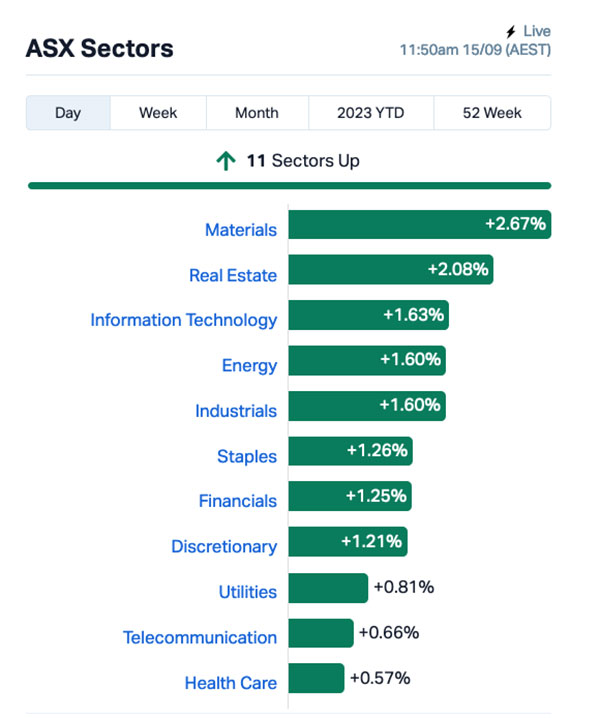
It’s a happy day on the ASX at lunchtime, with the market up 1.6% as a whole, led to greener pastures by a significant bump from Materials and Energy today.

Even the worst performer, Health Care, is doing better than a few of the winners we’ve seen this week.

asx winner OzAurum
Chart via MarketIndex.com.au

Leading the Large Caps are Liberty Financial (ASX:LFG), up 8.8% since everyone’s forgotten how shoddy the company’s IT security was for years, and Centuria Capital (ASX:CNI) has added 7.4% because that’s what capital companies are supposed to do.

In the headlines today, it’s become very clear that someone at the ACCC’s holiday plans were ruined by a cancelled flight, after the watchdog gave Qantas another kicking this morning, refusing to allow the company to collude – sorry, co-ordinate – with Chinese carrier China Eastern on passenger and cargo transport operations between two countries.

And it would seem that founder and CEO of Gurner Group, Tim Gurner, has seen the error of his ways, after showing the world just how much of an arsehole people can be when they’ve got money.

In case you missed it, here’s what Gurner said the other day.

Gurner Group founder Tim Gurner tells the Financial Review Property Summit workers have become “arrogant” since COVID and “We’ve got to kill that attitude.” https://t.co/lcX3CCxGuj pic.twitter.com/f9HK2YZRRE

— Financial Review (@FinancialReview) September 12, 2023

He’s since issued an apology. Sort of.

“There are clearly important conversations to have in this environment of high inflation, pricing pressures on housing and rentals due to a lack of supply, and other cost-of-living issues,” he said in a statement.

“My comments were deeply insensitive to employees, tradies and families across Australia who are affected by these cost-of-living pressures and job losses.

“I want to be clear: I do appreciate that when someone loses their job it has a profound impact on them and their families and I sincerely regret that my words did not convey empathy for those in that situation.”

Now, the last thing I want is to end up on the unemployment queue, despite how much joy it would obviously bring to Gurner’s coal-black swine heart – so, I’ve chosen my words very carefully here.

[redacted]

NOT THE ASX

Earlybird Eddy Sunarto has reported that Wall Street’s had a decent day for a change, which left the S&P 500 up by +0.84%, blue chips Dow Jones up by +0.96%, and tech heavy Nasdaq by +0.81%.

That’s off the back of news that US retail sales increased more than expected by 0.6% in August, which points to the resilience of US consumers despite rising interest rates, but the US Producer Price Index meanwhile increased 0.7% in August, indicating stubborn inflation.

Arm Holdings’ highly-anticipated trading debut on Nasdaq got off to a good start, with the chip design company soaring by 25% to close at US$63.59.

At a US$60 billion valuation, Arm’s PE (price to earnings) multiple is trading around 110x, which is comparable to Nvidia’s valuation at 108x.

Other chipmakers like Micron Technology and Broadcom also added between 1-2% last night.

EV maker Nikola surged more than 32% after the company announced plans to sell its hydrogen fuel-cell trucks later in September.

Online used car retailer Carvana also surged 13.5% as investors turned bullish on used cars in anticipation of the the looming UAW workers’ strike which analysts say could be the ‘biggest auto strike in generations’.

In Asia,  Japan’s Nikkei is up 1.34%, Shanghai is 0.5% higher and Hong Kong’s Hang Seng has climbed 1.53% as well.

The mood is buoyant in the region despite news that Russian leader Vladimir Putin has reportedly accepted an invitation from Kim Jong-Un to visit North Korea.

“I would love to visit your beautiful country and will be there with 250,000 troops as soon as I have finished my visit to Ukraine,” Putin didn’t say, but we all know he was thinking it.

ASX SMALL CAP WINNERS

Here are the best performing ASX small cap stocks for 15 September [intraday]:

Swipe or scroll to reveal full table. Click headings to sort:

Code Company Price % Volume Market Cap
OZM Ozaurum Resources 0.098 206% 15,594,825 $4,064,000
AVW Avira Resources 0.002 100% 1,000,000 $2,133,790
PNX PNX Metals 0.003 50% 101,309 $10,761,249
ADS Adslot 0.004 33% 2,308,645 $9,799,853
BNR Bulletin Res Ltd 0.08 33% 802,720 $17,615,466
EVR Ev Resources Ltd 0.015 25% 810,957 $11,231,809
AUG Augustus Minerals 0.25 25% 531,815 $16,324,000
GTG Genetic Technologies 0.0025 25% 261,039 $23,083,316
GTR Gti Energy Ltd 0.01 25% 19,750,267 $16,359,577
PIL Peppermint Inv Ltd 0.01 25% 7,294,522 $16,302,855
SI6 SI6 Metals Limited 0.01 25% 11,833,243 $15,950,875
TKL Traka Resources 0.005 25% 3,450,000 $3,485,317
OKR Okapi Resources 0.13 24% 3,753,851 $22,059,032
LBT LBT Innovations 0.017 21% 267,077 $4,982,605
IEC Intra Energy Corp 0.006 20% 8,710,080 $8,103,908
SIS Simble Solutions 0.006 20% 1,684,945 $3,014,754
FBM Future Battery 0.135 17% 9,795,592 $52,365,315
SZL Sezzle Inc. 21.21 17% 31,806 $49,637,929
BSN Basin Energy 0.14 17% 698,558 $7,203,600
KGL KGL Resources Ltd 0.14 17% 12,186 $68,075,024
CRB Carbine Resources 0.007 17% 470,000 $3,310,427
NES Nelson Resources 0.007 17% 72,857 $3,681,566
TAS Tasman Resources Ltd 0.007 17% 100,000 $4,276,016
5EA 5E Advanced 0.405 16% 966,591 $106,398,873
TON Triton Min Ltd 0.023 15% 448,649 $31,227,112

Topping the small caps chart today is Ozaurum Resources (ASX:OZM), which is so far out in front of the rest of the market, everyone’s starting to miss it.

OZM was flying hard right from open this morning, on news that the company has snapped up the Linopolis Jaime Project – a strategically held area of over 20 Lithium-Cesium-Tantalum (LCT) bearing pegmatites that have been mined intermittently for tantalite, beryl, tourmaline, brazilianite and feldspar intermittently by the Pacheco family and other artisanal miners for over 50 years.

OZM wants the spot for its lithium, as it boasts spodumene grades of up to 7.36% LiO2 with an average spodumene grade of 6.94% LiO2 confirmed within a +7m wide spodumene zone.

Them’s big grades.

Future Battery Minerals (ASX:FBM) is rising nicely this morning, up nearly 22% on news that the company has received firm commitments for a heavily oversubscribed $7.6 million placement, including dollars coming in from some Big Names like Hancock Prospecting.

FBM says it’s going to spend the money on speeding up exploration drilling at the Kangaroo Hills Lithium Project (KHLP) in WA, in which the recent Phase 3 drilling has confirmed a significant spodumene bearing pegmatite swarm at the Big Red and Rocky prospects.

Also moving, but in a weird way, is Element 25 (ASX:E25), which is up 25% this morning on no local news, the morning after its OTCQX-listed arm ELMTF dropped a similar amount overnight.

That one’s a little above my pay-grade to understand – if anyone’s got a theory, I’m all ears.

(Ed: Or maybe you need a pay cut.)

ASX SMALL CAP LOSERS

Here are the most-worst performing ASX small cap stocks for 15 September [intraday]:

Swipe or scroll to reveal full table. Click headings to sort:

Code Company Price % Volume Market Cap
CT1 Constellation Tech 0.002 -33% 500,000 $4,413,601
BGE Bridgesaaslimited 0.025 -22% 67,787 $929,152
AVM Advance Metals Ltd 0.005 -17% 2,051,924 $3,531,352
EDE Eden Inv Ltd 0.0025 -17% 2,668,130 $10,090,911
FFG Fatfish Group 0.01 -17% 295,631 $14,282,876
RLC Reedy Lagoon Corp. 0.005 -17% 79,944 $3,700,102
AMN Agrimin Ltd 0.185 -16% 34,790 $63,437,547
NAG Nagambie Resources 0.022 -15% 304,142 $15,124,884
1AG Alterra Limited 0.006 -14% 1,646,769 $4,875,868
AJL AJ Lucas Group 0.012 -14% 250,000 $19,260,215
EMP Emperor Energy Ltd 0.012 -14% 1,495,700 $3,764,075
14D 1414 Degrees Limited 0.033 -13% 508,939 $9,050,404
MGU Magnum Mining & Exp 0.034 -13% 3,548,498 $28,218,777
BMO Bastion Minerals 0.021 -13% 522,023 $4,159,781
MOZ Mosaic Brands Ltd 0.13 -12% 276,931 $26,329,700
ZNC Zenith Minerals Ltd 0.093 -11% 416,791 $36,999,993
XF1 Xref Limited 0.16 -11% 20,590 $33,511,732
CCZ Castillo Copper Ltd 0.008 -11% 93,121 $11,695,548
JTL Jayex Technology Ltd 0.008 -11% 955,053 $2,531,507
NAE New Age Exploration 0.008 -11% 3,397,497 $12,923,090
SHO Sportshero Ltd 0.016 -11% 3,284,255 $10,350,020
MTC Metalstech Ltd 0.175 -10% 18,923 $36,777,895
AHK Ark Mines Limited 0.22 -10% 62,767 $11,060,466
RDM Red Metal Limited 0.09 -10% 612,719 $24,559,174

The post ASX Small Caps News Wrap: Who got canned for their love of monkeys this week? appeared first on Stockhead.

Jorge Luis Pacheco: The Lockdown Album

In a couple of months, we will turn the bend to 2024. The thought does arise: Hadn’t we better leave the pandemic and its horrors in the rearview mirror? And with it, things like the nightmare off the lockdown? However, it is especially true – at least when it comes to the lockdown – that scores of peoples’ livelihoods were severely curtailed because of all the above. Few experienced more upheaval than recording and performing artists like Jorge Luis Pacheco, whose ability to earn a living ground to a screeching halt overnight – not to mention the fact that it stayed that way for almost two years.

In the case of Mr Pacheco, however, listening [this late] to how he turned despair into triumph musically – and emotionally speaking – is nothing short of miraculous. This scintillating hour-long disc – The Lockdown Album – is dazzling from end to end. From the iconic Compay Segundo classic Chan-Chan, which evokes the darkness of solitariness at the beginning, then turning ever so gradually towards light is – in its dreaminess – simply one of the most fabulous openings to a set. Ever. Not the least because nothing can prepare you – even if you know the next monumental piece by Frederic Chopin – for the Revolutionary Etude, and not because of its frenzied, monumental melodic and harmonic architecture, but because of the brilliant, almost insolent virtuosity with which Mr Pacheco makes it his own.

Sviatoslav Richter has played one of the purest versions of this work, Vladimir Horowitz with his genius for everything Chopin and his attack has performed perhaps the mightiest rendition. Mr Pacheco’s rendition reveals his mastery of two idiomatic languages – the one in which Chopin wrote [i.e., the ‘Romantic/Classical’ one] and Mr Pacheco’s own deeply interiorised [Afro-Cuban] idiom. From its turbulent Chopinesque first part, which brims with furious cascades of musical divine madness, with double notes and grand arpeggios and one hyperactive virtuoso gesture after another.

The naughty capering continues as Mr Pacheco turns his di-optic visionary attention to the Afro-Cuban interpretation of the Revolutionary Etude as he is joined in by virtuoso bassist Helmut Reuter and the brilliant drummer Thomas Hempel. There is ample reason to regard the performance of this work not only as one of the most inventive, but also – for all the reasons mentioned above – as one of the best versions even if it veers away from Chopin’s script when Mr Pacheco turns it into an Afro-Cuban idiomatic performance.

If you thought that this might just be the apogee of the album [certainly in my view], there is more to come in the form of Ludwig van Beethoven’s celebrated final movement of his epic 9th Choral Symphony – Ode An Die Freude. The unforced manner of the grandiosity and at times, fragile music is stunning. In the most robust passages of the work, with its delicate pizzicato pedal notes, it is refreshing to hear all the detail that Mr Pacheco brings out in his version of the work. Registrations of theme and gestures are beautifully balanced throughout, and the pleno, while thrilling, isn’t overbearing. There is fizz and sparkle in all the right places and just enough warmth in the bass. If you blink you might almost miss the brilliant touch of the faux chorale provided by The Twäng.

The performance is not all about grandiosity and vaunted ornamentation. Mr Pacheco knows exactly when to put his virtuoso pianism to work emphasizing pianissimo passagework and that is clear to see in his breakout soli on La Conga, and – especially on the next truly astounding musical accompaniment to William Shakespeare’s famous Sonnet 18. The pianist’s glorious restraint makes way for the spotlight to be put exactly where it should be – on the lustrous voice of Anna Rabea Pacheco, who turns the poet’s lyric into something heart-stoppingly memorable.

At first blush, the Bee Gees song How Deep is Your Love may sound out of place, but it certainly isn’t. This is music to get the artist and his beloved through the loneliness of the lockdown, after all. And the aching beauty of Ms Pacheco’s vocal is once again a reminder that she is – with her feather-light voice – an artist of the first order. You might also almost forget the racy missive To Oscar, which seems to me to be a perfectly climactic finale to an utterly brilliant album.  

If there is one thing I would wish for this recording, it would be more careful attention to separating the thunder of the Mr Hempel’s bass drum and Mr Reuter’s dark, rumbling bass. It doesn’t mar this brilliant music but makes it a little difficult to listen to – and enjoy – the music at high volume, which is how it should be enjoyed. It would also enhance the poignancy of Mr Pacheco’s fortissimos and pianissimos which play out so subtly in this music that you ascend to a rarefied realm just by playing – and, indeed, enjoying – large chunks of his music over and over again. Even with this engineering flaw [and even my acoustic tiles didn’t help much] this is still an album to die for.

Deo gratis…

YouTube Playlist – Jorge Luis Pacheco: The Lockdown Album

Music – 1: Chan-Chan; 2: Revolutionary Etude; 3: La Conga; 4: How Deep is Your Love; 5: Ode an Die Freude; 6: 705 y Medio; 7: Sonnet 18; 9: To Oscar.

Musicians – Jorge Luis Pacheco: piano, synthesizer, and voice; Helmut Reuter: bass; Thomas Hempel: drums; Anna Rabea Pacheco: voice [5, 7]; The Twäng: chorus [5].

Released – 2022
Label – ropedope [RAD 667]
Runtime – 1:00:37

5 Tips For Choosing Gifts

5 Tips For Choosing Gifts

We all enjoy to obtain presents, whether it’s at Christmas or birthday celebrations, or also an unique wedding anniversary. Below are a couple of pointers that might assist you select the ideal present for the appropriate individual.
1. To aid comprise your mind you can quickly check out testimonials of presents you are taking into consideration purchasing locations like Amazon.com, Buy.com, Epinions.com, BizRate.com, and so on. As well as naturally, you can also buy from there as well.
Cost contrast for presents is simple if you’re switching over in between websites like Shopping.com, PriceGrabber.com as well as Cnet.com. The least expensive present cost is out there.
You can conquer this by obtaining present devices, such as headscarfs, belts, hats, and so on 4. It’s evident, however maintaining an up to day listing of the birthday celebration, wedding anniversary, and so on, days of your loved ones and also good friends will certainly indicate that you’ll constantly recognize when it’s time to get a present.
5. Constantly think of the recipient of the present. Your initial auntie is not likely to value a year’s membership to a provocative prestige publication, as well as your young nephew most likely does not truly desire a set of socks.
Presents must not be simply for Christmas and also birthday celebrations. There’s no factor why you can not offer an unique present to a person unique simply since you desire to at any kind of time of the year.

We all like to get presents, whether it’s at Christmas or birthday celebrations, or also an unique wedding anniversary. Right here are a couple of pointers that might aid you select the best present for the appropriate individual.
It’s noticeable, however maintaining an up to day checklist of the birthday celebration, wedding anniversary, and so on, days of your loved ones as well as pals will certainly indicate that you’ll constantly understand when it’s time to purchase a present. There’s no factor why you can not provide an unique present to a person unique simply due to the fact that you desire to at any kind of time of the year.

How Trickshot CEO Makes Drinks 🎱 #shorts

I am a big fan of trick shots, and I enjoy watching Trick shot CEO’s unreal videos of him playing 🎱.
So I decided to make a video. What if he was making drinks the same style as he plays pool!

You will love these videos:

This trick will never happen again

This trick shot will never happen again

MY SOCIAL MEDIA:
INSTAGRAM https://www.instagram.com/vladslickbartender/ 
MY YOUTUBE SHORTS https://www.youtube.com/c/SlickBartenderShorts  
VLADFLIX VLOG CHANNEL: https://www.youtube.com/c/Vladflix 
TIKTOK @SLICKBARTENDER  https://vm.tiktok.com/TTPdBTYnV5/ 
FACEBOOK Vlad Slickbartender https://www.facebook.com/vladslickbartender
FOR SPECIAL/VIRTUAL EVENTS https://slickbartender.com 

#shorts

Tagged:

Wife of ‘El Chapo’ released from US prison

Emma Coronel, the wife of Mexican drug lord Joaquin ‘El Chapo’ Guzman, seen during his trial on 2019 (Don Emmert/AFP

Emma Coronel Aispuro, the wife of jailed Mexican drug lord Joaquin “El Chapo” Guzman, was released on Wednesday after serving nearly two years of a three-year prison sentence for drug trafficking and money laundering.

The 34-year-old Coronel was released from a halfway house in Long Beach, California, according to the Federal Bureau of Prisons.

The former beauty queen, who married the ruthless drug czar when she was a teenager, was sentenced to three years in prison by a US judge in November 2021.

Guzman was extradited from Mexico to the United States in 2017 and sentenced in July 2019 to life in prison.

During her trial, prosecutors and her defense lawyers said Coronel was not involved in the core business of Guzman’s Sinaloa Cartel, which shipped hundreds of tons of cocaine, heroin, methamphetamine and other drugs into the United States.

“The defendant’s actual role was a minimal one,” prosecutor Anthony Nardozzi said.

“The defendant was not a leader, organizer, boss or other type of manager,” Nardozzi said. “Rather she was a cog in a very large wheel of a criminal organization.”

Coronel, who helped facilitate Guzman’s spectacular 2015 escape from a Mexican prison, regularly attended her husband’s trial in New York.

A dual US-Mexican citizen, Coronel was able to move in and out of the United States freely until she was arrested at Dulles International Airport outside Washington in February 2021.

For customer support contact
[email protected]. Report typos and corrections to
[email protected].

Proud Boys leader Enrique Tarrio, who was recently sentenced to more than two decades in prison for engaging in a seditious conspiracy against the United States government, believes that former President Donald Trump will pardon him should he get reelected next year.

CBS News’ Scott MacFarlane reports that Tarrio this week delivered that message to supporters via a jailhouse call to a vigil being held outside the prison where he has been incarcerated.

“Bring people to vote,” Tarrio told the crowd, according to MacFarlane. “President Trump gets re-elected in 2024, because that’s our number one hope for all of us to go free.”

Trump has flatly stated that he would pardon many of the people who violently stormed the United States Capitol building on January 6th, 2021, although he has said he would be reluctant to pardon rioters who engaged in particularly brutal violence against Capitol police officers.

Trump notoriously used his presidential pardon powers for the benefit of political allies during his one term in office, including on people who went to jail for crimes that they committed on his behalf, including former campaign manager Paul Manafort and right-wing operative Roger Stone.

CONTINUE READINGShow less

A Fox News host asking a House Republican if he has any evidence President Joe Biden benefitted from his son Hunter’s business contracts got the brush off and was forced to remind the congressman “everybody” has seen a video he claimed no one is talking about.

That video is of then-Vice President Joe Biden talking about how he followed official U.S. foreign policy that was also supported by European nations, the World Bank, and the International Monetary Fund (IMF), requiring the Prosecutor General of Ukraine, Viktor Shokin, to be relieved of his duties over his record of not prosecuting corruption.

Republicans have turned the video’s implication on its head, wrongly insisting it is evidence of corruption and bribery of the now -President, and using it in their efforts to change public opinion and attack Biden.

“Shokin’s inaction prompted international calls for his ouster and ultimately resulted in his removal by Ukraine’s parliament,” USA Today reported in 2019. “Without pressure from Joe Biden, European diplomats, the International Monetary Fund and other international organizations, Shokin would not have been fired, said Daria Kaleniuk, co-founder and executive director of the Anti Corruption Action Centre in Kiev.”

“At one point, Biden withheld $1 billion in aid to Ukraine to pressure the government to remove Shokin from the Prosecutor General’s Office,” the paper adds. “Burisma Holdings was not under scrutiny at the time Joe Biden called for Shokin’s ouster, according to the National Anti-Corruption Bureau of Ukraine, an independent agency set up in 2014 that has worked closely with the FBI.”

U.S. Rep. Jason Smith, Republican of Missouri, told Fox News’ Martha MacCallum that President Joe Biden “could be compromised.”

“Have you seen evidence,” MacCallum asked Smith, “that shows a link to money from these contracts that Hunter Biden had, that that money helped to support the lifestyle of President Biden? Have you seen that connection?”

Instead of answering the question, Congressman Smith said, “You know one thing people’s not talking about, what we have seen is his video statement in Ukraine, saying that they needed to remove the federal prosecutor that was investigating the Burismo which is the company that his son was sitting on the board getting paid over two million dollars to be sitting on it, and he brags about the gentleman being fired –” Smith said, wrongly naming Burisma.

Before he could finish MacCallum interjected, saying, “Yeah, everybody has seen that one,” referring to the video.

“That right there is enough in itself to say, something is not right,” Smith concluded.

“Alright, we will see where this goes. Representative Smith, thank you,” MacCallum said.

Former Lincoln Project executive director Fred Wellman called Smith’s remarks, “Complete bullshit.”

“Dozens of countries were pushing to get the deeply corrupt Shokin fired and the Republicans are now using him as a witness. That’s before we talk about all of that happened before he was President. These clowns have nothing.”

Watch the video below or at this link.

CONTINUE READINGShow less

Just months before the death of Spanish dictator Francisco Franco in 1975, Julio Pacheco Yepes says he was arrested and tortured by police for belonging to a left-wing underground movement that opposed the regime.

Now, nearly five decades on, Pacheco Yepes is set — at a hearing that opens on Friday — to become the first victim of the Franco dictatorship to testify before a Spanish judge investigating allegations of torture.

“It could open a chink in the wall of impunity that we (victims) have had to suffer for so long,” the 67-year-old told AFP at his home in Vallecas, a working-class district of southeastern Madrid, referring to the people who suffered repression during Franco’s 1939-75 rule.

“It is an important milestone. Keep in mind that this all happened nearly 50 years ago. Until now, nobody, no judge, has accepted a lawsuit or heard testimony in court. This is a first.”

Over the years, around a hundred lawsuits have been filed over alleged torture suffered during the Franco era, but none of them was ever admitted, according to associations representing victims.

Judges have argued that the amnesty law passed in 1977 during Spain’s transition to democracy made it impossible to prosecute crimes committed by political opponents of the regime or those perpetrated by “civil servants and public order agents” such as police.

But many Franco-era victims such as Pacheco Yepes and his wife Rosa Maria Garcia Alcon — who was also arrested in 1975 — argue that torture is a crime against humanity which cannot be covered by an amnesty and the statute of limitations.

– ‘A pact of silence’ –

“What was imposed (in Spain) was a pact of silence and it has taken many years” to break it, said Garcia Alcon, 66, who heads La Comuna victims’ association.

In August 1975, Pacheco Yepes and Garcia Alcon — teenagers who were going out together at the time — were both arrested for their involvement in the Revolutionary Anti-Fascist and Patriot Front (FRAP), a left-wing student movement opposed to Franco.

They were taken to the police headquarters in Madrid’s Puerta del Sol Square, which was used as a lockup and torture centre during the dictatorship.

They say various officers tortured them there for days before jailing them for “terrorism”.

In December 1975, a month after Franco’s death, the pair were released on bail. Several months later they were pardoned.

In 2018, Garcia Alcon filed a lawsuit against one of the two police officers she says tortured her but it was not admitted by the courts.

She will also take the stand on Friday as a witness in the case brought by her husband.

She says one of the ways the police tortured him was to force him watch them hurting her.

– ‘Only truth can heal’ –

Pacheco Yepes filed his lawsuit against four of his alleged torturers in February, just months after Prime Minister Pedro Sanchez’s left-wing government passed the democratic memory law honoring the victims of violence and persecution under Franco.

The law was opposed by the right, which said it would only re-open the wounds of Spain’s past.

Pacheco Yepes said it was difficult to gather the documentation to support his case, given the “total” unwillingness of public bodies such as the National Archive to “cooperate”.

While he would like to see his alleged torturers “sitting in the dock”, if the judge ultimately decides not to put them on trial, it will still serve as an important reminder about “what Francoism was”, he says.

This is particularly important at a time when the far-right Vox party is gaining ground and there is “a strong current” of nostalgia about the Franco era, he says.

“The only way to fight this… is by showing how politically backwards (the Franco dictatorship) was,” he told AFP.

“The only way to close wounds is with the truth… If you don’t, they will always bleed.”

CONTINUE READINGShow less

The history of Lisbon: Portugal’s capital of exploration and commerce | HistoryExtra

Olisipo: Lisbon under the Romans

The location was good for the Romans for several reasons. The Tagus was rich in fish, especially the ones used for garum – a smelly, fermented fish sauce. It also provided an ideal stopping-off point on the route north out of the Mediterranean, to the British Isles or France.

They planted their city, Olisipo, on the south-facing slope of what’s now the castle hill. At the top was a fortification, with the settlement spreading along the riverbank and surrounded by a defensive wall.

Roman theatre. (Photo by Dreamstime)

Olisipo became a wealthy, important Roman city, with a 190m-long hippodrome on the site of what’s now officially King Pedro IV Square, better known as Rossio Square. It also had a theatre seating more than 3,000, the remnants of which can be visited just north of the Sé Cathedral.

More like this

Al-Ushbuna: Lisbon under Islamic rule

After Roman rule in western Europe collapsed around the early fifth century, Olisipo largely fades from the historical record. Several tribes invaded from the north-east during this period, including the Visigoths – who stayed for about three centuries – but they left little trace.

History’s Greatest Cities: A HistoryExtra podcast series

This companion piece accompanies our podcast miniseries

The next big watershed moment came in the eighth century, with the arrival of Islamic invaders from north Africa, who took the city in AD 714, calling it Al-Ushbuna. They built a citadel on top of the Roman fortress, where St George’s Castle (Castelo de São Jorge) currently stands.

Spreading downhill from that bastion is the distinctive Moorish labyrinth of the old town – the Alfama and Mouraria districts – which bear some semblance to a North African souk. When you wander the winding alleys, ducking under washing hung out to dry and sniffing the aroma of grilling sardines, it conjures up a flavour of what it must have been like 12 centuries ago.

The so-called reconquest of the peninsula by Christian forces reached Lisbon in 1147. A European coalition army of crusaders travelling from the north stopped off in Porto, where the bishop persuaded them to come and help King Afonso Henriques of Portugal take Lisbon.

What we know of the siege mostly comes from an English crusader’s letter home, now held at Corpus Christi College in Cambridge. He provides a thrilling account of how the crusaders built two siege towers, and used battering rams and catapults to attack the city walls. The siege lasted from 1 July until late October, when the Moors finally surrendered.

Lisbon and the birth of Portugal

This marked a pivotal moment for the Portuguese kingdom, which was only half a dozen years old at that point. One Portuguese historian claimed that the conquest of Lisbon wrote out the nation’s birth certificate.

The city now grew quite quickly, with the next king, Dinis, continuing the momentum, extending the city walls – a 30m stretch that was discovered during work on the Bank of Portugal in 2010.

Carmo Church in Lisbon. (Photo by Getty Images)

One of the most interesting sites from that period is the Carmo Church and monastery (officially known as the Convent of Our Lady of Mount Carmel) in the downtown area next to Rossio Square. It’s now a roofless ruin, but still retains glorious soaring arches like great stone ribs.

Its construction began in 1389 on the orders of arguably Portugal’s greatest military leader, Nuno Álvares Pereira – a key figure in Lisbon’s story.

Pereira became the richest man in Portugal after the king, and a great national hero. He led the army when Portugal was fighting for survival against Castile in the 1383–85 war, and helped put King João I on the throne. He also won a major victory over the Castilians at Aljubarrota in 1385, with the help of English longbowmen, defeating a much bigger army. His triumph galvanised Portugal, showing that this little country could prevail against the odds.

João I married Philippa of Lancaster, daughter of John of Gaunt. Some of their children, including Henry the Navigator, would become what the Portuguese refer to as the ‘illustrious generation’ – the figures behind the Age of Exploration.

Lisbon during the Age of Exploration

In the 15th century, the stars aligned for Portugal in a spectacular way. Its empire burgeoned, driven by technical ingenuity, the geopolitical guile of its leaders and daring ambition.

Crucially, Portugal had impressive naval architecture: it had caravels – the swiftest craft on water – plus large galleons called carracks.

The Portuguese quickly built up an impressive knowledge of the winds and the ocean currents. They had excellent mathematicians, and invented astronomical instruments such as a simplified astrolabe.

Lisbon was behind all of this power that Portugal projected across the Atlantic Ocean, the Indian Ocean, the Red Sea and beyond. It became the first European power to reach Japan, in 1543. And the upshot was that back in Lisbon it rained money.

Initially, the Portuguese sailed along the African coast, reaching Madeira and the Azores. In 1488, Bartolomeu Dias became the first European to round the Cape of Good Hope and reach the Indian Ocean. At the end of the 15th century, Manuel I sent Vasco da Gama off from Belém, the riverside area just west of central Lisbon, on his great voyage to India.

Manuel’s successor, João III, hatched the ambitious India Plan to divert the lucrative spice trade with the Orient through Lisbon instead of Venice – to bring these hugely profitable goods to Europe by sea instead of overland. King João III, known as the coloniser, expanded Portuguese power still further, stabilising Brazil, which the Portuguese officially ‘discovered’’ in 1500.

Lisbon’s imperial wealth

The vast wealth harvested during the early days of the Age of Exploration was concentrated in Lisbon, which became one of the biggest and busiest ports in Europe. It was an Aladdin’s cave of exotic goods from Africa and the Orient: gold, silk, jewels, sugar and spices, enslaved people from Africa, Chinese porcelain, Indian filigree, monkeys, parrots and more.

It was also a Renaissance melting pot. As well as Europeans, people arrived with these returning voyages from Africa, India and Brazil. This was a time of plenty for the church, which travelled together with the crown on these voyages of discovery. Churches, convents and monasteries multiplied in Lisbon, taking prominent hilltop locations.

In 1498, Manuel I set in motion a plan to move out of St George’s Castle to the riverside, which shifted the city’s centre of gravity and completely reshaped its growth. The building of his palace on the river – the Paço de Ribeira, which no longer exists – triggered an urban revolution.

The palace was said to be one of the most luxurious and stunning Portuguese dwelling ever seen, housing artwork by old masters, around 70,000 books, an elaborate royal chapel. Around it sprang up the trappings of the empire: India House, the Royal Mint, the Royal Armoury – and the king could gaze out from his palace and see it all.

The greatest surviving monument from that time is the Jerónimos Monastery in Belém. This was Manuel I’s big prestige project built on a vast scale, and the very ornate style in which it was designed is known as Manueline. It stands right by the river, so any ship sailing into Lisbon had to pass it – sending out a clear message: we are very rich, but also very pious.

Lisbon’s Castilian interlude

After flying so high, Lisbon came back down to Earth with a bang, when the quixotic young king Sebastian’s unwise military adventure in North Africa handed the keys of the kingdom to Castile.

Sebastian acceded to the throne in 1557, at the age of just three, so the country was ruled by regents until he turned 14 in 1568. He then reigned for only ten years before his death on the battlefield in North Africa, seduced by tales of chivalry and the glorious feats of his royal ancestors.

Sebastian ordered the rebuilding of the old royal quarters in the castle, and in fact was the last Portuguese monarch to sleep there. But after his African misadventure, Lisbon went from the seat of the royal court and an imperial capital to being just another provincial city.

That was because the throne passed to Phillip II of Spain: grandson of Manuel I, and son of Isabella of Portugal. And so, in 1580 he also became Felipe I of Portugal – changing everything.

There’s only a very faint footprint of Spanish rule in Lisbon, which Castile mostly ignored. The most noticeable legacy of that period is the Monastery of São Vicente de Fora – a massive building, Felipe’s pet project. It’s a very sober, imposing building with two towers at the front to make it look like a cathedral.

There was a gradual groundswell of Portuguese nationalism, with a group called the Forty Conspirators plotting against Spanish rule. And in 1640, independence was restored on 1 December – which is still a public holiday in Portugal.

That opened another new chapter for Lisbon, boosted later that century when gold started flowing from Brazil. The first shipment arrived in Lisbon in 1699; one legendary gold nugget, which was mined in Brazil in 1732, weighed more than 20kg.

This second period of huge wealth helped pay for major projects such as the Lisbon Aqueduct, which still stands.

It also fuelled opulence and flamboyant consumption under King João V. His son, José I, built a glittering, grandiose Royal Opera House by the Riverside Palace, equal to any in the rest of Europe. Unfortunately, it would last only 215 days.

Devastation and restoration

On 1 November 1755 a hugely powerful earthquake devastated Lisbon. Three violent tremors hit in quick succession, followed by a tsunami the height of a double-decker bus that rolled up the Tagus, then a six-day fire that turned sand to glass.

Central Lisbon was built on gravelly earth, which shifted – and the city collapsed. All those great buildings – along with the treasured artworks, books, and official records of the Age of Exploration – were lost, either in the quake or the fire or the tsunami.

The king, José I, became a nervous wreck, and handed over the rebuilding of the city to the Marquis of Pombal, a towering figure in Portuguese history who still overlooks his work from a pedestal in the middle of Lisbon’s biggest roundabout. This uncompromising but enlightened despot was given carte blanche to reconstruct the city, rebuilding downtown Lisbon in a sober, symmetrical gridiron pattern a million miles away from those narrow, sinewy Moorish streets of the Alfama and Mouraria.

Lisbon in the aftermath of the Peninsular War

As winter approached in 1807, there was a frenzy along the riverside at Belém – Napoleon’s army was bearing down on Lisbon, and anyone with money, power and influence was scrambling to get out. The elite planned to uproot Portugal and just replant it 8,000km to the south-west, in Brazil.

These early days of the Peninsula War marked the start of a wretched century for Portugal. Lisbon was stripped of its status and its treasures as the echoes and repercussions of the French Revolution were felt across Europe.

In 1820, there was a liberal revolution in Portugal, which led to the country’s first election. King João VI, who by this point had been in Brazil for almost 14 years, finally returned in 1821. The following year – amid fears that Brazil could be reduced from a kingdom to a Portuguese colony –his son Prince Pedro declared Brazil’s independence, becoming Emperor Pedro. And when João VI died in 1826, he was proclaimed King Pedro IV of Portugal too.

Pedro’s exiled brother, Miguel, challenged him for the Portuguese throne, sparking a civil war. It ended with a triumph for Pedro’s liberal faction in 1834, which resulted in a dissolution of the monasteries and convents, their premises taken over by public institutions.

In the 1830s, a generation of new intellectuals emerged, including dramatist Almeida Garrett, who drove the construction of the Queen Maria II National Theatre in Rossio Square.

Another place worth visiting from that period is the Ajuda Palace, started in 1796 but only partly finished in the first half of the 19th century. Because it took so long, it started out as a baroque palace and ended up as a neoclassical one.

The next watershed moment came in 1851, when the Duke of Saldanha seized power in a military insurrection, and brought about what’s called the Regeneration. Fontes Pereira de Melo, the government minister of public works, oversaw another major redevelopment of the city. New avenues were built, new public transport installed, new drains and sewage networks laid.

The chief engineer of Lisbon City Council, Ressano Garcia, took his cue from Baron Haussmann’s ambitions in Paris, introducing parks and gardens and woodlands. And later that century, Lisbon’s trademark funiculars were installed.

Lisbon under Salazar’s dictatorship

In 1908, King Carlos I and his son and heir were assassinated. The carriage in which they were riding at the time is on display at the National Coach Museum in Lisbon; you can still see the bullet holes from that attack.

It was the starting pistol for more unrest that century, including the Republican Revolution of 1910 that brought bloodshed, barricades and cannon fire in the streets of downtown Lisbon. King Manuel II fled – and that was the end of the Portuguese monarchy.

At the time of yet another military coup in 1926, António Salazar was a professor at Coimbra University, between Lisbon and Porto. He was named as finance minister and, eventually and incredibly, balanced the national books – so impressing the military that in 1932 they appointed him the head of government.

He came to rule as a repressive dictator, staying in power until 1968. Through that turbulent period, dissent was repressed and the population kept largely poor. He did, though, keep Portugal out of the Second World War, and during this time Lisbon became known as Europe’s quayside because of the numbers of refugees fleeing the Nazis, mostly sailing to the US.

Amid all that, there was one remarkable event in 1940: the Portuguese World Exhibition, staged in Belém to mark the founding of Portugal in 1140 and the restoration of independence in 1640, but also to show off the Portuguese empire.

The Padrão dos Descobrimentos (Monument to the Discoveries), with Henry the Navigator leading the ship. (Photo by Dreamstime)

A first version of the riverside monument to the discoveries was created in the shape of a stylised caravel poking out into the river, with statues of 32 Portuguese heroes alongside it – Henry the Navigator and Vasco da Gama among them.

Salazar’s public works minister, Duarte Pacheco, extended and improved Lisbon with new housing estates and new sanitation. He built the National Stadium, the National Library, Lisbon Airport, the Royal Mint, the Lisbon University campus, all in a very new, rather brutalist style – typical of Estado Novo, the ‘new state’. But the main contribution, in visual terms at least, from that period is the Salazar suspension bridge, which looks like the Golden Gate Bridge in San Francisco, built in 1966.

The Salazar regime came to an end with what’s known as the Carnation Revolution. On 25 April 1974, Lisbon woke up to find tanks in the streets – and Portuguese society turned on its head overnight.

At the time, Portugal was fighting to quell independence movements in its African colonies – Angola, Guinea-Bissau, Mozambique, Cape Verde, and São Tomé and Príncipe – all of which now soon gained independence, and half a million expat Portuguese flooded back to Lisbon.

Portugal today

In 1986, Portugal joined the European Economic Community – now the European Union – which brought a cash bonanza to a country that was very poor at the time. Then, the Expo ’98 World’s Fair brought about the so-called Lisbon Big Bang, continuing and expanding the development programme – extending the underground network, building skyscrapers and much more.

The Expo’s main legacy was the Vasco da Gama Bridge, Europe’s longest at the time stretching for 17.2km. It’s a very can-do, wind in your hair kind of monument – a symbol of the wider retooling of a city that’s now such a fascinating, engaging place to explore.

Barry Hatton was talking to Paul Bloomfield, travel journalist and host of our podcast series History’s Greatest Cities

What to see: Lisbon in five places

From Roman colony to Moorish citadel and springboard for global exploration, Portugal’s capital has played many roles. Barry Hatton highlights five sites to explore in Lisbon.

1. Castelo de São Jorge

More palimpsest than palace, the layers of history visible in this hilltop citadel reveal the capital’s tale since its earliest days. This is where the Romans built their fortification after founding their settlement of Olisipo in 138 BC, on the site of an even earlier Iron Age settlement, traces of which are found in the north-eastern corner of the Castle of St George.

Following the victory of Christian forces over Islamic occupiers in the 1147 Siege of Lisbon, King Afonso Henriques transformed the Moorish citadel into his royal residence. After Manuel I moved his home into a more luxurious palace by the river in 1511, the castle served other purposes, used as a prison among other things.

Its ramparts, ruined by the 1755 earthquake that devastated the city, remained in ruins till they were heavily renovated under dictator António Salazar in 1938. Today, the castle is like a crow’s nest: from this eyrie, the city spreads out at your feet across a patchwork of terracotta roofs. Visit early in the morning or evening, when the soft light gives the castle’s yellowish stone a golden hue.

2. Centro Cultural de Belém

In some ways, this building is a missed opportunity. Constructed in 1993 as a cultural and conference centre, its pale, blocky, square form is in stark contrast to the ornate, overwrought decorations of the nearby Mosteiro dos Jerónimos.

But it’s a fine place to visit for concerts and other events, and to explore the excellent collection of modern art in its Museu Coleção Berardo – including works by Picasso, Andy Warhol, Jeff Koon and Piet Mondrian, as well as pieces by top Portuguese artists such as Paula Rego.

As a bonus, it’s just along the street from Pastéis de Belém, a Lisbon institution baking what some claim to be the capital’s finest //pastéis de nata// – the custard tarts created by the monks of Jerónimos well over three centuries ago.

3. Mosteiro dos Jerónimos

The Jerónimos Monastery, with its cloisters and church, are simply magnificent – and a testament to the vast wealth brought back to Lisbon during its golden age of exploration and trade.

Commissioned by Manuel I in 1501, construction took more than 100 years to complete. It’s the supreme example of the architectural style dubbed Manueline, with rich, detailed, ornate stone carving. Look for the beautiful //azulejos// (typical blue decorative tiles) in the refectory, the spectacular roof vaulting in the nave, and the 19th-century tomb of explorer Vasco da Gama.

You’ll also find the empty tomb of young King Sebastião, whose death in battle in north Africa in 1578 led to nearly six decades of Spanish rule in Portugal.

4. Aqueduto das Águas Livres

This vast aqueduct, rising above the west of the city, is sober and simple in style, not like the highly decorative Manueline monuments elsewhere. It’s plain and it’s to the point, its splendour lying in its sheer scale – an emphatic reminder of the bounty that Brazilian gold brought to the capital.

Started in 1731, a passion project of João V, its Arco Grande (Great Arch) is 65 metres high and 28 wide – reputedly the biggest stone arch of its kind in the world. It’s said to have three keystones, and can be sundered only by a special kind of sound. It’s not known //what// that sound might be, but obviously it’s not the sound of an earthquake – because it survived the massive tremor of 1755. to younger visitors.

5. Palácio Nacional da Ajuda

After the city was razed by the earthquake and resulting tsunami of 1755, King José I ordered a new palace to be built in the Ajuda hills above Belém, where the ground was solid. Thus began an astonishingly lengthy period of construction lasting 240 years.

Started as a baroque edifice, it was ravaged by fire in 1795, and abandoned when the royal family fled to Brazil on the approach of Napoleon in 1807. It was used as a royal residence by Luis I from 1861, but still incomplete at the time of the 1910 revolution, when work stopped again.

It was ‘finished’ at the end of the 20th century, though the western wing was completed only in 2021. Today it houses a priceless collection of royal treasure, including gold and diamonds from Brazil, plus textiles and artefacts from Japan and elsewhere.

Kim-Putin’s Vladivostok bromance may risk global security, from Europe to Asia

Updated Sept. 11, 2023, 2:42 p.m. ET

Four years ago, North Korean leader Kim Jong Un made a symbolic journey southwards, crossing the border with his armored train to engage with the leaders of the democratic world.

A similar image was in the making Monday, only this time, his train has headed in the opposite direction – towards a deepening bromance with his fellow leader of the authoritarian world, Russian President Vladimir Putin.

Kim had already departed the North Korean capital, a person familiar with the matter told Radio Free Asia, but did not say exactly when.

Kim will “soon visit the Russian Federation at the invitation of the President of the Russian Federation, Comrade Vladimir Putin,” North Korea’s official Korean Central News Agency said late Monday. Simultaneously, the Kremlin also confirmed the visit, according to Russia’s official news agency, Tass. The Kremlin added that the visit will be made in the “coming days.”  

The reports confirm days of speculation of an impending summit between North Korea and Russia in Vladivostok. The increased bilateral diplomatic exchanges – the most recent being the Russian Defense Minister Sergei Shoigu’s visit to Pyongyang in July – have also served to signal that preparations for a major visit are underway.

Japanese media including ANN reported that Russia is preparing for what appears to be a welcome ceremony at its border station of Khasan, where a red carpet will be rolled out.

While the  reports stopped short on saying where Kim and Putin will meet, an earlier report from Tass said Putin is on a two-day work trip to Vladivostok to attend the Eastern Economic Forum, coinciding with information from multiple South Korean diplomatic sources who told RFA that Kim will be traveling to Russia during the period of the forum.

Kim and Putin’s last summit in April 2019 also took place in Vladivostok, where the two reinforced their diplomatic ties. The meeting came a mere two months after Kim’s high-stakes nuclear negotiation with the United States collapsed in Hanoi. After the summit, where Putin reiterated Russia’s role as a regime backer, Kim returned to his brinkmanship diplomacy, firing multiple missiles.

Experts said this week’s summit between the two authoritarian leaders could exacerbate the precarious geopolitical dynamics and inflict further consequences to global and regional security, not only posing new threats to the U.S. and its allies’ spectrum of policies from Europe to Asia, but also affecting Pyongyang’s relations with its other backer, China.   

‘Hat in hand’

The Kim-Putin summit could change security-related dynamics in Europe, as arms trade is likely to dominate the agenda. 

“As we have warned publicly, arms negotiations between Russia and the DPRK are actively advancing,” U.S. National Security Council spokeswoman Adrienne Watson said last week, referring to North Korea by its formal name. “We have information that Kim Jong Un expects these discussions to continue, to include leader-level diplomatic engagement in Russia.” 

Any ammunition supplies to Russia would prolong its aggression against Ukraine and drag the war into a long-term conflict that further destabilizes Europe. Strained ammunition supplies are currently holding Russia back to advance deeper into Ukrainian territories. 

U.S. State Department spokesman Matthew Miller said during a briefing Monday that Russia’s turning to North Korean for weapons support shows that Western sanctions are working.

“A year and a half ago, President Putin launched this war against Ukraine with his full-scale aggression, with a dream of restoring the glory of the Russian Empire. That hope, that expectation of his, has failed. It will continue to fail,” Miller said. “There’s no better evidence of that than now a year-and-a-half later, not only has he failed to achieve his goals on the battlefield, but you see him traveling across his own country hat-in-hand to beg Kim Jong Un for military assistance.”

Miller also pointed out that the meeting is happening on the heels of this past weekend’s Group of 20 summit in India — which Putin skipped, underlining what he called Russia’s “pariah status” in the eyes of many.

“It means that he is having trouble sustaining the military effort,” he said. “So he’s looking for help from North Korea.”

Stronger ties between North Korea and Russia is a worrying development for countries backing Ukraine, said said Ramon Pacheco Pardo, Professor of International Relations at King’s College London and the KF-VUB Korea Chair at the Brussels School of Governance of Vrije Universiteit Brussel.

“This means that Putin will be able to continue his war longer,” Pacheco Pardo said. “It also means that there are countries that think that they can support Russia openly without suffering any serious consequences.” 

The talks would be “aimed primarily at enhancing the bilateral military cooperation,” said Yang Moo-jin, a professor at the University of North Korean Studies in Seoul who had advised the South Korean government over the years. “Especially from Russia’s point of view, it desperately needs conventional weapons from North Korea, in the form of artillery shells, drones and missiles, as it continues its war with Ukraine.” 

Wang Son-taek, director of the Global Policy Center at the Han Pyeong Peace Institute, agreed. It “wouldn’t be a bad idea” from Russia’s perspective to cooperate with North Korea as leverage to break the U.S.-led order and create a “neo-Cold War-like” confrontational security climate, Wang said.

Denuclearization of North Korea

The summit would also set the U.S. back in its denuclearization efforts in the Korean peninsula. North Korea’s acquisition of hi-tech Russian weapons would inevitably boost the country’s deterrence capability against the U.S. and its regional allies. Some of those technologies may include satellite launch technology, advanced inter continental ballistic missiles (ICBMs), and nuclear-powered submarines.  

“It is possible that North Korea could demand a gradual and phased transfer of technology from Russia,” Yang said. “The North could first request technology transfer for its spy satellite, as it has already announced that it will launch one in October. Then, it could ask for ICBM re-entry technology, followed by nuclear-powered submarine technology, and so on.”

Pacheco Pardo also raised the possibility that the bilateral military cooperation may not be a one-time political stunt. “More generally, I think this means that Russia and North Korea will have strong ties as long as Putin is in office, and will provide diplomatic and military support for each other,” he said. 

Any economic support from Russia may also undermine and water down the effects of the international community’s imposed sanctions to force North Korea to denuclearize. On the other hand, a bolstered alliance between Moscow and Pyongyang would reshape the region’s geopolitical dynamics, pulling it further away from the pressure to disarm and non-proliferation.  

Still, Pyongyang’s indignance to international condemnation comes at the expense of a crippling domestic economy. Almost half of the North Korean people were undernourished between 2020 and 2022, a World Food Program report published in July found. The food shortage in North Korea appears to be spreading, with sources inside the country telling RFA that as many as 30% of farmers in two northern provinces are unable to work on collective farms because they’re weak from hunger.

“In the case of North Korea and Russia, they are already under economic sanctions under the U.S.-led world order,” Wang said. “And they may have believed that it may prove difficult for them to remain in compliance with the current order.”

China on the fence

Would the burgeoning Kim-Putin bromance create an opportunity for the United States to thaw the ice with China? China, which wants to elevate its bargaining power against the U.S. and degrade Washington’s global leadership over time, is unlikely to prematurely collide directly with the U.S. However, Beijing could be compelled to reassess its relations with its authoritarian neighbors, as well as with Washington.  

Equally, Washington may use the summit as a means to strengthen cooperation among allies, Wang pointed out. “It could strengthen liberal-democratic alliances and provide an opportunity for the U.S. to align with the democracies, which would put pressure on China to conform more to the rule-based-order.”

For Beijing, the two authoritarian regimes are valued as a strategic asset against the U.S., but cuddling too close with them may jeopardize its relations with the U.S. and its regional allies, which are crucial to improving its economic situation. It needs to maintain access to international markets and foreign investment in order to prevent a further deterioration of its economy. 

“China’s position is to continue its cooperation with North Korea and Russia, but not to confront the U.S. head-on,” Wang said. “In fact, there are fundamental constraints when it comes to North Korea-Russia relations, which arguably question its sustainability. Historically, North Korea has harbored resentment towards Russian imperialism, while Russia perceives North Korea as a demanding friend, often making challenging requests.

“A long-lasting friendship between them might seem elusive. This dynamic may explain China’s fence-sitting, as it appears Beijing is carefully assessing the situation, by neither actively participating nor intervening, gauging the sustainability of these relationships.”

Updates with U.S. State Department spokesman’s comments, attribution in graf 8.

Additional reporting by Alex Willemyns in Washington. Edited by Elaine Chan, Mike Firn and Malcolm Foster.

« Previous Page — Next Page »