Beginning this academic year, the College of Arts and Sciences Office of Undergraduate Academic and Career Advising at Syracuse University debuted an initiative using the artificial intelligence software VMock, an online resume review software.
Though VMock has been available to all SU undergraduate students since 2020, this new initiative allows sophomores to choose between using VMock or meeting one-on-one with a career counselor to develop their resume. This initiative only extends to second-year undergraduate students with declared majors in Arts and Sciences or the Maxwell School of Citizenship and Public Affairs, though VMock is a tool available to students in other SU schools and colleges.
SU is not alone in its implementation of VMock as a step in the career advising process. Over 250 higher education institutions in more than 130 countries use VMock’s services, according to its website.
“VMock is intended as a potential, non-required, avenue and tool for all undergraduates as a first pass at their resume,” Steven Schaffling, assistant dean of student success of Arts and Sciences, told The Daily Orange in an email statement.
Sophomore students who have not already met with a career advisor are required to either schedule a 30-minute meeting or upload their resumes to VMock to lift a hold on their MySlice account, which stops students from registering for classes next semester.
If students choose a one-on-one conference, they are still instructed to upload their resumes to VMock prior to the meeting, according to an email sent to Arts and Sciences sophomore students with account holds. The email states that the VMock option takes five minutes.
Sophomores were selected to ensure that students have some version of a resume early on in their academic career, Schaffling wrote. He wrote that the Arts and Science advising office believes starting sophomore year assures that students won’t fall behind in searching for internships or other experiential education opportunities.
“In a post-pandemic age we want to be dynamic and responsive to student needs … allowing fall semester sophomores multiple avenues is the college being responsive to student needs and experience,” Schaffling wrote.
Using VMock, students can receive rapidly-generated, specific feedback, ranging from spell-check to structural issues, by uploading their resume to the VMock website or app.
Hamid Ekbia, a university professor in Maxwell and the director of SU’s Autonomous Systems Policy Institute, said it’s important to keep up human discretion with AI processes like VMock.
“That’s very encouraging to know that the entities, they try to help students, but these are statistical machines and ultimately they find patterns, and patterns are aggregate patterns, they are not individual,” Ekbia said. “As best as we might try to craft a resume that is unique to us, a lot of that might get lost in the process.”
Ekbia is teaching SU’s first AI and Humanity course this fall, listed between the School of Information Studies and Maxwell.
Though VMock’s feedback is unlimited on each resume submission, students can only upload their resumes 10 times per year, according to the SU career services website. VMock also offers community insights about resumes previously uploaded by Syracuse students, from the average number of words to the typical layout.
VMock also includes an option to start a resume from scratch by using community templates from SU’s career services. With formatting pre-determined in the templates, students only have to input their information and experience.
Resumes submitted through VMock are scored based on three categories — impact, presentation and competencies — and receive a score out of 100 points. Impact is worth up to 40 points, while presentation and competencies are both worth up to 30.
Ekbia said filtering software used in hiring practices is designed to find candidates that have similar traits and experiences to what the company is searching for, not what distinguishes candidates. Softwares like VMock can amplify this, which students need to be careful of, he said.
“What matters most when you apply for a job is what makes you different and unique, not what makes you similar to other people,” Ekbia said. “That is the biggest concern that I have with the use of these systems, because they essentially pigeonhole you.”
SU’s College of Engineering and Computer Science has also implemented VMock as part of its career advising process.
ECS Career Services regularly connects with employers to ensure the resume templates used in VMock match up with the industry standards for what a student is pursuing, Sarah Mack, the director of student success and career services for the ECS, wrote in a statement to The Daily Orange.
Dan Pacheco, a professor of practice of magazine, news and digital journalism and the Peter A. Horvitz Endowed Chair in Journalism Innovation at the S.I. Newhouse School of Public Communications, said students’ exposure to and familiarity with programs like VMock is a great way to prepare them to be successful in their job and interview searches.
Although he said services like VMock can be “foresightful,” Pacheco said it’s still important to be aware of artificial intelligence’s inherent flaws. Because artificial intelligence is created by humans — who all have their own biases — and is trained on human data, all AI software also has biases, Pacheco said.
“In the United States, that means that cis, white, heterosexual males have an even bigger advantage when applying for the best jobs because they are already in the majority in the white-collar workforce,” Pacheco wrote in a statement to The Daily Orange.
Both Schaffling and Mack shared the view that VMock is capable of addressing the different resume formats dependent upon a student’s post-graduation goals.
“Advisors and VMock both have the ability to help students put their resume into effective templates to increase their success,” Schaffling wrote.
Mack also wrote that students in the beginning stages of resume creation can use VMock so their individual meetings with advisors are more productive. If VMock has already reviewed the resume, students can focus on discussing how to gain additional experience and receive coaching on their job search when they meet with advisors, she told The D.O.
Even though AI usage can present concerns, Pacheco remains optimistic that when used correctly, the opportunities software like VMock can benefit students.
“As long as humans are using the tools in conjunction with keeping themselves in the equation, and they’re using the tools as a way to enhance what they’re able to do or make themselves more efficient, then we all need to be doing more of that,” Pacheco said.
Tens of thousands of Guatemalans have marched peacefully for the fourth consecutive day, demanding the resignation of powerful senior prosecutors accused of working to undermine President-elect Bernardo Arevalo’s ability to take office.
The centre-left Arevalo was elected in a landslide win in August, but since then Attorney-General Consuelo Porras has intensified efforts to disqualify his anti-graft Movimiento Semilla party and ordered raids on the electoral authority’s offices, seizing ballots.
“We’re going to paralyse the country indefinitely. We demand the resignation of the prosecutor, Consuelo Porras,” said protester Luis Pacheco, head of 48 Cantones, a large Indigenous organisation.
Pacheco spoke on Thursday outside Porras’ offices in Guatemala City, where other groups have been camping out since Monday, waving Guatemalan flags and hoisting signs demanding an end to corruption.
Another sign read: “Get out, coup plotters.”
The prosecutor’s office has defended what it describes as lawful actions to investigate Semilla over alleged registration issues and the need to secure evidence via raids.
Arevalo, a previously little-known lawmaker who struck a cord with his campaign pledge to tackle corruption, is fighting a bitter post-election battle with entrenched foes ahead of January’s scheduled inauguration.
After he secured unexpectedly strong support in June’s first-round vote, Porras asked a judge to disqualify Semilla, alleging the six-year-old registration flaws.
Her office’s raids have prompted international criticism while also stoking popular anger. A wide range of protesters, including Indigenous people, rural farmers, and teacher and student groups have taken to the streets to demand the resignations of Porras and one of her top prosecutors, Rafael Curruchiche.
Both have been accused of corruption by the US government.
President Alejandro Giammattei, who in August promised an orderly transition, nominated Porras to her present term as attorney general, and has mostly remained silent on the investigations and raids.
On Wednesday, Giammattei’s government said it was restarting transition talks with Arevalo’s team.
Matt Shepard posts heartfelt message for Detroit Tigers fans
The Detroit Tigers have a storied history, not only on the baseball diamond but also in the broadcast booth. However, news recently broke that Bally Sports Detroit play-by-play announcer Matt Shepard would not return for the 2024 season. In a touching message shared on Twitter, Shepard expressed his gratitude to the Tigers faithful, emphasizing the incredible privilege of being a part of their homes.
TL;DR (too long didn’t read)
Matt Shepard, the Tigers’ radio announcer for five seasons, bids farewell.
Tigers fans, known for their loyalty to announcers, are left with warm memories.
The team faces a season of change with Miguel Cabrera’s departure and an unconventional hire.
What did Matt Shepard Say?
After news broke that Shepard would not be the Tigers’ play-by-play man in 2024, he took to social media to thank the fans.
“I want to thank so many of you for such warm thoughts and heartfelt wishes,” Shepard posted. “The support has been humbling. The last 5 seasons of calling tigers baseball has been an incredible privilege & It’s been my honor to be invited into your homes. Anxious for the next chapter. Go Tigers!”
Bottom Line – A Resonant Farewell
Though the majority of fans did not seem to care too much for Shepard as a play-by-play man, there is no question about it that he is a class act and that he loves the Detroit Tigers. With that being said, we certainly wish Shep the best of luck as he writes his next chapter. The question is, who will replace him? Here are 5 options.
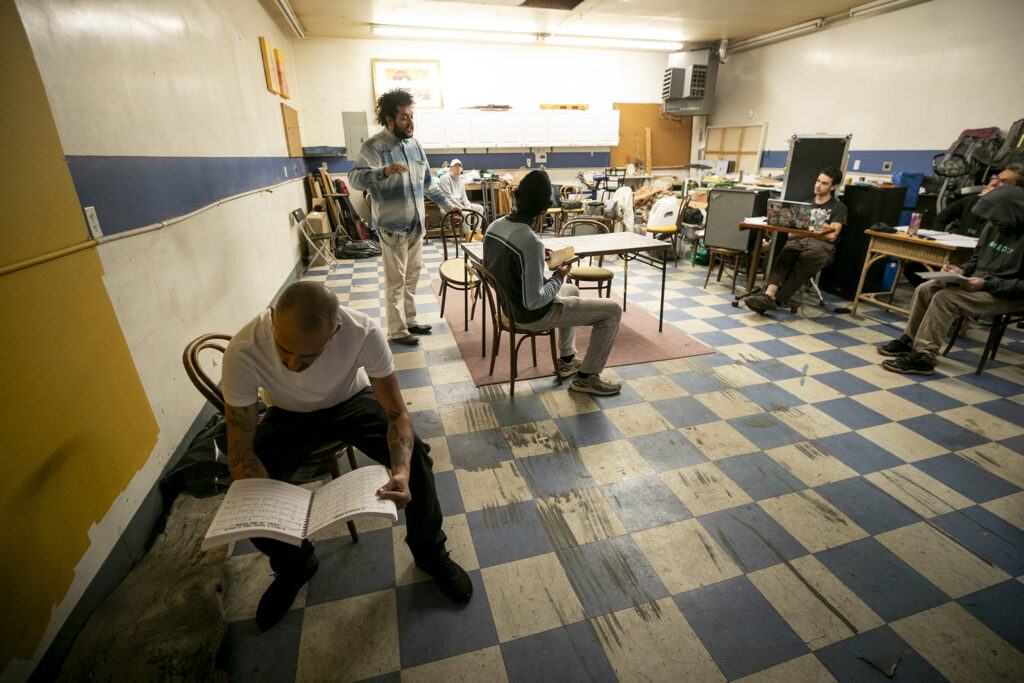
Night has fallen over a cold concrete driveway that leads into a Westwood neighborhood garage. Inside, an old AC unit creaks along as Diego Florez-Arroyo and his directing team watch local actors recite lines and shuffle wooden chairs between scenes of their upcoming theatrical production.
“I am a newcomer to the theater community but also come from a musicians background,” Florez-Arroyo said, a Denver artist of many talents, most notably as a member of the local Chicano Funk band Los Mocochetes. “A lot of it is rehearsing in whoever’s garage and playing endless nights until it sounds good. I’m thankful to have a space to welcome everyone and bring these words to life.”
A rehearsal for “Cuauhtémoczin,” by Diego Florez-Arroyo, in Florez-Arroyo’s Westwood garage. Sept. 20, 2023.
Kevin J. Beaty/Denverite
Florez-Arroyo is set to add “playwright” to his long list of creative accolades, premiering “Cuauhtémoczin,” a mythological impressionist play put on with the help of Control Group Productions and MCA Denver.
A fresh take on a typical prison drama, the multimedia production follows the life of Dante as he embarks on a journey of self-discovery in the face of his caged reality. The narrative dances between reality and Mexican mythology, connecting Dante to Cuauhtémoc, the last emperor of the Aztecs and calls attention to the trials and tribulations that human relationships suffer from imprisonment.
Actress Hannah Lucero rehearses a scene from “Cuauhtémoczin,” a play by Diego Florez-Arroyo, in Florez-Arroyo’s Westwood garage. Sept. 20, 2023.
Kevin J. Beaty/Denverite
Phillip Luna, award winning actor, director and SAG-AFTRA member, was brought on to help Florez-Arroyo carry out his vision for the play. Sitting outside of a neighborhood garage where the cast was set to do a full-run through weeks leading up to opening night, Luna said part of what they do as artists, actors, directors and lighting designers is to help create different worlds.
“When [Florez-Arroyo] came to me with this piece he already had a very strong vision, and a willingness to experiment,” Luna said. “Working in a garage, it lends more to the contribution and the exchange of ideas. The idea of being here in Denver, it’s important that there is a sense of community and a sense of ensemble when you work. As opposed to that hierarchy, because then you feel like a hired hand.”
The story was inspired by Florez-Arroyo’s epic poem that he wrote while exploring Chicago’s Pilsen neighborhood. It was later developed into a play with the help of the Emerging BIPOC Playwrights Project, in association with Flamboyán Theater, a program that provides mentorship and production of new plays by writers of color who live in the Denver metro.
“This is the biggest thing I’ve done up to this point in my life and I want to continue on this path because of the support from the community, the team and family,” Florez-Arroyo said. “It may be a story set in prison but there’s things there for everyone.”
“Cuauhtémoczin” writer Diego Florez-Arroyo (left to right), director Phil Luna and stage manager James Jewkes work on a rehearsal in Florez-Arroyo’s Westwood garage. Sept. 20, 2023.
Kevin J. Beaty/Denverite
The homegrown feel of this production is apparent in the creative minds that were brought together to see it through.
The cast, some of whom will be in their first theater production, is made up of 18 Denver- and Colorado-based creatives. You can read more about them here.
James Jewkes, stage manager and assistant producer, first met Florez-Arroyo through Anthony Garcia Sr. and the Birdseed Collective, a nonprofit community outreach organization in Denver.
A rehearsal for “Cuauhtémoczin,” by Diego Florez-Arroyo, in Florez-Arroyo’s Westwood garage. Sept. 20, 2023.
Kevin J. Beaty/Denverite
Part of this production’s challenge is figuring out how to bring all of the multimedia layers to life inside of the MCA Holiday Theatre, a venue built for film. This has meant that Jewkes and other creative producers have had to work collaboratively since rehearsals began back in August.
“Theater is a new love of mine. My background is in music production,” Jewkes said. “Knowing [Florez-Arroyo] and seeing him paint everyday, I was always blown away by his commitment and his discipline. [Anthony Garcia Sr.] put us together because he knew that together we could do something.”
Actor Diego Estrada Bernuy screams as he rehearses a scene for “Cuauhtémoczin,” a play by Diego Florez-Arroyo, in Florez-Arroyo’s Westwood garage. Sept. 20, 2023.
Kevin J. Beaty/Denverite
Diego Estrada Bernuy plays Dante in the production. He was in Peru at the time that Florez-Arroyo posted a casting call. When Bernuy returned, the two Diego’s got dinner together and discussed the show.
“[Florez-Arroyo] is extraordinary,” Bernuy said. “He put up a good team and it feels like we’re right where we are supposed to be.”
After that first meeting, Bernuy knew he could fit right into the vision of “Cuauhtémoczin.” He also knew he’d be a perfect fit to play the role of Dante.
“We all believe in this work,” Bernuy said. “In a way I feel like all of us are or have been Dante. Especially as a brown person, we are all trying to figure out who we are. And this gives us a purpose.”
Actors Diego Estrada Bernuy (left to right), Jesse Pacheco and Sid Madrid rehearse a scene for “Cuauhtémoczin,” a play by Diego Florez-Arroyo, in Florez-Arroyo’s Westwood garage. Sept. 20, 2023.
Kevin J. Beaty/Denverite
Born and raised in Lima, Peru until the age of 10, Bernuy moved to Aurora in 2005 and later moved to Denver where he now runs a small video production company, Degetelo Studios. When he is not producing videos, like Dante, Bernuy is figuring out where he belongs in the world. After researching Aztec and Incan mythology to prepare for the role of Dante, Bernuy says the experience has changed him as a person.
“When we do this work of looking backwards, we are healing not only for the people that come ahead of us but also for the people that came before us. Because they didn’t get that same opportunity,” Bernuy said. “I want people to just take it in. And if you walk out of there with something then I think we all did our job.”
Jesse Pacheco (right) and Dillon Autry rehearse a scene in “Cuauhtémoczin,” a play by Diego Florez-Arroyo, in Florez-Arroyo’s Westwood garage. Sept. 20, 2023.
Kevin J. Beaty/Denverite
Wrapping up a run-through rehearsal the cast regroups one final time to go over notes that Luna, Florez-Arroyo and Jewkes have for them.
The goal of this rehearsal was to help everyone get into a rhythm for the show leading up to their final rehearsals inside of the MCA Holiday Theatre.
“The thing about theater is it’s different every night,” Luna said. “Whatever moment you choose it won’t be there tonight. It’s going to be something else. If you want to see the same moment, watch a film or listen to a record but if you want to see it change every night, moment by moment, come see theater.”
Lynn Mandziuk and Diego Estrada Bernuy rehearse a scene in “Cuauhtémoczin,” a play by Diego Florez-Arroyo, in Florez-Arroyo’s Westwood garage. Sept. 20, 2023.
Kevin J. Beaty/Denverite
The challenge for Bernuy, like the rest of the cast, is tapping into the character of Dante four more times.
“When you’re in the system of incarceration, you forget the relationships that are going to be strained. I think Diego does a really good job of writing that,” Bernuy said. “I’m definitely different from this journey. It has helped me figure out my voice.”
A colorimetric breathalyzer that can catch a popular cannabis component within minutes has been developed by a VCU professor.
Emanuele Alves, an assistant forensic science professor at VCU, teamed up with Wagner Pacheco, a postdoctoral fellow from the Universidade Federal Fluminense in Rio de Janeiro, to work on the device.
“Our goal is to be able to detect THC in exhaled air, and our idea is to create a test that we can give a fast result in a range of concentrations that is similar to what we see in alcohol breathalyzers,” Alves said.
THC, or tetrahydrocannabinol, is a psychoactive component found in cannabis, also known as marijuana. If THC is detected, the device will change colors, like an at-home COVID-19 test or “pH papers,” Alves said.
“The nice catch about that device we are developing, it’s able to give negative results for CBD if only THC is present and vice versa,” Alves said.
CBD, or cannabidiol, is found in hemp and is a part of the cannabis family, but does not have psychoactive effects like THC. CBD is oftentimes sold in smoke shops, gas stations and hemp stores in Virginia, yet its legality varies state by state.
The device produces different colors when THC or CBD is present, so it doesn’t have the problem of giving a false positive, according to Alves.
“The goal of this device is to improve road safety. It’s not like, ‘Oh, I want to put everybody in jail,’ it’s not that, but at least people should be conscious,” Alves said.
The VCU professor received threats after she did an interview on TV about her work on the breathalyzer.
“I was kind of upset about it,” Alves said. “My husband was truly upset and he was afraid,” Alves said.
Alves said the pair is not working on the breathalyzer to judge impairment.
“There are other groups working in impairments and THC, ” Alves said. “How the legislation, law enforcement, policies are going to be using — it’s not our goal to determine — I’m not working on this to determine if a person is impaired or not.”
Virginians do not view mairjuana-impaired driving as more risky than other dangerous behaviors, according to research. Sixty percent of Virginians view texting as “extremely dangerous,” 49% for alcohol-impaired driving and just 26% for cannabis-influenced driving, according to a recent survey conducted by the Virginia Cannabis Control Authority, or CCA.
The researcher said there are several studies that need to happen to make the connection between impairment and THC side effects.
“However, I would like people to be conscious that if you use marijuana there is a possibility of you to be impaired — so don’t drive, because you can be caught,” Alves said. “I’m not against or in favor, I never used drugs and I don’t judge who use drugs, it’s not my business.”
Nature Scientific Reports data states that detection of THC in exhaled breath and blood does not directly correlate with recent cannabis consumption or impairment, according to a report by the National Organization for Reform of Marijuana Laws, or NORML.
“NORML has long argued against the expansion of drug detection testing and has instead opined in favor of the greater use of performance-based tests,” said JM Pedini, NORML’s development director who also serves as executive director of the state chapter, Virginia NORML.
There are products available today like DRUID and AlertMeter that measure a person’s impairment, according to Pedini.
Virginia’s cannabis laws have wavered in the past two years under the GOP-controlled House and Republican Gov. Glenn Youngkin’s administration.
Cannabis possession became legal in July 2021 with hopes of recreational sales by 2024. Individuals 21 years old and older can possess up to one ounce in public and may grow no more than four plants in their residence. However, cannabis consumption is illegal in public and while driving, according to the CCA.
“It’s entirely possible that the outcome of the November election will influence the direction of cannabis policy in Virginia,” Pedini said. “Retail sales for adult use have yet to be enacted, directly because of the Youngkin administration’s opposition in doing so.”
Former Gov. Ralph Northam and the Democrat-led legislator pushed for decriminalization and recreational sales. Youngkin has vowed for tighter regulation on Virginia’s hemp industry, according to Richmond Times Dispatch .
Joseph Guthrie, commissioner of the Virginia Department of Agriculture and Consumer Services told the Daily Progress that Youngkin was not interested in legalizing recreational use of marijuana.
The research pair hopes the first prototype is completed by 2025.
Roseville Today News, Business, Travel & Entertainment
Folsom’s Premier Concert & Entertainment Venue
Folsom, Calif.- The renowned Harris Center is gaining steam heading into the holiday season with an exciting schedule of entertainment on tap. Tickets often sell out quickly for holiday events and concerts, so plan accordingly!
Easily accessible from the Sacramento and Placer region, the Harris Center has become one of the region’s premier showcases for world and local music along with popular favorites. Intimate venue boasts excellent audio, seating and visuals in modern theatre atmosphere.
The Harris Center’s proximity to Roseville and ease of access make it a convenient and hassle free entertainment destination any night of the week.
Harris Center 2023
Oct 6: Queen of the Night- Remembering Whitney
Oct 12: Jesse Cook
Oct 14: Emerald Extravaganza
Oct 15: Face Vocal Band
Oct 25: Student Showcase
Oct 29: Great Composers Chamber Music Series
Nov 19: David Shannon
Nov 20: Nashville Songwriters
Nov 21: The 55th Anniversary of the Beatles White Album
Nov 25: Bee Gees Gold
Nov 26: Queen of Motown
Nov 28: Mannheim Steamroller
Nov 30: Nathan Pacheco Christmas
Dec 1: Cirque Music Holiday Wonderland
Dec 2- 3: Holiday Pops
Dec 7: Fall 2023 Nutcracker Reimagined
Dec 9 & 10: Happy Holidays Symphony
Dec 14- 17: The Nutcracker
Dec 18: Irish Christmas
Dec 21: High Voltage Holiday Celebration
Dec 22: A Master Singers Christmas
Harris Center 2024
Jan 5: Zep Live: the Led Zeppelin Concert Experience
Jan 7: Chamber Music Series
Jan 10- 13: Jesus Christ Superstar
Jan 14: Collision of Rhythm
Mar 9 – 10: Big Band Pops
Mar 17: Key of G Live!
April 21: Black Market Trust
may 9- 12: The Cher Show
For a complete list of shows, times, ticket availability and additional entertainment options, visit https://www.harriscenter.net
Skewed data was used to determine the impact of the EU’s renewable energy directive, a scientific paper has claimed, raising questions about the model and process employed by the European Commission to assess policy options for transport decarbonisation, including for fuels.
Published in the scientific journal Fuels, the paper examines the so-called Price-induced market equilibrium system (PRIMES) model used by the European Commission to simulate the impact of proposed policies.
The PRIMES model provides a projection of future energy demand and supply, as well as prices and emissions under different scenarios. It was used in part to determine the impact of the Renewable Energy Directive, a key piece of EU legislation, which contains strict sustainability criteria for the production of biofuels.
The research, led by Dr Zoltán Szabó, a sustainability consultant with biofuel company Ethanol Europe, devised a PRIMES model with revised assumptions using the “latest available market and industry data”.
One of the key differences was the inclusion of co-products in the generation of biofuels.
When ethanol is distilled, protein feed is produced as a co-product. This is typically used to feed animals, preventing the need for animal fodder imports or additional land cultivation.
However, the Commission’s calculations did not include the climate impact of having a domestic supply of high-protein animal feed.
Once the new parameters were used, the model produced significantly different results.
While the Commission’s modelling found that the carbon abatement cost of ethanol is in the range of about 220–390 EUR/tCO2eq, the revised modelling found that crop-based bioethanol has negative abatement costs.
Electromobility, which was absent from the Commission’s impact assessment, was found to be in the range of 100–150 EUR/tCO2eq.
The paper concludes that “transport plans presented to the [European Commission] were not backed by underlying cost assessments”, which runs the risk that “transport decarbonisation efforts in the EU may become unnecessarily costly”.
The production of bioethanol in Europe has led to greater yields of animal fodder than fuel in 2021, new figures show – further evidence that biofuels can also contribute to food stability, according to the industry.
Black box
Exactly how the PRIMES model works is not known – specifics are not made public, with the model considered a “black box”.
The modelling is carried out for the European Commission by E3Modelling, a private company closely linked with the Technical University of Athens.
A request for comment from E3Modelling was not returned.
Energy campaigners have long questioned the Commission’s use of PRIMES, criticising the secretive nature of the model.
“The list of what PRIMES misses isn’t short: its electric vehicle battery prices were insanely high, with values for 2030 and 2050 above current market values,” according to Transport and Environment (T&E), a clean mobility group.
“When we don’t know the details of what goes in, it is impossible to ensure that what comes out is a good reflection of a sustainable future transport sector,” T&E’s Carlos Calvo Ambel wrote back in 2018.
Despite the criticism, the Commission maintains confidence in the PRIMES model as a good analytical tool, pointing out that modelling is just one element in developing impact assessments, as the final document is also shaped by input from stakeholder consultation.
It’s understood that data for the PRIMES model is based on the EU Reference Scenario 2020, an analysis tool which draws information from national energy and climate plans and consultations with experts.
Joao Pacheco, a former deputy director-general in the European Commission’s agriculture directorate who is now advisor at think-tank Farm Europe, said that the information presented in the scientific paper calls into question the validity of impact assessments done by Brussels.
“All the wrong assumptions and old data put together give a completely distorted picture of the greenhouse gas savings achieved by biofuels and their costs,” he said.
“The EU’s policymaking gets distorted. The EU’s economy loses, farmers lose, consumers lose, the climate loses,” he added.
Pacheco said that the reputation of the Commission has been damaged by the flawed impact assessments and asserted the Renewable Energy Directive should be reviewed as a matter of priority.
“It is now time to reassess what has been proposed,” he said.
‘Maladministration’
Ethanol Europe, meanwhile, presented the Fuels study as a “clear-cut case of maladministration” by the Commission.
“The PRIMES model has been the backbone of all Renewable Energy Directive-related impact assessments and policy justifications for 15 years, and all of Europe had to assume since the inner workings of the PRIMES model were kept secret, that the model was fit for purpose,” said Eric Sievers, director of Ethanol Europe.
“However, now we know that the model and the Renewable Energy Directive are, and always have been, completely at odds with each other.”
Sievers branded the PRIMES methodology “indefensible from a scientific standpoint”.
Food Safety Commissioner Stella Kyriakides defended the key points of the EU executive’s proposal to re-approve the contentious herbicide glyphosate, signalling that the expected tweaks to the text at this point are likely to be relatively minor.
Speaker Kevin McCarthy, announcing that the House of Representatives will pursue an impeachment inquiry, suggested that the probe will hinge in part on deceiving the American public about Hunter Biden’s foreign business ventures.
“President Biden did lie to the American people about his own knowledge of his family’s foreign business deals,” McCarthy said at a press conference. GOP lawmakers, he added, have “uncovered credible allegations into President Biden’s conduct.”
Such an investigation will likely force an examination of the public narrative regarding Hunter Biden’s consulting deals that go back at least a decade. During President Obama’s second term, then-Vice President Joe Biden was the administration’s point man on the nation’s policy toward Ukraine, a perch he used to urge the country to resist “the cancer of corruption” and enact sweeping ethics reforms.
At the time, some American journalists began to question whether the vice president’s stern message was undermined by his son Hunter Biden’s employment at the Ukrainian energy firm Burisma, which was owned by a notorious local oligarch.
Emails on Hunter’s laptop reveal that the inquiries sparked an internal debate within his team of consultants and public relations agents. Ultimately, they devised a series of responses about Hunter’s work with Burisma that were, at best, misleading and, at worst, outright falsehoods.
The Biden team has constructed a careful image of Hunter Biden’s business ventures, sometimes employing a sophisticated myth-making operation aided by allies in the media who rarely challenged or investigated their false claims. The laptop emails show that the team closely monitored critical reporting and pushed to shape coverage with reporters from the New York Times, Time magazine, the Wall Street Journal, and the Associated Press.
Their spin informed much of the ensuing coverage in the mainstream press, defusing the issue, even as President Trump and other Republicans insisted that Ukraine was a hotbed of Biden family corruption. Although he had no background in the energy field and little experience in corporate governance, Hunter Biden, who had a law degree, was appointed to the board of Burisma in May 2014.
Washington Post
It was revealed later that he was paid about $1 million per year – as was his business partner Devon Archer. In a press release announcing his appointment, Hunter Biden is quoted as saying, “I believe that my assistance in consulting the Company on matters of transparency, corporate governance and responsibility, international expansion and other priorities will contribute to the economy and benefit the people of Ukraine.”
That same month, journalist Michael Scherer reached out with questions about the arrangement.
Several consultants employed by Burisma, including Ryan Toohey of FTI Consulting and Heather King, a partner at the law firm Boies, Schiller, & Flexner, where Hunter worked as counsel, strategized over how to respond to Scherer, a reporter then with Time magazine who has since joined the Washington Post.
For the Scherer inquiry, laptop emails show, Hunter’s business associates settled on a strategy to deflect the most direct questions and obfuscate the true intent of Burisma’s attempts to sway U.S. government officials.
One of Hunter’s associates noted that they planned to respond to Scherer’s attempts to reach David Leiter, a former aide to then-Secretary of State John Kerry, hired to work for Burisma. The plan was to use an assistant to make Leiter “unavailable to comment, as opposed to some sort of statement that made it seem like we were unwilling or refusing to engage with the reporter.” Leiter, the emails show, was in fact available, but the public relations team wanted to keep him out of reach.
FTI Consulting
Scherer wanted to know why Burisma was on a hiring spree of well-connected American lobbyists, including Leiter and others. In response, Toohey planned to tell Scherer that the hired guns were simply working on issues related to energy independence, economic growth, as well as “transparency and good governance.”
In response to other questions posed by Scherer, Toohey prepared a statement claiming that Hunter Biden will “not be engaged with the U.S. government” on anything related to Burisma.
The response belied a detailed lobbying agenda spelled out in other emails.
Burisma had made clear that the company had hired Leiter, Hunter Biden, and other political operatives as part of a focused plan to obtain Burisma owner Mykola Zlochevsky a U.S. visa as well as to persuade American officials to intervene with Ukrainian government officials to drop an investigation of his business interests.
In a May 2014 email, Vadym Pozharskyi, a close adviser to Zlochevsky, explained to Hunter that he needed his “advice on how you could use your influence to convey a message/signal, etc. to stop what we consider to be politically motivated actions,” a reference to an ongoing investigation of Zlochevsky by Ukrainian prosecutors.
That month, Pozharskyi again wrote to Hunter, spelling out the “working plan for both FTI and David,” reiterating that he wanted the lobbyists to intervene against the “politically motivated proceedings initiated against us in Ukraine” and to overcome the “US entry ban” for the Burisma owner.
“The immediate plan is to reach out to the Energy and Ukraine desks, respectively, at State Dept,” wrote Heather King, the attorney working closely with Hunter Biden at the time. “That will include outreach to Carlos Pascual, he is the top US energy diplomat,” she added.
Scherer printed the denials, but to his credit, reported on the odd circumstances surrounding Biden’s hiring, at a time when Joe Biden was the Obama administration’s point person for Ukraine, with a special focus on energy policy in the region.
In many cases, Hunter Biden’s associates cast him as simply an auditor with a special focus on renewable energy sourced from geothermal vents. That was the strategy in response to an inquiry from Stephen Braun, a reporter for the Associated Press. “Mr. Biden will not lobby on behalf of Burisma. His role is to advise the company’s legal and compliance unit, including guidance on corporate governance standards.”
Behind the scenes, Hunter Biden’s team knew otherwise. In emails conferring over how to deal with Braun’s questions, one lobbyist reiterated the plan to provide Braun with “minimum information.”
Like many other articles from this time, the AP story focused on the conflict of interest issues, noting the denials around any lobbying with a degree of skepticism:
Stephen Braun, AP: The plan was to provide him with “minimum information.”
AP/YouTube
A former Washington lobbyist, the vice president’s son is effectively exempt from most rules that would require him to describe publicly the legal work he does on behalf of Burisma.
Hunter Biden will not lobby for the company, said Lawrence Pacheco, an official with FTI Consulting, a Washington government affairs company recently hired by Burisma.
Pacheco did not say whether Biden might oversee or advise on any future Burisma lobbying strategy in the U.S. Pacheco said the company “does not take positions on political matters.”
Braun could not be reached for comment. Scherer declined an opportunity to comment on the Hunter Biden emails. Biden, Toohey, and King did not respond to a request for comment.
However, the emails clearly indicate that substantial resources were allocated to managing both Burisma and Hunter’s personal image. Pozharskyi pointed out that Burisma had retained American consultants to reach out to “the most reputable European and American journalists/newspapers, magazines, websites, blogs,” while assistance was required to handle Wikipedia, Facebook, LinkedIn, and other online platforms. Burisma, wrote Pozharskyi, sought a “detailed algorithm on how the Company should act in case of bad publicity.” The effort included scrubbing negative details from Hunter Biden’s Wikipedia, while bolstering the online credentials of Burisma, emails show.
A highly focused effort to monitor and shape news media coverage helped maintain the public profile. Even with relatively low visibility, independent media were closely watched. Hunter and his team monitored Vice News as well as the gadfly website ZeroHedge. In response to critical reporting from Vice, one colleague noted approvingly that the article was not being “reposted or republished” in Ukrainian media.
In July 2014, Toohey circulated an investigative piece I wrote for Salon about Hunter Biden’s hiring at Burisma, which noted that the vice president’s son had been retained amid a string of nepotistic hires likely aimed at influencing natural gas and energy policy.
In the article, I noted that Joe Biden had traveled to Ukraine to “announce a $50 million aid package that included technical support for increasing the country’s natural gas production – an investment that could bolster profits at Burisma Holdings, where his son is a director.” What was not known at the time, however, was that Hunter Biden was already working with a team of public affairs consultants to channel U.S. government technical assistance to his client.
The laptop emails show that even this relatively brief mention of Hunter Biden and a potential conflict of interest with his father raised concerns.
“All, please see below a piece that mentions Hunter’s appointment as part of a broader trend, mostly within the context of relatives of eleceds [sic] engaged to lobby for the energy industry,” wrote Toohey, attaching a copy of the text of my piece. But, he added, “This was a freelanced piece picked up in a number of web-based outlets including Salon, but nothing with significant reach.”
Pozharskyi replied that he had seen the piece earlier and “wanted to have a discussion in this regard.”
In some cases, the team celebrated media coverage that elevated its desired narrative. Politico reported Hunter’s hiring at Burisma and simply printed quotes from the company’s official statements:
“The company’s strategy is aimed at the strongest concentration of professional staff and the introduction of best corporate practices, and we’re delighted that Mr. Biden is joining us to help us achieve these goals,” Alan Apter, Burisma Holdings’ chairman of the board of directors, said in a statement, which was reported by The Moscow Times on Tuesday.
Biden, joining the board, will be in charge of the legal unit, the company said. He will also provide support for Burisma Holdings “among international organizations.”
Biden said the company will help strengthen Ukraine’s economy.
Pozharskyi circulated a link to the Politico article to Hunter and his associates, noting the “positive coverage.”
Slowking4/Wikimedia
Hunter’s membership on the Burisma board received renewed attention in late 2015, as then-Vice President Biden was set to visit Ukraine where he planned to address the parliament on the need to adopt new reforms against a culture of corruption in the country. James Risen of the Times, among others, renewed inquiries directed toward Hunter and his associates about the rationale behind his appointment to the company, Burisma, and why the company appeared to be buying access to high levels of government.
In one email found on Hunter’s laptop, Risen asked, “What lobbying activities is the company engaged in the US?” among other questions to Hunter Biden. In response, a Burisma spokesperson straightforwardly claimed that “no one is lobbying on their behalf.”
The company’s lobbying efforts were not covered in the story ultimately published by the New York Times, which featured Risen’s piece on Dec. 8, 2015. The article included a statement from the Hunter Biden team, crafted by the strategy firm FTI Consulting, asserting that the company’s focus was on “corporate governance and transparency.”
Risen’s article did not address whether Hunter’s business career demonstrated such expertise or his lack of experience in the energy field. Although Risen identified Hunter as “a former Washington lobbyist,” he accepted the denial that no lobbying was involved.
In reality, just a month prior to the email exchange with the Times, Burisma, following Hunter Biden’s advice, had hired Blue Star Strategies, a Democratic lobbying firm, to influence the Obama administration. A copy of the agreement, belatedly filed with the Justice Department, reveals that the firm, which aided in lobbying State Department officials on Ukrainian energy policy, received a monthly retainer of $30,000.
Blue Star Strategies was even copied on the emails with the Hunter Biden team on its response plan to Risen.
Risen also allowed a Burisma spokesman to decline to state Hunter’s compensation while claiming it was “not out of the ordinary” for such board positions. It was later disclosed that he was paid about $1 million per year, which is far higher than the typical compensation. As a point of comparison, median annual compensation of board members at Fortune 500 companies is around $110,000.
Risen, now with The Intercept, did not respond to a request for comment.
Blue Star Strategies
Political operatives of all ideological backgrounds frequently manipulate public perception – often employing specialized “crisis communication” firms to suppress negative coverage and shape desired narratives. What is remarkable about the Hunter Biden episode is how successful it was, and how uncritically most media organizations treated this unorthodox relationship between a president’s son and a controversial foreign corporation.
In response to the Wall Street Journal, Toohey worked closely with Blue Star Strategies’ Sally Painter and Karen Tramontano to craft a message defusing questions around a conflicting message between Hunter and his father. They settled on a strategy of presenting the Ukrainian gig as perfectly “aligned” with an anti-corruption agenda, laptop emails show. The lobbyists suggested that they release a statement to the Journal claiming that Hunter’s work for the Ukrainian energy giant, to supposedly strengthen corporate governance, are “also goals the United States.”
The Journal printed the statement, attributing it to a spokesperson.
LinkedIn
Such coverage – which suggested Hunter Biden had engaged in questionable but ultimately harmless behavior that did not involve, much less implicate, his father – set the narrative for most coverage in mainstream outlets. When President Trump told Ukraine’s president in 2018 that “there’s a lot of talk about Biden’s son” and asked him to look into Joe Biden’s demand that the prosecutor looking into Burisma be fired, Democrats moved to impeach him.
The Biden spin continued even after the New York Post published the first articles based on material from Hunter’s laptop in October 2020. The Washington Post’s fact checker, Glenn Kessler, sought to discredit the New York Post’s reporting that Hunter Biden had arranged a dinner meeting between his Ukrainian associates at Burisma and his father when he served as vice president. At the time, the Biden presidential campaign claimed that it “reviewed Joe Biden’s official schedules from the time, and no meeting, as alleged by the New York Post, ever took place.” Kessler reiterated this denial as though it were an established fact.
It turned out to be false. The July testimony by former Hunter Biden associate Devon Archer confirmed that Hunter Biden had arranged a secret dinner with his Ukrainian business partner and his father, as the New York Post had originally reported. The ongoing saga over the Washington Post’s role in discrediting the Biden revelations was detailed last month by RealClearInvestigation’s Paul Sperry.
Also last month, Washington Post columnist Philip Bump, who has dismissed any hint of scandal regarding Biden business dealings, appeared on Live at the Table, a podcast hosted by Noam Dworman, the owner of New York City’s Comedy Cellar. The show went viral as Dworman challenged Bump’s claims that there was “no evidence” of wrongdoing by Joe Biden.
In a heated exchange, Bump conceded that Hunter Biden’s text messages that claim, “unlike pop, I won’t make you give me half your salary,” was one form of “evidence.” Moments later, Bump ended the interview and walked off the set.
The interaction provided a rare moment of visible accountability for the establishment press, which has largely followed the Biden spin for an entire decade on this issue.
Yet the White House is still hoping it can still instruct journalists on how to cover the story. Shortly after McCarthy’s impeachment inquiry announcement, President Biden’s White House staff circulated a memo, instructing media outlets on how to cover the news. In bold type, the memo claimed that the entire Hunter Biden conflict of interest scandal had been “refuted” and “debunked” – language that was adopted in media reports about the inquiry in Vox, NBC News and CNN.
Lee Fang is an independent journalist based in San Francisco. He writes an investigative newsletter on Substack via www.leefang.com.