Collin County Politics: What Kind of World Do You Want? | The Psychological Hook

June 21, 2022

Picture: Hundreds braved the heat to celebrate Pride with Drag Queen Bingo, an event put on by the McKinney Area Democratic Club.

Covid Update: Collin County has 224,007 confirmed Covid cases. That’s 1,565 more cases than I reported last week and 1,510 of our Collin residents have died (no deaths). We’re holding our own but there are still risks, especially of long Covid. Although not enough is known about long Covid, a recent study showed that women are more likely to develop it than men. Of course, we are. It’s not enough that women in the United States are poised to lose our freedom. Now we have to manage increasing levels of illness too. Awesome.

Commissioner’s Court: Chris Hill couldn’t be bothered to attend their 20-minute meeting last week. The rest of them passed the land lease with LifePath Systems for their new building. Duncan Webb pulled the item from the quick and dirty consent agenda vote so he could mention how exciting it was for LifePath be more central to the jail and expand their mental health services to more residents of the county. I wish I could share his excitement but I can’t. While I appreciate any increase in mental health treatment options, it seems like they’re always doing too little, just enough to make people think they’re actually taking it seriously.

For example, Lifepath was just briefed on the new state funded mental health hospital being planned for Dallas that will serve five North Central Texas Counties (Dallas, Tarrant, Denton, Collin and Ellis) or about 3.8 million Texans. The planned hospital will have 200 beds, a number based upon a state-funded needs assessment from 2014, seven years ago. I guess the huge population explosion just escaped their notice. The hospital is intended for short-term services (30 days or less) and developers couldn’t answer questions about the types of services provided, how they plan to staff it (as there is a major shortage of workers in behavioral sciences), or whether they’ll dedicate beds by county. This is a major concern since the facility is being built right across the street from the Dallas County Hospital at Parkland, but will service a five County area. See? Just enough. With Greg Abbott taking $200 million away from mental health treatment to send to the border, the funding just isn’t there for any meaningful expansion of services. Come on, now! Say it with me: thanks, Republicans!

This was Webb’s meeting as he also gave an update from the Regional Transportation Council (RTC) of which he was just named Chair. I hate when Webb gives updates because listening to him talk without having google handy is an exercise in frustration. Would it kill him to actually explain acronyms and programs? I mean, they certainly have the time given the minimal amount of time they meet every week. I had to look up information it would’ve taken him 2 minutes to explain. This is a transparency problem he could solve quite easily if only he cared! But he doesn’t. None of them do.

The RTC just approved a policy for managed lanes (previously used as High Occupancy Vehicle or HOV lanes) and revenue sharing. Managed lanes (where you pair free lanes with ones that cost) are becoming more common across the region which Webb thinks is great because it gives people “choice.” What he actually means is that these lanes allow rich people to avoid more traffic than the poors. Managed lanes also completely ignore the concept behind HOV lanes which were trying to combat climate change by having fewer vehicles on the road. But I guess we’ve forgotten all about that pesky issue (kind of like Covid!).

Any excess revenue from managed lanes will be returned to the “funding partners” (the counties). Fantastic! With all the extra money coming our way, maybe the commissioners could upgrade their video system so the transmission doesn’t have to reload every few minutes. I doubt it though. That might encourage more people to watch their meetings and they certainly don’t want that!

In a win for Collin County, 380 is shown as a freeway for the first time on the Mobility 2045 map. This is a big deal because, without being a freeway, it can’t have money allocated to it or be built. While it’s still in the environmental clearance process, the estimated cost of building 380 (with whatever option they choose) is $3.2 billion. Webb says he’s trying to find that money and has a little over $1 billion currently.

Hey, I know a way to reduce about $80,000 of those expenses! Refuse to buy the WRAP System restraints. Remember how I questioned the acquisition of these restraints for the jail? Well, they’re even worse than I thought! The system is “safe” because the company says so (without evidence) but people have died. Plus, it looks like the entire WRAP system costs $1450 each. Since we’re paying around $80,000, how many restraints are we actually buying?

During public comments, the world-weary tone of Cheryl Williams calling Joshua Murray’s name was quite amusing. Every time I think I can fast-forward through Josh’s comments, he lands a doozy. This time, he asked if there was a policy or court order that could be adopted to require all elected and appointed employees of the county to utilize government resources when conducting official business. While this sounds vague, what Josh was doing was subtly attacking the tendency of Chris Hill and Darrell Hale to use campaign accounts to send official information to constituents. They have no official accounts, so if you want to learn about what’s going on, you must endure their partisan bullshit. It also allows them to block constituents they don’t like which they would not be allowed to do on official accounts. They truly need to be called out on this tendency which, if it isn’t already, should be illegal.

Dallas College Board of Trustees: In the runoff on Saturday for the District 1 seat, Dr. Catalina Garcia emerged as the winner! Garcia, a retired physician who won more than 63% of the votes, will serve for two years since she’s taking the seat of a trustee who died. Given her strong victory, it’s clear Garcia’s message resonated. She wants to increase the college’s involvement with high schools to nurture a student pipeline, focusing especially on students who may not be considering pursuing a degree because of cost. She also intends to reprioritize the English proficiency curriculum in order to not have an “ignorant” workforce. Congratulations, Dr. Garcia! It sounds like you’ll be a much-needed breath of fresh air on the board.

Allen School Board: Given the chaos created by MISD’s right-wing extremist trustee, it’s going to be interesting to see what the right-wing extremist trustees just elected to AISD will do. Based on this meeting, it seems like very little. Elle Holland arrived 50 minutes late while Sam Abiog struggled to understand basic concepts. The CFO went over Board Policies since there were new members coming on (too bad Elle missed this!), including how expenses and reimbursement are handled. President Amy Gnadt asked for clarification on tips. When the CFO said up to 20% is allowed, Gnadt responded that she never tips above 15%. Why am I not surprised?

The board went over the 2022-2023 Budget Planning. Employees are expected to get a 1.5% salary increase. Wow! How generous! With our current inflation, that’s next to nothing! The largest projected expenditure by far is the recapture of funds by the state of Texas. Recapture is a huge state-wide problem for public education. When local property values grow (as ours most definitely have), the state uses our money first which means it doesn’t put in as much. While recapture’s stated purpose is to level the playing field between rich ISDs and struggling ones, the reality is that it’s merely a way to distract us from realizing that Texas is underfunding public schools. Over the last 10 years, the amount of money the state removes from school districts through recapture has almost TRIPLED. Not only that but this money, almost $3 billion per year, gets put in the State General Fund and never gets spent on education.

The trustees also talked about the $2 million surplus in Food Services. They’re assuming a 31% increase in Food Services. This led to a discussion about students who have never paid for breakfast or lunch and are not on Free/Reduced lunch. I imagine this is because of the free school meals program started in March 2020 by the U.S. Department of Agriculture to help people during the pandemic. A federal waiver made school breakfasts and lunches free to students regardless of their family’s income. However, this waiver is set to expire on June 30th so students will return to paying for their meals.

The fact that 1 in 5 food-insecure students live in a home that isn’t eligible for a free—or even reduced—school lunch doesn’t seem to bother the Allen trustees. They decided to address students not paying for meals by encouraging parents to budget better. That’s such a tone-deaf response that I have no words. They’re also looking at a potential increase in meal prices. Given inflation, gas, healthcare, and a possible Covid surge in the fall, these sound like dandy ideas. Research shows that well-fed students are healthier and perform better academically but that really shouldn’t even be the issue. Shouldn’t we all want hungry kids to be fed? Again I must say: thanks, Republicans! The two trustees they elected to the board “for the kids” can’t be bothered to show up on time or are focused solely on things like class rank. Neither advocated for hungry children. So typical for the party of “family values.”

Plano City Council: The council heard an informative presentation from the North Texas Municipal Water District (NTMWD). They highlighted some upcoming capital improvements including a water treatment facility near New Hope (the Sister Grove plant) which they were proud of since they worked a lot with the neighborhood and received zero protests against the permit. This is unusual which makes me wonder what they did differently. The other information from NTMWD was much more concerning.

Water treatment is a big concern right now due to supply chain issues and materials price volatility. Suppliers of the chemicals have seen an average 50% increase in cost. Long-term fixed price contracts will be going away and prices will be renegotiated as the market fluctuates. We’re all going to feel this in our water bills. The price of fresh water is projected to go up 10-13% in 2023 and wastewater fees to increase by about 7%. That isn’t even the worst news!

At current population projections and if we have more dry years (which we absolutely will given the present state of climate change), our current water sources will be insufficient by 2036. The NTMWD is actively pursuing 25 different strategies to get more water such as pipelines from other reservoirs like Texoma. A new reservoir is not off the table but it’s 30-40 years out, so it isn’t a short-term solution. There is a capital fund of $1.5 billion to do this work and it is supplemented by water rates. It’s clear that water issues are going to be a large, ongoing issue for the area. This is frustrating on many levels, not the least of which is that no one seems to be interested in focusing on water conservation. Like we do with so many other issues, we’re sticking our heads in the sand and hoping everything will turn out OK.

The public comments period was dominated by people concerned about zoning issues, specifically about short-term rentals (STRs), such as VRBO and Airbnb. Two speakers were from an advocacy group called North Texas Neighborhood Coalition. Their goal is to eliminate all STRs in residential areas. Three residents of a neighborhood in west Plano spoke about the disruption, noise, fights, and other problems they face due to a “party house” rental in their neighborhood, which is owned by an out-of-town corporation. Plano currently does not have STR-specific zoning rules and people must call the police if the noise exceeds the law. But this clearly isn’t adequate. Mayor John Muns stated that the council already decided to put this topic on the agenda at a future date.

The STRs situation is a huge issue across Collin County. While we’re not all going to agree on everything, there are several aspects to consider. Some believe that zero rentals in a neighborhood should be the goal. Others think there should be limits, like strict rules on headcounts and no parties. Should we insist owners must be local so they are part of the community and pay taxes? Demanding STRs become a new zoning category closer to a hotel than a home is an option but that could hurt responsible locals who make money by renting out their place. This option is unlikely to pass since several city council members (in various cities) already own STRs. Regardless of your opinion, learn what your city does to control STRs and ask your city council to put the topic on the agenda.

Richardson School Board: In the runoff on Saturday, Vanessa Pacheco won the District 2 seat! Her message of ensuring progress for all students convinced voters she was the person for the job. Congratulations, Vanessa! This is what happens when Democrats get out to vote!

Every aspect of our lives is, in a sense, a vote for the kind of world we want to live in.

Local Politics: The question is increasingly clear: what kind of world do we want to live in? Do we want to find ourselves in a fascist regime (because we’re already living in the Weimar Republic) or do we want a world in which the promise of American democracy is bright? The Texas Republican party has already answered that question and if their extremism doesn’t scare you, it should. We may not be able to do something about this at the federal level but we sure as hell can do something about it at home. If you want a world in which we take care of each other, treat everyone with respect, recognize the rights of all to bodily integrity, have the ability to love who we want, and can live without fear of violence, you need to do the work.  

Show up and get engaged as our vote for the world we wish to see. Sign up to join the team covering your city council or school board. Everyone is welcome. Contact me at [email protected] and let me know you’re interested.

Cute Bird#short

Resourceful Volkswagen continues teasing new Amarok ahead of 7 July debut

Ahead of its highly awaited world debut next week Thursday (7 July), Volkswagen has released yet another teaser video of the all-new Amarok, this time relating to the infotainment system.

While already shown twice before in December and January, the latest clip focuses on the physical switchgear located underneath the portrait-style infotainment system, which, like in its twin, the Ford Ranger, will come in two sizes; 10.1-inch and twelve-inches.

Remarkable design and functionality in every detail: Textured surfaces combined with an aluminium look give an elegant appearance in @VWCV_official new #Amarok. The mix of intuitive buttons, switches and a modern touch display makes operation easy in every situation. pic.twitter.com/PQybvlltE9

— Volkswagen Commercial Vehicles (@VWCV_official) June 27, 2022

Despite the size similarity, the Amarok’s interior has been subtly tweaked in the form of redesigned air vents, a Volkswagen specific steering wheel and likely better materials.

As seen by the sketch images released in 2020 and last year, followed by another in February and then the pre-production depictions in April, the Amarok will be longer and narrower than the current model, and offer a towing capacity of up to 3 500 kg.

New Volkswagen Amarok teasers continue still
Profile similar to the Ranger, but small aesthetic differences will prevail.

Set to ride on wheel sizes up to 21 inches, the newcomer, which Wolfsburg has stated will be different from the Ranger despite sharing the T6.2 platform, will have a choice of four initial trim levels; Life, Style, PanAmerican and Aventura, and in certain markets, a single cab for the first time since 2017.

“The new Amarok is a much better pick-up than if Volkswagen had done it alone. The same goes for Ford: without our input, the new Ranger wouldn’t be so good,” Volkswagen Commercial Vehicles Marketing Head, Lars Krause, told Britain’s Autocar in April.

New Volkswagen Amarok teasers continue still
LED headlights will be standard and the Matrix I.Q. diodes optional.

Spied for the first time in September last year undergoing testing, the Amarok, whose platform also underpins the Everest and Ranger Raptor, will come with rear-wheel-drive as standard, as well as two four-wheel-drive systems; a part-time system with low range and a permanent setup similar to the current range-toping model.

As is known by now, global production will take place at Ford’s Silverton Plant outside Pretoria following the Blue Oval’s record R15.8-billion investment last year, though assembly will continue at the General Pacheco plant in Argentina for South America.

New Volkswagen Amarok teasers continue still
Tailgate has been revised subtly from the Ranger.

The localisation stretches further to the Struandale Engine Plant in Gqeberha, which will assemble the 2.0-litre four-cylinder Panther and 3.0-litre V6 Lion turbodiesel engines following last year’s R600-million investment.

Replacing the current Volkswagen-sourced engines with the same displacement and turbo allocation, the single turbo Amarok will come in two states of tune; 110kW/350Nm and 125kW/450Nm, and 155kW/500Nm in the case of the bi-turbo.

New Volkswagen Amarok teasers continue still
Prior sketch of the interior.

In select European markets, the Volkswagen will offer the option of Ford’s 2.3 EcoBoost petrol that punches out 200kW/420Nm in the North American Ranger. Unlike that model though, electrification, rumoured since 2020, won’t be offered in the Amarok.

At the range’s sharp-end, the 3.0-litre turbodiesel V6, once sold under the Powerstroke moniker in the F-150, and internally known as the Lion engine, will replace the current Amarok’s 190kW/580Nm 3.0 TDI with outputs of 184kW/600Nm.

New Volkswagen Amarok teasers continue still
New infotainment system will come in two sizes; 10.1-inch and twelve-inches.

Unconfirmed speculation though is that the bent-six could potentially produce more grunt in order to not only better that of the Volkswagen unit, which sported an overboost function that increased power to 200 kW for a few seconds, but justify the Amarok’s likely price premium over the Ranger.

Depending on the engine, transmissions will comprise a six-speed manual or a revised version of the General Motors co-developed ten-speed automatic in place of the current eight-speed Tiptronic.

New Volkswagen Amarok teasers continue still
Screengrab shows the physical buttons underneath the infotainment system.

A no-go is the much rumoured Amarok R following Ford’s decision not to offload the blueprints for the Ranger Raptor to Wolfsburg.

Going on sale in South Africa from the first quarter of next year, the official launch on 7 July will take place on local soil and screened to other countries online.

2022 PFL 6 Pre-Fight Interview: Larissa Pacheco

Larissa Pacheco discusses her upcoming bout Friday at PFL 2022 6 (prelims: 6 p.m. ET on ESPN+, main card at 8 p.m. ET on ESPN).

Rusia | Putin llega a Turkmenistán en su primera cumbre internacional desde la invasión de Ucrania

Es en Asjabad, capital de Turkmenistán, donde participa en la cumbre del Mar Caspio. Intervienen los dirigentes de los cinco países ribereños de este gigantesco lago de aguas salobres, tan grande como Alemania, con enormes reservas energéticas.

MÁS INFORMACIÓN : https://es.euronews.com/2022/06/29/rusia-putin-llega-a-turkmenistan-primera-cumbre-internacional-desde-la-invasion-de-ucrania

¡Suscríbete a nuestro canal! https://www.youtube.com/c/euronewses?sub_confirmation=1
Euronews Señal en directo: https://www.youtube.com/c/euronewses/live

Euronews está disponible en 12 idiomas: https://www.youtube.com/user/euronewsnetwork/channels

#World

France sweep to bonus-point win on a tough night for the Ireland U20s

France 42

Ireland 21

RICHIE MURPHY’S IRELAND U20s came into this Summer Series in Italy with the well-earned tag of Grand Slam winners but the truth is that this is a very different team to the one that swept to Six Nations glory.

Injuries have decimated Murphy’s group, meaning 15 new faces in the 31-man squad for this trip. Key men like Patrick Campbell, Jack Boyle, Charlie Tector, and James Culhane are among those missing.

And so, it wasn’t a huge surprise that France had too much quality for the Irish on a sweltering evening in Verona, with the temperature still at 27°C for the 8pm kick-off at the Payanini Centre.

Back in February, Ireland beat France 17-16 in Aix-en-Provence on their way to the Slam, but only seven of that same team started again in Italy today.

While the superb French notched a five-try bonus-point win in Verona and also had three other possible scores chalked off – all of them correctly ruled out – there were some signs of Irish grit as they bagged three tries of their own through wing Aitzol King, centre Fionn Gibbons, and a penalty try at the maul.

Murphy will have been pleased too with the impact of an inexperienced Irish bench, several players making their U20 international debuts, but this was a tough night for his side as they opened their Series with a big defeat.

Ireland now look towards another daunting challenge in next Wednesday’s clash against South Africa, who started their Series with an impressive 30-22 win over England earlier today.

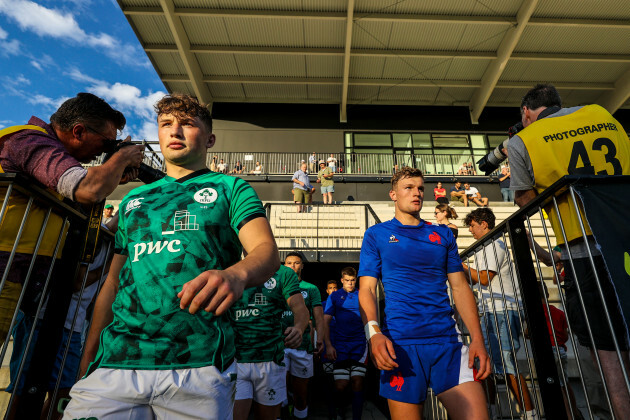
rueben-crothers-and-emilien-gailleton-lead-their-teams-out
Reuben Crothers leads Ireland out in Verona.


Source: Ben Brady/INPHO

Ireland were under pressure from early on against the French as a string of penalty concessions allowed them to camp out in the Irish 22, concluding with the French pack taking the Irish scrum apart at scrum time to allow fullback Max Auriac to fire over the opening three points off the tee. 

Auriac missed with his second shot from another scrum penalty but France scored their first try on the very next passage. Deft hands from number eight Killian Tixeront sent out-half Léo Barré on a darting half-break and he offloaded one-handed back inside for lock Léo Labarthe to race clear with an impressive turn of pace. 

Auriac converted and France had a 10-0 lead at the first water break on 16 minutes.

They didn’t let up from there, scoring a stunning second try from inside their own half soon after. Bordeaux wing sensation Louis Bielle-Biarrey released outstanding captain Émilien Gailleton down the left with a clever step and return pass before Gailleton played a one-two with centre partner Nicolas Depoortère to finish a sweeping effort that Auriac converted again.

Ireland were in trouble at 17-0 but a yellow card for Samuel M’Foudi gave them some respite. It could have been red as the France lock tipped Ireland centre Daniel Hawkshaw over onto his head and neck in a tackle. Referee Adriaan Jacobs felt Hawkshaw had “contributed” and that it hadn’t been a malicious tackle, so M’Foudi was binned.

Ireland’s attack was still poor, though, and France nearly bagged a superb third try through Gailleton only for the score to be ruled out on TMO review for a forward pass by Auriac. 

aitzol-king-scores-a-try
Aitzol King scores for Ireland.


Source: Ben Brady/INPHO

Ireland finally hit back just before M’Foudi returned. A big hit from centre George Coomber, on temporarily for Hawkshaw, gained some momentum for Murphy’s side and they were soon down in the French 22 battering at the tryline.

It took a smart decision and sharp pass from scrum-half Ethan Coughlan to send right wing King over on a clever line under the posts, with out-half Tony Butler adding the conversion.

Ireland were under more pressure just before the break on account of a lineout failure and another penalty concession, but they held out as France flanker Noé Della Schiava was pinged for running in to get involved in a bout of push-and-shove.

Trailing 17-7, Ireland looked like they had conceded early in the second half as Gailleton crossed again but he was denied for the second time by the TMO review, which showed that Bielle-Biarrey had knocked-on in the build-up.

Auriac did extend their advantage with his second successful penalty shot in the 46th minute, and they had their third try very soon after as Depoortère scorched home from inside his own half, breaking through the Irish defence all too easily from a simple scrum attack but showing impressive pace and a nice step to seal the deal.

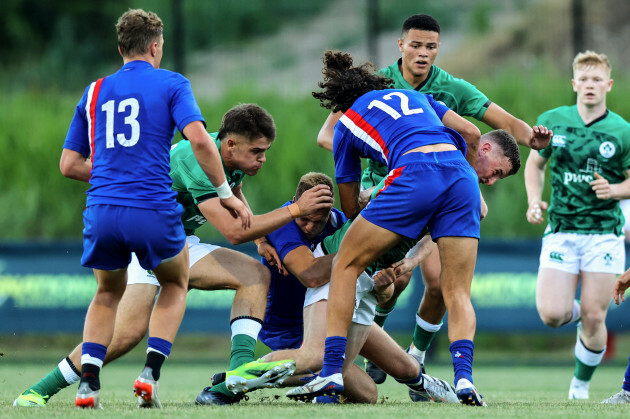
fionn-gibbons-is-tackled-by-nicolas-depoortere
The French centres were influential.


Source: Ben Brady/INPHO

Auriac added the extras after that try and then popped over another penalty just before the 57th-minute water break.

The French thought they had scored immediately upon the resumption when replacement wing Gatien Masse swerved away from a quickly-taken lineout but yet another TMO review showed that Ireland’s restart hadn’t gone out on the full and so, the French lineout was taken ahead of the mark. 

Ireland showed their grit to muscle their way to a second try in the 65th minute as their forwards earned a penalty try with their close-range mauling efforts, referee Jacobs yellow-carding Jules Coulon for his infringement in collapsing it.

The 30-14 scoreline at that stage wasn’t a true reflection of the difference in quality between the sides but France notched their bonus-point try five minutes later when sub hooker Victor Montgaillard powered over off a potent five-metre maul.

Ireland refused to let up, though, and replacement scrum-half Michael Moloney hit centre Gibbons with a pass a few metres out from the tryline, allowing the Munster-bound midfielder to show his power by barging over for their third score.

Exclusive NZ – IRE
Rugby Analysis

Get Murray Kinsella’s match analysis and Garry Doyle’s updates from New Zealand exclusive to members


Become a Member

Get Murray Kinsella’s match analysis and Garry Doyle’s updates from New Zealand exclusive to members

Murphy’s men worked their way into the France 22 with two minutes left but couldn’t find the try that would have given them a point point and the French countered all the way down to the other end to score their brilliant fifth through Victor Montgaillard.

France scorers:

Tries: Leo Labarthe, Émilien Gailleton, Nicolas Depoortère, Victor Montgaillard [2]

Conversions: Max Auriac [4 from 4], Mateo Garcia [0 from 1]

Penalties: Max Auriac [3 from 4]

Ireland scorers:

Tries: Aitzol King, Penalty try, Fionna Gibbons

Conversions: Tony Butler [1 from 1], Sam Prendergast [1 from 1]

FRANCE: Max Auriac; Ethan Randle (Gatien Masse ’33), Émilien Gailleton (captain), Nicolas Depoortere, Louis Bielle-Biarrey; Leo Barre (Mateo Garcia ’60), Baptiste Jauneau (Simon Tarel ’59); Thomas Moukoro (Pierre-Emmanuel Pacheco ’46), Connor Sa (Victor Montgaillard ’56), Eliott Yemsi (Robin Bellemand ’48); Samuel M’Foudi (yellow card ’22) (Malohi Suta ’67), Leo Labarthe (Raphael Portat ’42); Noé Della Schiava (Leo Banos ’60), Maxime Baudonne, Killian Tixeront (Jules Coulon ’40 (yellow card ’66)).

Replacement not used: Emile Dayral

IRELAND: Dylan O’Grady; Aitzol King, Fionn Gibbons, Daniel Hawkshaw (HIA – George Coomber ’21 to ’31) (Reece Malone ’78), Shay McCarthy (George Coomber ’56); Tony Butler (Sam Prendergast ’48), Ethan Coughlan (Michael Moloney ’59); Oisin Michel (George Hadden ’48), James McCormick (Josh Hanlon ’53), Darragh McSweeney (Kieran Ryan ’48); Conor O’Tighearnaigh (Charlie Irvine ’59), Adam McNamee (Diarmuid Mangan ’59); James McNabney, Reuben Crothers (captain) (Ronan O’Sullivan ’56), Lorcan McLoughlin (George Shaw ’70).

Referee:  Adriaan Jacobs [SARU]. 

Cute funny Burger meow’s 😻🎉#shorts #shortsvstiktok #tiktok #cat #cats #funny

#shorts
#funnucat#cute #funny #cuts
cats,funny cats,funny cat videoshow to draw a cat,how to draw cat,how to pick up a catdoja cat,cat videos,nyan cat
cat,cats,heat,eats,treat,cat tv,batman,nature,big cat,aww cat,44 cats,cat fail,baby cat,cat baby,cute cat,cat 2022,cats 101,lolcats,cat meme,catmems,funny cat,cat video,cat logic,cute cats,baby cats,marathon,fanny cat,cat memes,cat owner,cat lover,meatball,cat 794ac,cat cover,cats sing,cat vines,cat songs,funny cats,cat videos,cats funny,team match,super cats,scp attack,cat rescue,cutest cat,hosico cat

SEE HOW THEY RUN Trailer (2022) Saoirse Ronan

SEE HOW THEY RUN Trailer (2022) Saoirse Ronan, Sam Rockwell, Adrien Brody
© 2022 – SearchlightPictures

DEWALT 6 Gal. 165 PSI Electric Pancake Air Compressor DWFP55126 – $75

If you Change to Store 1089, it shows up $75 and allows you to ship to home for free.

SKU# 205298243

https://www.homedepot.com/p/DEWALT-6-Gal-165-PSI-Electric-Pancake-Air-Compressor-DWFP55126/2 …

This content was originally published here.

Peru’s Democracy Is Dying

When Pedro Castillo, the dark horse candidate representing the self-described Marxist-Leninist Free Peru party, was elected president last June, many Peruvians warned that he would turn the country into another Venezuela. His party manifesto was replete with attacks on the media and calls for nationalizing the mining and energy sectors, while his mentor Vladimir Cerrón, the domineering founder and leader of Free Peru, had been barred from running due to a corruption conviction following his scandal-wracked time as a regional governor. The specter of economic collapse, one-party kleptocracy, and ruthless repression of criticism seemed almost tangible.

But that thesis was always fundamentally flawed. Even before he was sworn in last July, Castillo—who had no prior experience of elected office—was a weak and isolated leader. He faced a hostile Congress and media as well as a deeply skeptical electorate that had voted for him as the lesser of two evils. Since then, he has proved incapable of handling even mundane government tasks, never mind passing the grand reforms he had promised, while his administration has been ravaged by incompetence, corruption, and infighting. According to a recent poll, 70 percent of Peruvians disapprove of his performance, and many of Castillo’s supporters have now turned on him.

Meanwhile, Congress’s conservative majority has run roughshod over democratic norms and institutions, seeking to modify the constitution by stealth to concentrate power in legislators’ hands, threatening electoral authorities for doing their jobs, retroactively reducing fines for lawmakers’ campaign funding violations, and shielding a former chief prosecutor and comptroller general from prosecution for what appear to be clear cases of corruption.

A different president might have stood up to Congress. Yet Castillo, whose only media appearance over the last three months was a widely panned interview with the public relations head of Peru’s state-run TV channel, has been notable only by his absence in the face of lawmakers’ actions. Instead of an authoritarian power grab, as many had feared, it is Castillo’s inability to lead that appears to be having a lasting impact. The result is that Peru’s democracy, so embattled since the 2016 election, is closer than ever to its breaking point.

Castillo is already on his fourth cabinet in less than a year, and public agencies have seen a mass exodus of experienced mid-level and senior officials who have either been replaced by Free Peru allies or quit in disgust. This is a loss that undermines the state’s administrative capacities across the board, in everything from environmental oversight to infrastructure contracting to safeguarding Peru’s archeological heritage to diplomacy.

At the same time, Castillo has appointed unqualified Free Peru members to public office. His ministers have routinely been the subject of ongoing or unresolved criminal investigations, above all for graft but running the gamut from murder to domestic violence and, including the president, allegedly forged master’s theses. Things are only likely to get worse: Peru’s chief prosecutor launched a criminal investigation into Castillo in May for his apparent role in the irregular awarding of public contracts worth roughly $215 million.

The assault on Peru’s stability has come not just from the power vacuum in the presidential palace.

The administration has also failed to take concrete steps to address the surging price of fertilizer, which has reportedly led to many smallholder farmers and campesinos (those of mixed or Indigenous ancestry who work the land) being potentially unable to grow cash crops this season. Peru is now also on its fourth agricultural minister this year, with the previous two ministers having been forced out for their alleged links to serious crime—in one case, two separate homicides—and for their lack of experience in the agricultural sector. Last month, Castillo—who, as Peru’s first campesino president, bases his entire political identity on his affinity with the poor—dismissed the warnings of possible famine by insisting that only the “lazy” would suffer.

Arguably, the only thing the administration has done well was continue the successful COVID-19 vaccination program it inherited from the previous government. But after six months, Castillo without explanation fired his health minister, Hernando Cevallos, the most popular member of his cabinet, and replaced him with another doctor, Hernán Condori—a Free Peru ally who, it emerged, had previously peddled a costly fake anti-aging cure. At his inauguration, Condori claimed falsely that the product had been approved by the U.S. Food and Drug Administration. His two-month spell in office ended in his impeachment in March but not before the country’s vaccination rate fell by half.

But the assault on Peru’s stability has come not just from the power vacuum in the presidential palace. In fact, there are three things the executive and legislature do see eye to eye on: their social conservatism, a shared affinity for graft, and their distaste for democratic accountability. That has allowed a Congress dominated by populist right-wing parties that has twice sought—and failed—to impeach Castillo on constitutionally dubious grounds to pass a series of counterreforms, some in alliance with the government, that have reversed many of the gains made by Peru’s fragile institutions since the return of democracy in 2000.

The counterreforms have included legalizing Peru’s deadly and unregulated system of “collective” taxis, effectively allowing anyone with a vehicle to pick up rides. That move was pushed by Castillo’s then-transport minister, Juan Silva, who is now on the run as prosecutors investigate his alleged role in a kickbacks scandal over public infrastructure contracts. Congress has also ended gender awareness education in schools—in a society with extreme levels of domestic violence. And lawmakers have effectively dismantled Peru’s private pension system, allowing members to withdraw thousands of dollars from their pension pots, supposedly to meet urgent economic needs due to the pandemic, even though Peru is currently between COVID-19 waves. The system was in need of reform, but the move could leave 80 percent of the 6.5 million affiliates with no pension, undoing nearly three decades of painstaking progress since it was first introduced.

But Congress’s most devastating counterreforms have been to Peru’s political institutions and the electoral system itself. Legislators have repeatedly sought to preserve the current closed party system, which political scientists, civil society, and the media have widely criticized for perpetuating a venal and unrepresentative political class, where neither the right nor left has been able to offer meaningful responses to citizens’ basic demands on a broad range of pressing issues, including corruption, violent crime, and wages.

This system intentionally deters the development of new parties by requiring them, among other stipulations, to have nearly 25,000 members before participating in national elections. Existing party registrations are controlled by a handful of businessmen, many of whom use the parties they run to fend off regulation of the lucrative but low-quality private universities they own.

First, lawmakers from both the opposition and Free Peru temporarily suspended reforms passed during Martín Vizcarra’s presidency from 2018 to 2020 that required internal primaries, instead of party bosses choosing candidates in an opaque system. Then, in May, Congress passed a law to unpick the reform altogether, putting through a bill to reopen the selection of candidates by nomination—rather than one member, one vote—for November’s regional and municipal elections, even though the process was well underway.

When the electoral authorities refused to follow the law, arguing that it was both unconstitutional and impossible to implement, lawmakers responded by threatening them with a constitutional prosecution, which could land them in jail.

Read More


Supporters of Hernando de Soto attend a campaign rally.

Peru’s Election Is About to Make Its Problems Worse

This weekend’s vote will deepen the pandemic-ravaged country’s impasse.

Then, upping the pressure on Peru’s two main electoral bodies—the National Office of Electoral Processes and the National Tribunal of Elections—Congress demanded they produce evidence of fraud in Castillo’s electoral triumph last year, despite the vote being given a clean bill of health by the Organization of American States, European Union, and U.S. State Department. Congress is now even more loathed than the president, with its disapproval rating recently hitting 86 percent.

Meanwhile, both Castillo and Congress have repeatedly attacked the free press. The president has threatened to sue journalists reporting on his alleged graft and promised to withdraw state advertising from media outlets that report on public discontent with his presidency. His prime minister, Aníbal Torres, has said something “must be done” with the press over its negative coverage of the government. And Maricarmen Alva, the president of Congress, barred journalists from the Congress chamber for months, while lawmakers have also sought to criminalize reporting of leaked official information.

All of this turmoil comes at a critical time for Peruvian society, which is still reeling from the world’s highest COVID-19 mortality and now faces possible famine as a result of Russia’s war in Ukraine. The state’s ability to respond to citizens’ most basic needs—and therefore maintain trust in its institutions—has been drastically compromised by the leadership vacuum in the executive and the legislature’s failure to provide an alternative form of stable governance. This is all occurring in a society that already has the third-lowest level of support in the Americas for the notion that democracy is the best form of government.

Peruvians proved in November 2020, when nationwide protests brought down a de facto government widely viewed as illegitimate, that their patience is not unlimited. As Castillo staggers from scandal to scandal and Congress fails to provide good faith oversight, the big question today is what it will take for exasperated but so far largely passive citizens, ground down by the pandemic and endless misgovernment, to once again take to the streets.

There are now only two certainties in Peruvian politics: that with each passing day, the country inches closer to public disgust with the government, potentially boiling over into civil unrest; and unless that happens, citizens will have no chance of forcing the government and lawmakers to pass the deep political reforms needed to make the next presidential and congressional elections yield more qualified officials who will put the country’s interests above their own. Peru’s fragile democracy is on the line.

« Previous Page — Next Page »