Ciambotta / Giambotta: An Italian Vegetable Stew – Forager | Chef

A hearty Southern Italian stew of vegetables perfect for when the garden’s overflowing. Ciambotta, also known as giambotta, is a great way to turn a handful of vegetables and fresh herbs into a meal you’ll come back to again and again. This ciambotta recipe is adapted from a family recipe given to me by my friends Barry and Amy who helped test recipes for my book.

What is ciambotta?

Ciambotta in Italian basically refers to a dish of stewed vegetables. Its often compared to French ratatouille as it includes summer vegetables like Italian eggplant, tomatoes, zucchini and bell peppers. It’s typically served as a main course, or as a side dish with grilled sausages or swordfish.

It’s part of a family of similar dishes that can be known as minestra. Depending on where you are in Italy (or places Italians emigrated like the United States and Argentina) it can have many different names. At one restaurant I was taught to make chicken giambotta, which only includes potatoes, chicken and peppers.

Barry and Amy’s recipe is different from others I’ve made as it focuses on zucchini, omitting eggplant and bell peppers. I really enjoyed their version, but many recipes will look similar to Lidia Bastianich’s recipe pictured below. Her book on Italian American cooking was one of the first books I cooked from. You’ll notice her version contains no additional liquid and is basically a vegetable saute.

How to make ciambotta

First the vegetables are cut and diced into roughly even-sized pieces.

Next I score the bottom of a few roma or plum tomatoes with an X. The tomatoes are quickly blanched in water, peeled, seeded and chopped.

To cook the dish, first the potatoes are added to a wide pan with plenty of oil and cooked. Then the zucchini, onion, garlic and string beans are added and cooked until the onion’s no longer raw. Next fresh tomatoes, beans, stock or water are added.

The whole pan is simmered until the vegetables are tender and the potatoes, beans and tomatoes have thickened the liquid. Fresh basil is added, along with pecorino or parmesan cheese before serving. I like to add a pinch of red pepper flakes too.

The finished dish can be served immediately like a loose stew, or cooked down until thicker. It will taste the best the day after it’s made. Try it on it’s own or with a slice of crusty bread, and keep the evoo and pecorino cheese handy.

More Summer Italian Food

Ciambotta / Giambotta: An Italian Vegetable Stew

A rich, hearty Italian vegetable dish perfect for when the garden’s overflowing with produce. It can be served as a side dish or a main course.
Prep Time15 minutes
Cuisine: Italian, Italian American
Score the tomatoes end opposite the stem with an X. Core the tomatoes with a paring knife.
Bring 2 quarts of salted water to a boil and cook the tomatoes for 1-2 minutes, or until the skins start to peel. Transfer the tomatoes to a bowl of ice water to cool until you can handle them. Squeeze out the seeds and discard with the skins. Dice the flesh into rough ½ inch cubes and reserve. There should be about 8 oz of chopped tomatoes.

Build the Giambotta

Heat the oil in a wide pan, like a 10 inch skillet with high sides. When the oil is hot, add the potatoes and cook for 2 minutes, stirring occasionally so they don’t stick.
Add a pinch of salt, then the garlic, stir and cook for 30 seconds, then add the rest of the vegetables, turn the heat to medium, and cook slowly for 5 minutes, stirring regularly, until the onion is translucent and the vegetables are about half cooked.
Add the stock, beans, pinch of thyme and tomatoes, bring the mixture to a brisk simmer, turn the heat to medium and simmer for 15-20 minutes, or until the vegetables are tender and the liquid has reduced and thickened.
Add the basil, season the mixture with salt to taste, stirring and repeating the process until it tastes good to you. Dishes like this take more salt than you may be used to, especially if you make it with water instead of stock.
Serving: 10oz | Calories: 957kcal | Carbohydrates: 152g | Protein: 39g | Fat: 53g | Saturated Fat: 6g | Polyunsaturated Fat: 14g | Monounsaturated Fat: 30g | Trans Fat: 0.2g | Cholesterol: 18mg | Sodium: 964mg | Potassium: 5187mg | Fiber: 26g | Sugar: 46g | Vitamin A: 4924IU | Vitamin C: 261mg | Calcium: 321mg | Iron: 10mg

From Isabel to España: The Passionate Life of Isabel Pacheco

Portrait of Isabel Pacheco

From Isabel to España: The Passionate Life of Isabel Pacheco

Introduction:
Isabel Pacheco, a name that would resonate through the annals of history as one of the most influential figures in Spain’s vibrant past. Born on April 17, 1528, in the enchanting city of Seville, Isabel emerged as a force to be reckoned with during a time of great political and social upheaval. Her unwavering determination and passionate spirit would shape her journey from an ordinary citizen named Isabel to one who became synonymous with the very essence of España.

Chapter 1: A Fiery Soul
Isabel was born into a humble family who instilled in her the values of hard work and perseverance. Even as a young girl, she possessed an unyielding thirst for knowledge and an insatiable curiosity about the world around her. History tells us that she spent countless hours perusing ancient texts within Seville’s library, devouring every word on heroes and hidden treasures.

Chapter 2: The Spark Ignites
As Spain underwent rapid transformations under Emperor Charles V’s rule, unrest began to simmer among its citizens. It was during this critical period that Isabel found herself at the forefront of societal change. Her rallying cries for justice resonated with others longing for freedom from oppression and inspired many to take action.

Chapter 3: An Advocate for Change
Embarking upon a path riddled with obstacles and patriarchal constraints, Isabel fought tirelessly to make herself heard in male-dominated arenas. She sought solace in connecting with other like-minded individuals fighting against injustice within Spanish society. Through her eloquent speeches and persuasive writing skills, she became an influential advocate for social reform.

Chapter 4: Love Amidst Turmoil
Amidst political turmoil and societal unrest, love blossomed unexpectedly between Isabel Pacheco and Diego García de Hernández—a renegade whose fervor matched hers perfectly. Together, they embarked on a journey that would test their commitment to both one another and their shared ideals. Their love story became an inspiration for generations to come.

Chapter 5: A Nation Transformed
Isabel’s unwavering dedication bore fruits as Spain underwent a cultural renaissance fueled by her relentless efforts. She spearheaded initiatives focusing on education reform, gender equality, and religious tolerance, all of which played pivotal roles in reshaping the Spanish nation. Isabel’s influence extended far beyond her lifetime, leaving an indelible mark on the fabric of Spanish society.

Chapter 6: Legacy and Legend
Isabel Pacheco passed away peacefully on November 3, 1604, leaving behind a nation transformed by her contributions. Her legacy continues to live on through the countless lives she touched and the trailblazing path she forged for future generations of Spaniards. Today, Isabel remains an embodiment of passion, courage, and dedication—a shining example of how one individual can shape the destiny of a nation.

Conclusion:
From Isabel to España: The Passionate Life of Isabel Pacheco showcases the inspiring journey undertaken by a young girl who dared to dream beyond societal norms. Her unwavering determination and tireless efforts propelled her from obscurity to becoming an emblematic figure in Spain’s history—an unparalleled testimonial to the transformative power that lies within each individual striving for change. Isabel Pacheco’s life serves as a testament that true passion can move mountains and shape nations with its fervor.

Hemp as well as Marijuana – ELIMINATING THE CONFUSION

Hemp as well as Marijuana – ELIMINATING THE CONFUSION

” Hemp/industrial hemp” as well as “cannabis” are 2 unique ranges of the exact same plant types. “Hemp” is a fiber plant. “Marijuana” is a medicine plant.

1600-1930s Hemp’s Long History in North America
Words “hemp” has actually remained in the English language for over 800 years. Words “cannabis” is just 100 years of ages.
From the initial settling of North America till the 1930s, “hemp” was one of the most usual term for Cannabis sativa fiber plants. “Marijuana” was never ever made use of to explain hemp fiber plants, which were expanded for canvas, rope, gas oil, and also paper. “Hemp” fiber plants were traditionally reduced THC and also entirely non-psychoactive.

1930s-1940s Marijuana tax obligation Act perplexes “Hemp” and also “Marijuana”.
In the 1930s, the psychedelic (high-THC) range of marijuana sativa, imported from Mexico, ended up being typical in the southerly U.S. It was called “cannabis”, a word promoted with the “Reefer Madness” project, to identify it from the “hemp” fiber plants (which nobody ever before smoked).

In 1937, the flow of the Marijuana tax obligation Act hopelessly perplexed the terms “hemp” and also “cannabis”. For the very first time, Congress specified these distinctive ranges of Cannabis sativa as coinciding. What had actually been generally referred to as “hemp” was currently “cannabis”.

1950s “Hemp” Crops Become Extinct.

In 1957, the last “hemp” fiber plant was gathered in the U.S. Because low-THC Cannabis sativa fiber plants were currently vanished, words “hemp” left of usage and also was neglected.

1960s “Marijuana” Legalization Movement Begins.
In the 1960s, the psychedelic range of marijuana sativa (” cannabis”) ended up being preferred amongst the counter-culture. The motion to legislate “cannabis” in the 1970s and also 1960s did not utilize the term “hemp” to define “cannabis”.

1985 “Hemp”/ “Marijuana” Movement Begins.
In 1985, words “hemp” re-surfaced in guide The Emperor Wears No Clothes by Jack Herer. This publication exposed info that had actually been shed for practically 40 years concerning “hemp’s” historic usages as a fiber plant. Guide additionally promoted “hemp” as an option to modern-day ecological troubles.
Due to the fact that The Emperor was targeted at a “cannabis” motion and also because it was not commonly recognized that low-THC selections of hemp existed in Europe and also Asia, it was thought that “cannabis” should be legislated to enable commercial uses “hemp”. And also since it was the conservationists as well as the counter-culture that started advertising hemp as a different fiber plant, they were not taken seriously.

1989 European Farmers Grow “Hemp”.
In Europe, some nations (like France as well as Spain) had actually never ever quit creating “hemp”. In 1989, the European Economic Community created regulations to regulate “hemp” manufacturing that related to all its participant nations. The EEC specified authorized seed selections for reduced THC “hemp” and also techniques for screening “hemp” for THC web content.

1993-1994 England and also Canada Grow “Hemp”.
In 1993, England formally identified the distinction in between “hemp” and also “cannabis”, to make its farmers affordable in the EEC. In 1994, Canada, seeing competitors from Europe, enabled “hemp” manufacturing.

1994 Kentucky Appoints “Hemp” Task Force.
In November of 1994, the Governor of Kentucky, seeing competitors from Canada and also Europe, assigned a Task Force to examine the business opportunities of “hemp” in his state.

1994-1995 “Hemp/Industrial Hemp” Movement Begins in U.S.
For the very first time, farmers, makers, cpus, and also farming scientists in North America started to take a severe take a look at “hemp” as a farming plant as well as alternate fiber. The “hemp” conservationists within the “cannabis” motion see that signed up seed ranges exist to identify “hemp” from “cannabis”.
This varied union starts making use of words “commercial hemp” (or merely “hemp”) to refer solely to low-THC non-psychoactive selections of Cannabis sativa. The objective of the “commercial hemp” motion is to permit genuine manufacturing of “hemp” fiber plants and also to check out the ecological advantages of “hemp” as an alternate fiber, pulp, as well as oil resource.

Jan. 1995 Colorado Senator Introduces “Hemp” Legislation.
In January 1995, Senator Lloyd Casey (D-Northglenn), made Colorado the initial state to try to specify “hemp/industrial hemp” as unique type “cannabis” when he presented the Hemp Production Act. This expense was eliminated in Committee due to arguments from the government Drug Enforcement Administration.

Oct. 1995 North American Industrial Hemp Council Formed.

In October 1995, the guiding board of the North American Industrial Hemp Council made “commercial hemp” a completely unique problem, different from the legalisation of “cannabis”.

Jan. 1996 Colorado as well as Vermont Introduce “Hemp” Legislation.
Lawmakers in 2 states presented “commercial hemp” regulation, Sen. Lloyd Casey (D) from Colorado and also Rep. Fred Maslack (R) from Vermont.

Jan. 1996 Support for “Hemp” Grows.

A solid union of varied companies currently sustains “Industrial hemp”, consisting of:.

American Farm Bureau federation (4.6 million participant).
Colorado Farm Bureau.
Colorado Department of Agriculture.
Colorado State Grange.
Kentucky Farm Bureau.
Kentucky Hemp Growers Cooperative.
Wisconsin Agribusiness Council.
Wisconsin Department of Agriculture.
International Paper Company.
Bolton Emerson Americas.
Colorado Environmental Coalition.
Oregon Natural Resources Council.
HIA (Hemp Industries Association).
North American Industrial Hemp Council.
The majority of, otherwise every one of these teams have actually especially specified that they are opposed to the legalisation of cannabis. They recognize the distinction in between “hemp/industrial hemp” as well as “cannabis” which “hemp/industrial hemp” can be expanded securely without impacting “cannabis” regulations, manufacturing, or usage.

Today: Making Progress …

25 of 53 state hemp-related costs presented considering that 1995 have actually passed and also in general, 14 states have actually effectively passed hemp-related regulations. In 2002, hemp expenses have actually been presented in 7 states: Arizona, California, Hawaii, New Mexico, Vermont, Wisconsin and also West Virginia. The CA, hello there as well as WV costs have actually passed, the NM and also VT expenses have actually passed away in board, as well as the AZ and also WI expenses have actually been held till 2003.

” Hemp/industrial hemp” as well as “cannabis” are 2 unique selections of the exact same plant varieties. “Marijuana” was never ever utilized to define hemp fiber plants, which were expanded for canvas, rope, gas oil, as well as paper. In 1937, the flow of the Marijuana tax obligation Act hopelessly puzzled the terms “hemp” as well as “cannabis”. What had actually been generally understood as “hemp” was currently “cannabis”.

The EEC specified authorized seed selections for reduced THC “hemp” and also techniques for screening “hemp” for THC material.

How to Save Vegetable Seeds From Your Garden With Ease!

If you are looking for a way to save big on your gardening budget – and grow bigger, better and more productive plants next year, then you need to save the vegetable seeds from your biggest and best plants this year!

Whether purchasing new seed or buying transplants each spring, it can be expensive starting a garden. But by saving seeds from the best of the best of your plants late this summer, you can not only have free seeds for next year, but also grow healthier, stronger, and more productive plants!

It’s a simple fact, healthy plants and fruit produce healthier seed stock. In addition, the more a plant continues to develop in the same soil (by planting seeds from the same plant year after year) the better it adapts to that soil.

save vegetable seeds from your garden
Saving seeds from your garden harvest not only saves money, but also can help grow better plants from year to year.

But beyond all of those great advantages to saving your own seeds, there is something else that makes it great too – and that is the satisfaction that comes from growing your own plants year after year! For us, there is just something special about watching our own plants grow and produce!

With all of that in mind, here is a look at how to save seeds from your garden – including which seeds you can save, and which you can’t.

How To Save Vegetable Seeds From Your Garden

Knowing Which Seeds You Can Save

When it comes to saving vegetable seeds, success starts with knowing which seeds can be saved – and which can’t. One type of plant you will need to avoid are hybrid plants. Although they can grow amazing fruit and vegetables, their seed is not suitable for saving.

Why? Because hybrid plants are a cross of two or more separate vegetable plants. When grown, the seeds from these plants will not produce the same plant the following year.

Instead, they revert back to one of their original crossed-plants, or most often, an undesirable new mutation. Usually, plants grown from hybrid seed stock will result in plants that produce oddly-shaped ad quite tasteless fruit. Sometimes, the plants turn out sterile and won’t produce any blossoms or fruit at all.

big harvest
Hybrid plants are bred from multiple plants. Because of this, the seeds will not produce the same plant the following year.

Knowing Which Vegetable Seeds You Can Save

When it comes to saving seeds successfully, its all about selecting heirloom (open-pollinated) plant varieties. Seed from open-pollinated plant varieties bear the same crop year after year.

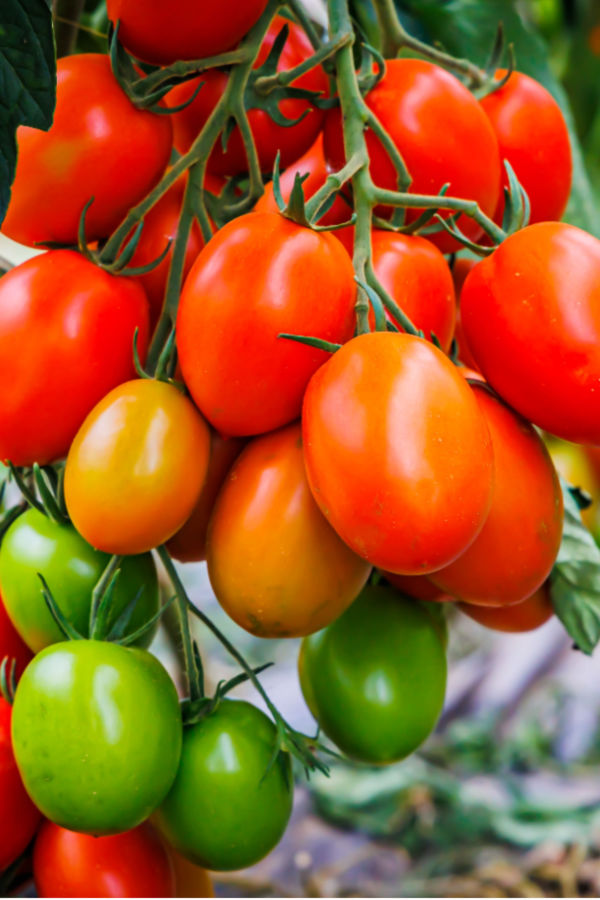
That means when you collect and save seed from these plants, you know exactly what you will get from year to year. And is there ever a wide range of open-pollinated varieties available! From tomatoes, peppers, beans and onions, to peas, corn, pumpkins and more – there are thousands of open-pollinated plants.

Saving Vegetable Seeds – Choosing Your Seed

Now that you know what you can and can’t save, it’s time to start saving seeds! The best time to start saving seed from your plants is after the plant reaches full maturity.

If you select seeds from the first fruit the plant produces, the plant may have not matured enough to produce good seed. With this in mind, selecting fruit during mid to late summer is best. Not is there a better selection of vegetables to choose from, the seed will be much more viable.

When it comes to selecting vegetables for seeds, you want to select the best vegetables your plant produced to take seeds from. The seeds from your highest quality plants and vegetables are also most likely to grow strong and productive plants next year.

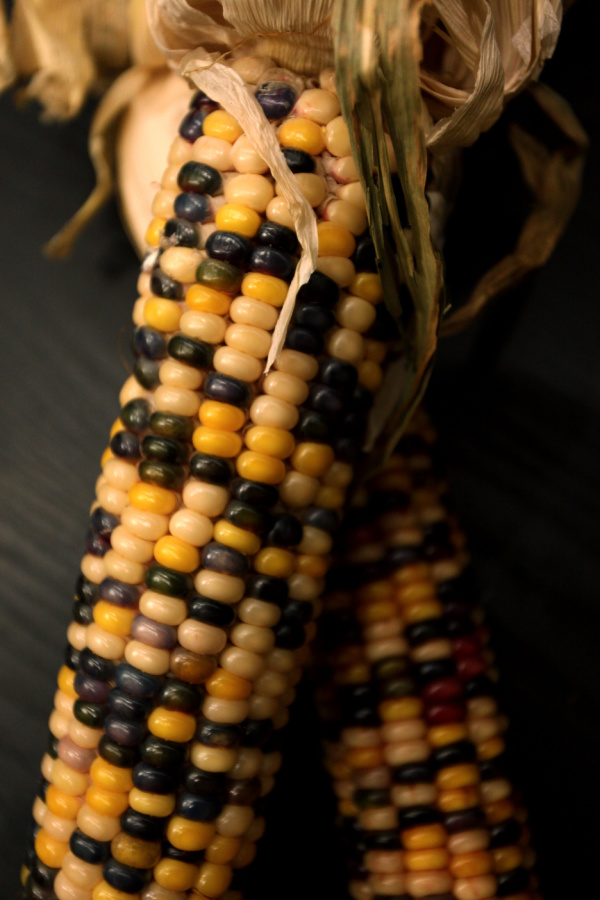
heirloom corn seed
Save seed from the best of the best of your vegetables. This heirloom corn developed perfectly – and the kernels are likely to produce similar plants next year.

It goes without saying, do not use any seeds from damaged vegetables or ones that are coming from plants that show any sign of issues or disease. The likelihood of passing those traits on to next year’s plants are high!

Be sure to pick only mature vegetables that have reached their final size and coloring. If you are growing more than one plant of the same variety, pick a few vegetables from different plants. Not only will it give you adequate seeds to plant next year, it also guards against the chance any one vegetable having a bad seed core.

Drying & Saving Seed

Other than tomatoes (which are covered below), the process of saving seed is nearly identical for all vegetables.

For soft vegetables, cut the vegetable in half and scrape out the seeds from the seed core. For harder vegetables like beans and corn, allow them to dry out a bit before shelling for seed.

Once the seed is our, lay them on a paper towel in a sunny or warm location. This will help to remove excess moisture in the seed and help them dry out. Most seeds will dry out in about a week or two. Once the seeds have dried completely to the touch, place the seeds in a folded paper towel.

By placing in a paper towel, any remaining moisture will wick away from the seed. Now it is all about storing your seed properly – which means sealing them in an airtight zip-lock bag or container and placing in a cool, dry location until ready to use.

You can also store chilled in the refrigerator until spring – but it often takes up valuable refrigerator space. One thing you do not want to do is freeze them. It can simply develop too many moisture issues for your seed.

About Tomatoes – How To Save Vegetable Seeds From Your Garden

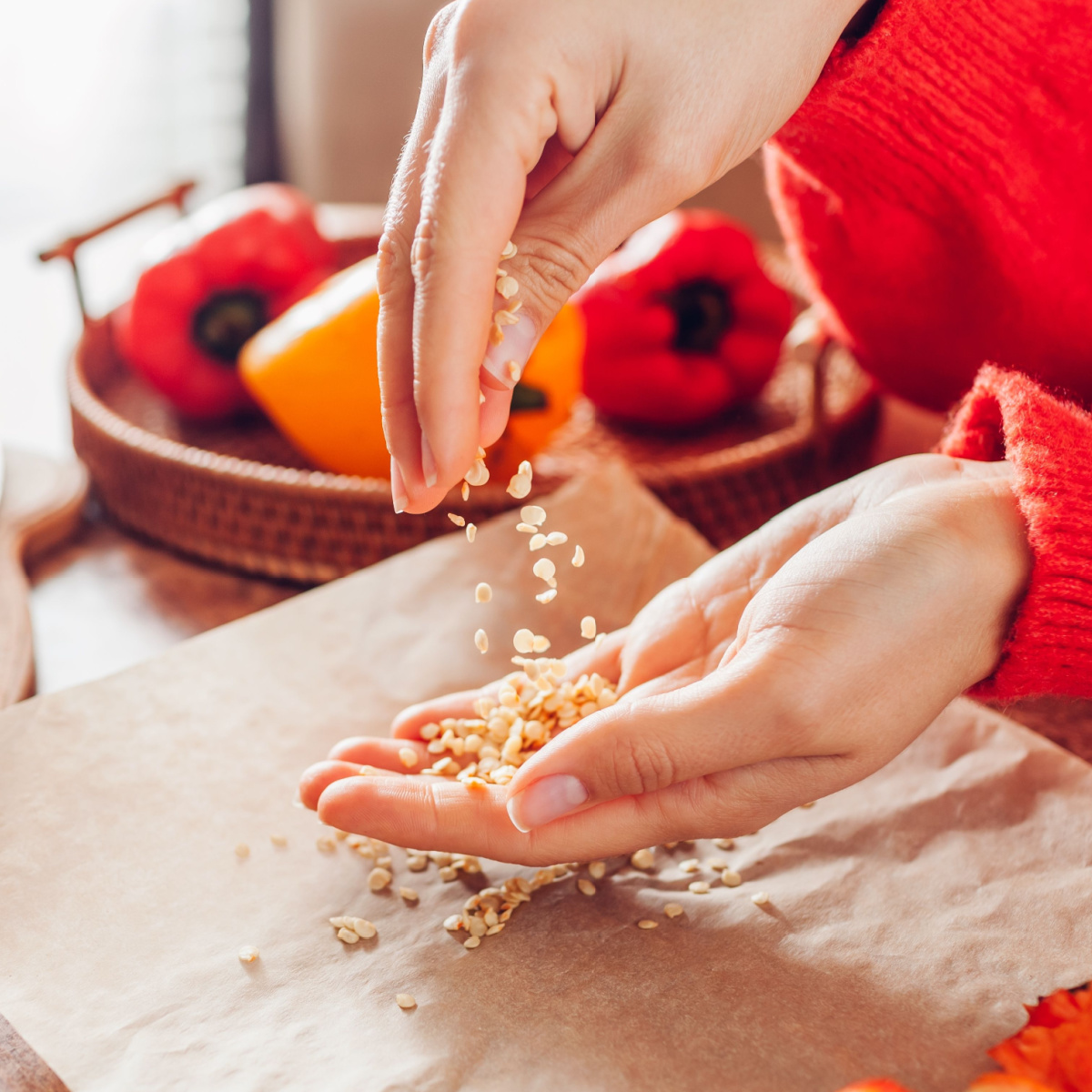
Tomatoes, unlike other vegetable plants, require an extra few steps for saving. To create good seed, tomatoes actually need to ferment a bit before drying and storing. This process helps to break down the outer protective coating on a tomato seed, allowing it to germinate the following year.

It sounds difficult and technical, but the process is fairly easy to accomplish. Simply scoop out the pulp and seeds of the tomatoes and place in a jar.

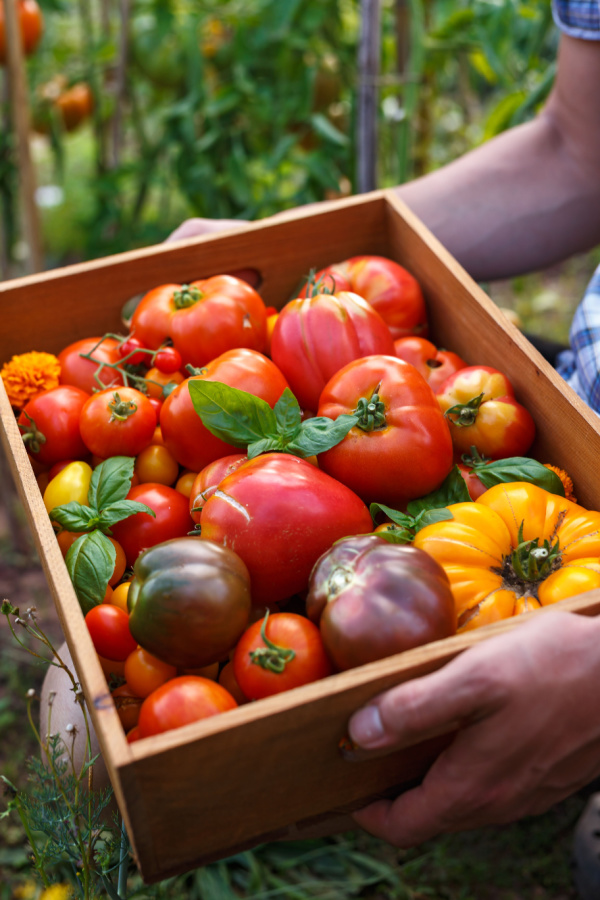
heirlooms
Saving your own seed allows you the opportunity to grow the plants and vegetables you love most – all for free!

Place the seeds in an out of the way area and allow the seeds and pulp to mold for a few days. This can sometimes put off an odor, so placing them away is a good idea! Then after a few days – just wash off and dry the seeds like above. The mold will etch the seeds and have them ready to germinate next season!

Once all of your vegetable seeds are saved and stored, you will be armed and ready for planting your garden next year – with zero expense! Happy Gardening – Jim and Mary

As always, feel free to email us at [email protected] with comments, questions, or to simply say hello! You can sign up for our free email list in the subscribe now box in the middle of this article. Follow us on Facebook here : OWG Facebook. This article may contain affiliate links.

This content was originally published here.

The Beloved Theologian: The Life and Legacy of Agustín de Hipona Pacheco

Portrait of Agustín de Hipona Pacheco

The Beloved Theologian: The Life and Legacy of Agustín de Hipona Pacheco

Introduction:
Agustín de Hipona Pacheco, widely known as Saint Augustine, was a renowned philosopher, theologian, and bishop who profoundly influenced both religious thought and Western philosophy. Born in the year 354 in the town of Tagaste, Numidia (present-day Algeria), his life journey led him to become one of the most celebrated figures of early Christianity. This biography delves into the extraordinary life and lasting impact of this beloved theologian.

Chapter 1: Childhood in North Africa
– Early years in Tagaste under the influence of his pious mother, Monica.
– Education at Madaurus and Carthage, where Augustine indulged in worldly pursuits.
– Intellectual curiosity ignited by reading Cicero’s Hortensius.

Chapter 2: Conversion to Christianity
– Joining Manichaeism but later growing disenchanted with its teachings.
– Encounter with Bishop Ambrose of Milan during a trip to Italy that played a pivotal role in his conversion to orthodox Christianity.
– Augustin’s baptism by Ambrose leading him towards a profound spiritual transformation.

Chapter 3: Writings on Theology and Philosophy
– Augustine’s prolific literary career encompassing influential works like “Confessions,” “City of God,” “On Christian Doctrine,” and many others.
– Exploration of philosophical concepts such as free will, original sin, predestination, grace, and divine omnipotence.
– Contributions to the development of Christian theology through innovative ideas blending Neoplatonism with orthodox Christianity.

Chapter 4: Episcopacy and Ecclesiastical Influence
– Appointment as Bishop of Hippo Regius (present-day Annaba), where he dedicated himself to pastoral duties for over three decades.
– Battles against heresies like Donatism and Pelagianism through writings and public debates.
– Political engagement and mediation during tumultuous times, striving for unity within Christendom.

Chapter 5: Legacy and Influence
– Examination of Augustine’s lasting impact on religious thought, philosophy, and Western civilization as a whole.
– Consequences of his ideas on Christian doctrine, moral theology, sacraments, just war theory, and political philosophy.
– Influence on prominent thinkers like Thomas Aquinas, Martin Luther, John Calvin, and modern theologians.

Conclusion:
Agustín de Hipona Pacheco’s journey from a restless youth to becoming the beloved theologian Saint Augustine is an inspiring tale of personal transformation. His exceptional intellect combined with a deep spirituality allowed him to address complex theological questions that continue to resonate throughout the centuries. Saint Augustine’s teachings have left an indelible mark on religious discourse and philosophical inquiry while shaping the understanding of Christian faith in diverse cultural contexts. As his legacy persists to this day, Agustín de Hipona Pacheco remains treasured as one of Christianity’s most profound thinkers.

Dish: Bean Curd With Pineapple

Bean Curd With Pineapple

ACTIVE INGREDIENTS:

1 pound bean curd
1 lg can of pineapple pieces
1 tsp cornflour
2 tablespoon soy sauce
2 tablespoon completely dry sherry
Oil
1 ea eco-friendly onion, cut
1 mug bean sprouts

PREP WORK:

Cut drained pipes bean curd right into little dices. Drain pipes syrup from the pineapple, keeping 1 tablespoon of it. Liquify cornflour in this.
Mix in sherry as well as soy sauce. Include bean curd as well as allow mean 15 mins.
Warmth oil in a frying pan and also mix fry the marinaded bean curd till the fluid has actually been soaked up. Drain and also get rid of.
Include a bit even more oil as well as stir-fry the eco-friendly onion, bean sprouts as well as pineapple for 1 min.
Include bean curd, chef for 2 mins. Offer with steamed rice.

Tien Comes Back, Hui Rolls On to Reach US Open Junior Championships Semifinals; Ram and Salisbury Aim for Third Straight US Open Title; Gauff Advances to Women’s Final; Breaking Barriers USTA G18s Highlight Show Airs Saturday

©Colette Lewis 2023–
Flushing Meadows NY–

Katherine Hui and Learner Tien have plenty in common: both are from Southern California, have played on the biggest stages in American junior tennis in San Diego and Kalamazoo, and have been in New York for several weeks due to their performances there. But those similarities disappear when it comes to their experience in junior slams and their paths to Friday’s US Open Junior Championships semifinals.
Hui, who lost in the first round of women’s qualifying to Genie Bouchard on August 22 and has been in New York ever since, is playing in just her second junior slam and won her first main draw match on Sunday. Today she continued her spectacular run, with just 13 game lost, beating No. 6 seed Ena Koike of Japan 6-0, 6-3 in the stifling heat and humidity in the midday match.
Tien has now reached at least the semifinals in all three of the junior slams he has competed in this year, adding a US Open semifinal to his Australian Open final and his Roland Garros semifinal, but after losing in the first round of the main draw to Frances Tiafoe on Monday August 28th, he had to dig deep to defeat No. 2 seed Rodrigo Pacheco Mendez of Mexico 4-6, 6-0, 7-5.
With the temperatures in the 90s and the heat index in the 100s, the heat rule, which offers a 10-minute break between the second and third sets, was in effect before the matches began, but after winning the 28-minute second set, Tien wasn’t interested in giving up his momentum. Pacheco would have every reason to take a break, but he declined, and play resumed without any break.
“I was expecting him to take the 10 minutes,” Tien said. “I thought he looked pretty tired and he would kind of want a momentum change, have a fresh start in the third. It was pretty surprising he didn’t take the 10 minutes.”
Tien won the first two games of the third set, but Pacheco got on the board with a break, only to give the break back for a 3-1 lead for Tien. Tien held on to that until serving for the match at 5-3, with Pacheco swinging away and making none of the unforced errors that had plagued him earlier in the set.
“There’s obviously some nerves when you’re trying to close out a match like that,” Tien said. “I think he was playing pretty loose, because he had nothing to lose at that point, I’m serving for the match. I really tried to make him earn it and he came up with some good points, so I tried to let it go and refocus.”
Pacheco continued that higher standard of play, hitting an ace and two forehand winners down 15-30 serving at 4-5. But the 18-year-old left-hander, who has been as high as No. 1 in the ITF junior rankings, didn’t maintain it in Tien’s service game, which the 17-year-old American quickly won at love for a 6-5 lead.
“It was obviously a really big game for momentum and I tried to put a lot of emphasis on getting that game and thankfully he played a couple of loose points and I was able to get that game pretty quickly,” Tien said.
Tien played some great defense to earn the first point, and at 30-all, Pacheco blinked. He didn’t get a first serve in on either of the next two points, and after a forehand error and a backhand error, Tien was through to the semifinals.
Tien said his first experience at the US Open last year, when he lost in the first round of the men’s main draw and in the opening round of the junior championships, helped his preparation this year.
“I think I know my way around a little bit more this year,” Tien said. “Last year was my first time in New York, my first time coming to the grounds here. I kind of feel like I’ve got my restaurants down. We’ve been going to this dumpling place, Joe’s Dumplings, and I think we’ve been there nine times….it’s treated me well so far.”
Tien also now has a pro hitting partner to help him prepare for his junior matches, Alex Michelsen, who has trained with him for the past several years and has been watching his matches this week.
“I’ve been lucky to have him here the past few days,” said Tien. “He’s just been hanging around because he didn’t want to go back to California and all the way back out [to the ATP Cary Challenger next week]. I was able to hit with him a good bit, between men’s and juniors because he was still in mixed doubles. This week he’s been warming me up, we’ve drilled a good bit, trying to get some good practices in.”
Tien will face No. 15 seed Arthur Gea of France, who defeated wild card Alex Frusina 6-4, 6-3 to reach his first junior slam semifinal.
“I’ve seen him around all the slams, the ITFs, but I’ve never seen him play and never played against him,” said Tien, who will study what videos of Gea he can find. “I’ll try to get a decent idea of how he plays.”
Hui is encountering top international juniors regularly for the first time this week, but the turning point came much earlier, in her qualifying match with Bouchard.
“Going into qualies against Genie I had so many expectations of what I wanted to do that it kind of made me not fully enjoy the moment I was in,” said Hui, who received the qualifying wild card as the San Diego 18s finalist. “Staying the present has really helped my mentality; I didn’t put too many expectations results wise, obviously I have expectations for how I want to play and how I want to execute my game, but I think I have confidence I can win the tournament, I’m just not putting pressure on myself.”
Hui has always played an aggressive game, but her confidence in that style has been visible on every shot this week.
“My footwork is one of my strengths, getting in on every ball, but these last two weeks I’ve worked on it especially hard,” Hui said. “With the quality balls of the pros, it’s hard to do, so seeing these (junior) balls, sometimes they come off a little easier, so I can come in.”
Hui, who starts at Stanford on the 19th, has been bonding with future teammate Valerie Glozman this week, and they have also had the support of 2022 NCAA finalist Connie Ma during their junior matches.
“She’s been here the last three days, she warms me up, practices with me,” Hui said. “Valerie got her a credential, but she’s leaving tomorrow, so I’m really sad. But our whole team is super supportive.”
Hui is scheduled to play No. 10 seed Laura Samsonova of the Czech Republic, who advanced to the semifinals when an injured Hannah Klugman of Great Britain retired down 6-0, 3-0. Samsonova was herself injured during the match however, and was unable to take the court for her doubles quarterfinal. Her status for Friday’s semifinal is unknown. She is scheduled for the second match on Court 7, with the first match set for noon.
The other girls semifinal will feature top seed Renata Jamrichova of Slovakia, who reached her second consecutive junior slam semifinal with a 6-4, 6-4 win over Anastasiia Gureva of Russia, and No. 9 seed Tereza Valentova of the Czech Republic, who defeated No. 4 seed Sara Saito of Japan 6-2, 6-4. Although both are 16 and have been regulars on the ITF Junior Circuit for the past two years, they will be meeting for the first time Friday.
The top half boys semifinal will feature No. 14 seed Federico Cina of Italy and No. 7 seed Joao Fonseca of Brazil. The 16-year-old Cina, who beat top seed Yaroslav Demin in the third round Wednesday, got his easiest win of the week today, beating No. 9 seed Yi Zhou of China 6-2, 6-2.
Fonseca lost his first set of the week to No. 3 seed Cooper Williams, but played inspired tennis down the stretch to come away with a 7-6(8), 3-6, 6-3 victory and his first junior slam semifinal.
The 17-year-old from Brazil said the key point in the third set came at 3-3 on his serve, when Williams, normally an excellent volleyer, botched one and, after throwing his racquet, was given an unsportsmanlike conduct warning. Fonseca held for 4-3, then blasted forehand winners right and left to break. 
“The game changed in the third set, at 3-all 30-all,” Fonseca said. “It was an incredible point and he missed a volley, and I screamed so loud. I think the game was back to me. In the next game, I played incredible, made all the returns and I was so happy about that.”
One more task faced Fonseca, serving out the match, and he double faulted and missed a forehand wide after taking a 30-0 lead. But he came up with an ace to get to match point.
“I knew I needed a serve, and then I hit an ace wide,” Fonseca said. “Good to have the serve on the important moments.” 
Fonseca missed his first serve on match point, but hit a good second, and Williams’ return went long.  
Fonseca had lost in the quarterfinals of all three previous junior slams this year, so this was a breakthrough for him.
“It’s very emotional for me,” said Fonseca, who had lost to Williams in the J300 in Australia in January. “Almost getting there three times and now getting through, after two hours and 40 minutes in I don’t know how many degrees. It was so hot, and I’m very happy I fought to the last point and very happy with the win.”
Fonseca and Cina have played twice in the last ten months, on clay, with Fonseca winning both matches in straight sets.
Two Americans have advanced to the semifinals in doubles. Kaitlin Quevedo, who is playing with Jamrichova, got a walkover from Klugman and Mingge Xu of the Great Britain. The top seeds will play the unseeded Japanese team of Saito and Nanaka Sato, who defeated Annika and Kristina Penickova 7-6(1), 6-0.  Alexander Razeghi, playing with Australia’s Hayden Jones, defeated Cooper Woestendick and Maxwell Exsted 6-7(1), 6-3, 11-9 and will play Max Dahlin of Sweden and Oliver Ojakaar of Estonia, who took out No. 2 seeds Fonseca and Iliyan Radulov of Bulgaria 6-4, 4-6, 10-8. 
The boys doubles semifinal in the top half features No. 1 seeds and Roland Garros champions Pacheco and Yaroslav Demin of Russia against No. 6 seeds Federico Bondioli of Italy and Joel Schwaerzler of Austria.  Demin and Pacheco defeated Aryan Shah of India and Seungmin Park of Korea 6-2, 3-6, 10-6, while Bondioli and Schwaerzler beat No. 4 seeds Kyle Kang and Williams 6-3, 7-6(5). 
The girls doubles semifinal in the bottom half has the unseeded Japanese team of Hayu Kinoshita and Wakana Sonobe taking on No. 8 seeds Mara Gae of Romania and Gureva. Kinoshita and Sonobe got the walkover from Wimbledon champions Samsonova and Alena Kovackova of the Czech Republic; Gae and Gureva beat Alanis Hamilton and Tatum Evans 6-4, 7-5.
Rajeev Ram(Illinois) and Great Britain’s Joe Salisbury(Memphis) will play for their third straight men’s doubles title at the US Open Friday at noon, after the No. 3 seeds defeated No. 2 seeds and Roland Garros champions Austin Krajicek(Texas A&M) and Croatia’s Ivan Dodig 7-5, 3-6, 6-3 in Thursday’s semifinals. Ram and Salisbury face No. 6 seeds Rohan Bopanna of India and Matthew Ebden of Australia, who defeated Pierre-Hugues Herbert and Nicolas Mahut of France 7-6(3), 6-3.
Krajicek and Jessica Pegula will play for the mixed doubles title on Saturday against Anna Danilina(Florida) of Kazakhstan and Harri Heliovaara of Finland.
At the age of 18, Coco Gauff has reached her second women’s (Roland Garros 2022), beating Karolina Muchova of the Czech Republic Thursday night 6-4, 7-5 in a tense, two-hour semifinal.  Gauff will play the winner of the late semifinal match between Madison Keys and Aryna Sabalenka of Belarus.
Tennis Channel will air a one-hour highlight show of this year’s USTA Billie Jean King Girls 18s and 16s National Championships in San Diego Saturday at 11 a.m. Eastern, the morning of the women’s singles final. The show, entitled “Breaking Barriers” will look at the tennis competition last month and the tournament’s impressive history, as well as the impact that Billie Jean King herself has had on the tournament and on the competitive opportunities for women in sports. 

5yclone vs NAVI – ESL Pro League Season 18 – Group C

Watch live on Twitch:
https://www.twitch.tv/eslcs

Join the discussion:

http://www.facebook.com/eslcs
http://www.instagram.com/eslcs


http://www.facebook.com/iem

Get the latest ESL apparel:
http://shop.eslgaming.com

Your leading Competitive Gaming Platform:
https://www.faceit.com

Get free statistics for your matchmaking games with
https://www.csgostats.gg

Tagged:

2023 sees a return to normality for Brazil’s Independence Day

Today’s official Independence Day celebrations were calm and quiet this morning in Brasília. President Luiz Inácio Lula da Silva took part in the traditional military parade at the Esplanade of Ministries, alongside the head of Congress, Rodrigo Pacheco, and Supreme Court Chief Justice Rosa Weber. 

The Brazilian press is calling this year’s Independence Day a “return to normality,” as the previous two September 7 holidays had been hijacked into political rallies by far-right former President Jair Bolsonaro.

Bolsonaro’s supporters did not mobilize to organize demonstrations in favor of the former president. As The Brazilian Report showed this week, allies of the defeated politician joined a campaign for the right-wing to stay at home this Independence Day, understanding that this year’s celebrations are proof that the Armed Forces have bent the knee to Lula. 

Pro-Bolsonaro radicals have fallen out of love with the military, having trusted that the Armed Forces would have helped launch a coup to keep the former president in power and prevent Lula from taking over. In social media posts, angry Bolsonaro voters are criticizing the Armed Forces and calling them “watermelons”: with green uniforms on the outside, but red and “communist” inside. 

The Lula administration prepared today’s festivities to symbolize “a new moment of unity” in the country. It’s the first major civic event in Brazil’s capital since the January 8 Brasília riots, and the president sees it as a chance to whitewash the military’s crucial role in plotting a coup against him last year.

The post 2023 sees a return to normality for Brazil’s Independence Day appeared first on The Brazilian Report.

Spider-Gwen Annual #1 Review

Marvel presents Spider-Gwen Annual #1, Spider-Gwen’s second yearly special, punctuating the conclusion of the Shadow Clones arc. Written by Karla Pacheco, illustrated by Rosi Kämpe and Marika Cresta, with colors by Irma Kniivila and letters by VC’s Ariana Maher, Spider-Gwen Annual #1 continues Marvel’s overarching Contest of Chaos event. With the heart of the elder god Chthon in the hands of Agatha Harkness, Ghost-Spider is unknowingly thrust into single combat that could decide the fate of the universe.

Spider-Gwen Annual #1 opens with the unlikely scene of Gwen Stacy being roused by her squire and wizard assistant to prepare for an all-out assault on the castle gates — enemy forces closing in on the keep and their magical orb that protects the kingdom. On the battlefield, Ghost-Spider meets her rival, Ami Han, AKA The White Fox, but together, they quickly realize that something much more cosmic and complicated is afoot.

Spider-Gwen Annual #1 is brimming with dynamic dialogue and comedic beats and has a masterful grasp of tone that keeps the story moving. Pacheco quickly finds the narrative voice of the issue, building a great sense of pace and wit that reflects the characters perfectly. The annual is funny and light-hearted, with a distinct sense of buoyancy that gives extra punch to the dramatic conclusion. Unfortunately, the meat of the story is fairly paltry, following a plot structure that feels formulaic despite its elevated execution. Co-opting the annual special in favor of another installment in a 1v1 Face-Off Event feels like a missed opportunity, with the issue feeling much more like Contest of Chaos #6 than anything oriented around Gwen that expands her lore or character. The appendix chapter Contest of Chaos Part 5 (Phillips, Foche, Angulo) continues the ongoing mythos and adds to this effect, leaving Gwen Stacy a contestant when she should be the issue’s centerpiece.

The art of Spider-Gwen Annual #1 has a stylized quality with a retro feel just below the surface. Working in thin but multiple lines, Kämpe and Cresta create a world that is aesthetically interesting without feeling too dense or complex, perfectly matching the fluffy tone of the writing. The full-page panels are a lot of fun, punctuating the best narrative moments with bombastic visuals that feel iconic and memorable. The action scenes are also impressive, flowing with a real sense of motion and momentum from one panel to the next.

The colors slowly become richer and more intense as Spider-Gwen Annual #1 progresses. Kniivila moves from a balmy fantasy pallet to moody and atmospheric darkness. Kniivila’s use of light and contrast is impressive, creating some striking neon moments that pop off the page. Maher’s letters are clear and well-constructed throughout. The alternate lettering used for the cybernetic voice that appears at the conclusion is visually interesting and surprisingly onomatopoeic.

Spider-Gwen Annual #1 succeeds as a Contest of Chaos installment, but audiences looking for a more Gwen-centric experience may come away disappointed. The illustration, colors, and dialogue are charming, but the plot is hampered by its self-imposed framework, and a lack of creative leeway prevents the comic from being truly memorable. Although it is nice to see Gwen incorporated into large-scale overarching narratives, it very much comes at the cost of a rare Ghost-Spider one-shot when it feels like Contest of Chaos could be its own run rather than spreading itself across individual characters’ yearly specials.

« Previous Page — Next Page »