Easy Vegetable Lasagna No Pasta – gluten free, vegetarian dinner!

A delicious vegetable lasagna no pasta noodles necessary! Yes, it’s all veggies, cheeses and marinara sauce for a tasty gluten free, vegetarian dinner. (You won’t miss the noodles!) This is the perfect dish for using fresh veggies from the garden or just when you are craving Italian food on a gluten free diet.

You might also like these microwave lasagna cups with zucchini!

white dish with veggie lasagna with no pasta
This post contains affiliate links. For more information visit our policies page.

I’ve been wanting to try this for a long time. I love zucchini and eggplant by my husband does not. So one night when he wasn’t going to be home for dinner I made this vegetable lasagna without noodles for myself and I loved it.

I knew I would. What’s not to love? It’s full of a variety of cheeses and creamy ricotta and some of my favorite veggies. I also liked it because it was gluten free and vegetarian which is a nice change sometimes.

Unfortunately neither my hubby nor my son will eat this but maybe that’s a good thing as that means more for me. I frozen a few pieces for a quick and tasty lunch!

I pretty much followed the same method as my mom’s unforgettable lasagna. For a traditional lasagna I really think it’s the best I ever had so check it out.

However I skipped the meat sauce in the original recipe. If you want you can easily add ground beef, ground turkey or even Italian sausage to the marinara sauce to make a meat sauce.

Just heat up a pan to medium heat and brown the ground beef. Then add the sauce and mix well. Cook for a few minutes so the flavors blend together well.  

Recipe ingredients I used.

The basic ingredients I used I this vegetable lasagna were vegetables, ricotta cheese, egg yolks, fresh parsley, marinara sauce and cheeses. If you want to add a bit of heat you can also use some hot pepper flakes. Mix it in with the sauce. 

Fresh Vegetables
I used eggplant, zucchini and bell peppers for this dish. There aren’t many other veggies that I think would work well as “noodles” so I would stick with these three or use just one of them if you want. Fresh spinach would also work well in addition to the noodle layers made with the veggies.

Ricotta Cheese
I like whole milk ricotta cheese because it’s richer and tastier in my opinion but you can use lower fat if you want.

Marinara Sauce
I love Rao’s marinara sauce and it was great in this recipe. I also love Trader Joes marinara in a can. I really like the taste of both and I use them a lot in my cooking because of their amazing flavor. However you can just use your favorite pasta sauce for this recipe.

Cheeses
I like the combination of parmesan and mozzarella cheese for this dish. The parmesan adds flavor while the mozzarella as that gooey cheese factor. Provolone is also good in a dish like this.

Egg Yolks & Parsley
This helps thicken the ricotta mixture and is necessary. The fresh parsley is for flavor and color. You could also use fresh basil leaves if you love that flavor but parsley works great.

How to cut the veggies.

Start by cutting off the tops and bottoms of the bell peppers and cleaned out the seeds. It should look like wide tube. Cut that in half and you will get two flat pieces of peppers.

The key for the eggplant and zucchini is to slice them very thin. I use one of my favorite kitchen tools – this mandoline that I bought at a tupperware party. However I also have one from Aldi that was $5 and it works great too! If you have good knife skills just make sure you slice them lengthwise very thin.

If you decide to use other veggies just make sure you slice them thinly and if they are a harder vegetable like carrots for instance, you will want to precook them in the microwave or by boiling them first.

How to make vegetable lasagna no pasta.

Preheat oven to 400°F and spray a baking or casserole dish with nonstick cooking spray and set aside.

Step 1: The hardest thing about this dish is getting the veggies soft. Get a large pot of water boiling over high heat. Cut the peppers as mentioned above and then add the peppers and cook for 6 minutes. Take them out and let them cool. Peel off the skins if you can and set aside.

You can also cook them in the microwave for about 5 minutes. It’s hard to get the skins off though but you can keep them on if you want.

Step 2: Get out a medium bowl and add the ricotta, egg yolks and chopped fresh parsley. Mix well and set aside.

Step 3: Get out the prepared baking dish and add a single layer of eggplant, then spoon ⅓ of the ricotta mixture over top. Pour ⅓ of the tomato sauce over the layer of ricotta filling and then top the layer of marinara sauce with ⅓ of the parmesan cheese and then ⅓ of the mozzarella cheese.

I did a layer each of peppers, zucchini slices and eggplant slices.

Step 4: Begin again with the zucchini slices for the next 2nd layer and finally with the peppers for the 3rd layer. The order for each layer is veggies -> ricotta -> marinara -> cheese then repeat.

Step 5: Cover with a piece of aluminum foil and place the preheated oven. Bake for 30 minutes then take off the foil and bake for 15 minutes more until the veggie lasagna is fork tender and the cheese is golden brown. Note baking time may vary depending on the thickness of the veggies.

You can also place it under the broiler for 3-4 minutes to brown the cheese if it is not to your liking after baking for a total of 45 minutes.

Step 6: Let set for 15 minutes to cool and set up before serving. Store leftovers in an airtight container. Please scroll down to view a printable recipe card.

As you can see below this is a bit runny because of the liquid in the veggies but it does not taste watery in my opinion. This also has a lot of ricotta cheese which I like but if you want you can skip the top layer if you don’t like it as much as I do.

Serve this veggie lasagna with a simple green salad and add some garlic bread if you aren’t gluten free of course!

More gluten free vegetable main dishes to try.

Below are some of my favorite recipes for veggie main dishes that don’t have any bread, pasta, etc. so they are gluten free too. These recipes are perfect for meatless meals or when you you want something a bit lighter for dinner.

Well I hope you like this veggie lasagna without pasta as much as I did. Unfortunately my husband doesn’t eat zucchini nor eggplant so this was all for me. But maybe that’s a good thing? 😉

Cook Time:
45 minutes
Total Time:
1 hour

A delicious veggie lasagna no pasta! Yes, it’s all veggies, cheeses and marinara sauce for a tasty gluten free, vegetarian dinner. (You won’t miss the noodles!)

Instructions

Notes

I like Rao’s marinara and Trader Joe’s Tuscan Marinara in a can because these sauces have more of the savory garlic and onion flavor and are not too sweet. However you can use whatever pasta sauce you like best.

If you want to add a bit of heat you can also use some hot pepper flakes and mix it in with the sauce.

Also I did not use added salt or black pepper. The sauce and cheeses tend to add enough of salt for my tastes but you can sprinkle salt and ground black pepper over the veggies if you wish.

Lastly if you want you can use minced fresh basil leaves in place of the parsley or in addition to it if you like that flavor.

Nutrition Information:
© Denise Wright (MyLifeCookbook.com)


Cuisine:

Italian

/
Category: Main Course

This content was originally published here.

DVIDS – News – The Pride of Belonging

Photo By Cpl. Bernadette Pacheco |
U.S. Marine Corps Pvt. Daniela Portillo, a recruiter assistant under the Command……
read more
read more

NASHVILLE, TN, UNITED STATES

08.28.2023

When U.S. Marine Corps Pvt. Daniela Portillo first sat down with her Marine recruiter, he placed 11 engraved tags on the desk in front of her. These tags, known as “benefit tags”, present tangible and intangible benefits to help identify the motivations of potential Marines. Portillo took a moment to survey her options, then pointed to the “Pride of Belonging”.

Portillo, soft spoken and shy, graduated Osbourn High School in Manassas, Virginia, in 2022. She planned to enlist in the Marine Corps alongside her sister, Kimberly. Kimberly was her close confidant, and Portillo had always looked up to her. In high school, Kimberly had decided to join the Marine Corps in order to open the door to educational opportunities. When she approached Portillo with the idea of earning the title together, Portillo immediately said yes.

However, Portillo began to experience intense homesickness for her home country of El Salvador. Her aspiration to join the Marine Corps had weakened, and she felt lost and aimless. She decided to temporarily postpone her enlistment in order to spend time there with her relatives.

After a few months, rejuvenated from the time spent with family, Portillo returned to the United States and resided in Tennessee with her father. She started working, but didn’t intend to stay at her customer service job long term – it was just a means to get back on her feet. But the weeks stretched into months, and soon a year had passed.

Kimberly, a year into her enlistment, reached out to her sister and encouraged her to reclaim her original goal. Longing for a purpose, and uplifted by her sister’s words, Portillo contacted Staff Sgt. Sean Clark, a recruiter out of Recruiting Substation (RSS) Murfreesboro, Recruiting Station Nashville.

On April 24, 2023, Portillo stepped on the infamous yellow footprints abroad Marine Corps Recruit Depot, Parris Island, South Carolina. These painted footprints, arranged in a formation outside the base’s Receiving Building, signifies an individual’s new status of “recruit”. The next 13 weeks hold physical and mental challenges that will push recruits to their limit. Their voices will be hoarse from the yelling that is their only authorized form of communication, they will be exhausted due to long nights and early mornings, and they will be homesick from weeks separated from loved ones.

Portillo determined her secret to survival was to embrace an optimistic mindset – and this is what she did.

“I always tried to make the best of it,” she explained. “If I was being negative about it, I just knew it was going to be harder for me to get through.”

Portillo successfully earned the title of Marine, and graduated recruit training on July 21, 2023. She then returned to RSS Murfreesboro as a recruiter assistant under the Command Recruiting Program. This program offers new Marines the opportunity to return to their recruiting station in support of recruiting efforts. As a fresh face to the Marine Corps, they serve as a link between their fellow peers and recruiters. Portillo visits high schools with recruiters, where she interacts with teachers and students in order to establish a Marine Corps presence.

Portillo expressed excitement for the next stage of her career, which is Marine Combat Training (MCT) at Camp Geiger, North Carolina. There, for 29 days, she will acquire combat-based skills required of all non-infantry Marines in order to ensure fighting readiness. After MCT, she is slated to attend her Military Occupational Specialty training as a logistics specialist.

A longing for purpose is what drove Portillo to enlist in the Marine Corps, and she cites this as something that will carry her throughout her career.

“I felt lost and like I had no purpose,” Portillo stated. “And the Marine Corps opened me up to my purpose. And I feel like I’ll discover it more fully the longer I’m in.”

LEAVE A COMMENT

Date Taken: 08.28.2023
Date Posted: 08.28.2023 09:20
Story ID: 452262
Location: NASHVILLE, TN, US 
Hometown: MANASSAS, VA, US
Web Views: 12
Downloads: 0

PUBLIC DOMAIN  

Hong Kong Braces for Biggest Typhoon Since 2018

Hong Kong was starting to feel the impact of Super Typhoon Saola as winds reached hurricane force and rain lashed the city.

The government said it will raise the No. 9 storm signal — the second highest — at 6:20 p.m. That will be the first time in three years such a warning has been issued. The city earlier closed the stock market along with schools and grounded most public transportation ahead of the storm’s arrival later Friday.

The storm, which was 90 km (56 miles) away from the financial hub at 6 p.m., currently has sustained winds of 210 km/hour near the center, according to the local observatory. That makes it as strong as a category 4 major hurricane on the Saffir-Simpson wind scale.

Gale force winds were affecting the territory, with occasional storm force winds offshore and hurricane force winds on some high ground, the observatory said in its latest update. There were also heavy squally showers, it said.

The storm, which is on track to be the strongest to affect the city since at least Mangkhut in 2018, is a major test for Chief Executive John Lee’s government. Mangkhut provoked public criticism after roads remained blocked for days by some of the tens of thousands of trees toppled by the typhoon and people struggled to get to work.

Saola is forecast to be within 50 km south of Hong Kong late Friday and early Saturday, the observatory said, warning that a storm surge will cause water levels to rise rapidly in low-lying coastal areas. The maximum water level may be similar to when Mangkhut hit Hong Kong, it said. Mangkhut was 100 km away from the city at its closest point.

Chief Secretary Chan Kwok-ki, who is leading a government task force to deal with the storm, warned residents to stay indoors.

“This can be a very destructive typhoon,” the chief secretary said Thursday, flanked by heads of various government departments. “We hope to minimize the damage.”


In the past 40 years, only five storms have prompted the raising of the highest signal in Hong Kong, according to observatory data. The No. 10 signal means hurricane force winds reaching a sustained speed of at least 118 km an hour.

Residents took advantage of the calm conditions on Friday morning to do some outdoor exercise, walk their dogs and stock up on food before the storm arrived. At one Wellcome supermarket in Wanchai on Hong Kong island, vegetables, fresh meat and hot food were running out by mid-morning, while instant noodles and pasta were in short supply.

About 460 flights in total have been canceled on Friday, according to the local airport authority. Cathay Pacific Airways Ltd., the city’s flag carrier, said it halted all Hong Kong flights from 2 p.m. Friday until 10 a.m. Saturday.

In Hong Kong, all inner harbor and outlying islands ferry services were suspended, along with all bus services.

Nearby Shenzhen airport halted all flights from noon, the airport operator said. Businesses closed from 4 p.m., while transport would stop three hours later, the government said. Trains traveling to and from Guangdong province would be halted from 8 p.m. Friday to Saturday evening.

The Hong Kong exchange halted stock trading because of rules requiring it when signal no. 8 or above is in place. Trading halts due to severe weather are seen as increasingly antiquated given that the global finance industry adjusted to remote working during the pandemic.

With most orders now received and executed electronically, the case is growing for Hong Kong to ensure continuous trading in bad weather. Financial Secretary Paul Chan said earlier this year that the city will explore arrangements to allow stock trading under severe weather.

China’s national weather authorities reiterated their highest alert for the typhoon on Friday morning. They warned of severe weather in the coastal provinces of Fujian and Guangdong, and urged local officials to be ready for flash flooding. China dealt with several bouts of extreme weather this summer, with dozens of deaths in northern areas including Beijing that were caused by flooding from Typhoon Doksuri.

Another storm is expected to affect Taiwan and eastern China in coming days. Severe tropical storm Haikui, with maximum sustained winds of 110 km per hour, is forecast to be close to northern Taiwan on Saturday evening or Sunday morning before making landfall in mainland China near Fuzhou.

Currency and fixed income markets in the Philippines were closed on Friday after government offices including the central bank were shut due to monsoon rains enhanced by Saola and other storms.

–With assistance from Jing Li, Philip Glamann, Filipe Pacheco, Danny Lee, Luz Ding, Dominic Lau, Olivia Tam and Alfred Liu.

Photograph: Pedestrians brace from the wind and rain on the waterfront in Tsim Sha Tsui district during a No. 8 storm signal raised for Super Typhoon Saola in Hong Kong, China, on Friday, Sept. 1, 2023. Hong Kong hunkered down on Friday as officials and residents prepared for the impact of Super Typhoon Saola, which is forecast to hit the city toward the end of the day. Photo credit: Justin Chin/Bloomberg

Just how To Grow Your Micro-Business

Just how To Grow Your Micro-Business

You could think about some of the searchings for of a study by Statistics Canada if you desire to expand your micro-business (specified as a service with less than 5 staff members).

1. The Findings

According to “Growth Determinants of Micro-Businesses in Canada” (Evangelia Papadaki and also Bassima Chami, Small Business Policy Branch, Industry Canada), the study by Statistics Canada exposed the following:

Micro-businesses obtain a lot of their suggestions from family members, consumers, providers as well as buddies. Accounting professionals are a lot more generally spoken with for service recommendations than lenders as well as attorneys.

Conclusion of secondary school was mentioned as a variable for development in the micro-business. Possibly remarkably, university or college education and learning was marked down as an aspect for success.

Age or sex of entrepreneur did not influence service development. Neither was being an immigrant a substantial variable.

For development, wanting to pass on, think danger, and also share possession all appeared to be aspects for success.

Development of the neighborhood market was more vital for development than the export market for the micro-business.

Development micro-businesses involve and also introduce in shopping tasks.

2. The Opportunities

You do n`t always require a whole lot of cash for specialist experts to expand your micro-business. Age, sex or nation of beginning are not pertinent aspects for expanding your micro-business.

You ca n`t do whatever on your own if development of your micro-business is your objective. You have to want to delegate (or probably also share possession of your service with others). Advancement, a readiness to take threats, and also use the Internet are additionally crucial to your development.

Do you utilize shopping in your service? Are you utilizing the Internet to broaden your neighborhood service?

Your micro-business is positioned for development if you can respond to these inquiries agreeably.

You do n`t always require a whole lot of cash for expert experts to expand your micro-business. Age, sex or nation of beginning are not pertinent variables for expanding your micro-business.

If development of your micro-business is your objective, you ca n`t do whatever on your own. You need to be prepared to delegate (or probably also share possession of your organization with others). Development, a readiness to take threats, and also usage of the Internet are additionally vital to your development.

Digging deeper into how vaccines work against parasitic disease

Digging deeper into how vaccines work against parasitic disease
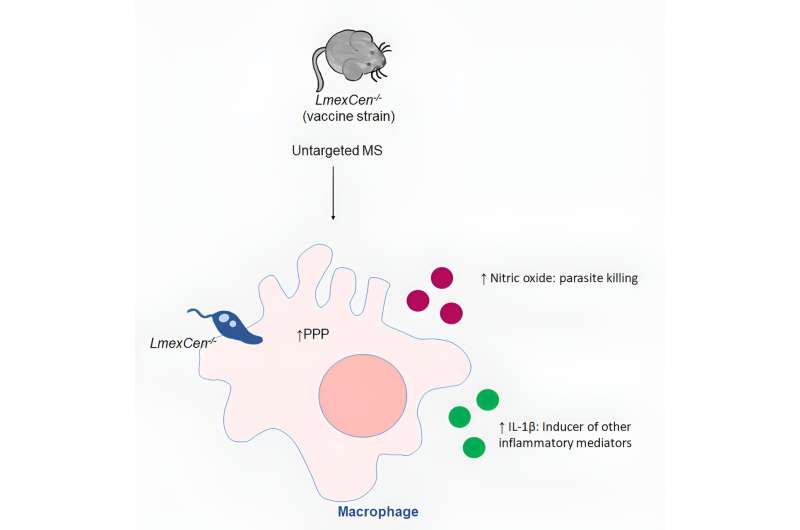
Credit: iScience (2023). DOI: 10.1016/j.isci.2023.107594

Scientists have established the effectiveness of vaccines they developed to prevent the disfiguring skin disease leishmaniasis in animal studies, and Phase 1 human trial planning is in motion for the most promising candidate.

But in new work, the research team has determined how these , created using mutated disease-causing parasites, prompt molecular-level changes in host cells that have specific roles in helping generate the immune response.

Despite using the same CRISPR gene-editing technique to make the vaccines, the two species of Leishmania parasites on which the vaccines are based produced very different effects in the immunized host: One enables the immune response to unfold by inhibiting a host metabolite that suppresses immune activity, and the other drives up activation of a chemical pathway in a way that primes immune cells to fight pathogens.

“I think it’s an important finding in the sense that we show that in the big picture, yes, these vaccines are protective, but at the molecular level the mechanisms can be totally distinct,” said Abhay Satoskar, professor of pathology in The Ohio State University College of Medicine and co-leader of the research team.

“This is not only conceptually important, but if you can find how these things are modulating the in the right direction, and identify the pathways, then perhaps those pathways could be used for developing new interventions,” said Satoskar, a senior author of two new papers describing the findings.

The primary vaccine was made by editing the genome of Leishmania major, which causes in tropical and subtropical regions of the Eastern Hemisphere, and a backup vaccine was made using Leishmania mexicana, a more virulent species found in South, Central and North America.

The study findings on the of the L. major and L. mexicana vaccines were published Aug. 29, 2023, in the journal iScience.

Leishmaniasis is prevalent in 90 countries affecting about 12 million people globally at any given time, but no licensed human vaccine yet exists, and the only drug treatment for the requires weeks of daily injections with unpleasant side effects. The more lethal visceral leishmaniasis affects organs and is fatal if left untreated.

In developing these live attenuated vaccines, Satoskar and colleagues applied new technology to the century-old Middle Eastern practice of leishmanization—introducing the live parasite to the skin to create a small infection that once healed, leads to life-long immunity against further disease.

The researchers previously reported using CRISPR to delete centrin, the gene for a protein that supports the parasite’s physical structure, from the genomes of both L. major and L. mexicana. Experiments showed vaccinated mice remained clear of skin lesions and the number of parasites at the infection site were held at bay.

Digging deeper into the vaccines’ effects in these new studies, researchers inoculated mouse ears with a normal parasite, a mutated parasite vaccine or a placebo, mimicking the bite of a sand fly—in humans and animals, leishmania is transmitted through the bite of infected sand flies.

The team used mass spectrometry at the inoculation site to identify the most prominent metabolites—the , vitamins and other small molecules produced as a result of metabolism, the many chemical reactions that keep the body functioning.

Results showed the L. major vaccine promoted a pro-inflammatory metabolic response in mice by using the amino acid tryptophan to block signals from a molecule that helps suppress immunity. The L. mexicana vaccine, on the other hand, enriched a series of metabolic reactions that activated the necessary pro-inflammatory work of front-line immune cells.

“We took an unbiased approach to analyze the metabolites detectable at the inoculation site. There is growing interest in understanding the role immune cell metabolism plays in modulating immune function,” said Satoskar, also a professor of microbiology at Ohio State.

“We also learned that by removing the centrin gene, we got rid of the parasites’ ability to manipulate metabolic pathways in a way that would impair development of protective immunity, and in fact, promoted vaccine-induced immunity. That’s important to know for a live attenuated —there is a unique case for each parasite species.”

Though this information is not required for regulatory approval of these vaccines, the data could prove useful to supplementing vaccination.

“There are only four existing drugs for leishmaniasis,” Satoskar said. “We need to know the mechanism of vaccines so the knowledge can be used to develop newer vaccines or newer drugs that target these pathways. What you learn from immunomodulation can be used for developing other therapeutic agents.”

Co-authors of both papers include Sreenivas Gannavaram and Hira Nakhasi, who co-led the L. major study, and Nazli Azodi and Hannah Markle, all of the FDA; Greta Volpedo of Ohio State; Timur Oljuskin of the USDA Animal Parasitic Diseases Laboratory; Shinjiro Hamano of Nagasaki University; and Greg Matlashewski of McGill University. Thalia Pacheco-Fernandez of Ohio State co-authored the L. mexicana paper and Parna Bhattacharya of FDA co-authored the L. major paper.

More information:
Timur Oljuskin et al, Leishmania major centrin knock-out parasites reprogram tryptophan metabolism to induce a pro-inflammatory response, iScience (2023). DOI: 10.1016/j.isci.2023.107593

Greta Volpedo et al, Leishmania mexicana centrin knockout parasites promote M1-polarizing metabolic changes, iScience (2023). DOI: 10.1016/j.isci.2023.107594

Citation:
Digging deeper into how vaccines work against parasitic disease (2023, August 31)
retrieved 31 August 2023
from https://medicalxpress.com/news/2023-08-deeper-vaccines-parasitic-disease.html
This document is subject to copyright. Apart from any fair dealing for the purpose of private study or research, no
part may be reproduced without the written permission. The content is provided for information purposes only.

What If the Sun Dimmed Down?

Learn what Emily Calandrelli, better known as the Space Gal, has to say about space weather and our dependence on the Sun: https://bit.ly/what-if-the-sun-dimmed-down-discussed

The sky appears darker. The temperature is starting to drop. Our rivers are freezing, crops are covered in snow! People could go hungry. Is it just me, or is the Sun dimming? Are we about to enter a solar minimum? Would this help fight global warming? But wait. Why is NASA and Elon Musk so happy?

Transcript and sources: https://whatifshow.com/what-if-the-sun-dimmed-down-2/

Subscribe to our second channel called “How to Survive”: https://bit.ly/how-to-survive-by-what-if

Can you translate this episode into another language? Add subtitles and we will link your YouTube channel in the description: https://www.youtube.com/timedtext_video?v=uSsCtaZEPz4

Watch more what-if scenarios:
Planet Earth: http://bit.ly/YT-what-if-Earth
The Cosmos: http://bit.ly/YT-what-if-Cosmos
Technology: http://bit.ly/YT-what-if-Technology
Your Body: http://bit.ly/YT-what-if-Body
Humanity: http://bit.ly/YT-what-if-Humanity

T-shirts and merch: http://bit.ly/whatifstore
Suggest an episode: http://bit.ly/suggest-whatif
Newsletter: http://bit.ly/whatif-newsletter
Feedback and inquiries: https://underknown.com/contact/

What If elsewhere:
Instagram: http://bit.ly/whatif-instagram
Twitter: http://bit.ly/whatif-twitter
Facebook: http://bit.ly/facebook-whatif
What If in Spanish: http://bit.ly/YT-Spanish-what-if
What If in Mandarin: http://bit.ly/YT-Chinese-what-if
Podcast: http://bit.ly/yt-what-if-show-podcast

What If is a mini-documentary web series that takes you on an epic journey through hypothetical worlds and possibilities. Join us on an imaginary adventure through time, space and chance while we (hopefully) boil down complex subjects in a fun and entertaining way.

Produced with love by Underknown in Toronto: https://underknown.com

Tagged:

Brats and Biers in SF Bay! 25+ local Oktoberfest celebrations for 2023

Bust out that lederhosen and don your best dirndl, because it’s Oktoberfest time! From Munich munchies to Bavarian bites and Prost parties, there are near-endless ways to celebrate Oktoberfest from right here in the Bay.

Woodsfest – Island Oktoberfest: 12 to 6 p.m. Sept. 9, 1 Avenue of the Palms, San Francisco. Celebrate Oktoberfest in the Bay with festive music from Joe Smiell’s German Brass Band and delicious food, including grilled sausages, housemade sauerkraut and soft pretzels, plus breathtaking views of Treasure Island. $25.

Schroeder’s Annual Oktoberfest Block Party: 3 to 10 p.m. Sept. 15, Schroeder’s, 240 Front St., San Francisco. Come out for Schroeder’s annual Oktoberfest Block Party featuring live music, beverages and bites, plus games and activities including stein chugging, stein holding and costume contests. Free admission.

Benicia Oktoberfest & Marketplace: 11 a.m. to 6 p.m. Sept. 16, First Street Green, Benicia. Indulge in the spirit of Oktoberfest as Benicia brings you the best of German culture. From traditional Bavarian music to mouthwatering food and an artisanal marketplace, this event promises an unforgettable experience for all. Grab your lederhosen or dirndl and immerse yourself in the lively atmosphere. $10.

Oktoberfest at Original Pattern Brewing: 12 to 8 p.m. Sept. 16, 292 Fourth St., Oakland. Dust off that lederhosen and mark your calendars for another epic Oktoberfest in the heart of Oakland. Keep the German legacy going with live music, delicious bites, beer, games, prizes, and, of course, Original Pattern’s festive annual beer releases. $25-$40.

Oktoberfest at Side Gate Brewery: 12 to 9 p.m. Sept. 16, 1822 Grant St., Concord. Side Gate’s Oktoberfest will include live music, a craft fair, a stein-holding contest, corn hole and delicious German-style bites and beers on tap. Pre-sale tickets $25. sidegatebrewing.com/oktoberfest

Radhaus’ Oktoberfest: Sept. 16-Oct. 3, Radhaus, Fort Mason, San Francisco. Head to the Alpine Beer Hall and Restaurant for Oktoberfest to enjoy an impressive lineup of daily specials, rare German beers, delicious Bavarian eats (including a new in-house pretzel program) and unrivaled views of the bay. Free admission.

REDWOOD CITY, CA - SEPTEMBER 25: Redwood City hosts an Oktoberfest celebration in Redwood City, Calif., on Saturday, Sept. 25, 2021. (Anda Chu/Bay Area News Group)
REDWOOD CITY, CA – SEPTEMBER 25: Redwood City hosts an Oktoberfest celebration in Redwood City, Calif., on Saturday, Sept. 25, 2021. (Anda Chu/Bay Area News Group) 

Oktoberfest Downtown Redwood City: Sept. 20-24, Courthouse Square, Redwood City. Immerse yourself in the spirit of traditional Oktoberfest revelry with authentic German music, brimming steins of delicious brews on tap, tasty German delights like pretzels and brats, plus fun games, activities and contests. $10-$27.

Parktoberfest: 6 to 9 p.m. Sept. 22, Park Chalet Coastal Beer Garden, 1000 Great Highway at Ocean Beach, San Francisco. Oktoberfest in the Park is back with specialty beers and German-inspired menus, fun contests and live music from Alpine Sounds. $48. parkchalet.com/oktoberfest

Vacaville Oktoberfest: 11 a.m. to 6 p.m. Sept. 23, Greater Town Square, Downtown Vacaville. PureGrain Bakery and Downtown Vacaville are partnering again to make this annual event fun and festive, just in time for the grand season of Oktoberfest. Enjoy beers, brats, pretzels and German music galore. Free admission.

Flagship Taproom Oktoberfest: 12 to 10 p.m. Sept. 23, Flagship Taproom Cotati, 8099B La Plaza, Cotati. Join the festivities at this Oktoberfest parking lot party offering 15+ different German beers, a special menu of German bites, plus yodeling, mug holding and, of course, the traditional costume contest. Free admission.

Oktoberfest Midtown Sacramento: 3 to 9 p.m. Sept. 30, Der Biergarten, 2332 K St., Sacramento. Der Biergarten will once again take over the block of 24th and K Streets in Midtown for an Oktoberfest street party. Plan on German beer, entertainment, food and games. $10-$15.

Oktoberfest by the Beach: 4 to 11:30 p.m. Sept. 30, 2700 45th Ave., San Francisco. Come out for the fifth annual Oktoberfest by the Beach at the United Irish Cultural Center featuring music by Alpine Sound, German beer and tasty food in the large bier hall and outdoor beer garden. $25-$35.

Shadelands Ranch Oktoberfest: 5 to 9 p.m. Sept. 30, 2660 Ygnacio Valley Road, Walnut Creek. Enjoy an afternoon of fun Oktoberfest activities in the beautiful Shadelands Ranch Museum Biergarten. This festive event offers stein holding and costume contests, dancing, and an authentic German dinner and dessert booth. $60.

Sacramento Oktoberfest Pub Crawl: 5 to 11 p.m. Sept. 30, various venues in Sacramento. The magic of this event lies in the diversity of venues you’ll explore. From cozy corners that exude the warmth of rustic charm to sleek modern spaces reimagining tradition, each bar is a unique chapter in your Oktoberfest adventure. Free admission.

Clayton Oktoberfest: Sept. 30-Oct. 1, Main Street, Clayton. Experience a Munich-style Oktoberfest in picturesque downtown Clayton with an authentic German biergarten, delicious German foods, live music and dancing, arts and crafts vendors, plus a full-size carnival with amusement rides, game booths and street performers. Free admission.

Bob Bloom drinks a beer during the 10th annual Oaktoberfest on Sunday, Oct. 1, 2017, in Oakland, Calif. (Aric Crabb/Bay Area News Group)
Bob Bloom drinks a beer during the 10th annual Oaktoberfest on Sunday, Oct. 1, 2017, in Oakland, Calif. (Aric Crabb/Bay Area News Group) 

Oaktoberfest in the Dimond: Sept. 30-Oct. 1, 3426 MacArthur Blvd., Oakland. Oaktoberfest offers a hopping main stage with four additional stages of music and dance performances, an outdoor artisan marketplace, interactive games and activities, plus local craft brews from more than 50 breweries and a mouthwatering collection of traditional German-inspired cuisine. Free admission. oaktoberfest.org/

OktoberFest Los Gatos: 1 to 6 p.m. Oct. 1, Civic Center Lawn, Los Gatos. Cheers! All are invited to kick off the fall season with OktoberFest Los Gatos. Enjoy authentic German music and dancing, contests and lawn games, plus plenty of German bites, brats and beers. Free admission. kcat.org/oktoberfest-2023

San Ramon Historic Foundation Oktoberfest: 11 a.m. to 3 p.m. Oct. 7, Forest Home Farms Historic Park, 19953 San Ramon Valley Blvd., San Ramon. This annual fundraising event will feature a German-themed lunch, live music from the Olympia Fields Brass, a sheep herding demonstration and tours of Forest Homes Historic Park. $0-$40.

Oktoberfest at the Northern California Renaissance Faire: Oct. 7-8, Casa de Fruta, 10031 Pacheco Pass Highway, Hollister. If jousting and pageantry aren’t your cup of tea, don’t fret, because the Renaissance Faire will be hosting a special Oktoberfest weekend. Join the German mercenaries and their camp followers, as they ring in the harvest season with some cold Willingtown ale. $25-$35.

Oktoberfest Food Festival at Six Flags Discovery Kingdom: Oct. 9-29, 1001 Fairgrounds Drive, Vallejo. Hop off your favorite ride and straight into Oktoberfest to enjoy Bavarian delicacies and craft beers. Feel transported with themed décor, live entertainment and activities including the beer keg tapping ceremony, pretzel eating contests and giant beer pong. $45+ admission.

Walnut Creek Oktoberfest: Oct. 13-14, Civic Park East, 1375 Civic Drive, Walnut Creek. Raise your beer steins high and dust off your lederhosen because Walnut Creek’s Annual Oktoberfest is back! The Bavarian spirit will be on full display with an authentic biergarten, German delicacies, dozens of artisan vendors, plus live entertainment and a Kinder Platz Kids Zone. Free admission.

Oktoberfest at SideTrack Bar + Grill: Oct. 13-14, 30 W. Angela St., Pleasanton. SideTrack’s parking lot transforms into an Oktoberfest destination this year with a walk-up bar offering German food and drinks, a full-size band bringing a mix of live polka and German folk music, plus cornhole, Jenga and other fun festivities. $0-$65.

Turn Verein Oktoberfest: Oct. 13-14, Turner Hall, 3349 J St., Sacramento. The Sacramento Turn Verein will hold its 54th annual Oktoberfest at Turner Hall. Enjoy authentic German food, an outdoor biergarten and German beer on tap, live music from three different bands, German music and dancers, plus an array of fun kids activities. $5-$40.

CAMPBELL, CALIFORNIA - OCTOBER 17: Daniel Hernandez and Erica Vega-Coloca get their photo taken with an Oktoberfest sign at the 26th Annual Oktoberfest on East Campbell Avenue in Campbell, Calif., on Sunday, Oct. 17, 2021. (Shae Hammond/Bay Area News Group)
CAMPBELL, CALIFORNIA – OCTOBER 17: Daniel Hernandez and Erica Vega-Coloca get their photo taken at the 2021 Oktoberfest in Campbell. (Shae Hammond/Bay Area News Group) 

Campbell Oktoberfest: Oct. 21-22, East Campbell Ave., Downtown Campbell. For 28 years, the Campbell Chamber has celebrated all things German during this annual festival featuring German foods, beers and ales in the Biersch Garten, arts and craft booths, live music and entertainment, plus stein-holding and costume contests and kids activities. Free admission.

Piedmont Oktoberfest: 12 to 5 p.m. Oct. 22, Piedmont Park, 356 Highland Ave., Piedmont. Piedmont’s Oktoberfest is back! This festive event features local craft breweries, the Wente Wine Grotto, grilled sausages, German-style pretzels and music by Polka Geist, which organizers call the best German oompah band in the Bay Area. $60-$200. piedmontoktoberfest.com/

Oktoberfest BBQ at Cavallo Point: 1 to 4 p.m. Oct. 22, 601 Murray Circle, Sausalito. Get ready to experience a feast of epic proportions at Cavallo Point’s unique spin of this iconic German tradition. Let rich flavors transport you to the heart of Germany with every bite from the grill, sip craft beer and wine, and enjoy the festive sounds of Tim Weed & Friends. $15-$45.

Ludwig’s Oktoberfest: 4 to 10 p.m., Fridays and Saturdays Oct. 22-30, Ludwig’s Biergarten, 383 Castro St., Mountain View. Celebrate Oktoberfest the Ludwig’s way with a traditional Oktoberfest menu, live music and entertainment, plus a costume contest and stein holding competition. $0-$140.

Have an Oktoberfest event to add? Submit it online at .

From Rags to Riches: The Extraordinary Life of Francisco Javier Pacheco

From Rags to Riches: The Extraordinary Life of Francisco Javier Pacheco

Chapter 1: Early Beginnings

Francisco Javier Pacheco was born on July 13, 1965, in a small rural village in southern Spain. Growing up in a humble family, Francisco faced many challenges from an early age. His parents, Manuel and Maria Pacheco, worked as farmers and struggled to make ends meet. Despite the hardships they faced, they instilled in Francisco the values of hard work, perseverance, and determination.

As a young boy, Francisco showed great curiosity and intelligence. He excelled academically and displayed a natural talent for mathematics. Recognizing his potential, his teachers encouraged him to pursue higher education. However, his family’s financial situation made it difficult for him to afford further studies.

Chapter 2: A Leap of Faith

Determined to create a better future for himself and his family, Francisco took a leap of faith at the age of 18. He left his hometown in search of opportunities in the bustling city of Madrid. With only a small amount of money saved from odd jobs he had taken during summers, Francisco knew he had to find work quickly.

His first job was as an assistant at a local accounting firm. Despite starting at the bottom rung of the corporate ladder, Francisco embraced every opportunity to learn and grow. He dedicated himself fully to his work and quickly gained recognition for his exceptional analytical skills.

Chapter 3: Climbing the Corporate Ladder

Francisco’s dedication did not go unnoticed by his superiors at the accounting firm. Impressed by his performance and work ethic, he was promoted within just two years. As he climbed up the corporate ladder, Francisco continued expanding his knowledge through evening classes at a local university.

With each promotion came additional responsibilities and challenges that Francisco tackled head-on. His ability to problem-solve and think critically earned him a reputation as a reliable and efficient professional. Soon, he was entrusted with managing large accounts for prestigious clients.

Chapter 4: Entrepreneurial Ventures

After nearly a decade of working in the corporate world, Francisco felt a burning desire to start his own business. He had gained valuable experience and expertise in accounting and finance, which he believed could be put to use in building something of his own.

In 1993, Francisco took the leap once again and founded his own accounting firm, “Pacheco & Associates.” Armed with determination and a clear vision, he set out to provide high-quality financial services tailored to the needs of small businesses. His attention to detail and commitment to client satisfaction quickly gained him a loyal clientele.

Chapter 5: Expanding Horizons

As Pacheco & Associates flourished, Francisco’s ambitions grew. He saw an opportunity to expand his business beyond the borders of Spain. In 2001, he opened his first international office in London, England. This marked the beginning of an era of global expansion for his firm.

With each new international office that opened its doors under Francisco’s guidance, Pacheco & Associates became a recognized name in the financial industry worldwide. Francisco’s ability to adapt to different cultural contexts and understand local business practices played a crucial role in this success.

Chapter 6: Philanthropic Endeavors

Despite his busy schedule as an entrepreneur and global businessman, Francisco never forgot his humble beginnings. He firmly believed in giving back to society and making a positive impact on the lives of others.

Over the years, Francisco established several charitable foundations aimed at providing educational opportunities for underprivileged children. Through these foundations, countless children have been able to access quality education that would have otherwise been out of their reach.

Chapter 7: A Legacy Continues

Today, Francisco Javier Pacheco is widely recognized as one of the most successful self-made entrepreneurs in Spain. His journey from rags to riches serves as an inspiration to individuals around the world, demonstrating that with hard work, determination, and a clear vision, anyone can achieve their dreams.

Pacheco & Associates has grown into a multinational financial services firm with offices in major cities across the globe. Francisco’s commitment to excellence and client satisfaction remains at the core of the company’s values.

As an author of biographies, it is clear that Francisco Javier Pacheco’s life is a testament to the power of resilience and ambition. From his humble beginnings in a small rural village to becoming an influential figure in the global financial industry, Francisco’s story is one of triumph over adversity.

His journey serves as a reminder that success is not limited by one’s circumstances but rather by one’s determination and willingness to pursue their dreams relentlessly. Francisco Javier Pacheco has undoubtedly left an indelible mark on the world through his entrepreneurial ventures and philanthropic endeavors.

In conclusion, Francisco Javier Pacheco’s extraordinary life showcases the transformative power of hard work, perseverance, and unwavering belief in oneself. His story will continue to inspire generations to come and serve as a reminder that no dream is too big for those who dare to pursue it.

Tagged:

Art to End Fossil Fuels

In the midst of climate-charged extreme weather, several artists have created designs for Art to End Fossil Fuels, a project designed to print, distribute, and display 50,000 color posters across North America connecting the dots between heat, smoke, fires, and floods and the culprit behind them: fossil fuels. Groups and individuals can order a free set of posters to paste up in public spaces, use them as signs to mobilize for actions, or use them in pop-up art displays (an Art Kit offers tips and downloads). The project uses visual art and poetry to make the climate crisis and its impacts visible, in support of this September’s global call to “End Fossil Fuels.”

Fossil fuels are the primary cause of the climate crisis, resulting in this summer’s extreme heat, mega-fires, toxic smoke, and flooding disasters. As the climate crisis escalates, so too does the movement for climate justice.

The United Nations is calling on world leaders to take real steps to lead us off fossil fuels in order to protect people and the planet. On September 20 at the U.N. Climate Ambition Summit, government leaders from around the world will meet with the goal of committing to phasing out fossil fuels.

At the same time, people across the world will be in the streets pushing these leaders to end fossil fuels. Thousands will march in the streets of New York City at the March to End Fossil Fuels, students across the world will be engaging in a Climate Strike, and Global Fight to End Fossil Fuels will have actions everywhere. Simultaneously, Art to End Fossil Fuels posters and signs will be in the streets and on walls across North America.

In the U.S., climate activists are demanding that the Biden administration:

  • Stop federal approval of new fossil fuel projects and repeal permits for “climate bombs” like the Willow Project and the Mountain Valley Pipeline;
  • Phase out fossil fuel drilling on our public lands and waters;
  • Declare a climate emergency to halt fossil fuel exports and investments abroad;
  • Turbocharge the build-out of more just, resilient, distributed energy (like rooftop and community solar); and
  • Provide a just transition to a renewable energy future that generates millions of jobs while supporting workers’ and community rights, job security, and employment equity.

Artist-organizer Favianna Rodriguez lays out the importance of art and artists in the movement to protect our climate:

The power of art and culture is that it speaks to our heart. It speaks to our emotions, and it also opens up our imagination to show us what’s possible. It takes us to another world. What we urgently need in our climate movement is to be able to imagine solutions and see ourselves in a different kind of relationship to nature.

Here are the five artists and their poster art designs.

Extreme Heat

A drawing of hands holding a magnifying glass over a woman watering a desert tree.

“I really wanted this poster to give some context about how this heat actually feels,” said Phoenix-based artist Luz Pacheco about the design they made for Art to End Fossil Fuels. Luz designed the poster during the hottest month ever recorded in a U.S. city, with every day in Phoenix above 110°F for a month, and never cooling below 90°F at night.

“My work and my identity are informed by the desert, its colors, its energy, and the living beings that call it home. I grew up in Sonora with my grandparents who took me on long road trips through nearby states. As they sourced merch for their tianguis and bodega, I spent a lot of time looking out the car window at the moving landscapes. I learned to measure distance in saguaros and mountains, and time by where the sun hits the car. I have experienced the desert in a lot of its seasons and phases, but never like this summer.”

Flooding

A young girl stands with her body below water and her head above, with her arms crossed.

The Rutland, Vermont, muralist and printmaker known as LMNOPI wrote in her statement about the design, “I took breaks from scrambling around my basement, sweeping water towards the pump, to work on the poster design for this campaign. Staring at the defiant red-headed girl up to her neck in water while I could hear water pouring into my basement felt surreal; as if I was staring into a kind of art mirror.”

The National Weather Service called it The Great Vermont Flood of July 2023, writing “Catastrophic flash flooding and river flooding occurred across much of Vermont. Extensive flooding to communities, washouts of numerous roads and bridges, and even the occurrence of land and mudslides resulted in significant property losses. Two fatalities tragically occurred in connection with the flooding.”

Fire and Smoke

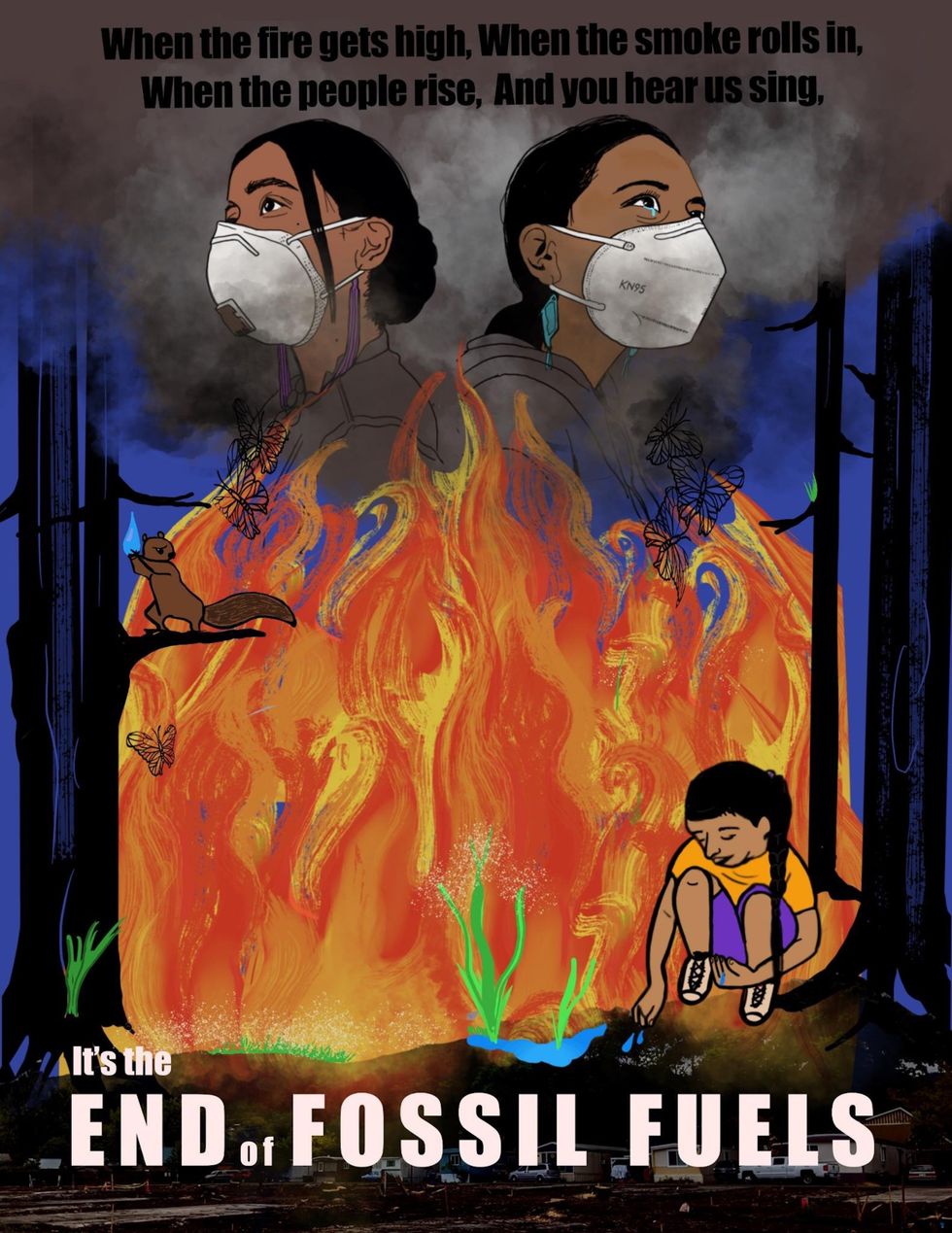
Two figures in face masks stand above flames while another huddles in the corner.

Erica Alexia Ledesma made her design amid summer wildfires and smoke.

“The last week there have been multiple fires in our Rogue Valley, Oregon,” she said. “AQI (Air Quality Index) has been over 500, which is completely unhealthy for our bodies, our lungs. In 2020 the Almeda Fire swept through our communities and destroyed my neighborhood. I’ve been involved in the just recovery work here at home. In my art piece the fire stands out. Fire has created a lot of trauma for my community. We also know that fire is medicine—sacred—but because we have not been tending to the lands and we have been disconnected from the land, we are experiencing more and more wildfires. Arts and culture are key tools in our fight to end fossil fuels and preserve a livable planet for future generations.”

The Power of Art

A woman embraces the planet.

Favianna Rodriguez writes, “In order for us to halt the climate crisis, we not only have to shut down the fossil fuel industry, but we have to reimagine our relationship to energy and to the natural world. Our current relationship to the Earth is based on destructive myths that have shaped our cultural imaginations since colonization. We need artists to help us imagine a future where together we thrive with nature.”

“The power of art is that it can help us heal our relationship to nature and help us as human beings understand that we can move away from an extractive relationship toward a regenerative one. Our collective home is literally on fire, and we need all the tools of creativity to awaken our communities so that we may rise up and topple the dirty energy industry.”

Mountain Valley Pipeline

A family pushes over an oil drill.

Jan Martijn Burger says, “I’ve been working to stop the Mountain Valley Pipeline—the Southgate Extension comes down the Haw River past our home in North Carolina. When a child sees their parents actively working for something they believe in—even something overwhelming like defending our climate against the fossil fuels industry, then the child will feel like it’s worth fighting for too. And that they have power and are not helpless. I made this image of a family pushing over an oil drill with that in mind.”

The Peace Poets

The Peace Poets recently wrote the song “The End of Fossil Fuels” for the NYC March, Climate Strike, and Global Days of Action. Specific lyrics were written for each of the three posters on Floods, Fires and Smoke, and Extreme Heat.

They write about the song, “This song comes from people’s pain transforming into people power! We are naming the disasters, we are declaring our commitment to rise up singing, and prophesying our victory by declaring what all life on Earth desperately needs: an end to the extraction of fossil fuels. When we sing these first lines together, we name the pain to make sure none of us feel alone in these crises. When we promise to rise up and sing, we’re inviting the activation of our collective voice to usher in the new era we need. Let us not be shy about predicting a future without fossil fuel extraction, let us sing this transformation into the streets and parliaments, the hearts and minds, of people everywhere until it becomes our reality. These are times for singing spells, times for composing commitments, time to fight back beautifully.”

Song: The End of Fossil Fuels

When we Organize

To Fight and Win

A whole new era is about to begin

It’s the END of FOSSIL FUELS

the END of FOSSIL FUELS!

When the fire gets high,

When the smoke rolls in,

When the people rise and you hear us sing,

It’s the END of FOSSIL FUELS

the END of FOSSIL FUELS

When the water gets high,

When the floods roll in,

When the people rise and you hear us sing,

It’s the END of FOSSIL FUELS

the END of FOSSIL FUELS

When the heat gets high,

When the sidewalks singe,

When the people rise and you hear us sing,

It’s the END of FOSSIL FUELS

the END of FOSSIL FUELS

Resources

ORDER POSTER ART:

ART TO END FOSSIL FUELS ART KIT: Artists’ full statements, art downloads, tips, recipes, and guide to use the poster art and make art to end fossil fuels:

Patrick Anderson on Debut Novel “Riders in Disguise”

My job as a creative writing professor at Miami Dade College is to help students dissect the narratives that intrigue them by breaking down how the author constructed a given story using the major elements of fiction: plot, character, setting, point of view, and theme.

It’s a mantra at this point, those words.

I’ve studied and lectured about them so much they’ve seeped into the very fabric of my being. With my career aspirations as both a teacher and an author becoming intricately intertwined over the last decade and a half, my way of thinking about almost everything is framed around those elements, including the reasons why I wrote my debut novel, Riders in Disguise.

Set in Miami in the eighties, Riders in Disguise follows four characters from different walks of life as they navigate one of the most tumultuous decades in Miami’s century-plus history. It’s easy to explain the location choice. I was born in South Miami in December 1983 and therefore lived through the era in question, albeit too young to grasp the complexities and contradictions of a city experiencing a boom like no other.

When I think about 1980’s Miami,

I feel like a child at his parents’ house while they’re throwing a party, forced to watch curiously from his bedroom doorway as the adults dance around the living room having the time of their lives. This curiosity stuck with me through college and found renewed fuel in 2006 when I first watched Billy Corben’s iconic documentary, Cocaine Cowboys. Admittedly, the film’s descriptions of brazen acts of violence are what initially piqued my interest in the topic. But as the lure of bloodshed faded, my fascination lingered on Miami’s symbiotic relationship with that specific decade, cementing a truth that I hadn’t really grasped before: Miami as I know it—the place where I was raised and which I love wholeheartedly—literally grew out of the eighties.

Beyond the Miami–Vice-meets-Scarface glitz and glamour and carnage, the eighties and everything it’s known for—parties and cocaine, the crack epidemic, skyrocketing murder rates, Mariel, Liberty City riots, cultural shifts that bore a Miami hip hop scene—shaped today’s South Florida.

During that first viewing of Cocaine Cowboys, I realized my base knowledge of Miami’s history was cursory at best. I still saw Miami just as the city I was born, nothing more.

The desire to write something like Riders in Disguise was there,

I just didn’t have enough details yet. I look back now and feel a bit naïve, like that child in his room again, sleeping soundly in bed while the party outside rages on and the city he looks to for comfort snorts a line off a coffee table.

As the years passed and I read more into Miami’s dramatic history, I realized that the narrative of the story I was trying to tell had to be driven by a combination of its main characters and the momentum of the decade. Riders in Disguise is divided into three parts, each taking place on a single day in 1979, 1980, and 1981 respectively.

Through the main characters, the reader gets a glimpse into four very different Miami communities. Tina Pacheco is a budding photo-journalist who lands a gig at the most prestigious newspaper in Miami after capturing images of the 1979 Dadeland Mall Massacre. Ralph Williams is a seasoned homicide detective and Vietnam war veteran trying to do his job amid a historic crime wave and growing corruption within his own department. Tommy Muñoz is a Pedro Pan survivor who is unwittingly (and violently) dragged into the world of drug trafficking when his wife’s uncle hires him as a driver. And then there’s Rig Lopez-Campbell, an impoverished middle-schooler growing up in Liberty City as the crack epidemic gets underway.

Each characters’ individual tale is a branch of the larger overarching narrative in Riders in Disguise. Their trajectories throughout the novel (and the planned trilogy) aim to shed light on the multifaceted storylines Miami residents experienced throughout the eighties, with the burgeoning drug war and its long-term impact lying center stage.

As I was plotting out the initial version of Riders in Disguise over a decade ago,

I quickly realized that I was one of dozens upon dozens of writers choosing to tackle the subject of drugs and violence in the eighties. This lack of distinctiveness almost made me abandon the project. I actually did put my pen down for a while. I continued researching though, and happened upon a couple of different works that gave me some perspective and an angle I could claim as my own.

One of these works was Don Winslow’s Border Trilogy (The Power of the Dog, The Cartel, and The Border). In this collection of novels, Winslow explores the War on Drug and its effects on Southern California and Mexico, combining research and masterful storytelling to great effect. As I read (and re-read) the trilogy, it occurred to me that I wanted to do what Winslow was doing, except in Miami. The scope and character choice for Riders in Disguise was also inspired by The Wire, David Simon’s five season epic that I like to consider a visual novel more than a simple TV show.

But while these works and others like it helped me see how I could better incorporate years of research into a single narrative, it was one particular film that cemented the theme of Riders in Disguise in my mind: 2016’s Moonlight, directed by Barry Jenkins and adapted from Tarell Alvin McCraney’s unpublished semi-autobiographical play “In Moonlight Black Boys Look Blue.”

Sitting in a theater on a random Tuesday evening (prime movie-going time, let me tell you) I found myself immersed in a narrative that seemed both familiar and foreign to me; familiar in that I grew up around these types of characters, and foreign in that I’d never seen them portrayed on the big screen in such a manner. It was the first major film production I’d ever seen where the writers and directors handled the story of a destitute kid from the ghetto with such respect and compassion for its protagonist. Walking out of the theater that evening, it hit me that Riders in Disguise was primarily the story of Rig and—through him—Miami’s black community.

In Riders in Disguise, Rig’s perspective is the antithesis to one-sided narratives about people from his background, offering an empathetic window into the life of an individual thrust into unsavory circumstances by the harsh reality of this country’s historical legacy. Where the other three main characters’ lives and stories are inspired by everything from newspaper articles to historical documents to real life interviews with a largely white community, Rig’s story is firmly entrenched in Miami’s black history, with much of his narrative inspired by the autobiographies of Miami legends like Luther “Uncle Luke” Campbell (The Book of Luke: My Fight for Truth, Justice, and Liberty City) and Maurice “Trick Daddy” Young (Magic City: Trials of a Native Son).

A lot of Rig’s story is also loosely based on my own personal experiences.

Cousins who served jail time for drug possession only for those same drugs to now be legal where they live. Myself and friends and acquaintances perpetually harassed by law enforcement throughout the years for seemingly no other reason than our being young and black. Though my parents live in a middle-class part of the city, going to public school in Miami makes nearly all of us “hood-adjacent.” As a result, I grew up with many people suffering through the same challenging circumstances as Rig experiences in Riders in Disguise, circumstances frequently exacerbated by the absurdity of outdated drug laws that have unjustly destroyed families, neighborhoods, and entire communities.

Riders in Disguise is really a story for and about them.

Each semester I end my creative writing classes with a discussion of revision tactics, looking at how they put together the first drafts of their stories, the commentary they received during workshop, and how they can use that commentary to improve their story for final draft submission. In constructing the many (many) drafts of Riders in Disguise over the years, the narrative remained foggy for a while. At first I thought this murkiness was a result of me trying to do too much, telling too epic of a story to handle on my own.

Then it occurred to me that I just hadn’t had the right experiences yet to visualize the point I was trying to make. The type of experiences that could give me the perspective I needed to know how to arrange the elements of fiction around that point. I’m thankful now that it’s all come together, and I look forward to hearing Miami’s thoughts on the result.

You can buy Riders in Disguise online here.  Come  out to hear Patrick Anderson speak at Books & Books Friday, September 15 at 7 p.m.

The post Patrick Anderson on Debut Novel “Riders in Disguise” appeared first on The Jitney.

« Previous Page — Next Page »