A rule that closed the Southern border to most asylum seekers and migrants because of the COVID-19 pandemic will expire on Thursday at 11:59 p.m. ET.
The Centers for Disease Control and Prevention in March 2020 implemented Title 42.
The Biden-Harris administration in April 2022 announced it would terminate the previous White House’s policy, but Republican attorneys general from Texas and more than a dozen other states filed a federal lawsuit.
The U.S. Supreme Court last December ruled Title 42 must remain in place. The Biden-Harris administration a few weeks later announced the COVID-19 public health emergency — and Title 42 — would end on Thursday.
“Title 42 exacerbated already dangerous and often deadly situations for LGBTQI people seeking asylum,” San Diego Pride Executive Director Fernando Z. López told the Washington Blade on Tuesday. “It’s tenure caused additional strain on direct services, legal aid and community organizing resources that were felt on both sides of our cross-border region.”
Abdiel Echevarría-Caban, a South Texas-based immigration attorney who the LGBTQ+ Bar in 2021 recognized as one of its 40 best LGBTQ lawyers who are under 40, on Tuesday said Title 42 “needed to end a long time ago, given the country was open to accept travelers through all our airports.”
“It did not make sense to keep enforcing the policy when we have public health safety protocols in place already,” he said. “The use of a public health mechanism to deter asylum seekers at the Southwest border from seeking protection was barbaric, wrong and a misuse of public policy.”
Echevarría-Caban further detailed the impact Title 42 had on LGBTQ and intersex people and other asylum seekers from vulnerable groups that he and other lawyers represented.
“Here, at the Southwest border, we had to request exemptions for people, especially women, children and LGBTQIA people, who were sent back to Mexico, and were exposed to further danger at the streets in Mexico, exposed to cartel violence, extortions, kidnapping and rape,” he said. “Here, in the United States, we have obligations under the Convention Against Torture. The United States was an active party in the development of our current international human rights and refugees system.”
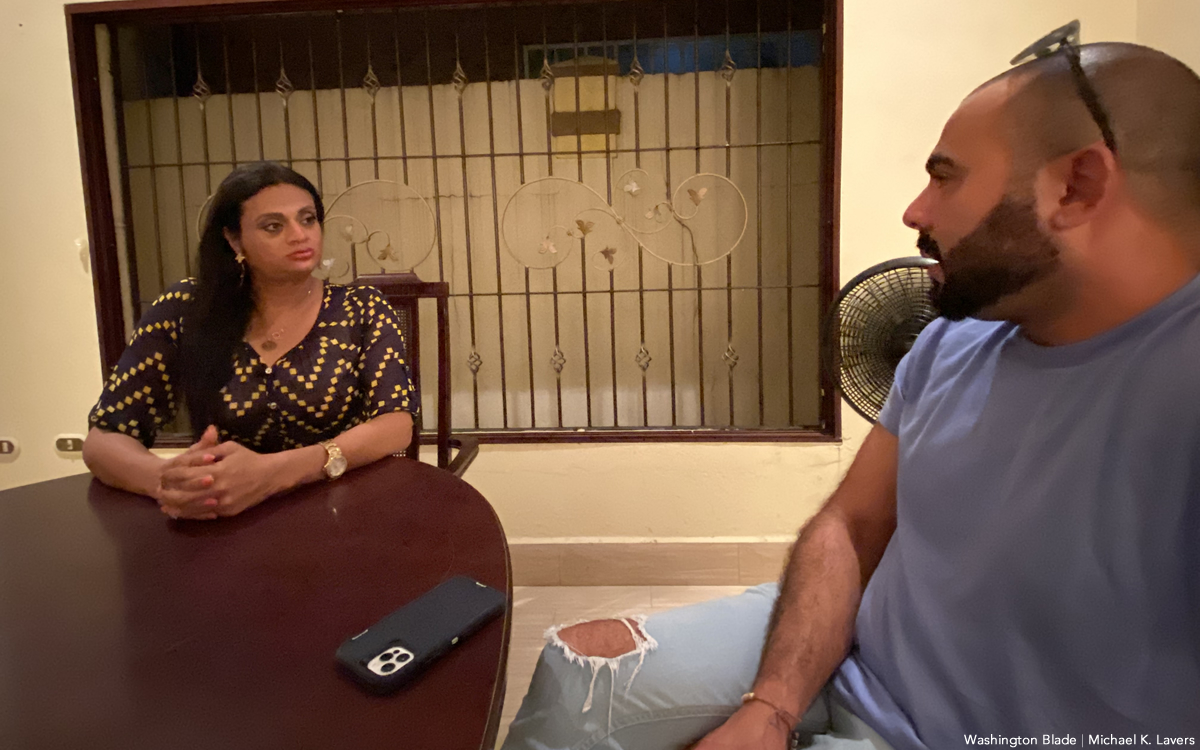
Abdiel Echevarría-Caban, right, talks with Organización Pro Unión Ceibeña (Oprouce) Executive Director Sasha Rodríguez at her organization’s office in La Ceiba, Honduras, on July 20, 2021. (Washington Blade photo by Michael K. Lavers)
The Associated Press notes the U.S. on Thursday will begin to deny asylum to migrants who don’t seek protection in a country through which they traveled or apply online before they reach the Southern border.
The Department of Homeland Security last fall created a humanitarian parole program for Venezuelans that it expanded to Cubans, Haitians and Nicaraguans in January.
A senior administration official on Tuesday said the Biden-Harris administration plans to “expand the family reunification parole programs” to Central American countries that include Guatemala, El Salvador and Honduras and to Colombia.
Secretary of State Antony Blinken and Homeland Security Secretary Alejandro Mayorkas, who was born in Cuba, on April 27 announced the U.S. will open more than 100 “regional processing centers” throughout the Americas. A senior administration official on Tuesday said they “will facilitate a broad range of legal pathways, lawful pathways to the United States and eventually Canada and Spain as well.”
“Again, our goal is to add these centers to the set of legal pathways that already exist and that the administration has rolled out over the last two years,” said the official.
Another senior administration official said the U.S. has “a robust set of consequences for noncitizens who, despite having these options available to them, continue to cross unlawfully at the border.”
They said the U.S. on Thursday will begin to return them to Mexico under Title 8 after it reached an agreement with Mexican President Andrés Manuel López Obrador’s government. (Mexican prosecutors have announced they will charge the director of the country’s National Immigration Institute after a fire at an immigration detention center in Ciudad Juárez, a border city that is across the Rio Grande from El Paso, Texas, killed 40 migrants on March 27. The Associated Press reported a security camera inside the facility recorded two guards who did not try to help the migrants who were inside the cell in which the fire began. The guards, according to the Associated Press, eventually walked away.)
“It also includes the circumvention of lawful pathways rule that we will be posting for public inspection tomorrow (Thursday) morning, and that rule will place significant conditions on asylum eligibility for individuals who do not take advantage of these robust lawful pathways that we have established, who do not schedule their safe and orderly presentation at the border using our CBP One mobile application, and who do not claim asylum in one of the countries that they travel through,” said the official.
The official further noted the U.S. will begin “significantly expanding … our use of expedited removal at the border.”
“This is our traditional Title 8 consequence for individuals who are encountered between ports of entry,” said the official.
TransLatin@ Coalition President Bamby Salcedo on Wednesday told the Blade it is “unfortunate that instead of moving forward, we continue to go backwards.”
“The elimination of Title 42 will impact all of us, but specifically LGBTQ asylum seekers,” said Salcedo. “It is incomprehensible that this administration is taking this step. It’s about moving forward and bettering the lives of people, not taking away the gains that we have earned with hard work, blood and tears.”
Immigration Equality Legal Director Bridget Crawford in a statement also sharply criticized the Biden-Harris administration over its new rules for asylum seekers and migrants once Title 42 ends.
“We are astonished by the administration’s callous disregard of the dangers President Biden’s asylum ban imposes on LGBTQ refugees. In the final rule — scheduled to go into effect once the Title 42 policy is lifted — the administration doesn’t meaningfully address or fix problems with the ban we identified in the notice and comment process. Instead, using circular logic, the administration dismisses our concerns, and doubles down on the illegal implementation of the ban,” said Crawford.
“This ban is a travesty that will cause LGBTQ refugees (and others) with strong, meritorious asylum claims to be sent back to countries where they will be persecuted or killed,” added Crawford. “By implementing this ban, instead of humane solutions that would effectively and compassionately manage the border, President Biden has broken his promise to protect LGBTQ asylum seekers and refugees.”
The Organization for Refuge, Asylum and Migration works with Jardín de las Mariposas, a shelter for LGBTQ and intersex migrants in the Mexican border city of Tijuana.
ORAM Executive Director Steve Roth on Wednesday said even though his organization “is glad to see an end to Title 42, an unlawful, Trump-era policy, we are deeply concerned about the new barriers to asylum put forward by the Biden administration.”
“President Biden’s restrictions on asylum will have especially harmful and dangerous consequences for vulnerable LGBTIQ refugees and asylum seekers, leaving them in places where their safety will be at risk,” said Roth. “The administration’s new border policies will continue to deny many LGBTIQ refugees their legal right to seek asylum at the U.S.-Mexico border.”
Echevarría-Caban said the new policies will “pose more obstacles, and contrary to what is expected, it will increase the immigration court backlogs.”
“Our government needs to understand that we cannot use domestic law to weaponize immigration proceedings to avoid compliance with our international obligations or due process,” he told the Blade. “Due process is the core of our legal system, without it, who are we as a nation?”
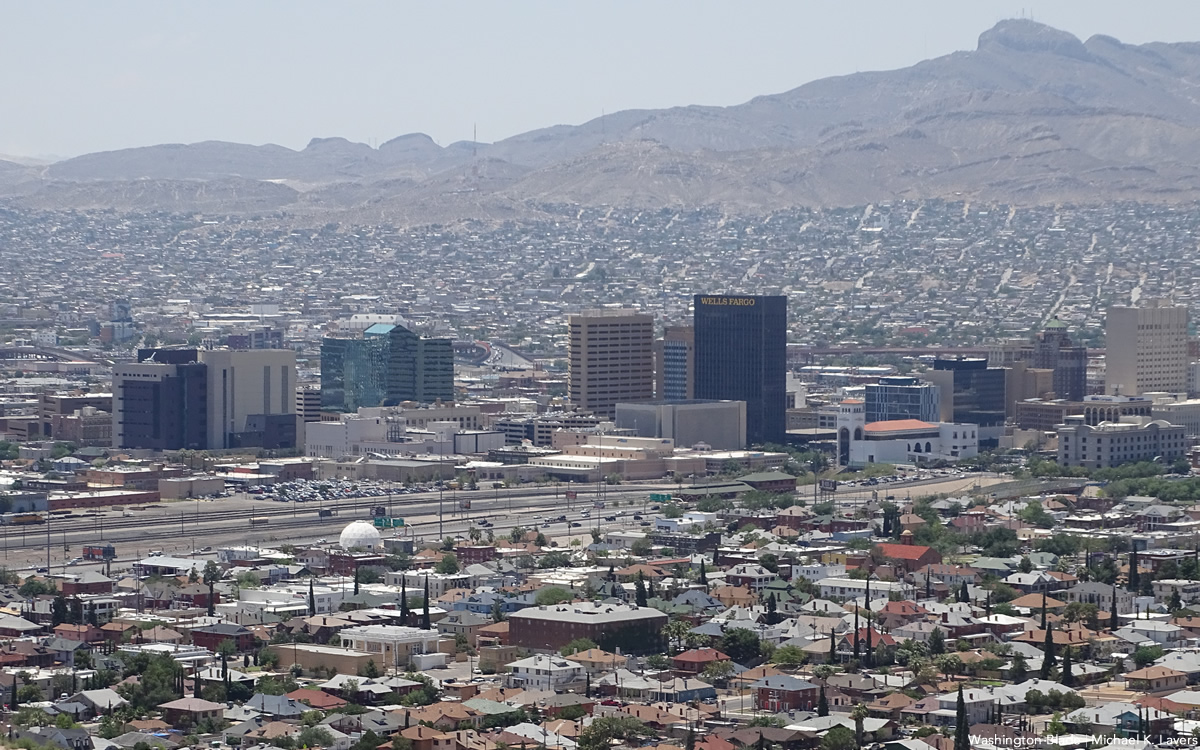
El Paso, Texas, and Ciudad Juárez, Mexico, on July 15, 2019. (Washington Blade photo by Michael K. Lavers)
Paloma de los Ángeles Villegas Pacheco, director of Trans Igualdad, a transgender rights organization in Ciudad Juárez, on Tuesday told the Blade there “is disinformation” among LGBTQ and intersex migrants who are in the city.
“They think that they are going to be able to access the legal asylum process,” said Villegas. “It will be more difficult for them to enter (the U.S.) once Article 42 ends. The impact will be worse for them.”
Altagracia Tamayo is president of Centro Comunitario de Bienestar Social (COBINA), a group that works with LGBTQ and intersex people and other vulnerable groups in Mexicali, a Mexican border city that borders Calexico, Calif., in California’s Imperial Valley.
Tamayo said roughly a quarter of the 600 migrants who are currently living in the two shelters that COBINA operates are LGBTQ. Tamayo, like Villegas, told the Blade there is “uncertainly” around the end of Title 42.
“The problem is that they think they are going to open the borders … they think they are going to receive them,” said Tamayo. “Article 8 is going to impose many, many restrictions.”
A fire destroyed a COBINA shelter in July 2021. Tamayo told the Blade her organization struggles to support the migrants who live in COBINA’s two remaining shelters.
“The heat is coming,” she said. (Summer temperatures in Mexicali frequently exceed 110°F) “We don’t have enough food to give them three meals a day. It is one of the problems of so much waiting, for so many months. It’s definitely very complicated.”
Mayorkas ‘clear-eyed’ about post-Title 42 challenges
Mayorkas on Wednesday during a press conference in D.C. said his agency is “clear-eyed about the challenges that we are likely to face in the days and weeks ahead, which have the potential to be very difficult.”
“Even after nearly two years of preparation, we expect to see large numbers of encounters at our Southern border in the days and weeks after May 11,” he said.
Mayorkas, nevertheless, stressed the end of Title 42 “does not mean our border is open.” He also reiterated the Biden-Harris administration’s immigration policy.
“We will once again process people at our Southern border using our immigration authorities under Title 8 of the United States code,” said Mayorkas. “Our overall approach is to build lawful pathways for people to come to the United States and to impose tougher consequences on those who chose not to use those pathways.”
“We are taking this approach within the constraints of a broken immigration system that Congress has not fixed for more than two decades and without the resources we need, personnel, facilities, transportation and others that we have requested of Congress and that we were not given,” he added.
In today’s digital age, eCommerce has become an essential part of retail and commerce. The world of retail is changing, and more and more people are turning to online shopping as their primary means of purchasing goods and services. In this article, we will discuss how Pacheco eCommerce is shaping the future of retail by providing an exceptional user experience, innovative features, and seamless integration with other platforms.
The Rise of eCommerce
The Impact of the Internet on Retail
The Convenience of Online Shopping
The Growth of Mobile Commerce
Over the past few decades, technology has transformed many fields, including retail. eCommerce is revolutionizing the way people shop, and it is now an essential part of modern retail. Online shopping has brought lots of convenience and ease to consumers. It has simplified the shopping process, saves time, and drastically improve the overall customer experience.
Pacheco eCommerce: Innovative Features
Intuitive User Interface Design
Advanced Search and Filter Options
Easy Check Out Processes
Product Recommendations
Innovative Payment Options
Pacheco eCommerce is a modern eCommerce platform that is shaping the future of retail through its innovative features. Pacheco eCommerce has an intuitive user interface design that makes browsing and shopping convenient and enjoyable. Additionally, Pacheco eCommerce provides advanced search and filter options, which makes it easy for shoppers to find the products they want. The checkout process is also very easy, saving the shopper valuable time. Pacheco eCommerce also provides product recommendations to customers based on their purchasing history. Lastly, Pacheco eCommerce offers innovative payment options like cryptocurrencies which enable customers to pay using a convenient method of their choice.
Pacheco eCommerce: Seamless Integration
Integrating with Social Media
Third-party Integration e.g. Amazon, Google Shopping, and eBay
Integrating brick and mortar stores
Integrating Payment Gateways
Pacheco eCommerce makes the online shopping experience even more impressive by offering seamless integration with other platforms. Customers can quickly and easily share their shopping experiences with their contacts on various social media platforms, boosting the eCommerce platform’s exposure. Pacheco eCommerce also integrates with third-party marketplaces such as Amazon, eBay, and Google Shopping, making it more accessible to an even larger audience. Pacheco eCommerce also provides integration with physical stores, enabling customers to purchase products online and pick them up at a physical store location of their choice. Lastly, integrating payment gateways makes it easy for customers to pay for their purchases using their preferred payment method.
Conclusion
In conclusion, Pacheco eCommerce is shaping the future of retail through its innovative features and seamless integration with other platforms. The intuitive user interface, advanced search and filter options, easy checkout processes, and innovative payment options make it easy and enjoyable for shoppers to find and purchase the products they want online. Integrating social media, third-party marketplaces, physical stores, and payment gateways, Pacheco eCommerce represents the future of eCommerce and retail.
FAQs
What is Pacheco eCommerce?
What makes Pacheco eCommerce innovative?
How does Pacheco eCommerce integrate with other platforms?
What payment options does Pacheco eCommerce offer?
Monster Energy Is Bringing the Heat to Japan with Its Team of the World’s Best Competing Athletes
Monster Energy, The Official Energy Drink Partner of X Games Chiba 2023, Is Bringing the Heat to Japan with Its Team of the World’s Best Competing Athletes
Three-Day Action Sports Spectacle Features more than 110 of the World’s Best Athletes in BMX, Motocross, and Skateboarding at ZOZO Marine Stadium on Tokyo Bay from May 12–14, 2023
CHIBA, Japan – May 11, 2023 – X Games is back in Japan! The world’s premier showcase in action sports competition will return to Japan for the second consecutive year. Monster Energy, the official energy drink partner of X Games, is proud to bring some of the world’s biggest names in competitive BMX, motocross, and skateboarding to X Games Chiba 2023 from May 12–14.
Following the success of last year’s event in Japan, X Games Chiba 2023 marks the 67th edition of X Games since the event’s inception in 1995. For three action-packed days, the action sports world will focus on ZOZO Marine Stadium on Tokyo Bay with a total capacity for 30,000 spectators.
The Japan edition of X Games is bigger than ever: More than 110 athletes from 20 countries will compete for a total of 33 medals in 11 events across three sports. This year, Moto X Best Trick will be contested as a medal event for the first time in Chiba.
All competitions will stream live globally across XGames.com, YouTube, and Twitch, supplemented by behind-the-scenes, athlete-curated, and complementary content on @XGames social media accounts.
Fans can look forward to an elite display of the best in action sports: X Games Chiba is an invite-only event reserved for multiple-time X Games medalists and highly competitive newcomers to keep the level of riding at premium levels. As the official drink sponsor of X Games Chiba 2023, Monster Energy is ready to raise the bar with a stacked team of riders, including action sports icons, defending gold medalists, and upcoming rookies.
Heading into X Games Chiba 2023, look out for the following key Monster Energy athletes and competitions:
The big spectacle in the Land of the Rising Sun kicks off on Friday, May 12, with eliminations in key BMX and skateboarding events at ZOZO Marine Stadium.
Athletes will then compete for the first set of X Games medals on Saturday in the BMX Street final. Be on the lookout for 24-year-old German team rider Felix Prangenberg ready to level up his silver medal in the discipline from X Games 2022 and expand his current count of four X Games medals. Also gunning for podium spots, Scotland’s own Alex Donnachie already owns gold from X Games Sydney 2018 and bronze from X Games 2021. And with three-time gold medal winner Kevin Peraza in the session, the first medal event of X Games Chiba 2023 is bound to be a battle for the history books. Let’s go!
For the Women’s Skateboard Park final, our squad consists of bona fide legends and rising stars: Stoking the hometown crowd, 21-year-old Mami Tezuka from Hikone, Japan, is a podium favorite with X Games silver and bronze under her belt. She will face off against her teammate and mentor, 30-year-old Lizzie Armanto, known as a legend in women’s skateboarding since winning Skateboard Park gold at X Games Barcelona in 2013. Also don’t count out Brazilian Olympic skateboarder Isadora Pacheco with some big tricks up her sleeve. Monster Army rider Grace Marhoefer from Cocoa Beach, Florida, on a mission for her first X Games podium after recently winning the women’s street contest at Phoenix Am. Last but not least, the upcoming American rider Ruby Lilley is ready for the world stage. Don’t miss it!
Skateboarding remains the focus in the Women’s Skateboard Street final, where last year’s X Games Chiba gold medalist Rayssa Leal will be the rider to beat. The 15-year-old from Imperatriz, Brazil, is the reigning SLS Super Crown World Champion and has won the last five consecutive SLS competitions. Plus, she has a score to settle after finishing closely off the podium at X Games 2022 last summer. Leal is facing off with a hometown favorite, three-time X Games gold medalist Aori Nishimura. Also, watch out for young Monster Army rippers Grace Marhoefer and Haylie Powell looking for their first podium at X Games. Let’s get it!
Next, Monster Energy rolls into the BMX Park with a squad of heavy hitters: Last year, young rider Justin Dowell made his X Games debut in Chiba by claiming silver, then followed up with another silver medal at the summer games. Will the 23-year-old clinch his first X Games gold this year? Or will 2022’s bronze medal winner Kevin Peraza go all the way up for his third gold in the discipline? Expect the unexpected because the competition is intense: 26-year-old Canadian Mike Varga has bronze in the discipline, plus three gold in Best Trick (more about that later), while Corona, California local Daniel Sandoval owns one gold and three bronze.
Another California rider, Pat Casey from Riverside, earned three of his five X Games medals in Park and clinched silver in Mega Park at X Games 2022 – making him a ‘mega’ contender this year! Never rule out Jeremy Malott from Lake Havasu City, Arizona, on a quest to expand on two bronze medals from Park Best Trick. Last but not least, the squad includes 22-year-old Bryce Tryon, already boasting an X Games silver medal, plus a recent win at the Monster Energy BMX Triple Challenge in Glendale. Also, keep an eye on reigning European champ Anthony Jeanjean and Argentinian young gun Jose Torres. Tune in for this epic battle!
All eyes will remain on the concrete bowl course for the BMX Park Best Trick final, where Monster Energy team riders will unleash their most technical trick creations. The biggest story: At X Games 2022, Canadian rider Mike Varga made history as the first athlete to win three consecutive gold medals in the discipline. Will he raise the bar to four gold? Don’t miss it!
Closing out an epic first day at X Games Chiba 2023, the Skateboard Vert event will bring the heat with technical halfpipe riding at its finest. Last year’s silver medalist, style sensation Moto Shibata from Osaka, has already shown the style and technique to claim gold – will he repeat the win from X Games 2017 this year? Heavy competition will come from New York City’s Elliot Sloan, owner of 15(!) X Games medals, including six gold, and last summer’s silver medalist in Skateboard MegaPark. Also heading to Chiba as a favorite, eight-time X Games medalist Tom Schaar just returned from injury by claiming a second-place finish in the Tampa Pro concrete jam. An explosive mix!
Sunday at X Games Chiba 2023 kicks off on a high note in the Men’s Skateboard Park final. All eyes will be on the golden boy, 19-year-old Australian ripper Kieran Woolley, after clutching gold at summer X Games 2022 and silver at X Games Chiba last year. The first-ever Australian park champ faces competition from 2021 X Games gold medalist Liam Pace from Tucson, Arizona. What’s more, previous X Games gold medalists in the Big Air event, Tom Schaar and Trey Wood, are looking for the top spot in Park. And making his X Games debut in Chiba, Australian Monster Army rider Keefer Wilson is bringing big tricks to the battle. All bets are off for this one!
At X Games Chiba 2022, the time-honored BMX Flatland contest returned after a 19-year hiatus. The fan favorite is back by popular demand this year, the roster including 38-year-old style legend and current Flatland World Champion Moto Sasaki from Chiba. Having claimed bronze in the previous year’s event, the hometown hero faces a field of upstarts and rookies. Will Sasaki once again prove that timeless style can still win podium spots?
As the action continues, technical halfpipe skateboarding takes center stage in Skateboard Vert Best Trick. Ready to push the limits, Elliot Sloan took gold in the discipline at X Games 2022 and joins the progression session along with teammates Shibata and Schaar. Get ready to see the full evolution of the sport on full display!
Speaking of evolution, the upcoming rider to watch in the Men’s Skateboard Street Final is a young prodigy: 16-year-old Daiki Ikeda earned a surprise silver medal in his X Games debut at X Games Chiba 2022 and has also won the 2022 edition of Tampa Am. But not so fast! The winningest street skater of all time, Nyjah Huston, just returned to competition earning a podium spot at SLS Chicago and commands the biggest stack of X Games medals of them all: Huston owns 20 X Games Medals (13 gold, five silver, and two bronze). Nyjah will go against 30-year-old Kelvin Hoefler from São Paulo, Brazil, a two-time X Games gold medalist who just put the field on notice by winning SLS Chicago 2023. The Olympic silver medalist will be joined by three-time X Games medalist Ishod Wair from New Jersey as well as Canada’s Matt Berger looking to level up from his bronze medal from X Games Real Street 2022.
But wait! A slew of young guns is ready to shake up the Skateboard Street event, including 26-year-old Jhancarlos Gonzalez from Columbia, who is ready to claim his first X Games medal after winning the 2022 Vans Showdown. Also, witness the X Games debut of 21-year-old Braden Hoban from Encinitas, California, who disrupted the status quo by finishing second in the 2022 SLS Super Crown finals. Not to be missed!
As the worthy finale of X Games Chiba 2023, Moto X Best Trick was featured as a demonstration event the previous year. Now contested as a medal event in Japan for the first time, the showcase for freestyle motocross is headlined by the most dominant rider in the discipline: Australia’s Jackson Strong holds eight medals in Best Trick (six gold, two silver) and brings some new moves to the battle. He’s facing fellow Aussie and 14-time X Games medalist Josh Sheehan, who most recently took Best Trick silver at X Games 2022.
The final battle of Chiba 2023 gets even hotter with the return to Japan of Julien Vanstippen from Belgium. Last year, the 25-year-old claimed bronze in Moto X Best Whip as his first medal. He’s now flexing his freestyle skills alongside decorated ripper Harry Bink from Australia, owner of bronze in Best Trick, and 38-year-old FMX icon Taka Higashino showcasing his mastery of the sport on home turf. A true classic in the making!
Visit www.monsterenergy.com for exclusive updates from X Games Chiba 2023, including photos, videos, and contest results as they happen. Follow Monster Energy on YouTube, Facebook, Instagram, Twitter and TikTok.
The
Professional Fighters League on Friday unveiled matchups for
the second half of its 2023 PFL Regular Season, which resumes on
June 8 at Overtime Elite Arena in Atlanta.
News broke earlier this week — originally reported by MMAFighting
— that nine fighters had tested positive for undisclosed banned
substances after their bouts in the PFL heavyweight, light
heavyweight and featherweight brackets. The list includes
heavyweights Bruno
Cappelozza, Cezar
Ferreira and Rizvan
Kuniev, light heavyweights Thiago
Santos, Krzysztof
Jotko, Will Fleury
and Mohammad
Fakhreddine, as well as featherweights Daniel
Torres and Alejandro
Flores. The fighters have been temporarily suspended by the
Nevada State Athletic Commission and are notably absent from the
cards released Friday.
“The PFL is excited to return to OTE Arena in Atlanta for the
second half of the 2023 Regular Season with three-action packed
events,” said Ray Sefo,
president of fighter operations for PFL. “Each fighter will have
one final attempt to punch their ticket to the PFL Playoffs and
take a step closer to a $1 million prize.”
In a dish carefully throw bananas with lemon juice. Prepare half the bread pieces in all-time low of a greased 2-quart square cooking meal. Leading bread with a layer of bananas, delicious chocolate items and also continuing to be bread pieces.
In a tool dish integrate eggs, milk, honey, vanilla essence as well as cinnamon. Put gradually over bread to layer uniformly. Cover as well as cool for 6 to 24 hrs.
Preheat stove to 425 levels F. Uncover the cooking recipe. Sprinkle bread with almonds and also sugar. Cook for 5 mins.
Lower stove temperature level to 325 levels F, after that cook 20 to 25 mins a lot more or till blade put near the facility appears leading and also tidy of French salute is gently browned. Allow stand 10 mins.
Offer with syrup, if wanted.
Makes 4 portions.
In a dish carefully throw bananas with lemon juice. Prepare half the bread pieces in the base of a greased 2-quart square cooking recipe. Leading bread with a layer of bananas, delicious chocolate items as well as continuing to be bread pieces.
Put gradually over bread to layer equally. Sprinkle bread with almonds as well as sugar.
The team created a standardized metric for nerve density to clarify the variation in distribution of nerves in the oral cavity, called normalized nerve density, and showed its importance in tumor progression. Credit: Cindy Perez-Pacheco
Researchers at the University of Michigan Rogel Cancer Center and the School of Dentistry have identified a new metric to articulate the relationship between nerve density and oral cancer. The study, published in Clinical Cancer Research, investigated normalized nerve density to translate previous mechanistic studies into a context that could be used in the clinic.
“We are recognizing more and more that there’s a very dynamic interaction between nerves and cancer cells in the tumor microenvironment,” said Nisha D’Silva, B.D.S., M.S.D, Ph.D., Donald Kerr Endowed Collegiate Professor of Oral Pathology and senior author.
The team looked at how the density of nerves within a tumor tied with the tumor’s growth. The oral cavity has several regions, each with different functions. The way each area receives nerves is distinct; the nerves in the inside of the cheek have a different role and are fewer than nerves on the tongue. Given these variations, looking at nerve density of the tumor without considering the normal innervation of the different areas in the oral cavity and each individual’s variation to assess whether a tumor is aggressive leaves an inaccurate picture.
To account for this, the team created a standardized metric for nerve density to clarify the variation in distribution of nerves in the oral cavity, called normalized nerve density, and showed its importance in tumor progression. Most of the work was done with human tissue, and the team then validated the findings using a mouse model.
They used adjacent tissue to compare and determine a “normalized” density for different regions in the oral cavity. “We showed that tumors with high normalized nerve density seem to be associated with poor survival for patients with tongue cancer, which is the most common type of oral cancer,” D’Silva explained. “We also found that patients with high normalized nerve density and a smaller distance between the nerve and the tumor have poorer outcomes.”
Additionally, the team explored the use of artificial intelligence to measure normalized nerve density, which could facilitate the use of this metric in clinical practice.
A challenge with treating oral cavity cancers is their tendency to recur. “The question becomes, how can you look for factors that could contribute to progression? How can you use nerve features to figure out which cancers will behave more aggressively?” D’Silva explained. She says if researchers can figure out which cancers will behave more aggressively from the outset, then they could treat the tumors more aggressively from the beginning. Normalized nerve density provides researchers with another data point to determine the best course of treatment.
Additional authors on the study include Cindy Perez-Pacheco, Ligia B. Schmitd, Allison Furgal, Emily L. Bellile, Min Liu, Aya Fattah, Laura Gonzalez-Maldonado, Shelby P. Unsworth, Sunny Y. Wong, Laura S. Rozek, Arvind Rao, Gregory T. Wolf, Jeremy M.G. Taylor, Keith Casper,and Michelle Mierzwa.
More information:
Cindy Perez-Pacheco et al, Increased Nerve Density Adversely Affects Outcome in Oral Cancer, Clinical Cancer Research (2023). DOI: 10.1158/1078-0432.CCR-22-3496
Citation:
Researchers identify new metric to articulate relationship between nerve density and oral cancer (2023, May 16)
retrieved 17 May 2023
from https://medicalxpress.com/news/2023-05-metric-articulate-relationship-nerve-density.html
This document is subject to copyright. Apart from any fair dealing for the purpose of private study or research, no
part may be reproduced without the written permission. The content is provided for information purposes only.
Monday, May 15 is the 75th anniversary of the Nakba. At the time of writing, the Zionist state of Israel is bombarding the Gaza Strip. Even amid the continued dispossession, displacement, and attacks, Palestinians are still fighting for their liberation. Around the world, massive demonstrations are taking place in solidarity with Palestine against the Zionist occupation.
The Nakba, or “catastrophe” in Arabic, refers to the forced displacement and dispossession of hundreds of thousands of Palestinians from their homes and land in 1948, when the Zionist state of Israel was established.
The Zionist state of Israel was backed by first British and later U.S. imperialism, created to be an enclave serving imperialist interests in the region. For decades, the U.S. has been the country’s main source of support through military and economic aid, providing billions of dollars each year. Israel is now the most powerful military force in the region.
The Nakba was characterized by widespread violence, including massacres, forced evictions, and destruction of homes and villages. Many Palestinians were killed or fled their homes in fear of violence. It resulted in the displacement of around 750,000 Palestinians, who became refugees. Many were forced to live in precarious refugee camps in Palestine and surrounding countries, and their ancestors continue to live there today.
While the Nakba marks a before and after in the history of Palestinian people, the process of their displacement began many decades before, signed by a series of wars and political developments in the early 20th century. The role of British and U.S. imperialism, the Zionist project, and often the complicity of Arab bourgeois governments, are still present in the ongoing oppression and displacement of Palestinian people.
The British Mandate for Palestine
The British occupation of Palestine started before World War I. This war was an imperialist war — a competition for markets, territories, and spheres of influence. The fight was centered on the control of international territory in the search for greater resources to boost these territories’ industries and thus gain new markets. The result of the war — a victory for the Allies, including the United Kingdom and France — reinforced the power and influence of the British in this area of the Middle East.
The decline of the Ottoman Empire, dominant in the Middle East until the end of the 19th century, created the conditions for the developed capitalist powers of Britain and France to become hegemonic in the region. These two countries divided up the region in 1915 through the Sykes-Picot Treaty.
In 1917, in order to neutralize the Arab nationalist movements that had arisen against the oppression of the Ottoman Empire and to safeguard the imperialist British interests in the area (like the control over of the Suez Canal), Britain promoted the declaration of British Foreign Secretary Lord Balfour, who stated that he was in favor of the “creation of a Jewish national home” in Palestine. A colonial official explained the goal was “forming for England ‘a little loyal Jewish Ulster’ in a sea of potentially hostile Arabism.”
The declaration had a significant impact on the course of history in the region, leading to increased Jewish immigration to Palestine and laying the groundwork for the establishment of the State of Israel in 1948.
The Mandate for Palestine was officially created in 1922, following the granting of a mandate to Britain by the League of Nations — the imperialist predecessor of the United Nations — to administer the territory of Palestine. “Mandates” were simply a way to establish de facto colonies of Britain and France while claiming they were liberating colonies from other imperialist powers.
The text of the Mandate reiterates Britain’s commitment to the Zionist project as phrased in the Balfour Declaration. It also decides that an ‘appropriate Jewish agency shall be recognized as a public body for the purpose of advising and cooperating’ with the Mandatory Power in matters related to the establishment of the Jewish National Home. It specifies that the Zionist Organization will be considered as such agency and requests it to secure the cooperation of all Jews who are willing to assist in the establishment of the Jewish National Home.
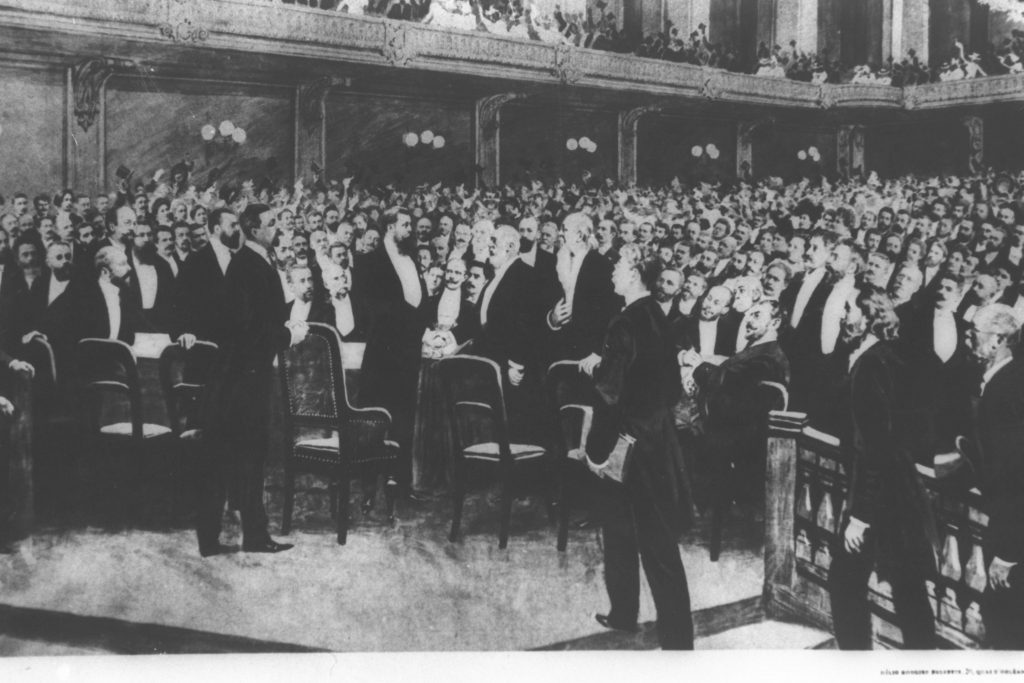
The delegates at the First Zionist Congress, held in Basel, Switzerland (1897).
The Origins Behind the Creation of the Zionist State of Israel
Zionism emerged in the late 19th century as a political and ideological movement in a small sector of the Jewish bourgeoisie. Their goal was to establish an exclusively Jewish homeland, choosing Palestine as the location. The movement gained some more momentum in the wake of a series of violent antisemitic incidents in the late 19th century, including the Dreyfus Affair in France and the pogroms in Tsarist Russia, but Zionists remained a minority.
At the end of the 19th century, they were forced to flee the pogroms that murdered them by the thousands, especially in Central and Eastern Europe, where bourgeois development was more backward, in contrast to Western Europe, whose bourgeois revolutions in England, France and the Netherlands allowed the progressive integration and assimilation of the Jews.
This backwardness of the Eastern European bourgeoisie as a social force, pushed the Jews to proletarianization, misery and confined them to live in ghettos. They had become practically the last rung of their societies and that served the bourgeoisie to set them up as scapegoats for the sufferings of the masses.
This situation of persecution, oppression and precarious living conditions, pushed large sectors of the Jewish community to lean towards socialist ideas and many joined socialist organizations with the aim of changing their living conditions and fighting against oppression.
Jewish Marxist Abraham Leon denounced Zionism “as a brake upon the revolutionary activity of the Jewish workers throughout the world, as a brake upon the liberation of Palestine from the yoke of English imperialism, as an obstacle to the complete unity of Jewish and Arab workers in Palestine.”
While Jewish people wanted to live free from persecution and discrimination, the founders and subsequent leaders of Zionism had their own political goals and didn’t hesitate to make alliances with anti-Jewish political leaders.
Theodor Herzl, considered as one of the main founders of Zionism, saw the deeply anti-Jewish Tsarist regime as a potential ally to create Israel. As writer Lenni Brenner explains:
Herzl looked elsewhere, even turning to the tsarist regime for support. In Russia Zionism had first been tolerated; emigration was what was wanted. For a time Sergei Zubatov, chief of the Moscow detective bureau, had developed a strategy of secretly dividing the Tsar’s opponents Because of their double oppression, the Jewish workers had produced Russia’s first mass socialist organisation, the General Jewish Workers League, the Bund.
This brought Herzl to St Petersburg for meetings with Count Sergei Witte, the Finance Minister, and Vyacheslav von Plevhe, the Minister of the Interior. It was von Plevhe who had organised the first pogrom in twenty years, at Kishenev in Bessarabia on Easter 1903. Forty-five people died and over a thousand were injured; Kishenev produced dread and rage among Jews.
Theodor Herzl also argued in his book The Jewish State that the Jewish colonization of Palestine represented the European advance embodied as “an outpost of civilization as opposed to barbarism” of the Arab peoples.
One of the most well-known examples of this type of alliance was the Haavara Agreement, which was signed in 1933 between the Zionist Federation of Germany and the Nazi government. It allowed Jewish people to transfer some of their assets out of Germany in the form of German goods, which were then sold in Palestine. The proceeds from the sales were used to finance Jewish settlement in the territory. With this agreement, the Zionists carried out the disgraceful policy of breaking the international boycott against Nazi Germany.
The creation of Israel was never about providing a safe homeland for Jewish people, but rather serving the interest of the bourgeois sector of the European Jewish community. In 1938, David Ben-Gurion, who was to become the first prime minister of Israel, wrote: “If I knew that it would be possible to save all the children in Germany by bringing them over to England, and only half of them by transporting them to Eretz Yisrael, then I would opt for the second alternative.”
The Jewish Community in Europe and in Palestine
Throughout the late 19th and early 20th centuries, Jewish people in Europe faced increasing antisemitism. This included discriminatory laws and violent pogroms across Tsarist Russia, Poland, and Germany, among other countries.
This was exacerbated by the rise of antisemitic political movements like fascism towards the second world war. Between 1941 and 1945, the Nazis carried out one of the most abhorrent events of human history: the Holocaust, which meant discrimination, dispossession, persecution, and the extermination of 6 million Jewish people in concentration camps.
Britain, the United States, and Zionists used this persecution and suffering of the Jewish people for their own purposes and to encourage migration towards Palestine.
Contrary to popular belief, the conflict between Jews and Muslim Arabs is not inherently a religious conflict. In fact, at the beginning of the 20th century, Palestinian workers welcomed Jewish people, and before the founding of the State of Israel, they coexisted peacefully in Palestine. There were even examples of class solidarity, in which Jews and Palestinians created strong alliances against their oppressors and exploiters.
During the centuries of Moorish domination of Andalusia, in the Spanish Empire, Arabs and Jews lived together in peace. After the Inquisition, Sephardic Jews were received by the Ottoman Empire in Egypt, North Africa, and for 500 years they lived peacefully alongside Turkmen and Christian Arabs. At the beginning of the 20th century, in Palestine, Jews constituted a minority of 5% of the population integrated into a predominantly Arab society, with full freedom of worship.
Concentrated in ports, communications, railroads, metallurgies, oil refineries and large bakeries, hundreds of thousands of Arab and Jewish workers performed common tasks. This working class resided in the two great urban centers: Jaffa (the founding neighborhood of the future Tel Aviv) and Haifa, the main port and industrial center. The relations of solidarity between Arabs and Jews were expressed in the bakers’ union, declared to be of ‘international character’ and ‘open to all workers’.
David Ben Gurion, leader of the Histadrut (the Zionist labor center) and future head of the State of Israel, maintained that Jewish workers should be organized in unions ‘linked’ although ‘separated’ from the Arabs, according to ‘national sections’. Jaim Arlozoroff developed this orientation by assimilating the experience of South Africa, where the most qualified tasks were reserved for whites, organized in unions separated from blacks. Thus, the Histadrut ended up expelling the communist militants of Jewish origin who fought for common unions.
The Zionist workers’ center put all its efforts into breaking strikes carried out jointly by Arabs and Jews, such as the conflict of April and May 1933 in the Nesher quarry. Under the slogan of kibush haavoda (conquest of work), the Histadrut concluded agreements with the employers to substitute the Arab labor force, in exchange for labor discipline. As a result of this racist and pro-employer policy, PAWS emerged, the first Palestinian workers’ union based in Haifa, Jaffa and Jerusalem, which stood for unity, against Zionism and Palestinian independence.
In the 1929-1939 period marked the fifth wave of Jewish migration to Palestine. The territory received over 230,000 immigrants, making it the largest wave before the Nakba. In this period, the persecution and massacres against Jewish people rose in the Nazi Germany and Europe. Meanwhile, the U.S. and European countries denied asylum for hundreds of thousands of Jewish refugees. One example from the U.S. is the case of the St. Louis, a ship that carried 937 passengers, almost all of them Jewish refugees from Germany. They were turned away at U.S. shores and 250 were killed once they came back to Europe.
Another example is the Wagner-Rogers Bill, a 1939 proposal in the U.S. Congress that would have admitted 20,000 Jewish refugee children from Germany over two years. But the bill was opposed by anti-immigration and anti-semitic groups, and never passed.
By contrast, Trotskyists of that era were campaigning to let them all in. The Socialist Workers Party (SWP) advocated for the admission of Jewish refugees and actively campaigned against the U.S. government’s restrictive immigration policies. In their publication Socialist Appeal, the main headline in November 1938 was “Let the Refugees into U.S.! – Open the Doors to Victims of Hitler’s Nazi Terror!”.
At the same time, the so-called “left-wing” Zionists set up “socialist” colonies (the so-called kibbutzim) in Palestine, which in fact were military camps that interfered with communications between the Palestinian villages.
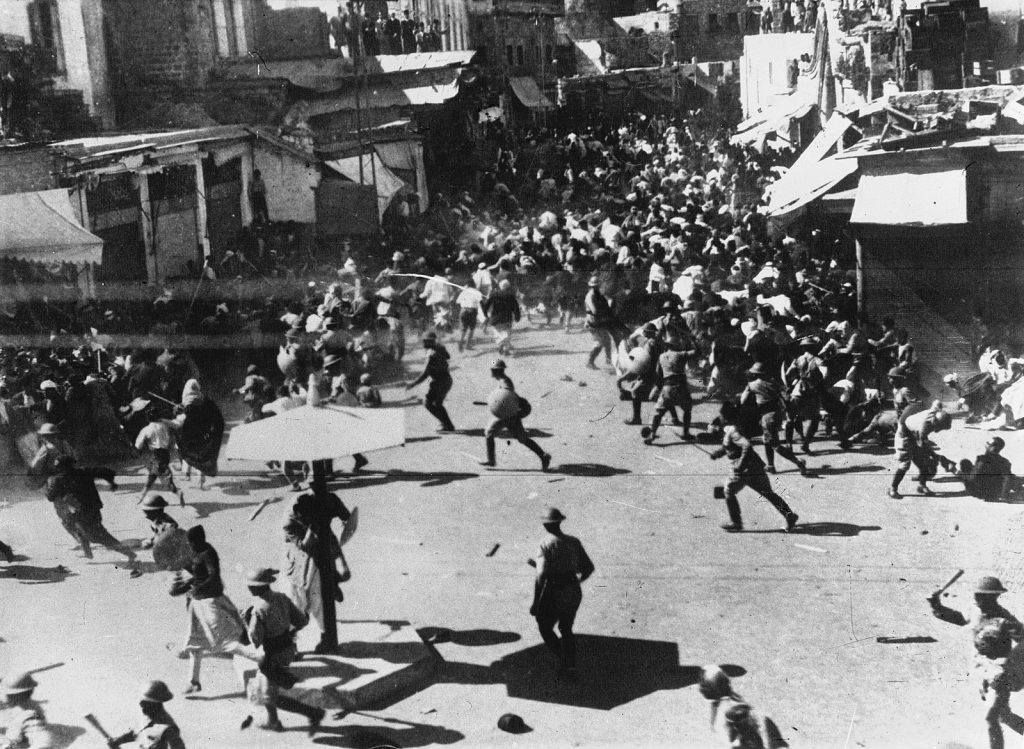
British policemen disperse Arabs protest protesting in Jaffa in April 1936
The Great Palestinian Revolt of 1936-39
In October of 1933, a general strike in Palestine took place in protest of the growing Jewish immigration and British pro-Zionist policy. The British Mandate authorities declared the strike illegal, and deployed troops to end the rebellion. Over the course of the strike, more than 30 Palestinians were killed by live ammunition and 200 were injured.
While the Palestinian political leaders ended the strike, the main issues remained unresolved and tensions were escalating. In 1935, a shipment of arms destined for the Haganah was discovered. The Haganah was a Zionist paramilitary organization that had existed in Palestine since 1920, working closely with British colonial authorities and carrying out clandestine operations, including smuggling in weapons. This deepened the Palestinians’ concerns that the Zionists were getting ready to advance in their project of building their own state and expelling the Palestinian population.
The Arab revolt began in April 1936 with a general strike and acts of civil disobedience, and quickly escalated into violent repression of the British security forces and Zionists.
The strike was widely observed and brought commercial and economic activity in the Palestinian sector to a standstill. Meanwhile, Palestinians throughout the countryside came together in armed groups to attack—at first sporadically, but with increasing organization— British and Zionist targets. Some Arab volunteers joined the rebels from outside Palestine, though their numbers remained small in this period. The British employed various tactics in an attempt to break the strike and to quell the rural insurrection. The ranks of British and Jewish policemen swelled and Palestinians were subjected to house searches, night raids, beatings, imprisonment, torture, and deportation. Large areas of Jaffa’s Old City were demolished and the British called in military reinforcements.
The British responded with a massive military crackdown, deploying tens of thousands of troops, tanks, warplanes, and heavy artillery. During the three years of the revolt, around 5,000 Palestinians were killed and nearly 15,000 wounded. To bring some stability in the region, the British wrote the White Paper of 1939, which stated that the British government intended to establish an independent Palestinian state within 10 years, conditional on safeguarding “the special position in Palestine of the Jewish National Home,” with a limit on Jewish immigration and land purchases in the meantime.
However, this was far from a real solution for Palestinians. The British Mandate had been collaborating with the Zionists since day one, and was responsible for their advance against the Palestinian population. Now, Palestinian resistance forced the British to change their strategy, which resulted in Zionist backlash against the British Mandate as well as Palestinian civilians. The deteriorating British hegemony in the region paved the way for the creation and strengthening of Zionist paramilitary organizations that enacted more terror on Palestinians.
Among these was Irgun, which launched a wave of attacks against Palestinians mainly in Haifa and Jerusalem, including bombs, killing dozens of Palestinians and wounding hundreds. The Irgun was formed in 1931 and it was led by Menachem Begin, who later became Prime Minister of Israel. Since then, the tensions between the British Mandate, the Zionist and Palestinians only deepened.
The Nakba
In December 1947, Palestinians constituted two thirds of the total population of Palestine. The other third were Jewish settlers, most of whom had arrived after 1920. Of the total cultivated land, most belonged to the native population and only 5.8 percent was in the hands of Jewish settlers. Most Jewish people had settled in the cities, and there were isolated Jewish colonies in the countryside.
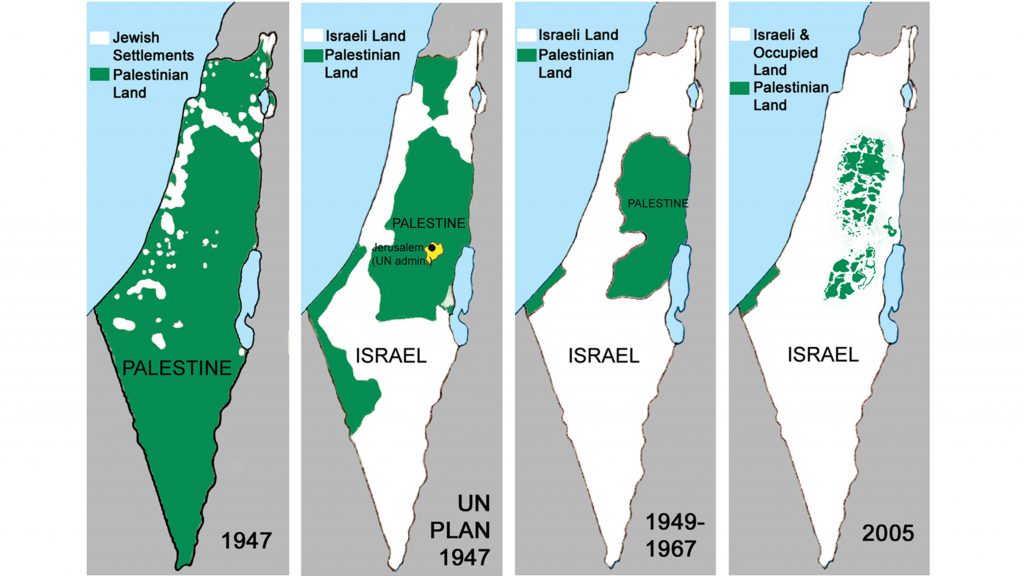
As the end of the British Mandate approached, the United Nations put forward a Partition Plan for Palestine, which was adopted by the UN General Assembly in 1947 as Resolution 181. In doing so, the United Nations was ready to hand over more than half of the Palestinian territory to the Zionists to create their new colonial state — without considering in the least the interests of the Palestinian population, who opposed the partition.
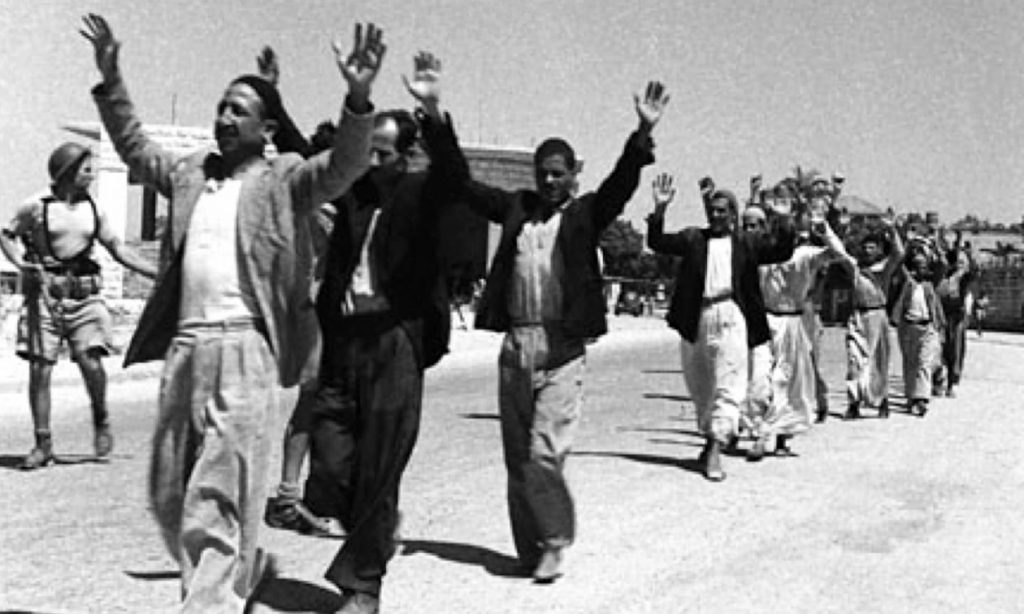
Palestinians refused to accept the plan. On May 15 in 1948, a day after the Zionist State was declared, a general strike took place across the country in opposition to this attack on Palestinian self-determination. But the strike was met with strong violence from Zionists, who imposed curfews and carried out political persecution and assassinations against resistance leaders. Palestinians also organized military defense at local levels, but they were defeated by Zionist forces which were armed with more advanced weaponry and trained mainly by British imperialism. The support from other Arab and Muslim countries was not coordinated enough to provide a stronger resistance. The occupation army was able to advance in Palestinian territory through blood and fire.
According to research by Salman Abu Sitta published in The Atlas of Palestine, an estimated 700,000 to 800,000 Palestinians out of a population of 1.9 million were displaced during the Nakba. Many were forced to flee their homes due to violence and intimidation, while others were expelled by Israeli forces. An estimated 15,000 Palestinians were killed.
The Nakba created one of the largest refugee populations in the world. Today, there are an estimated 5.7 million Palestinian refugees, including those who were displaced during the Nakba, as well as their descendants.
Over 500 Palestinian villages were depopulated or destroyed during the Zionist offensive. Many of them were openly massacred, like in Baldat al-Sheikh (1947), al Khisas (1947), al-Abbasiya (1948), Lyyda (1948), Deir Yassin (1948), among others. The latter involved the killing of over 100 Palestinian villagers, including men, women, and children by Zionist paramilitary forces from the Irgun and Stern gangs (also known as Lehi).
The attack in Deir Yassin began in the early hours of the morning, when Irgun and Stern members entered the village and began shooting indiscriminately at the villagers. Many were killed in their homes, while others were shot while trying to flee. The attackers also reportedly used grenades and machine guns to kill as many people as possible. This attack had a menacing impact on the surrounding Palestinian villages, prompting many people to flee their homes in fear of similar attacks.
Menachem Begin expressed in this memoirs that without what was done in at Deir Yassin, there wouldn’t have been an Israel. After that massacre, according to him the zionists were able to “advance like a hot knife through butter”.
Communists and the Creation of Israel
The first country to recognize the creation of Israel in 1948 was the United States on May 14, just hours after Israel declared “independence.” A few days later, on May 17, the bureaucratized Soviet Union under Joseph Stalin recognized the Zionist State after initially expressing support for the creation of a Jewish state. The following day, May 18, Czechoslovakia, which was already part of the Soviet Bloc, added its recognition and later sent weapons to the Zionists.
As a result of the Stalinist support to creation of Israel, writer Nathaniel Flakin points out:
the ideas of socialism and communism, which once had great appeal to the Arab masses, were discredited across the region. In the United States, the official communists were already used to accepting sudden zig zags in their political line. Within a few months, the CPUSA was offering unqualified support to the Zionists’ ethnic cleansing and spreading false reports about supposed Arab atrocities in order to justify it.
…
Genuine communists — those opposed to Stalinism — always rejected Zionism. While Stalin’s bureaucracy was busy making deals with imperialist powers — first with the Nazis, then with the “democratic” imperialists — it was the Left Opposition led by Leon Trotsky that fought for the political independence of the working class. This meant opposing any form of imperialism and colonialism, including Zionism.
Leon Trotsky said shortly before he was assassinated by a Stalinist agent: “The attempt to solve the Jewish question through the migration of Jews to Palestine can now be seen for what it is, a tragic mockery of the Jewish people. … the salvation of the Jewish people is bound up inseparably with the overthrow of the capitalist system.
Arab Governments and the Zionist State.
While the governments of the Arab League were against the creation of the Zionist State, there were occasions where their leaders tried to negotiate with them or didn’t rally united behind the Palestinians’ interest. That tension is even stronger today, as more Arab countries are establishing diplomatic relationships with Israel.
this policy of beginning to occupy lands that did not originally belong to them, constituted the great agreement between Zionism and the imperialist powers, specifically in this case Britain, but had the complicity of members of ‘royal’ Arab families, as is the case of Faisal Husain, a member of the Hashemite family. (…)
Husain was a nationalist leader of the Arab rebellion (1916/1920) against the Ottoman Empire and whose project was an Arab state, founded on the basis of a constitutional monarchy in the territories known at that time as Syria, which included present-day Syria, Lebanon, Jordan, the State of Israel and the occupied territories. As this project clashed with the aspirations of the imperialist powers for the distribution of markets, Faisal was confronted with France, which for that imperialist distribution possessed Northern Syria (Lebanon and Syria), he was expelled from Syria by the French who unleashed a bloodbath in that area, that made him turn to agreements with Britain and Zionism, since he was the visible face of the Arab monarchy that also claimed for itself the lands of Palestine.
In 1919 Faisal signed an agreement with Zionism represented by its leader Jaim Weizmann, where he recognized their right to mass immigration to Palestinian lands, simply in exchange for religious equality and Muslim control over the holy places of Islam and to promote the constitution of an Arab state that excluded Palestine.
However, the Faisal-Weizmann Agreement was never implemented due to political opposition from other Arab leaders and resistance from the British. A few months later, Zionism took advantage of the Paris Conference (the meeting where the Allies discussed the conditions to be imposed on the defeated countries of World War I) and Husain abandoned this strategy.
Later on, closer to the Nakba, the Arab League was divided in two sectors: a Hashemite bloc consisting of Transjordan and Iraq, and an anti-Hashemite bloc led by Egypt and Saudi Arabia. Neither sector had a solid and strong stance toward defending Palestine. Rather, they had their own political goals. For example, Jordanian King Abdullah bin Hussein had his own ambition of becoming the leader of a Greater Syria which included Transjordan, Syria, Lebanon, and Palestine, threatening these countries’ independence.
In 1979, Egypt became the first Arab country to sign a peace treaty with Israel, known as the Camp David Accords. In 1994, Jordan signed a peace treaty with Israel, normalizing relations between the two countries. Six years later, in 2020, the UAE and Bahrain signed the Abraham Accords and Morocco normalized relations with Israel in exchange for long-sought U.S. recognition of its claims on Western Sahara. These diplomatic and commercial relationships between Arab nations and Israel have created strong discontent among the population of these countries.
75 Years After Nakba
The Nakba is not merely a historical event — the catastrophe is ongoing.
Since the week prior to this year’s Nakba anniversary, the Zionist State of Israel has been attacking Gaza in an operation dubbed “Shield and Arrow” with the supposed goal of assassinating senior commanders of the second largest armed group in the coastal region, Islamic Jihad. But the attacks were far from hitting military targets: they destroyed over 15 homes, damaged over 900 houses, damaged other civilian structures, and killed at least 5 children and 31 other Palestinians.
Today, more than two million Palestinians are crowded into the Gaza Strip, one of the most densely populated areas in the world. It has been under blockade by Israel since 2006, and often described as “the world’s largest open-air prison.”
According to an Amnesty International report, there are over 600,000 Jewish Israeli settlers living on occupied Palestinian land. Those settlements are surrounded by walls, control towers, and a perpetual military presence. In the West Bank, this is a constant threat to Palestinians’ lives and livelihood. Not only because of the violence, harassment, and isolation from other Palestinian cities, but also because these zones are used as trenches to expand the dispossession, displacement, and killing of Palestinians.
Jerusalem, a city of religious significance to Jewish, Muslim, and Christian people alike, continues to be a zone of intense repression for Palestinians. Though Jerusalem has long been the capital of Palestine, the Zionist regime, with the support of U.S. imperialism, has claimed the city as its own capital. In Jerusalem and its surroundings, Palestinians suffer constant evictions and house demolitions, military harassment, and constant and increasing violence in the Al-Aqsa Mosque. Even Palestinian schools and education are under attack. The U.S. continues to contribute billions of dollars annually to arm the occupation forces to the teeth against Palestinian, as well as against other U.S. rivals in the Middle East.
In 2021, the occupation forces launched an eleven-day war against Gaza. It resulted in the deaths of over 250 Palestinians, including more than 60 children, and 12 Israelis. Many buildings and infrastructure in Gaza were destroyed or severely damaged during the conflict. This offensive sparked a massive international movement in solidarity with Palestine.
Recently, Israel has been immersed in massive protests against the new far-right government and their attacks against the judiciary system and democratic rights of Israelis. But, as Illan Pappé puts it,
their liberal Zionism is founded on a series of oxymorons: Israel as an enlightened occupier, a benevolent ethnic cleanser, a progressive apartheid state. Thanks to Netanyahu’s government, this image is now under threat; its contradictions are no longer containable. The state’s reputation is being damaged not only domestically, but also among the ‘international community’ that typically hails Israel as the only democracy in the Middle East and Tel Aviv as the LGBT capital of the world, while ignoring the besieged Gaza ghetto a few miles south.
This crisis also opens the question: democracy for whom? Any serious questioning has to include the end of the Palestinian occupation and the Zionist state.
For a Free and Socialist Palestine
A true peace, and a state where Arabs and Jewish people can coexist in full equality, will not be possible as long as a Zionist State exists. This state, an ally of imperialism, is based on colonization and national oppression, whose constitutive principle is the exclusionary Jewish character of the state. For this very reason, this state is completely incompatible with the Palestinian people’s right to national self-determination.
A State that shelters working people, regardless of whether they profess the Muslim, Jewish, Christian, or no religion — as they did for centuries before the imperialist offensive — will only be possible through a workers’ and socialist Palestine that embraces all its historical territory, defending the need for a Federation of Workers’ Republics of the Middle East. This is a task to be undertaken by the working class, poor, and oppressed of the whole region and the world.
A lot of people say that the big, fat belly of the bangus or milkfish is the best part of the fish. Whether you agree or not, this well-seasoned fried bangus belly makes a delicious addition on family dining table on weekends.
Chef Vicky Rose Pacheco gives this ordinary fish a delicious upgrade with a simple drizzling of sukang tuba (coconut floral sap vinegar) and oyster sauce. Bangus has a nice firm texture with mild and sweet taste. It’s also rich in vitamin B and omega-3 fatty acids.
“Bangus is so versatile,” she says. “You can do so many things to it — fry, steam, smoked, stuffed, bake or grill. The bangus belly, which is actually the best part of the fish, is elevated further with a homemade marinade and slightly thickened with butter for a richer flavor.”
The easy-to-follow recipe only requires a few ingredients. It’s also best eaten with fried rice and scrambled eggs, and veggies on the side.
“Go fish at least once a week to encourage families to eat fish and be healthy,” says Pacheco, executive chef and chief operating officer of 1771 Group of Restaurants.
Blissful Bangus Belly
Whole bangus 500g size, trimmed at sides, cut into 3 crosswise
100 ml bangus marinade
3 tbsp Palm oil
1 tsp Butter
For garnish:
40 g Pickled green mango, strips
3 g Red onions, sliced
3 g Native tomatoes, strips
Spring onions, chopped
Chopped brown garlic
For Marinade:
4 tbsp Mama Sita Sukang Tuba
4 tbsp Yamasa Soy Sauce (Japanese soy sauce)
3 tbsp Oyster Sauce
Make the marinade: Combine sukang tuba, soy sauce and oyster sauce in a bowl. Set aside. Pat dry bangus belly with paper towels. Drizzle marinade on the fish before cooking.
In a pan with oil, fry the bangus
— fat side down first. Turn and brown the skin side. Turn down the heat and pour a little marinade, swirling the pan. Turn the fat side down to coat with the sauce. Take out the fish and arrange on plate.
Add butter to the pan and boil once only. The sauce should become a little thick. Do not overboil. Pour over fish.
Top cooked fish with chopped browned garlic. Serve with pickled green mango, red onions, tomatoes and spring onions on the side.
The Detroit Tigers Minor League Teams had an interesting week, with two teams taking their series and the other two combining to go 1 and 11. The Tigers AAA team, the Toledo Mud Hens, took on the Indianapolis Indians. The AA team, the Erie Seawolves, took on the Bowie Baysox. The High A affiliate of the Tigers, the West Michigan Whitecaps, faced off with the Beloit Sky Carp. The A-level affiliate, the Lakeland Flying Tigers, had a series with the Clearwater Threshers.
Toledo Mud Hens
Mud Hens (17-9) vs. Indianapolis Indians (10-16)
The Toledo Mud Hens had a tough week. They won the first game they played but dropped the next five to Indianapolis.
– Advertisement –
Wednesday Game 1: Toledo 4, Indianapolis 3
The Mud Hens won the first game of their doubleheader against the Indians thanks to a four-run third inning. Andre Lipcius led the way on offense with two hits and two RBI, Justyn-Henry Malloy also picked up two RBI. Reese Olson got the start going five innings giving up three runs on five hits; he walked three and struck out four before giving the ball to Matt Wisler who went two innings and did not allow a run, a hit, or a walk and struck out three.
Wednesday Game 2: Toledo 0, Indianapolis 9
The Mud Hens dropped the second game of their doubleheader with Indianapolis. Toledo only had three hits coming from Brendon Davis, Corey Joyce, and Michael Papierski. Garrett Hill got the ball and went three innings giving up one run on one hit; he walked one and struck out three.
– Advertisement –
Thursday: Toledo 2, Indianapolis 5
Toledo dropped their second game of the week to Indianapolis. Five different Toledo hitters each had one hit, Parker Meadows and Tyler Nevin each an RBI in the loss. Ashton Goudeau got the start and went four innings giving up five runs on seven hits; he walked two and struck out one.
Friday: Toledo 3 Indianapolis 6
– Advertisement –
Toledo lost their third straight game to the Indians. Michael Papierski led the offense with two hits, while Donny Sands had two RBI. Zach Logue made the start and took his second loss of the season, going 4.2 innings and giving up four runs on eight hits; he walked three and struck out four.
Saturday: Toledo 1, Indianapolis 9
Toledo struggled again, dropping their fourth game in a row to Indianapolis. Five different Mud Hens hitters had a hit, but Corey Joyce led the way with two hits and drove in the lone run. Brennan Hanifee took the ball and took his first loss of the year, going five innings and giving up four runs on nine hits; he didn’t issue a walk and struck out three.
Sunday: Toledo 5, Indianapolis 9
The Mud Hens couldn’t keep pace with the Indians dropping their fifth in a row to end the week. Andre Lipcius and Tyler Nevin led the way for the offense with two hits each, and Nevin also drove in two runs. Garrett Hill made the start going 2.2 innings, giving up four runs on four hits; he walked two and struck out five.
Weekly Toledo Leaders
Coming Up Next: Toledo will hit the road for Iowa to take on the Iowa Cubs the AAA affiliate of the Chicago Cubs. Iowa brings in the 82nd-ranked prospect Outfielder Brennan Davis and the Cubs seventh-ranked prospect RHP Ben Brown who is expected to start Tuesday’s game.
Erie SeaWolves
Seawolves (8-13) vs. Bowie BaySox (6-13)
The Erie Seawolves finally got things going taking four of their six games against Bowie.
Tuesday: Erie 6, Bowie 2
The Seawolves started the week on the right foot with a win over Bowie. Dillon Dingler led the Erie offense with two hits in his first game since being called up from Lakeland; Colt Keith and Wenceel Perez each had two RBI on the day. Brant Hurter got the start going five innings giving up one run, unearned on three hits; he walked one and struck out seven.
Wednesday: Erie 12, Bowie 7
The Seawolves won their second straight game over the Baysox. Wenceel Perez, Dillon Dingler, Daniel Cabrera, and Julio Rodriguez each had two hits, with Rodrigues and Dingler combing for ten RBI in this one. Keider Montero, in his first start since being transferred from West Michigan, went 4.1 innings giving up four on five hits; he walked five and struck out three.
Thursday: Erie 4, Bowie 12
Erie lost their first game of the week to Bowie. Wenceel Perez and Dillon Dingler led the way in hits, and Trei Cruz and Dingler each had an RBI. Ty Madden got the start going five innings giving up three runs on seven hits; he didn’t walk anyone and struck out four.
Friday: Erie 7, Bowie 4
Erie got back in the win column against Bowie. Wenceel Perez had three hits, while Colt Keith, Julio Rodriguez, and Luis Santana each had two hits. Sawyer Gipson-Long made the start for Erie and picked up his third win of the year, going five innings and giving up just one run on five hits; he walked one and struck out two.
Saturday: Erie 10, Bowie 4
Erie picked up their fourth win of the week and second straight over Bowie. Dillon Dingler, Jake Holton, and Ben Malgeri each had two hits; Dingler and Colt Keith each had three RBI. Wilmer Flores made the start for the Seawolves and picked up his first win of the year, going five innings, giving up two runs on four hits; he walked two and struck out three.
Sunday: Erie 6, Bowie 7
The Seawolves dropped their finale to Bowie. Julio Rodriguez paced the Erie offense with two hits, while Gage Workman drove in three runs. Brant Hurter got the start and picked up his first loss of the season, going 4.2 innings, giving up six runs on eight hits; he walked one and struck out four.
Weekly Erie Leaders
Week Ahead
Coming Up Next: Erie will return home to take on the Richmond Flying Squirrels for their second series of the season. The last time these two teams met Erie lost four of the six games. The Flying Squirrels are the AA affiliate of the San Francisco Giants and will feature the 20th-ranked prospect SS Marco Luciano who did not play the last time these two teams met. Richmond also has the Giants’ seventh-ranked prospect Outfielder Luis Matos who went seven for 20 last series against the Seawolves, and Giants tenth ranked prospect RHP Mason Black who is expected to start Tuesday’s game; Erie also gave Mason Black a loss in his last start against the Seawolves.
West Michigan Whitecaps
WhiteCaps (12-9) vs. Beloit Sky Carp (14-6)
The West Michigan Whitecaps picked up a series win taking four of the six games against the Sky Carp.
Tuesday: West Michigan 13, Beloit 4
The Whitecaps started their week with a victory over the Sky Carp. Izzac Pacheco and Danny Serretti led the way on offense with three hits each. Serretti and Justice Bigbie each had three RBI for West Michigan. Garrett Burhenn picked up his first win of the season, going five innings and giving up one run. It was not earned on five hits; he walked one and struck out one.
Wednesday: West Michigan 1, Beloit 4
The Whitecaps took their first loss of the week to the Sky Carp. Steele Walker led the way with two hits, and the lone run scored on a solo home run. Jack O’Laughlin got the start going 3.2 innings giving up three runs on three hits; he walked one and struck out five.
Thursday: West Michigan 4, Beloit 3
The Whitecaps picked up their second win of the week. Three West Michigan hitters had two hits each: Danny Serretti, Justice Bigbie, and Austin Murr. Williander Montero got the start going four innings. He didn’t allow a run on five hits; he didn’t walk anyone and struck out four.
Friday: West Michigan 5, Beloit 3
West Michigan got their third win of the week and their second straight win against Beloit. Eliezer Alfonzo and Chris Meyers each had two hits, and Meyers had three RBI. Wilkel Hernandez got the ball and picked up his first win of the season with a dominating performance going five innings. He did not allow a run and gave up only one hit; he walked one and struck out six.
Saturday: West Michigan 0, Beloit 4
The Whitecaps picked up their second loss of the week. Josh Crouch had two hits on the day to lead the Whitecaps. Carlos Pena got the start for West Michigan, going 4.1 innings, giving up two runs on five hits; he walked two and struck out eight.
Sunday: West Michigan 7, Beloit 2
The Whitecaps ended their series against Beloit with a victory. Steele Walker led the way picking up four hits; Chris Meyers also collected three hits of his own. Garrett Burhenn made his second start of the week, going four innings and giving up one run on four hits; he walked one and struck out one.
Weekly West Michigan Leaders
Week Ahead
Coming Up Next: West Michigan will finally return home to take on the Lansing Lugnuts. The Lugnuts are the High A affiliate of the Oakland A’s. The Whitecaps split their last series against the Lugnuts. Lansing brings in the A’s fifth-ranked prospect Catcher Daniel Susac who was six for 24 in the last series against the Whitecaps. SS Max Muncy is also on the Lugnuts, the A’s seventh-ranked prospect; he went four for 21 in the last series against West Michigan.
Lakeland Flying Tigers
Flying Tigers (11-10) vs. Clearwater Threshers (15-6)
The Lakeland Flying Tigers lost all six games as the Threshers swept the series. Five of the six games were all one-run games for the Flying Tigers.
Tuesday: Lakeland 5, Clearwater 6
The Flying Tigers dropped the first game of the week against the Threshers. Three Lakeland hitters had two hits: Peyton Graham, Lazaro Benitez, and Andrew Jenkins. Jenkins also had two RBI. Edgardo Ibarra got the ball in this one and struggled going three innings giving up two runs on five hits; he walked three and struck out six.
Wednesday: Lakeland 7, Clearwater 13
Lakeland dropped their second straight to Clearwater. Andrew Jenkins had three hits on the day, along with Lazaro Benitez and Manuel Sequera, who picked up two hits each. Chris Williams Jr. got the start going 1.1 innings giving up five runs, four earned on three hits; he walked three and struck out three.
Thursday: Lakeland 2, Clearwater 3
Lakeland dropped their third straight of the week. The Flying Tigers offense only had three hits, with Manuel Sequera having two and Mike Rothenburg having the other. Troy Melton got the start going five innings giving up one run on four hits; he walked none and struck out four.
Friday: Lakeland 5, Clearwater 6
Lakeland continued to struggle against the Threshers, dropping their fourth straight. Lazaro Benitez had three hits and three RBI to lead the Flying Tigers. Marco Jimenez got the ball going just two innings, and he didn’t allow a run or a hit; he walked one and struck out one.
Saturday: Lakeland 5, Clearwater 6
Lakeland dropped their fifth straight to the Sky Carp. Lazaro Benitez and Dom Johnson each had two hits to lead the Flying Tigers’ offense. Ulices Campos got the ball and went 4.2 innings giving up five runs on seven hits; he walked one and struck out three.
Sunday: Lakeland 7, Clearwater 8
Lakeland lost the final game of the week to the Sky Carp, as Beloit secured the sweep. Eight different Flying Tigers hitters had a hit in this one; Dom Johnson and Alvaro Gonzalez picked up two RBI each in the loss. Carlos Marcano got the start going 3.2 innings giving up six runs on six hits; he walked two and struck out four.
Weekly Lakeland Leaders
Week Ahead
Coming Up Next: Lakeland will continue their road trip, this time heading to Bradenton to take on the Bradenton Marauders, the Single A affiliate of the Pittsburgh Pirates, who the Flying Tigers lost their last series against four games to two. The Marauders feature 22nd overall prospect 2B Termarr Johnson, who did not play the last time these two teams met. This series will also have Pirates 12th ranked prospect RHP Thomas Harrington who struggled in his last start against Lakeland, going 2.2 innings and giving up six runs; he is expected to start Wednesday’s game in this series.
As they await the near-guaranteed denial of her appeal to the Ninth Circuit, attorneys for convicted fraudster Elizabeth Holmes have made another legal maneuver that appears to give her another few weeks of freedom.
Holmes, who was granted an immediate stay of her April 27 prison-reporting date by virtue of a hail Mary appeal filed by her lawyers, was celebrating her second Mother’s Day on Sunday at the beach in San Diego. The UK Daily Mail scored some paparazzi shots of Holmes carrying her newborn daughter Invicta and partner Billy Evans carrying two-year-old son William and some balloons down to the beach near their reported $9 million home (a rental).
As we learned recently via an odd and fairly softball profile of Holmes in the New York Times, she and Evans relocated from Woodside, where they’d been living until sometime last year — maybe until Holmes’s November sentencing — to San Diego, which is where Evans’s family lives. This is perhaps practical from a childcare standpoint, given that Evans is about to become a single dad, save for some miracle or untold legal strategy that grants Holmes more continued freedom.
As NBC Bay Area reports, Holmes’s attorneys just filed a new motion in the state appeal of her fraud conviction, which gives the state 21 days to respond. Once the state responds, the lawyers have another 21 days to respond to that. So, this maneuver seems designed to give her another month or so with her newborn child before beginning what’s to be an 11-year sentence.
Though will she really end up serving all of that? Half of that?
The privilege that has pervaded this entire case and trial has been pretty obvious, apart from the actual sentence by U.S. District Judge Edward Davila. Holmes’s attorneys had tried to argue for no jail time at all, while she faced a maximum of 20 years for each of the four fraud counts on which she was convicted.
Holmes’s co-defendant and co-conspirator at infamous blood-testing startup Theranos, Ramesh “Sunny” Balwani, was tried separately and sentenced in December to 13 years. Balwani also appealed his conviction to the Ninth Circuit, that appeal was denied, and he began serving his time not far from San Diego last month.
Top image: Former Theranos CEO Elizabeth Holmes alongside her boyfriend Billy Evans, walks back to her hotel following a hearing at the Robert E. Peckham U.S. Courthouse on March 17, 2023 in San Jose, California. Holmes appeared in court for a restitution hearing. (Photo by Philip Pacheco/Getty Images)